
Dana Spicer S190 Series
Quick Facts
- Manufacturer: Dana Incorporated
- Brand: Spicer
- Product Family: S190 Series
- Axle Type: Single-reduction heavy-duty single drive axle
- Common Drive Configuration: 4×2, with additional multi-axle vocational configurations possible
- Primary Models: S26-190, S30-190, and S35-190
- GAWR Range: 26,000 to 35,000 lb
- Maximum Published Nominal GCW: Up to approximately 125,000 lb for selected models and duty cycles
- Published Ratio Range: 2.53:1 to 7.83:1
- Primary Applications: LTL, multiple-trailer linehaul, construction, refuse, city delivery, and fire and rescue
- Differential Options: Standard, limited-slip, NoSPIN, and driver-controlled differential lock
- Wheel-End Options: Spicer LMS and LMSi hub systems
- Notable Options: GenTech gearing, electromagnetic retarder, wide-track housing, and application-specific suspension mounts
- Primary Design Goal: Provide high single-axle capacity and severe-service durability with multiple traction and braking options
Overview
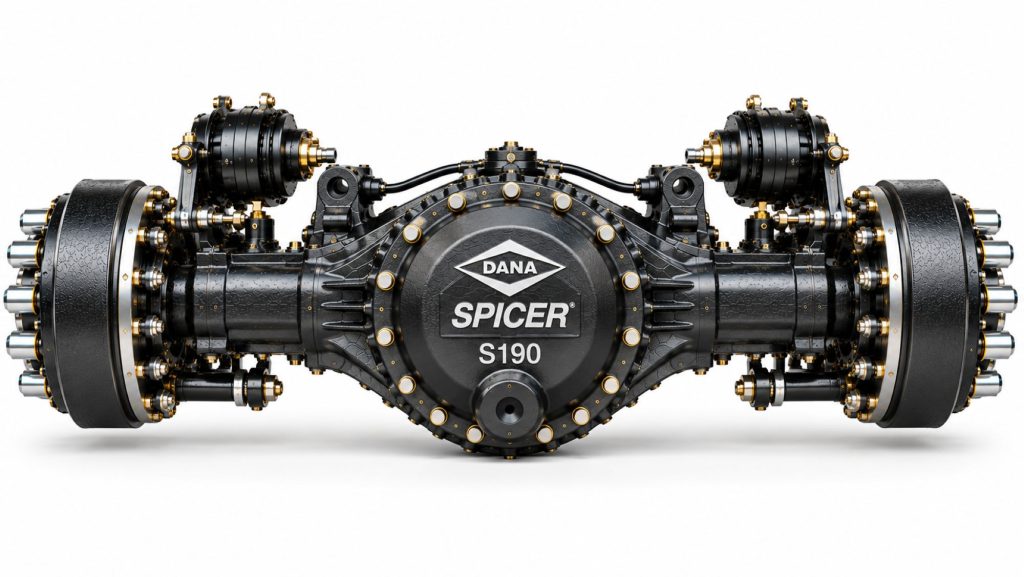
The Dana Spicer S190 Series is a family of heavy-duty single commercial truck drive axles for vocational, delivery, linehaul, fire and rescue, and other demanding applications.
Current Dana product information identifies the S26-190, S30-190, and S35-190 as the primary models. Their model designations correspond to general axle ratings of 26,000, 30,000, and 35,000 pounds.
The S190 uses the same general heavy-duty 190 Series design philosophy as Dana’s tandem products, but it operates as one powered axle rather than a pair of connected drive axles.
Its construction includes extra-wide gear faces, large wheel-differential gearing, high-capacity bearings, a forged and heat-treated differential case, and a heavy axle housing.
A broad selection of differential, wheel-end, gearing, and braking options allows the S190 to be adapted for highway, municipal, construction, refuse, emergency, and severe vocational work.
Key Characteristics
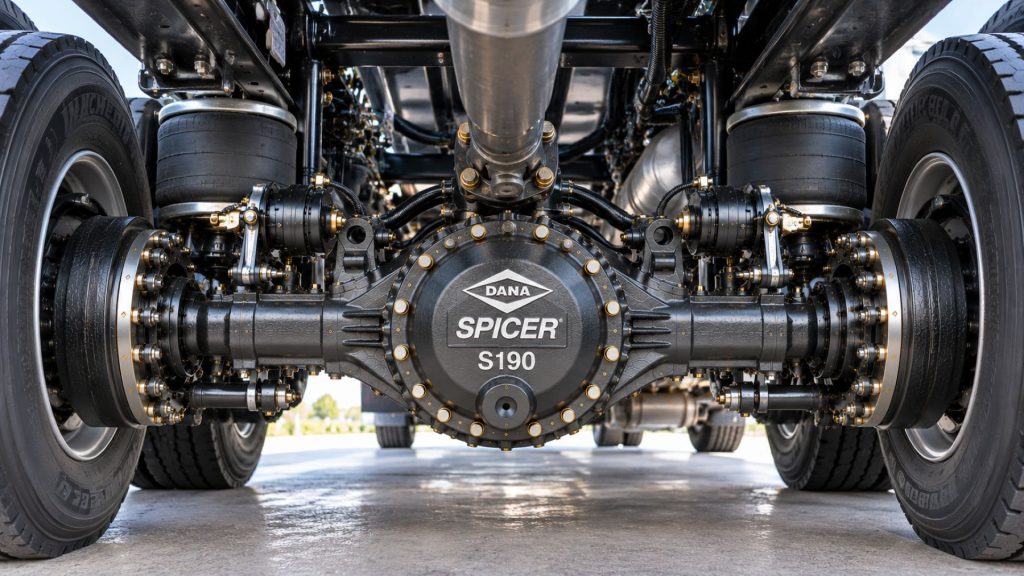
The S190 uses extra-wide face-width gearing to increase the amount of contact between the ring-and-pinion teeth. This provides additional strength under high loads and substantial drivetrain torque.
Its large wheel-differential gears provide high power density and durability in demanding vocational applications.
The differential case is manufactured from forged and heat-treated steel. This construction helps support long gear and bearing life under heavy loads.
Dana uses an integral pinion cage and carrier arrangement to improve carrier strength and eliminate a potential lubricant leak path.
A patented axle breather permits unrestricted airflow as internal temperature and pressure change. Dana describes this as a no-maintenance breather design.
With approved lubricants and operating conditions, Dana identifies an initial lubricant-drain interval of up to 250,000 miles for selected S190 applications.
Traction choices can include a limited-slip differential, NoSPIN differential, or driver-controlled wheel differential lock.
How the Axle or Differential Works
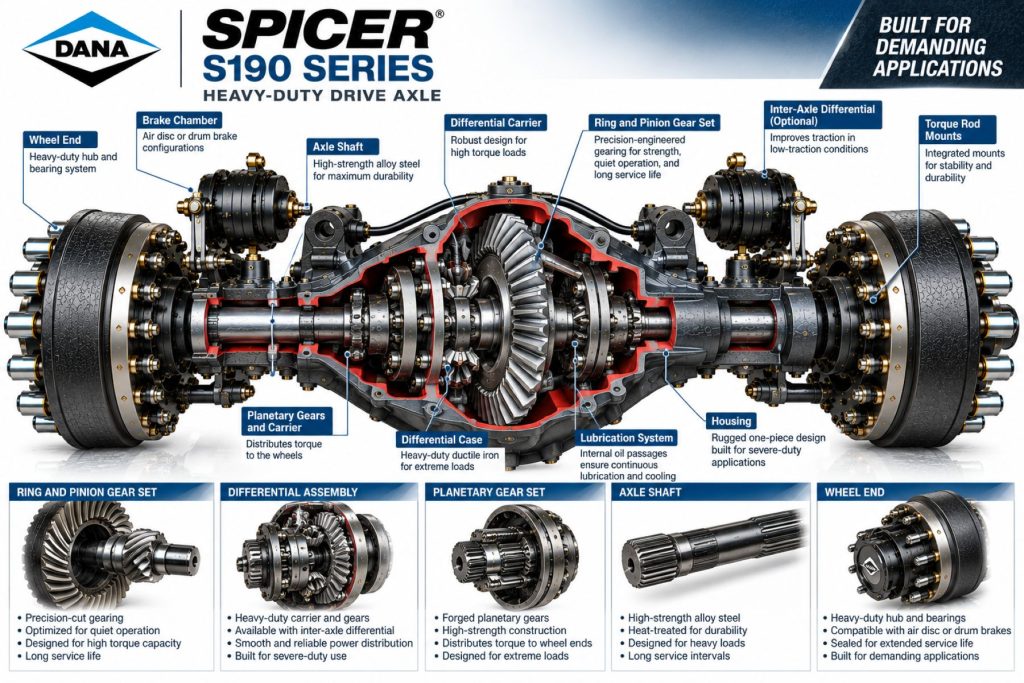
Engine torque travels through the transmission and driveshaft to the S190 input yoke and pinion shaft.
The pinion gear turns the larger ring gear inside the axle carrier. The size difference between the pinion and ring gear creates the final-drive reduction.
The ring gear is connected to the wheel differential. The differential divides torque between the left and right axle shafts while allowing different wheel speeds during turns.
The axle shafts transmit torque from the differential to the wheel ends. The housing supports the vehicle’s weight and provides mounting points for the suspension, brakes, hubs, and wheels.
A standard differential allows unrestricted speed differences between the wheels. A limited-slip unit restricts excessive wheelspin, while a NoSPIN or driver-controlled locking differential provides more aggressive traction control.
Because the S190 is a single drive axle, it does not use the power divider, inter-axle differential, output shaft, or inter-axle driveshaft found in the D190 tandem axle.
For more information, see How Commercial Truck Axles and Differentials Work.
Axle Position and Function
The S190 normally serves as the primary rear drive axle in a heavy vocational truck or high-capacity straight truck.
It can also be used with non-driven auxiliary axles in multi-axle vehicles. Pusher, tag, or lift axles can increase the vehicle’s total load-carrying capability without adding another powered axle.
The S190 provides final-drive reduction, distributes torque between the rear wheels, supports vehicle weight, and carries the brakes, hubs, bearings, wheels, and tires.
Using one powered axle reduces drivetrain complexity compared with a 6×4 tandem. It eliminates the power divider, second drive carrier, and inter-axle driveshaft.
However, one drive axle provides fewer driven wheel positions. This can limit traction in mud, snow, loose gravel, construction sites, and other difficult conditions.
Common Specifications
- Axle Design: Single-reduction single drive axle
- Primary Models: S26-190, S30-190, and S35-190
- S26-190 Maximum GAW: 26,000 lb
- S30-190 Maximum GAW: 30,000 lb
- S35-190 Maximum GAW: 35,000 lb
- Maximum Published Nominal GCW: Approximately 125,000 lb for selected S26-190 and S30-190 configurations
- Published Ratio Range: 2.53:1 to 7.83:1
- Common Conventional Ratios: 3.42, 3.58, 3.73, 3.91, 4.10, 4.30, 4.56, 4.78, 5.25, 5.38, 5.57, 6.14, 6.83, 7.17, and 7.83
- Nominal Ring-Gear Diameter: Approximately 18.5 inches in referenced configurations
- Axle-Shaft Body Diameter: Approximately 2.25 inches
- Axle-Shaft Splines: 46 splines
- Spline Diameter: Approximately 2.35 inches
- Housing Wall Thickness: Model-dependent, with heavy configurations reaching approximately 16 mm at the spring seat
- Differential Case: Forged and heat-treated steel
- Differential Options: Standard, limited-slip, NoSPIN, and driver-controlled lock
- Wheel-End Options: Spicer LMS and LMSi hubs
- Brake Options: Heavy-duty drum brakes or air-disc brakes depending on the OEM
- Additional Options: Electromagnetic retarder, GenTech gearing, and wide-track configurations
Specifications vary substantially by model, duty cycle, production date, and application approval.
Axle Ratios and Gearing
Dana identifies ratio coverage from 2.53:1 through 7.83:1 for the broader S190 family. Exact availability depends on axle model, housing, vehicle application, and production specifications.
Fast ratios near the lower end of the range can support highway-oriented applications with sufficient engine torque, suitable transmission gearing, and moderate startability requirements.
Ratios such as 3.42, 3.58, 3.73, and 3.91 can balance highway engine speed with the load-carrying requirements of LTL, delivery, and certain vocational vehicles.
Ratios such as 4.10, 4.30, 4.56, 4.78, 5.25, and 5.38 provide additional torque multiplication for construction, refuse, emergency, and municipal work.
Deep ratios such as 5.57, 6.14, 6.83, 7.17, and 7.83 are better suited to very heavy loads, large tires, steep grades, frequent starts, or vehicles operating primarily at low speeds.
Optional GenTech gearing is manufactured to reduce noise, vibration, and harshness. This can be useful in fire apparatus, refuse trucks, city-delivery vehicles, and other equipment where occupants remain near the drive axle.
See Commercial Truck Axle Ratios Explained for additional guidance.
Differential and Traction Options
The S190 can be configured with several different wheel-differential systems.
A standard open differential provides smooth turning but can allow one wheel to spin when traction differs significantly from side to side.
A limited-slip differential automatically restricts excessive wheel-speed differences. It can improve traction on wet, slippery, or uneven surfaces without fully locking both axle shafts together.
The NoSPIN differential provides more aggressive automatic traction control. It is commonly associated with demanding vocational applications where mobility is more important than the smoothest possible differential action.
An available driver-controlled differential lock allows the operator to restrict differential action when additional traction is required. Dana states that this feature can be retrofitted on certain S190 models.
The best differential depends on road surface, turning requirements, tire wear, driver training, duty cycle, and maintenance capability.
Learn more in Open vs Locking vs Limited-Slip Differentials.
Brake and Wheel-End Options
S190 installations may use heavy-duty S-cam drum brakes or commercial air-disc brakes. Brake availability depends on axle model, wheel size, vehicle manufacturer, and application.
Brake packages can include different drums, rotors, calipers, chambers, slack adjusters, dust shields, ABS sensors, tone rings, and parking-brake equipment.
Spicer LMS and LMSi wheel-end systems are available in selected configurations. These systems are designed to control bearing adjustment, reduce maintenance, and improve long-term reliability.
An electromagnetic retarder may be integrated with the axle or driveline. It provides supplemental braking without relying entirely on the service brakes.
Supplemental retardation can be valuable in refuse, fire and rescue, construction, and other operations involving frequent stops or extended descents.
Replacement brake and wheel-end parts must be matched using the complete axle model, serial number, hub system, spindle type, and OEM build records.
Common Applications
- LTL straight trucks
- Double- and triple-trailer linehaul equipment
- Construction trucks
- Heavy dump trucks
- Refuse trucks
- City-delivery trucks
- Fire apparatus
- Rescue trucks
- Municipal vehicles
- Utility trucks
- Heavy recovery trucks
- Concrete-support vehicles
- Airport emergency vehicles
- Multi-axle vocational trucks
- Vehicles requiring a 26,000- to 35,000-pound drive axle
- Applications using non-driven pusher, tag, or lift axles
Truck, Suspension, and Drivetrain Compatibility
The S190 is intended for heavy-duty vehicles requiring one high-capacity powered rear axle. The complete chassis may use a 4×2 arrangement or additional non-driven axles.
Compatibility depends on the exact S190 model, frame, suspension, engine, transmission, driveshaft, brakes, track width, hubs, wheels, tires, and expected operating weight.
Mechanical-spring, air-ride, walking-beam, and other vocational suspension designs may be compatible when approved for a single-drive-axle installation.
A lift or auxiliary axle may be installed to distribute vehicle weight. The non-driven axle must be coordinated with the S190’s load, traction, braking, and suspension characteristics.
Deep transmission reductions combined with a deep S190 axle ratio can create extreme axle-input torque. Driveshafts, universal joints, yokes, gearing, and axle shafts must have appropriate ratings.
Wide-track configurations may improve stability but affect vehicle width, wheel loading, tire clearance, and turning characteristics.
Advantages
- Provides axle ratings from 26,000 to 35,000 pounds
- Offers greater single-axle capacity than many highway drive axles
- Broad ratio coverage supports highway and vocational applications
- Deep ratios provide strong low-speed pulling capability
- Extra-wide gear faces increase strength
- Large wheel-differential gears provide high power density
- Forged heat-treated differential case improves durability
- Integral pinion cage strengthens the carrier
- Patented breather requires little or no routine maintenance
- Extended initial lubricant-drain interval is available with approved lubricants
- Limited-slip differential improves automatic traction
- NoSPIN differential supports demanding vocational work
- Driver-controlled differential lock provides maximum selectable traction
- Differential lock can be retrofitted on certain models
- GenTech gearing reduces noise and vibration
- LMS and LMSi wheel ends can reduce maintenance
- Electromagnetic retarder reduces service-brake demand
- Single-drive design is less complex than a powered tandem
- Can be combined with non-driven auxiliary axles
Limitations or Considerations
- A single drive axle provides less traction than a 6×4 tandem
- High axle ratings concentrate substantial weight on one axle position
- Legal single-axle limits may be lower than the axle’s mechanical capacity
- Not every jurisdiction permits 26,000 to 35,000 pounds on one axle
- Auxiliary axles may be required to distribute legal vehicle weight
- The published GCW depends on model, duty cycle, and application approval
- Fast ratios may reduce startability under heavy loads
- Deep ratios increase engine rpm during highway operation
- NoSPIN differentials may feel less smooth during turning
- Differential locks add controls and maintenance requirements
- Wide-track housings may affect legal vehicle width
- Heavy housings and wheel ends increase vehicle weight
- Electromagnetic retarders add electrical equipment and service needs
- The 250,000-mile initial drain interval requires approved lubricant and operating conditions
- S172, S190, and D190 parts should not be assumed to interchange
- Specialized repairs may require heavy shop equipment and trained technicians
Driver and Operator Experience
An S190-equipped vehicle can deliver strong low-speed performance when specified with a numerically high axle ratio.
Fire apparatus, refuse trucks, and construction vehicles may benefit from rapid response at low road speeds and the ability to move heavy loads from a stop.
Highway-oriented configurations may use a faster ratio to reduce engine speed. The correct choice depends on engine torque, transmission gearing, tires, and vehicle weight.
Limited-slip and NoSPIN differentials operate automatically, although their behavior can feel different during tight turns or when traction changes.
A driver-controlled differential lock requires operator input. The lock should be engaged before severe wheelspin develops and used only under approved conditions.
The electromagnetic retarder can provide smooth supplemental braking and reduce brake-pedal use during repeated stops or long descents.
Maintenance and Ownership Notes
The S190 should be maintained according to Dana service literature and the vehicle manufacturer’s schedule.
Dana identifies an initial lubricant-drain interval of up to 250,000 miles when approved lubricants and operating conditions are used. Severe vocational applications may require shorter intervals.
Lubricant type, fill level, axle installation angle, temperature, contamination exposure, and duty cycle all affect maintenance requirements.
Routine inspections should include the pinion seal, differential cover, wheel seals, breather, housing, suspension mounts, hubs, brakes, and differential controls.
The driveshaft, universal joints, yoke, slip joint, and fasteners should be checked for wear and looseness.
Limited-slip and NoSPIN differentials must be serviced using the correct procedures. Normal operational characteristics should not be mistaken for internal failure.
Differential-lock air lines, wiring, switches, actuators, and warning lights should be tested regularly.
Electromagnetic retarders require inspection of their mounting, wiring, controls, and operating condition.
Common Axle or Differential Problems
- Pinion-seal leakage
- Differential-cover leakage
- Wheel-seal leakage
- Low or contaminated lubricant
- Gear whine during acceleration or coast
- Carrier-bearing rumble
- Pinion-bearing wear
- Excessive ring-and-pinion backlash
- Damaged gear teeth
- Differential-case or side-gear wear
- Reduced limited-slip performance
- Harsh or abnormal NoSPIN operation
- Driver-controlled differential lock that will not engage
- Differential lock that will not release
- Air or electrical faults affecting the lock
- Axle-shaft or spline wear
- Wheel-bearing looseness or overheating
- Housing bending or cracking
- Suspension-mount damage
- Driveline vibration from worn universal joints
- Brake contamination from a wheel-seal leak
- Retarder electrical or mounting problems
- Uneven tire wear caused by axle or suspension misalignment
See Common Truck Axle and Differential Problems for additional information.
Identification Information
- Manufacturer: Dana Incorporated
- Product Family: Spicer S190 Series
- Primary Models: S26-190, S30-190, and S35-190
- Axle Type: Single-reduction heavy-duty single drive axle
- Identification Sources: Axle tag, carrier tag, housing stampings, and OEM build records
- Important Information to Record: Complete model number, serial number, specification number, ratio, and vehicle VIN
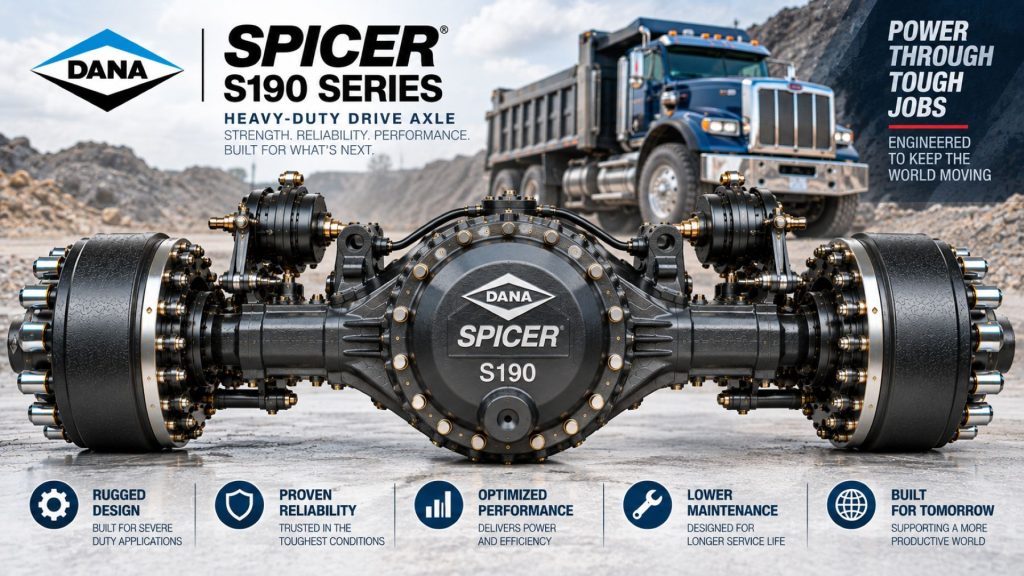
The S designation identifies a single drive axle. The following number indicates the axle’s general capacity, while 190 identifies the axle-head series.
Suffix letters can identify housing, differential, track-width, brake, wheel-end, retarder, or other equipment.
The S35-190 may be especially application-specific, including fire-truck or other specialized configurations. Its detailed ratings and equipment should be verified through Dana and the vehicle manufacturer.
If the identification tag is missing, use the vehicle VIN, OEM build sheet, carrier markings, housing stampings, ring-gear information, brake identification, hub numbers, and physical measurements.
Use How to Identify a Truck Axle or Differential before ordering replacement parts.
Buying Considerations
- Confirm whether the axle is an S26-190, S30-190, or S35-190
- Record the complete model and suffix information
- Verify the serial and specification numbers
- Confirm the axle’s maximum gross axle weight rating
- Check the approved vehicle and combination weight
- Verify that the axle rating is legal for the intended jurisdiction
- Confirm the axle ratio
- Match the ratio to the engine, transmission, tires, terrain, and duty cycle
- Identify the standard, limited-slip, NoSPIN, or locking differential
- Determine whether a differential lock was factory installed or retrofitted
- Check for GenTech gearing
- Identify standard, LMS, or LMSi wheel ends
- Verify drum-brake or air-disc-brake equipment
- Check for an electromagnetic retarder
- Confirm housing wall thickness
- Measure track width and suspension mounting locations
- Identify any welded or specialized suspension brackets
- Confirm driveshaft and yoke compatibility
- Verify tire, wheel, hub, and spindle ratings
- Inspect used gears for pitting, scoring, heat damage, and abnormal wear
- Inspect the housing for cracks, bending, corrosion, and poor repairs
- Check the pinion, cover, and wheel ends for lubricant leaks
- Inspect axle shafts, splines, bearings, and yokes
- Request lubricant, maintenance, and rebuild records
- Verify replacement-part availability
- Obtain application approval for high-GCW or severe-duty use
- Include freight, core charges, installation, brakes, lubricant, and calibration in the total cost
Variants and Configurations
- S26-190 with a 26,000-pound GAWR
- S30-190 with a 30,000-pound GAWR
- S35-190 with a 35,000-pound GAWR
- Standard wheel differential
- Limited-slip differential
- NoSPIN differential
- Driver-controlled differential lock
- Ratios from 2.53 through 7.83
- Standard gearing
- GenTech low-noise gearing
- Standard housing configuration
- Heavy-wall housing configuration
- Standard-track configuration
- Wide-track configuration
- Conventional serviceable wheel ends
- Spicer LMS wheel ends
- Spicer LMSi wheel ends
- Drum-brake configuration
- Air-disc-brake configuration
- Electromagnetic-retarder configuration
- 4×2 configuration
- Multi-axle configuration with pusher axles
- Multi-axle configuration with tag axles
- Multi-axle configuration with lift axles
- LTL and city-delivery configuration
- Construction and refuse configuration
- Fire and rescue configuration
Comparison to Similar Equipment
Compared with the Dana Spicer S172 Series, the S190 provides higher axle ratings, larger gearing, deeper ratio availability, and heavier vocational construction.
The S172 is lighter and better suited to linehaul, regional-haul, and weight-conscious 6×2 applications with drive-axle ratings up to 25,000 pounds.
Compared with the Dana Spicer D190 Series, the S190 uses one powered axle rather than two. It is lighter and mechanically simpler but provides less traction and lower combined axle capacity.
Compared with the Dana Spicer S140 Series, the S190 is intended for much heavier vocational vehicles. The S140 serves medium-duty trucks and buses with ratings up to approximately 21,000 pounds.
The S190 is best understood as a high-capacity single drive axle for specialized trucks that need more strength than a typical highway axle but do not require a powered tandem.
Best Fit For
- Heavy straight trucks
- LTL delivery vehicles
- Double- and triple-trailer linehaul equipment
- Construction trucks
- Large single-axle dump trucks
- Refuse trucks
- City-delivery trucks
- Fire apparatus
- Rescue vehicles
- Municipal trucks
- Utility vehicles
- Heavy recovery equipment
- Applications requiring a 26,000-pound drive axle
- Applications requiring a 30,000-pound drive axle
- Applications requiring a 35,000-pound drive axle
- Multi-axle vehicles using non-driven auxiliary axles
- Operations needing limited-slip, NoSPIN, or locking differentials
- Applications benefiting from an electromagnetic retarder
Related Truck Types
Related Truck Models
- Freightliner M2 106
- Freightliner 114SD
- International HV Series
- International HX Series
- Kenworth T280
- Kenworth T880
- Peterbilt 536
- Peterbilt 567
- Volvo VHD
- Western Star 47X
Related Axle and Differential Types
- Dana Spicer S172 Series
- Dana Spicer D190 Series
- Dana Spicer S140 Series
- Commercial Truck Drive Axles
- Truck Differentials
Related Equipment Systems
- Commercial Truck Transmissions
- Truck Suspension Systems
- Air Brake Systems
- Commercial Truck Tires and Wheels
- Lift Axles and Auxiliary Axles
Related Guides
- How Commercial Truck Axles and Differentials Work
- Single Axle vs Tandem Axle Trucks
- Open vs Locking vs Limited-Slip Differentials
Regulatory and Compliance Notes
The S190’s published axle rating describes the mechanical capacity of a specific axle configuration. It does not automatically establish the legal load allowed on a single axle.
Federal, state, provincial, and local rules commonly limit single-axle weight below the S190’s maximum mechanical capacity unless special permits or exemptions apply.
The allowable load is also limited by the suspension, frame, tires, wheels, hubs, brakes, and completed vehicle’s certified ratings.
Non-driven auxiliary axles may be necessary to distribute legal vehicle weight. Their spacing, controls, load capacity, and lift operation must comply with applicable regulations.
Brake, ABS, traction-control, and stability-control components must remain compatible with the axle and completed vehicle.
Ratio, tire, brake, retarder, suspension, or auxiliary-axle changes can affect electronic calibration, handling, braking, emissions operation, and warranty coverage.
Real World Operating Notes
The S26-190 can provide a useful balance between high single-axle capacity and manageable vehicle weight.
The S30-190 is appropriate for heavier vocational trucks that require additional capacity but still benefit from a single powered axle.
The S35-190 is a specialized high-capacity axle and may be most appropriate in fire apparatus or other applications operating under specific exemptions, permits, or off-highway conditions.
A limited-slip differential provides smoother automatic traction assistance, while a NoSPIN or driver-controlled lock provides more aggressive traction.
Adding pusher or tag axles increases total vehicle capacity but can reduce the weight carried by the powered axle. Poor load distribution may therefore reduce traction.
Deep axle ratios improve low-speed pulling performance but may create excessive engine speed if the vehicle regularly travels at highway speeds.
Frequently Asked Questions
What is the Dana Spicer S190 Series?
The S190 Series is a family of heavy-duty single-reduction drive axles for linehaul, delivery, construction, refuse, fire and rescue, and other vocational vehicles.
What models are included in the S190 Series?
Dana’s current product information identifies the S26-190, S30-190, and S35-190.
What is the S26-190 rated for?
The S26-190 has a maximum published gross axle weight rating of 26,000 pounds.
What is the S30-190 rated for?
The S30-190 has a maximum published gross axle weight rating of 30,000 pounds.
What is the S35-190 rated for?
The S35-190 has a maximum published gross axle weight rating of 35,000 pounds in approved applications.
What ratios are available?
Dana identifies ratio coverage from 2.53:1 through 7.83:1 for the S190 family. Exact availability depends on model and application.
Is the S190 a tandem axle?
No. It is a single drive axle. Dana’s D190 Series is the related tandem-drive family.
What differential options are available?
Options include a standard differential, limited-slip differential, NoSPIN differential, and driver-controlled differential lock.
Can a differential lock be added later?
Dana states that the wheel differential lock can be retrofitted on certain models. Compatibility must be verified before conversion.
What is a NoSPIN differential?
It is an automatic traction differential that directs torque to both wheels during low-traction operation while allowing differentiation under appropriate turning conditions.
What is GenTech gearing?
GenTech is Dana’s low-noise gearing option, designed to reduce axle noise, vibration, and harshness.
What is the maximum lubricant-drain interval?
Dana identifies an initial drain interval of up to 250,000 miles when approved lubricant and operating conditions are used.
Can the S190 use an electromagnetic retarder?
Yes, an electromagnetic-retarder configuration is available for selected applications.
Can the S190 be used with lift axles?
Yes. It may be installed in multi-axle vocational vehicles using non-driven pusher, tag, or lift axles, subject to engineering approval.
Can an S190 replace an S172?
Possibly, but it is not an automatic direct replacement. The S190 is larger and heavier, and its suspension mounts, brakes, track width, driveline, wheel ends, and frame requirements must be evaluated.
Availability and Where to Find
The Dana Spicer S190 Series is available through participating truck manufacturers, Dana-authorized distributors, commercial truck dealers, drivetrain specialists, vocational-equipment suppliers, rebuilders, and aftermarket sources.
New and remanufactured carriers, gear sets, bearings, seals, differential components, axle shafts, wheel-end parts, and traction-system components may be available separately.
Used complete axle assemblies may be available from commercial truck recyclers. Buyers should verify the exact model, capacity, ratio, housing, suspension mounts, track width, brakes, wheel ends, differential, retarder equipment, and overall condition.
Official product information, specification sheets, application guidelines, and warranty resources are available from the Dana Spicer S190 Series product page and the Dana Resource Library.
Support Trucking Families
Truck Equipment Atlas supports the mission of Grey Cross, a nonprofit dedicated to helping families of truck drivers who lose their lives while on the road. As the site grows, part of its mission is to bring awareness and support to these families.
Podcast or Video Section
Learn More Through Audio and Video
Truck Equipment Atlas will continue expanding with podcast episodes, interviews, and equipment breakdowns to help drivers and fleets better understand trucks and equipment.
Follow the Growth of Truck Equipment Atlas
Truck Equipment Atlas continues to expand with new truck profiles, trailer coverage, diesel engine pages, equipment system resources, manufacturer information, and educational guides.
Visit our Site Updates page to explore recent additions, project milestones, and upcoming resources as we continue building one of the industry’s growing commercial trucking equipment reference libraries.
View the Latest Site Updates: Truck Equipment Atlas Site Updates