
Dana Spicer AdvanTEK 40 Pro Tandem Axle
Quick Facts
- Manufacturer: Dana Incorporated
- Brand: Spicer
- Product Family: AdvanTEK
- Axle Type: Tandem drive axle
- Drive Configuration: 6×4
- Nominal Tandem Capacity: 40,000 lb
- Primary Vehicle Class: Class 8
- Maximum Published Engine Torque: Up to 1,950 lb-ft
- Maximum Published Engine Power: Up to 500 hp
- Ratio Coverage: 16 customizable ratio steps in Dana’s current product information
- Fastest Ratio: 2.05:1
- Differential-Lock Availability: Inter-axle lock with driver-controlled wheel differential locks available in all three differential positions
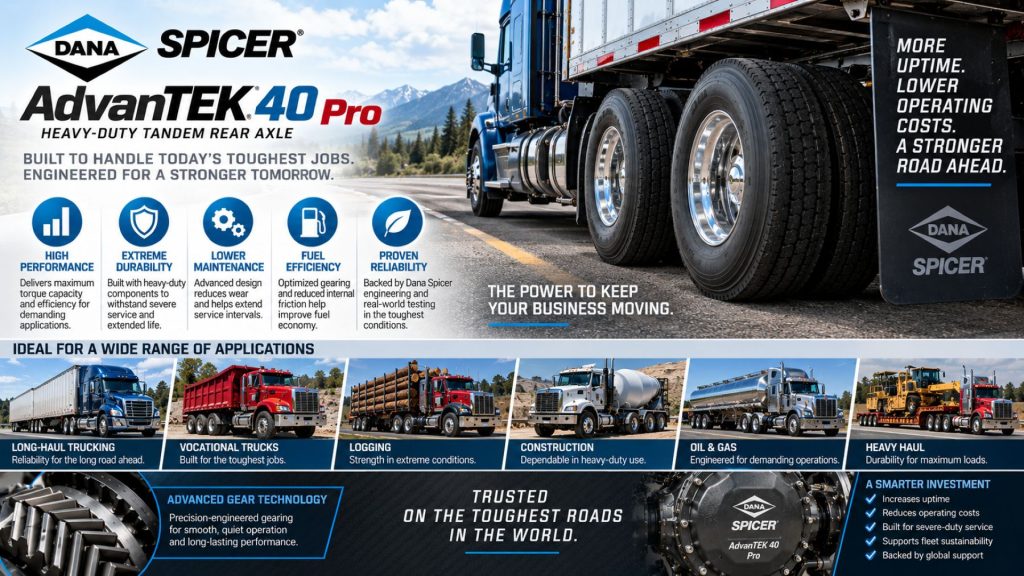
- Primary Applications: Linehaul, regional-haul, and selected vocational trucks
- Primary Design Goal: Advanced engine downspeeding with increased durability, efficiency, and specification flexibility
Overview
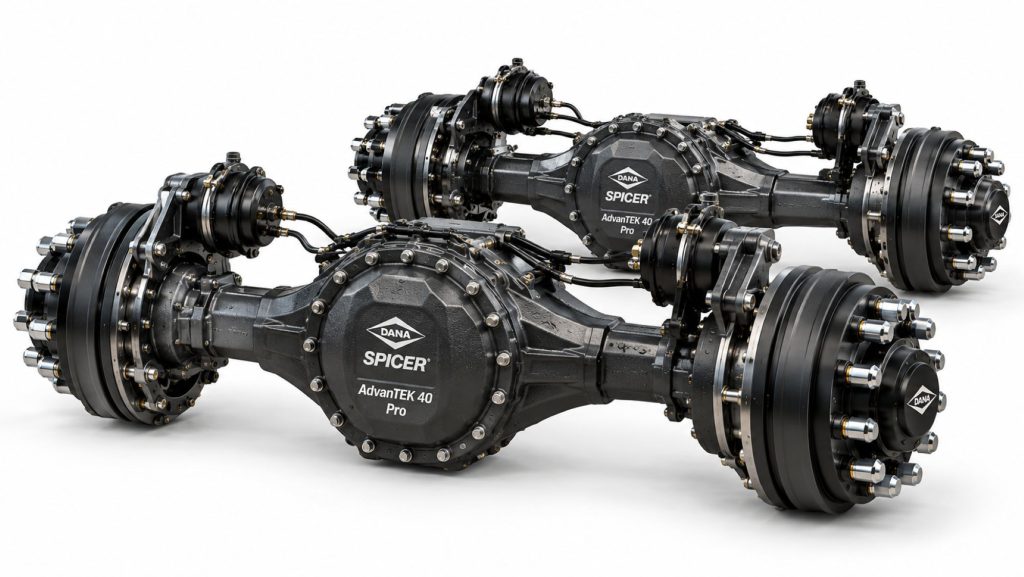
The Dana Spicer AdvanTEK 40 Pro is an updated 40,000-pound tandem commercial truck drive axle for Class 8 vehicles with a 6×4 drivetrain. It builds on the original AdvanTEK 40 platform while adding broader ratio coverage, higher power capability, updated bearings, a revised power-divider unit, and additional traction configurations.
Dana introduced the AdvanTEK 40 Pro for fleets seeking greater engine downspeeding without sacrificing axle durability. Its available 2.05:1 final-drive ratio allows a properly matched engine and transmission to maintain lower engine speeds during highway cruising.
The axle supports engines producing up to 1,950 lb-ft of torque and 500 horsepower in approved configurations. Actual allowable ratings depend on the ratio, driveshaft, transmission, tire size, vehicle application, and truck manufacturer’s approved specifications.
The AdvanTEK 40 Pro is intended to combine highway efficiency with enough configuration flexibility for linehaul, regional-haul, and selected vocational applications.
Key Characteristics
The defining feature of the AdvanTEK 40 Pro is its broad selection of axle ratios. Dana’s current product information identifies 16 customizable ratio steps, including the fast 2.05:1 ratio for advanced engine downspeeding.
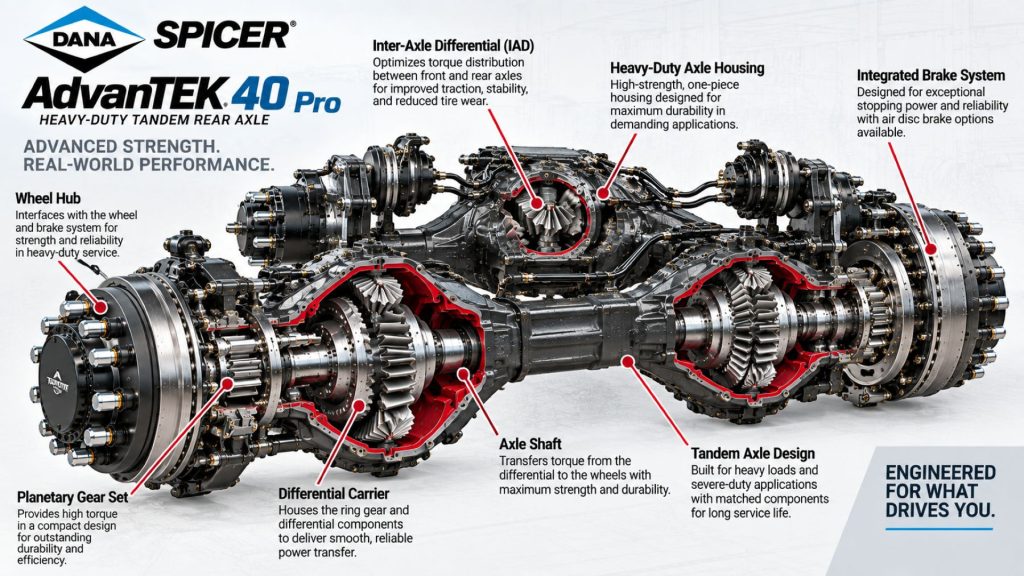
The axle incorporates a high-capacity bearing system designed to support fast ratios and increased torque throughout the tandem. This is important because numerically low axle ratios can place substantial torque loads on the transmission output, driveshafts, power divider, gearing, and axle shafts.
A redesigned power-divider unit is intended to reduce friction, improve efficiency, and extend component life. Advanced coatings in the inter-axle differential help retain lubricant on critical surfaces.
The Venturi differential cover manages lubricant flow while reducing the amount of oil exposed to unnecessary churning. This can help lower internal drag and operating temperature while continuing to protect the gear teeth.
Driver-controlled differential locks can be specified in all three differential positions: the inter-axle differential, forward wheel differential, and rear-rear wheel differential.
How the Axle or Differential Works
The AdvanTEK 40 Pro uses a forward drive axle and a rear-rear drive axle connected by an inter-axle driveshaft. Engine torque travels through the transmission and main driveshaft to the forward axle’s input.
Inside the forward carrier, the power-divider unit directs torque to the forward axle and through the output shaft to the rear-rear axle. This allows both drive axles to contribute traction while permitting differences in axle speed during normal operation.
Each axle contains a wheel differential that distributes torque between its left and right wheels. During a turn, the differential allows the outside wheel to rotate faster than the inside wheel.
The axle’s ring-and-pinion gears create the final-drive reduction. With the available 2.05:1 ratio, the driveshaft turns approximately 2.05 times for each complete rotation of the drive wheels.
The power-divider lock restricts speed differences between the two drive axles. Optional wheel differential locks can also restrict speed differences between the left and right wheels on either axle.
Learn more about the complete process in How Commercial Truck Axles and Differentials Work.
Axle Position and Function
The forward axle is installed ahead of the rear-rear axle. It receives power from the transmission through the main driveshaft and contains the power-divider unit that sends torque to both tandem members.
The rear-rear axle receives power through the short inter-axle driveshaft. It distributes that torque between the left and right rear wheel ends.
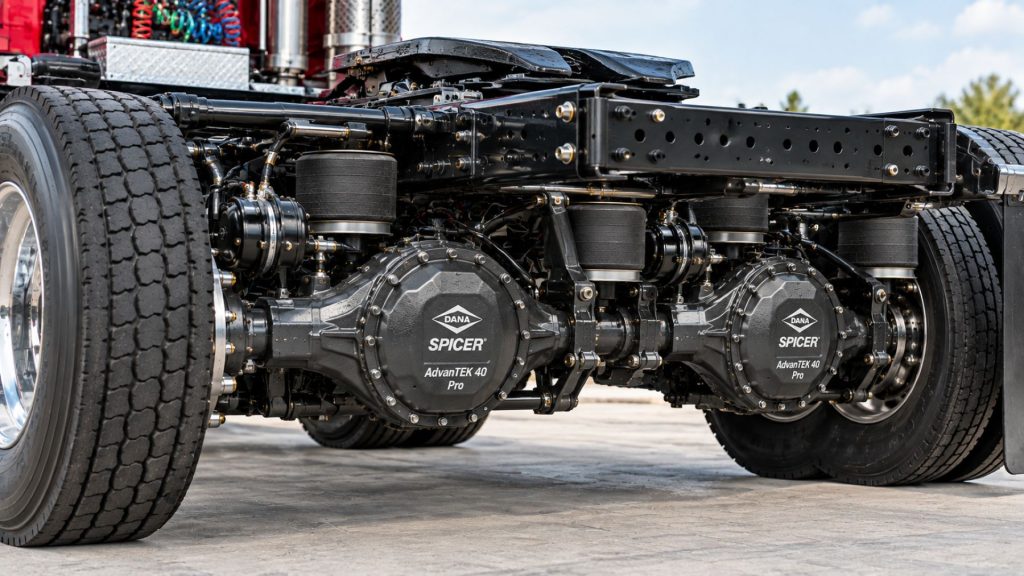
Together, the two drive axles create a 6×4 configuration. The truck has three axle positions, with both rear axles powered.
The tandem supports the rear portion of the truck or tractor while transmitting engine torque to the road. Its suspension helps equalize weight across the two drive axles, but actual load distribution also depends on cargo placement, fifth-wheel position, wheelbase, suspension setup, and axle spacing.
Common Specifications
- Axle Configuration: Tandem drive axle
- Drive Layout: 6×4
- Nominal Tandem Capacity: 40,000 lb
- Vehicle Class: Primarily Class 8
- Maximum Published Engine Torque: Up to 1,950 lb-ft
- Maximum Published Engine Power: Up to 500 hp
- Fastest Available Ratio: 2.05:1
- Current Published Ratio Selection: 16 customizable ratio steps
- Reduction Type: Single reduction
- Power Divider: Updated high-efficiency power-divider unit
- Bearing Design: High-capacity bearing system
- Differential Cover: Venturi-style cover designed to reduce lubricant volume and churning losses
- Traction Options: Inter-axle differential lock and optional driver-controlled wheel differential locks
- Wheel Differential-Lock Positions: Forward axle, rear-rear axle, or both drive axles
- Lubrication Option: Optional pump for circulating lubricant through critical inter-axle differential areas
- Brake Compatibility: Drum or air-disc brakes depending on the OEM configuration
- Wheel-End Compatibility: Application-specific hubs, bearings, brakes, wheels, and tire arrangements
- Primary Applications: Linehaul, regional haul, and approved vocational service
Actual specifications vary by axle ratio, model number, housing, brakes, wheel ends, suspension, drivetrain, and vehicle manufacturer.
Axle Ratios and Gearing
The AdvanTEK 40 Pro offers broader ratio coverage than the original AdvanTEK 40. Dana’s current product page identifies 16 customizable ratio steps, while the initial product announcement described 18 total axle ratios. The exact production selection should therefore be confirmed through the current Dana specification guide and the truck manufacturer’s data book.
The fastest published ratio is 2.05:1. This ratio is designed for advanced downspeeding powertrains that can produce substantial torque at low engine speeds.
Other available ratios allow the axle to work with different direct-drive and overdrive transmissions, tire sizes, engine calibrations, operating weights, cruise speeds, and terrain.
A fast numerical ratio can reduce engine speed and internal engine friction during highway cruising. However, it also provides less torque multiplication at the wheels than a numerically higher ratio.
Selecting the 2.05 ratio without evaluating startability, gradeability, driveshaft torque, transmission gearing, tire revolutions per mile, and expected gross weight can result in excessive shifting or poor low-speed performance.
See Commercial Truck Axle Ratios Explained for more information about matching an axle ratio to a truck’s work.
Differential and Traction Options
The AdvanTEK 40 Pro contains three differential positions: the inter-axle differential, the forward wheel differential, and the rear-rear wheel differential.
The inter-axle differential allows the forward and rear-rear axles to rotate at different speeds during normal operation. Its locking mechanism can temporarily connect the two axle outputs more directly when additional traction is needed.
Driver-controlled wheel differential locks may be available on the forward axle, rear-rear axle, or both axles. Dana describes differential-lock availability in all three positions, allowing fleets to choose the traction configuration that matches their operation.
A fully locking configuration can provide strong low-speed traction on snow, mud, gravel, job sites, and uneven surfaces. It also adds components, controls, and maintenance considerations.
Drivers should follow the vehicle manufacturer’s procedures for engaging and disengaging the locks. Tight turns on dry pavement with the differentials locked can cause tire scrub, driveline windup, and component damage.
Read Open vs Locking vs Limited-Slip Differentials for a comparison of common differential designs.
Brake and Wheel-End Options
The AdvanTEK 40 Pro can be integrated with commercial S-cam drum brakes or air-disc brakes according to the truck manufacturer’s available axle packages.
Brake specifications may include different drum or rotor sizes, calipers, chambers, slack adjusters, dust shields, ABS components, and parking-brake arrangements.
Wheel-end equipment can vary by truck manufacturer and application. Configurations may include conventional serviceable bearings or extended-maintenance hub and bearing systems.
The axle may be used with dual tires or approved wide-base single tires. Tire, wheel, hub, bearing, and axle ratings must be evaluated together.
Replacement brake and wheel-end components must be matched using the axle identification, OEM build information, hub model, brake family, and individual component numbers.
Common Applications
- Long-distance linehaul tractors
- Regional-haul tractors
- Fuel-efficient Class 8 fleet trucks
- Dry-van freight operations
- Refrigerated freight operations
- General freight transportation
- Pickup-and-delivery operations
- Trucks using direct-drive automated manual transmissions
- Powertrains designed for advanced engine downspeeding
- Applications requiring a 40,000-pound tandem rating
- Operations needing driver-controlled differential locks
- Selected vocational trucks approved by Dana and the vehicle manufacturer
Truck, Suspension, and Drivetrain Compatibility
The AdvanTEK 40 Pro is intended for Class 8 trucks using a 6×4 tandem-drive configuration. Compatibility depends on the vehicle manufacturer’s available axle packages and application approvals.
The 2.05 ratio and other fast ratios require careful coordination with the engine, transmission, driveshafts, tires, suspension, operating weight, cruise speed, and terrain.
Dana rates approved AdvanTEK 40 Pro configurations for engines producing up to 1,950 lb-ft and 500 horsepower. These figures should not be interpreted as automatic approval for every ratio or vehicle application.
High-torque, downsped powertrains can place considerable loads on the main driveshaft and inter-axle driveshaft. The complete driveline must have sufficient torque capacity for the chosen powertrain and operating conditions.
Suspension compatibility depends on axle spacing, bracket location, housing configuration, ride height, articulation, driveline angles, and gross axle weight rating. Changes in suspension ride height can alter universal-joint operating angles and create vibration.
Advantages
- The available 2.05 ratio supports advanced engine downspeeding
- Up to 16 customizable ratio steps provide broad gearing flexibility
- Supports approved engines producing up to 1,950 lb-ft of torque
- Supports approved engine ratings up to 500 horsepower
- High-capacity bearings help manage fast-ratio and high-torque operation
- Updated power-divider design reduces internal friction
- Advanced inter-axle differential coatings help retain lubricant
- Venturi differential cover reduces lubricant churning losses
- Reduced churning can contribute to lower axle operating temperatures
- Driver-controlled differential locks are available in all three differential positions
- Multiple locking configurations allow the axle to be tailored to operating conditions
- Optional lubrication pump protects critical areas under extreme conditions
- Broad ratio coverage supports direct-drive and overdrive transmission strategies
- The 40,000-pound platform is suitable for many common Class 8 fleet operations
Limitations or Considerations
- The 2.05 ratio is not suitable for every truck, route, or operating weight
- Extreme downspeeding requires an engine with sufficient low-rpm torque
- Fast ratios reduce torque multiplication at the drive wheels
- Poor ratio selection can result in frequent downshifts on grades
- Startability must be evaluated before selecting an extremely fast ratio
- Driveshaft torque capacity becomes especially important in downsped powertrains
- The highest published engine rating may not be approved with every configuration
- A 40,000-pound axle rating does not override legal axle-weight limits
- Severe vocational and heavy-haul applications may require a higher-capacity axle
- Multiple differential locks add cost, weight, controls, and service requirements
- The newer Pro platform may have less used-parts availability than older axle families
- Original AdvanTEK 40 and AdvanTEK 40 Pro parts should not be assumed to interchange
- The current ratio selection should be verified because Dana’s launch and current product materials report different totals
- OEM availability can vary by truck model, model year, and data book
Driver and Operator Experience
A properly specified AdvanTEK 40 Pro powertrain can operate at lower engine speeds during highway cruising. This may reduce cab noise and allow the engine to remain within its most efficient operating range.
Drivers may notice that a truck with a 2.05 or similarly fast ratio downshifts sooner when climbing a grade. This is a normal result of the reduced torque multiplication provided by the axle.
The transmission and engine controls play an important role in the driving experience. Automated manual transmissions can select lower gears when additional wheel torque is required while returning to efficient direct-drive operation on level roads.
Trucks equipped with multiple differential locks give drivers greater control in low-traction conditions. Operators must understand which switch controls the power divider and which switches operate the forward or rear-rear wheel locks.
Drivers should avoid spinning a wheel at high speed before engaging a lock. A sudden change in wheel speed can shock-load the differential, axle shafts, driveshaft, and transmission.
Maintenance and Ownership Notes
The axle should be serviced according to Dana’s current AdvanTEK 40 Pro literature and the truck manufacturer’s maintenance schedule.
Lubricant type is particularly important because the axle’s efficiency, cooling, bearing protection, and internal coatings depend on maintaining the correct oil specification and fill level.
Routine inspections should include the input seal, output seal, pinion seals, differential covers, wheel seals, breather system, power divider, and optional lubrication pump.
Technicians should inspect the main and inter-axle driveshafts for loose fasteners, worn universal joints, damaged yokes, missing balance weights, and improper operating angles.
Suspension ride height should remain within the vehicle manufacturer’s specification. Incorrect ride height can change inter-axle driveshaft angles and produce vibration or accelerated universal-joint wear.
Differential-lock controls should be tested periodically. Air lines, electrical connections, switches, warning lights, shift mechanisms, and lock engagement should all function correctly.
Any ratio change requires matching gears in the forward and rear-rear carriers. The engine, transmission, driveshaft, tires, electronic programming, and operating application must also be evaluated.
Common Axle or Differential Problems
Lubricant leakage from the input, output, pinion, differential-cover, or wheel-end seals
Low lubricant caused by an external leak or incorrect fill procedure
Contaminated lubricant from water, dirt, wear material, or incompatible fluids
Gear noise caused by bearing wear, incorrect backlash, damaged teeth, or improper setup
Power-divider noise or failure
Inter-axle differential lock that will not engage or release
Forward wheel differential lock that will not engage or release
Rear-rear wheel differential lock that will not engage or release
Air-system or electrical faults affecting the differential locks
Lubrication-pump failure or restricted lubricant circulation
Overheating caused by low lubricant, overloading, contamination, or internal damage
Universal-joint wear caused by incorrect ride height or driveline angles
Loose or worn yokes and input or output splines
Wheel-bearing looseness, overheating, or seal failure
Vibration caused by driveline imbalance, suspension changes, or improper installation
Read Common Truck Axle and Differential Problems for additional troubleshooting information.
Identification Information
- Product Family: Spicer AdvanTEK 40 Pro
- Manufacturer: Dana Incorporated
- Axle Configuration: 40,000-pound tandem drive axle
- Drive Layout: 6×4
- Important Identification Sources: Axle tags, carrier tags, housing stampings, and OEM build records
- Information to Record: Model number, serial number, specification number, ratio, carrier identification, and truck VIN
The forward and rear-rear axles should each have identification information. Record the details from both tandem members because the carrier assemblies and individual components perform different functions.
Model suffixes can identify housing thickness, differential-lock equipment, wheel ends, brakes, gearing, and other application-specific features.
The original AdvanTEK 40 and AdvanTEK 40 Pro should not be identified by appearance alone. Their similar names do not mean that carriers, bearings, power-divider components, covers, gears, or other parts are interchangeable.
If identification tags are missing, use the truck’s VIN, OEM build sheet, axle housing markings, carrier numbers, ring-gear markings, and component measurements.
Use How to Identify a Truck Axle or Differential before purchasing a replacement axle or internal component.
Buying Considerations
- Confirm that the axle is an AdvanTEK 40 Pro rather than the original AdvanTEK 40
- Record the complete model and serial numbers from both tandem members
- Verify the original OEM build specifications
- Confirm the 40,000-pound tandem rating
- Determine whether the quoted ratio is available for the specific truck and powertrain
- Evaluate startability and gradeability before choosing the 2.05 ratio
- Confirm engine torque and horsepower compatibility
- Check transmission gearing and direct-drive or overdrive configuration
- Verify main and inter-axle driveshaft torque capacity
- Confirm tire size and revolutions per mile
- Identify the inter-axle differential-lock system
- Determine whether the forward axle has a wheel differential lock
- Determine whether the rear-rear axle has a wheel differential lock
- Confirm whether the axle has the optional lubrication pump
- Verify housing, track-width, and suspension-mounting specifications
- Identify the brake and wheel-end packages
- Confirm yoke and driveline compatibility
- Inspect used gears, bearings, housings, seals, and differential-lock components
- Check for lubricant leaks, overheating, corrosion, cracks, and damaged mounting surfaces
- Ask whether software or speedometer calibration changes will be required
- Verify parts availability and technician familiarity in the operating region
- Include freight, core charges, lubricant, installation labor, programming, and related driveline changes in the total cost
Variants and Configurations
- 2.05 extreme-downspeeding ratio configuration
- Additional fast-ratio configurations
- Ratios for direct-drive transmissions
- Ratios for overdrive transmissions
- Standard wheel differentials
- Inter-axle differential lock
- Forward driver-controlled wheel differential lock
- Rear-rear driver-controlled wheel differential lock
- Three-position differential-lock configuration
- Standard lubrication arrangement
- Optional inter-axle differential lubrication pump
- Venturi differential cover
- Linehaul configuration
- Regional-haul configuration
- Approved vocational configuration
- Drum-brake configuration
- Air-disc-brake configuration
- Dual-tire configuration
- Wide-base single-tire configuration
- OEM-specific suspension and wheel-end packages
Comparison to Similar Equipment
Compared with the original Dana Spicer AdvanTEK 40 Tandem Axle, the AdvanTEK 40 Pro adds a faster 2.05 ratio, broader ratio coverage, a high-capacity bearing system, an updated power divider, advanced inter-axle differential coatings, and greater differential-lock flexibility.
The original AdvanTEK 40 remains a well-established highway axle with extensive fleet and aftermarket experience. The Pro version is aimed at newer powertrains requiring additional ratio choices and higher torque capability.
The Meritor 14X Tandem Drive Axle serves many comparable Class 8 applications. Selection depends on truck-manufacturer availability, ratio requirements, powertrain integration, traction options, weight, warranty, service support, and fleet parts standardization.
Compared with heavier vocational tandem axles, the AdvanTEK 40 Pro places greater emphasis on highway efficiency and downspeeding. High-impact vocational, off-road, mining, logging, and specialized heavy-haul operations may require a higher-capacity axle family.
Best Fit For
- Modern Class 8 highway tractors
- Linehaul fleets focused on fuel efficiency
- Regional-haul trucks with substantial highway mileage
- Powertrains designed for advanced engine downspeeding
- Trucks requiring a ratio faster than the original AdvanTEK 40’s 2.26 offering
- Approved engines producing up to 1,950 lb-ft of torque
- Approved engine ratings up to 500 horsepower
- Direct-drive automated manual transmission configurations
- Fleets needing broad final-drive ratio choices
- Operations requiring driver-controlled differential locks
- Applications needing a 40,000-pound tandem-drive rating
- Fleets ordering new trucks through participating OEMs
- Operations with access to Dana-approved service and parts support
Related Truck Types
Related Truck Models
- Freightliner Cascadia
- International LT Series
- Kenworth T680
- Kenworth T880
- Peterbilt 567
- Peterbilt 579
- Volvo VNL
- Mack Anthem
- Western Star 57X
Related Axle and Differential Types
- Dana Spicer AdvanTEK 40 Tandem Axle
- Meritor 14X Tandem Drive Axle
- Commercial Truck Drive Axles
- Truck Differentials
- Axles and Differentials
Related Equipment Systems
- Commercial Truck Transmissions
- Truck Suspension Systems
- Air Brake Systems
- Commercial Truck Tires and Wheels
Related Guides
- How Commercial Truck Axles and Differentials Work
- Commercial Truck Axle Ratios Explained
- How to Identify a Truck Axle or Differential
Regulatory and Compliance Notes
The AdvanTEK 40 Pro’s 40,000-pound nominal rating describes the axle system’s equipment capacity. It does not automatically authorize a truck to carry 40,000 pounds on its tandem under every operating condition or jurisdiction.
Legal loading depends on federal, state, provincial, and local weight regulations; axle spacing; bridge-formula requirements; tire ratings; wheel ratings; suspension capacity; and the completed vehicle’s certified axle and gross weight ratings.
Brake, ABS, traction-control, and stability-control components must remain compatible with the completed vehicle. Replacing brakes, wheel ends, sensors, tone rings, tires, or axle components can affect federally required safety systems.
Changing the axle ratio or tire size may require updates to the engine, transmission, speedometer, cruise control, ABS, stability system, and other electronic modules.
All powertrain, axle, suspension, and brake changes should follow Dana and vehicle-manufacturer application requirements.
Real World Operating Notes
The AdvanTEK 40 Pro’s 2.05 ratio provides the greatest benefit when used in a powertrain specifically engineered for extreme downspeeding. Simply installing the fastest available ratio does not guarantee improved fuel economy.
Routes with steady highway speeds, moderate grades, and predictable operating weights are more likely to benefit from extreme downspeeding than operations involving frequent starts, steep grades, soft surfaces, or constantly changing loads.
A slightly slower axle ratio may provide better real-world performance if it allows the truck to remain in top gear more consistently and reduces unnecessary transmission shifting.
Differential locks can improve mobility in terminals, snowy conditions, gravel lots, and uneven loading areas. They do not increase the axle’s weight rating and cannot compensate for unsuitable tires or unsafe driving conditions.
Because the AdvanTEK 40 Pro is newer than the original platform, fleets should confirm current parts stocking, technician training, warranty coverage, and OEM availability before standardizing a large number of trucks around it.
Frequently Asked Questions
What is the Dana Spicer AdvanTEK 40 Pro?
The AdvanTEK 40 Pro is a 40,000-pound 6×4 tandem drive axle developed for modern Class 8 trucks. It combines broad ratio coverage, high-torque capability, updated bearings, reduced internal friction, and flexible differential-lock options.
How much engine torque can the AdvanTEK 40 Pro handle?
Dana’s current product information states that approved configurations support up to 1,950 lb-ft of engine torque.
What is the maximum published horsepower rating?
Dana lists support for engines rated up to 500 horsepower in approved applications.
What is the fastest AdvanTEK 40 Pro ratio?
The fastest published ratio is 2.05:1. It is intended for advanced engine-downspeeding powertrains.
How many ratios are available?
Dana’s current product page lists 16 customizable ratio steps. The original launch announcement described 18 total ratios, so buyers should verify the current production selection through Dana and the truck manufacturer.
Is a 2.05 axle ratio appropriate for every highway truck?
No. It requires the correct engine torque curve, transmission gearing, driveshaft capacity, tire size, vehicle weight, cruise speed, terrain, startability, and gradeability.
Does the AdvanTEK 40 Pro have locking differentials?
The axle offers an inter-axle differential lock and optional driver-controlled wheel differential locks. Dana states that locks can be specified in all three differential positions.
What are the three differential positions?
They are the inter-axle differential, forward axle wheel differential, and rear-rear axle wheel differential.
What does the Venturi differential cover do?
It controls lubricant flow around the gearing while reducing excess lubricant volume and churning losses. This can improve efficiency and help the axle operate cooler.
What does the optional lubrication pump protect?
The pump circulates lubricant through critical areas of the inter-axle differential during extreme operating conditions.
Is the AdvanTEK 40 Pro the same as the original AdvanTEK 40?
No. The Pro is an updated platform with additional ratios, higher published power capability, a revised bearing system, an updated power divider, and other internal changes.
Can original AdvanTEK 40 parts be used in the Pro axle?
Parts should not be assumed to interchange. Always verify the complete axle model, serial number, specification number, ratio, and individual part number.
Can the AdvanTEK 40 Pro be used for vocational work?
Dana identifies linehaul and vocational markets for its commercial axle products, but each application must be approved according to vehicle weight, road surface, shock loading, grade, starts per day, tire configuration, and operating environment.
Can it replace another 40,000-pound tandem?
Possibly, but capacity alone does not establish compatibility. Suspension mounts, track width, driveline geometry, yokes, brakes, wheel ends, electronics, ratio, and OEM approval must also match.
Availability and Where to Find
The Dana Spicer AdvanTEK 40 Pro is available through participating commercial truck manufacturers and Dana-authorized sales and service channels. OEM availability depends on truck model, model year, application, and data-book offerings.
Complete axle systems, service components, specification guides, application information, and warranty resources may be available through Dana representatives, Spicer distributors, commercial truck dealers, and qualified drivetrain specialists.
Current specifications and official technical resources are available through the Dana Spicer AdvanTEK 40 Pro product page and the Dana Resource Library.
Before ordering, confirm the complete axle model, ratio, engine rating, transmission, driveshaft, suspension, brakes, wheel ends, differential locks, lubrication system, and OEM application approval.
Support Trucking Families
Truck Equipment Atlas supports the mission of Grey Cross, a nonprofit dedicated to helping families of truck drivers who lose their lives while on the road. As the site grows, part of its mission is to bring awareness and support to these families.
Podcast or Video Section
Learn More Through Audio and Video
Truck Equipment Atlas will continue expanding with podcast episodes, interviews, and equipment breakdowns to help drivers and fleets better understand trucks and equipment.
Follow the Growth of Truck Equipment Atlas
Truck Equipment Atlas continues to expand with new truck profiles, trailer coverage, diesel engine pages, equipment system resources, manufacturer information, and educational guides.
Visit our Site Updates page to explore recent additions, project milestones, and upcoming resources as we continue building one of the industry’s growing commercial trucking equipment reference libraries.
View the Latest Site Updates: Truck Equipment Atlas Site Updates