
Volvo I-Shift Transmission
Quick Facts
- Manufacturer: Volvo Trucks
- Transmission Type: Automated Manual Transmission
- Transmission Family: Volvo I-Shift
- Common Configurations: 12-Speed, 13-Speed with Crawler Gear, and 14-Speed with Crawler Gears
- Number of Forward Speeds: 12, 13, or 14 depending on configuration
- Number of Reverse Speeds: Four or six depending on configuration
- Maximum Input Torque: Up to 1,950 lb-ft on current North American configurations
- Maximum Highway Weight Rating: Up to approximately 143,000 lbs on applicable configurations
- Control Type: Electronically Controlled Automated Shifting
- Launch System: Electronically Controlled Dry Clutch
- Clutch Pedal: None
- Common Engine Pairings: Volvo D11, Volvo D13, and Volvo D13 Turbo Compound
- Common Truck Models: Volvo VNL, Volvo VNR, Volvo VHD, Volvo VNX, and Volvo VAH
- Available Drive Modes: Economy+, Economy, and Performance depending on configuration
- PTO Compatibility: Available with transmission-mounted PTO provisions
- Predictive Shifting: Available through Volvo I-See
- Production Status: Active Production
Overview
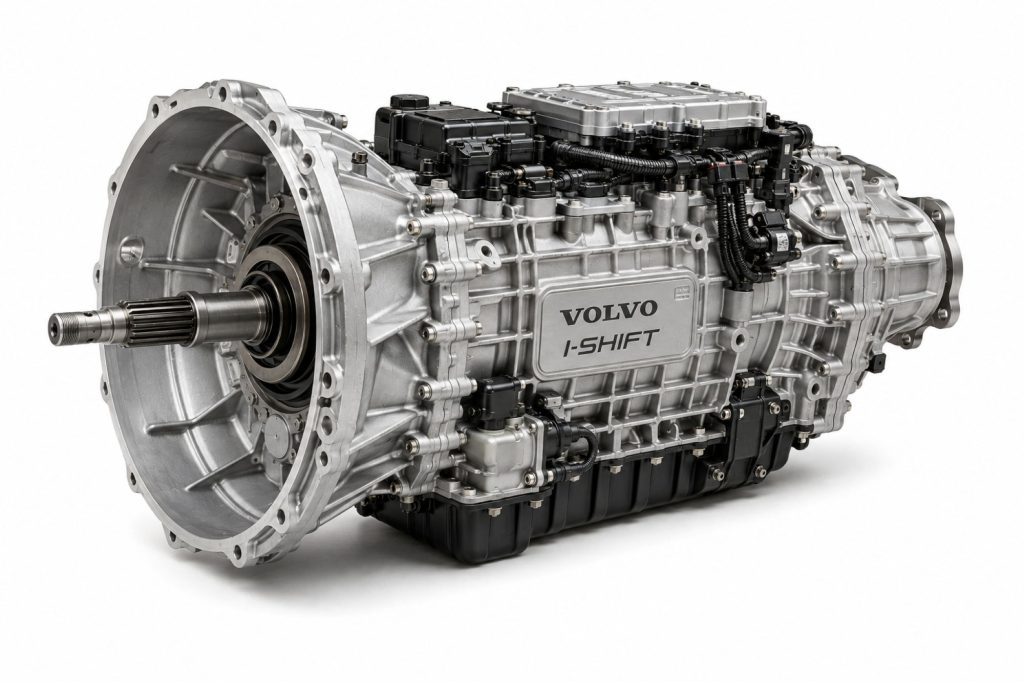
The Volvo I-Shift is an electronically controlled automated manual transmission developed as part of Volvo’s integrated truck powertrain.
Internally, it uses mechanical gears, shafts, synchronizing components, and a dry clutch similar to a manual transmission. Unlike a conventional manual, electronic controls and pneumatic or electromechanical actuators operate the clutch and complete the gear changes.
The driver does not operate a clutch pedal or manually move a traditional gear lever through each ratio. The transmission control system evaluates vehicle speed, engine load, road grade, accelerator position, gross vehicle weight, and other information before selecting and engaging the appropriate gear.
Standard highway versions commonly provide 12 forward gears. Specialized I-Shift with Crawler Gears configurations add one or two extremely low ratios, producing 13-speed or 14-speed arrangements for vocational, construction, off-road, and heavy-haul truck applications.
The I-Shift is closely integrated with Volvo engines, engine brakes, rear axles, cruise control, and vehicle electronics. This integration allows the complete powertrain to coordinate engine torque, clutch operation, shifting, and vehicle speed.
Current North American configurations can support engine torque ratings of up to approximately 1,950 lb-ft. Exact ratings depend on the transmission model, truck, engine, software package, rear-axle ratio, gross vehicle weight, and intended application.
Key Characteristics
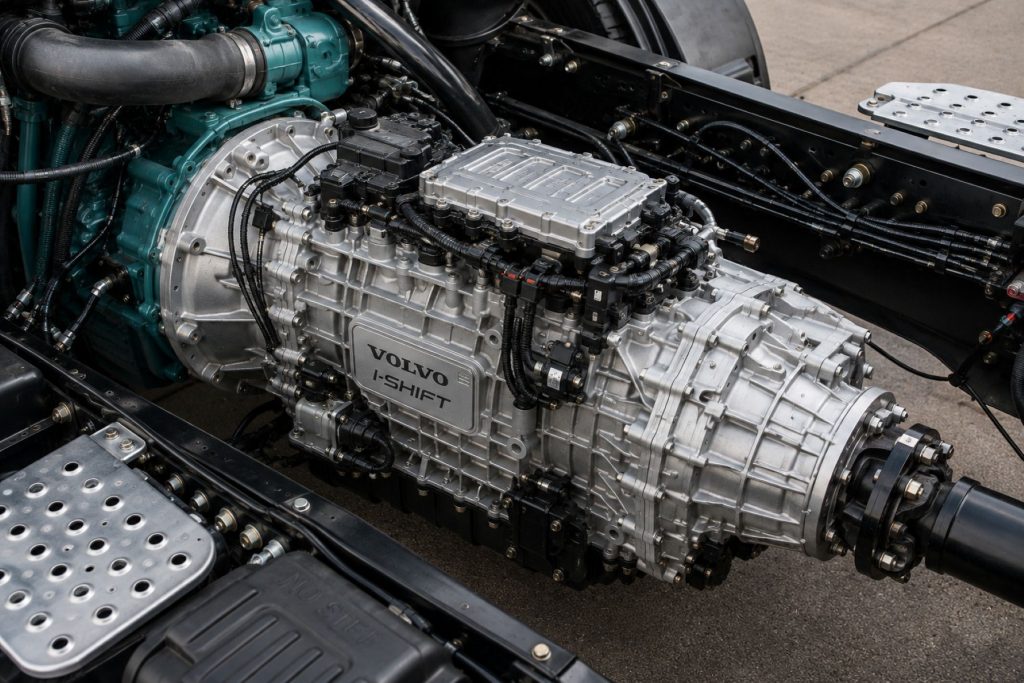
The Volvo I-Shift is an automated manual transmission rather than a conventional torque-converter automatic.
Its mechanical design provides a direct connection through the clutch and gears once the clutch is engaged. This helps reduce internal power loss compared with a traditional automatic transmission that depends heavily on a hydraulic torque converter.
Electronic controls determine when to shift, which gears can be skipped, how quickly the clutch should engage, and how engine torque should be adjusted during each shift.
The transmission communicates continuously with the engine control module. When a shift begins, engine torque is reduced, the clutch or driveline is unloaded, the current gear is released, and the next gear is engaged. Engine torque is then restored.
Because power is briefly interrupted during a gear change, the I-Shift may feel different from an Allison fully automatic transmission. Proper programming helps make the shifts smooth and predictable.
Volvo offers direct-drive and overdrive configurations. Direct drive can improve mechanical efficiency when paired with a properly selected rear-axle ratio. Overdrive provides additional gearing flexibility for highway, regional, vocational, and heavy-haul operations.
Crawler-gear models provide extremely low starting ratios. These configurations allow heavily loaded trucks to begin moving on steep grades and maneuver at very low speeds without excessive clutch slipping.
How the Transmission Works
The I-Shift uses a computer-controlled clutch between the engine and transmission.
When the truck begins moving, the transmission control unit commands the clutch actuator to engage the dry clutch gradually. The system uses engine speed, vehicle weight, accelerator position, road grade, and selected operating mode to determine the engagement rate.
Once the clutch is fully engaged, engine power flows mechanically through the selected gear and into the driveshaft.
During a shift, the transmission coordinates with the engine to reduce torque. Internal actuators disengage the current gear and select the next appropriate ratio. Engine speed is adjusted to match the new gear before power is restored.
The transmission can skip gears when the truck is lightly loaded or operating conditions do not require every available ratio. Under heavier loads or on steeper grades, it may use more intermediate gears to keep the engine within its efficient operating range.
When manual mode is available, the driver can request a gear or limit automatic shifting. The transmission may reject a request that could overspeed the engine, lug the engine, damage the clutch, or place the vehicle outside approved operating conditions.
I-See predictive cruise technology can use map and topography information to prepare the powertrain for hills and descents. The system may adjust vehicle speed, select a gear, use Eco-Roll, or coordinate engine braking based on the road ahead.
Crawler gears operate below the normal first gear. They are intended for starting heavy loads, maneuvering in difficult conditions, and maintaining extremely low vehicle speeds.
Common Specifications
Transmission Type
The Volvo I-Shift is an automated manual transmission. It uses mechanical gearing and a dry clutch with electronic and automated operation.
Forward Gear Configurations
Current North American configurations include:
- Standard I-Shift: 12 forward gears
- I-Shift with One Crawler Gear: 13 forward gears
- I-Shift with Two Crawler Gears: 14 forward gears
The number of available gears depends on the truck model, application, engine, and transmission specification.
Reverse Gears
Standard configurations commonly provide four reverse ratios.
Crawler-equipped configurations can provide as many as six reverse ratios, allowing improved low-speed control when backing heavy equipment or maneuvering in difficult conditions.
Gear Ratios
Exact ratios vary among direct-drive, overdrive, and crawler-gear transmissions.
Common 12-speed configurations provide a wide ratio spread through a main gearbox, splitter section, and range section. Crawler configurations extend the overall ratio range substantially.
Current Volvo specifications list overall ratio spreads ranging from approximately 14.94:1 to 40.8:1 depending on the selected transmission.
The identification number and Volvo specification documentation should be used when exact individual gear ratios are required.
Torque Capacity
Current North American I-Shift configurations can support up to approximately 1,950 lb-ft of engine torque.
Not every model carries the maximum rating. The transmission must be matched to the specific engine calibration and application.
Transmission Housing
The I-Shift uses an aluminum transmission housing to reduce powertrain weight while providing the structural strength required for commercial truck operation.
Clutch System
The transmission uses a computer-controlled dry clutch. There is no driver-operated clutch pedal.
Clutch engagement is controlled through the transmission electronics and clutch actuator. The clutch is used primarily during vehicle launch, very-low-speed maneuvering, stopping, and certain gear changes.
Transmission Weight
Volvo lists an approximate dry weight, including clutch and oil cooler, of:
- 12-Speed Configuration: Approximately 719 lbs
- 13-Speed and 14-Speed Configurations: Approximately 805 lbs
Weight varies with the model, clutch, oil cooler, PTO provisions, crawler section, and installed equipment.
Oil Capacity
Approximate oil capacity is:
- Standard Configuration: Approximately 18 quarts
- Crawler-Gear Configurations: Approximately 20.8 quarts
The exact capacity must be confirmed using the transmission model, serial number, and service information.
Electronic Controls
The I-Shift includes a transmission electronic control unit that communicates with the engine, brakes, vehicle electronic control unit, cruise-control system, body equipment, and diagnostic network.
Available functions can include:
- Automatic gear selection
- Skip shifting
- Load sensing
- Grade sensing
- Hill-start assistance
- Kickdown
- Eco-Roll
- Auto Neutral
- Idle Drive
- Power Launch
- Downhill Economy Mode
- Remote Diagnostics
- Remote Programming
Shift Selector
Current Volvo trucks can use a stalk-mounted shift selector. Earlier vehicles may use dashboard-mounted, seat-mounted, or console-mounted controls.
The selector provides Drive, Neutral, Reverse, manual gear selection, and operating-mode functions depending on the truck.
Drive Modes
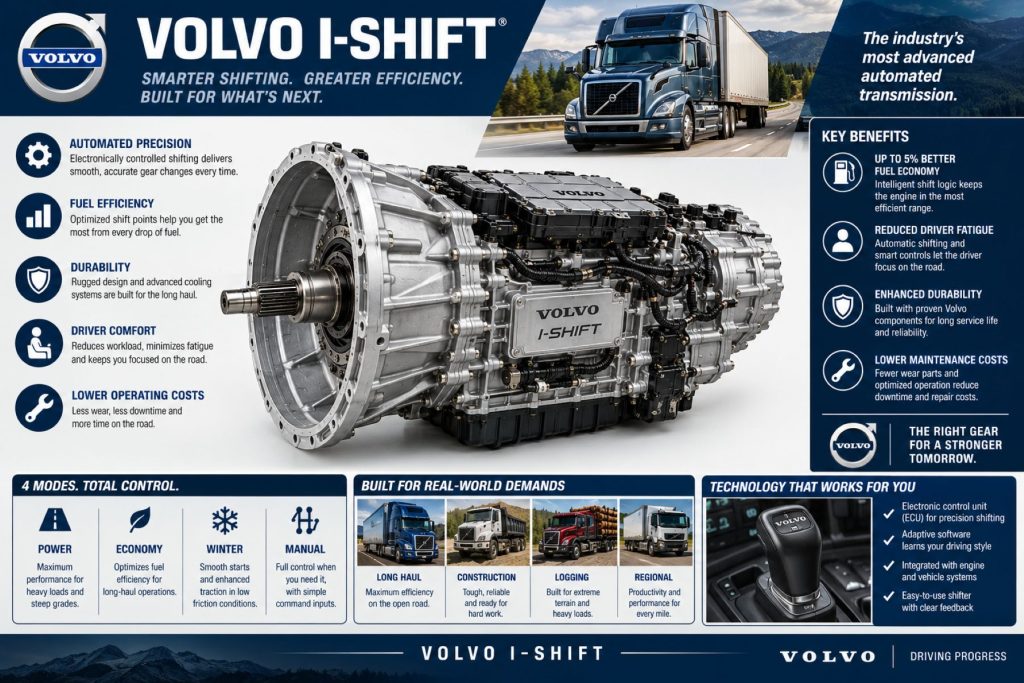
Available driver-controlled modes can include:
- Economy+: Prioritizes maximum fuel efficiency
- Economy: Balances efficiency and performance
- Performance: Holds gears longer and prioritizes responsiveness
Available modes and their operation depend on the software package and truck specification.
Direct-Drive Configuration
Direct-drive models use a 1.00:1 top gear and are paired with a numerically lower rear-axle ratio.
This arrangement can reduce gear-mesh losses because highway cruising occurs through a direct mechanical path.
Overdrive Configuration
Overdrive models reduce transmission output speed relative to engine speed in the highest gear. They provide additional flexibility for traditional axle ratios, varied terrain, vocational service, and I-Torque-equipped trucks.
Crawler Gears
Crawler gears provide extremely low ratios for difficult starts and slow maneuvering.
Volvo lists minimum vehicle speeds as low as approximately 0.6 mph in applicable configurations. Actual speed depends on engine rpm, tire size, axle ratio, vehicle weight, and transmission programming.
PTO Compatibility
The I-Shift can be ordered with transmission-mounted PTO provisions for hydraulic pumps and vocational equipment.
Available PTO functions may support dump bodies, walking-floor trailers, tank equipment, utility systems, refuse bodies, vehicle carriers, and other equipment.
PTO operation depends on the gear selected, vehicle speed, control programming, and installed safety interlocks.
Lubrication System
The transmission uses dedicated gear oil rather than conventional automatic transmission fluid.
The correct Volvo-approved lubricant must be used. Fluid specification and service intervals depend on the transmission generation, application, oil type, and operating conditions.
Oil-Change Interval
Current Volvo information lists oil-drain intervals reaching as much as six years or 500,000 miles under qualifying normal-duty conditions.
Severe service, high operating hours, contamination, extreme temperatures, vocational operation, or older transmission specifications may require shorter intervals.
Highway Weight Rating
Applicable current configurations can support highway vehicle weights reaching approximately 143,000 pounds.
This transmission rating does not replace axle, tire, chassis, bridge-formula, permit, or legal gross-weight restrictions.
Installation Requirements
Installation requires compatible engine software, clutch components, flywheel, bellhousing, transmission mounts, driveshaft, electronic controls, air supply, cooling equipment, shift selector, rear-axle ratio, and vehicle programming.
Common Applications
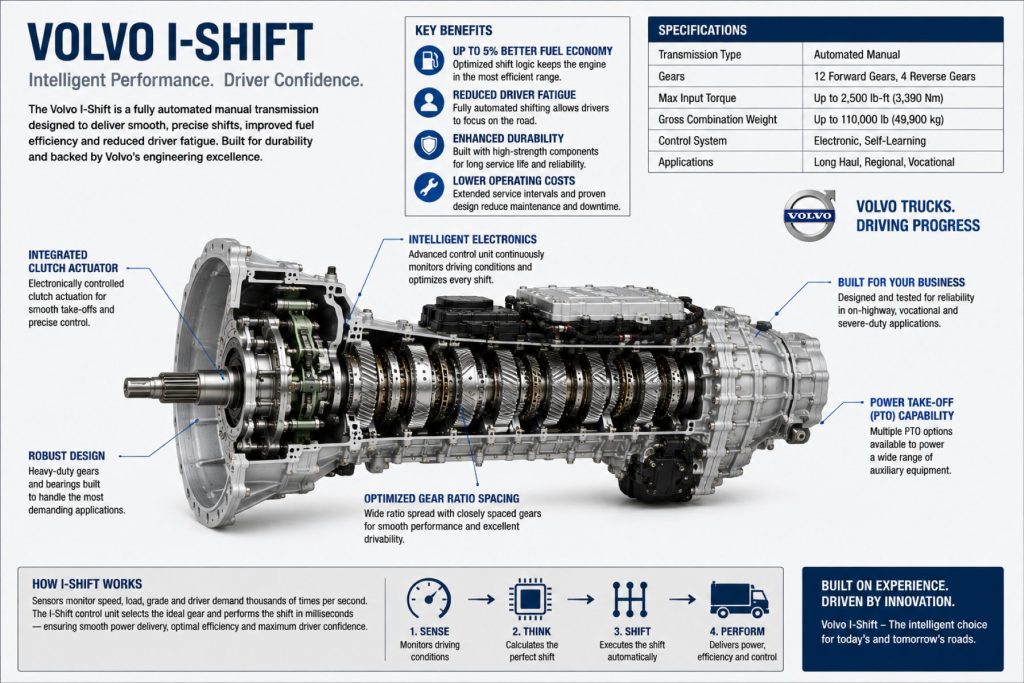
- Long-haul freight transportation
- Regional freight operations
- Local distribution
- Dry van transportation
- Refrigerated freight
- Tanker operations
- Flatbed transportation
- Automobile transportation
- Heavy-haul operations
- Dump trucks
- Construction trucks
- Mixer and construction-support vehicles
- Logging operations
- Refuse trucks
- Utility vehicles
- Snowplow trucks
- Municipal equipment
- Vehicle-transport trucks
- Vocational tractor operations
Truck and Engine Compatibility
The Volvo I-Shift is designed primarily for Volvo heavy-duty trucks and Volvo engines.
Common North American truck applications include the Volvo VNL, Volvo VNR, Volvo VHD, Volvo VNX, and Volvo VAH.
The VNL commonly uses the I-Shift in long-haul, regional, and day-cab applications. Current VNL powertrains combine Volvo D13 engines with 12-speed or specialized I-Shift configurations.
The VNR uses the I-Shift for regional, local, and urban freight operations. Current configurations include 12-speed and 13-speed options depending on the powertrain.
The VHD can use 13-speed or 14-speed crawler-gear configurations for construction, dump, mixer, municipal, and other vocational truck applications.
The VNX commonly uses 13-speed or 14-speed I-Shift with Crawler Gears transmissions for heavy-haul work.
The VAH uses the I-Shift in automobile-transport applications where low-speed maneuverability and drivetrain packaging are important.
Common engine pairings include:
- Volvo D11
- Volvo D13
- Volvo D13 Turbo Compound
Engine and transmission compatibility depends on model year. An I-Shift removed from one truck may not operate correctly in another truck without compatible hardware, electronics, clutch components, and programming.
Advantages
- Eliminates the clutch pedal
- Automatically selects gears
- Reduces driver workload
- Can improve fuel-economy consistency between drivers
- Integrates closely with Volvo engines
- Uses vehicle weight and road grade when selecting gears
- Supports direct-drive and overdrive configurations
- Available with predictive I-See technology
- Skip shifting reduces unnecessary gear changes
- Crawler gears support difficult launches
- Provides extremely low-speed maneuvering capability
- Reduces improper shifting and engine overspeed
- Can reduce driver-training requirements
- Works with Volvo engine-brake controls
- Supports transmission-mounted PTO equipment
- Available for highway, vocational, and heavy-haul trucks
- Remote Diagnostics can assist with fault identification
- Remote Programming can reduce shop visits for certain updates
- No torque-converter losses during normal locked mechanical operation
- Aluminum housing helps control transmission weight
Limitations or Considerations
- Uses a wear-sensitive dry clutch
- Clutch replacement can be expensive
- Shift quality depends on correct calibration
- Power is briefly interrupted during shifts
- Low-speed behavior differs from a torque-converter automatic
- Drivers may need time to understand automated clutch behavior
- Excessive creeping can accelerate clutch wear
- Backing heavy loads on steep grades creates clutch heat
- Electronic faults can prevent normal shifting
- Air-system problems can affect transmission operation
- Repairs require Volvo-compatible diagnostic equipment
- Transmission and engine software must remain compatible
- Used units may require programming before installation
- PTO operation has configuration-specific limitations
- Crawler-gear models add weight and complexity
- Incorrect axle gearing can reduce performance and efficiency
- The transmission is primarily tied to the Volvo powertrain ecosystem
- Manual-mode requests may be rejected by the control system
- Towing procedures must be followed to prevent internal damage
Driver and Operator Experience
The I-Shift removes the need for the driver to operate a clutch pedal or manually shift through every gear.
The driver selects Drive, releases the service brake, and applies the accelerator. The transmission determines the starting gear and controls clutch engagement.
The selected starting gear may change based on vehicle weight, road grade, axle ratio, accelerator input, and transmission programming. A lightly loaded truck may begin in a higher gear, while a heavily loaded truck may use a lower starting ratio.
Drivers will feel a brief reduction in power during some shifts because the I-Shift is an automated manual. This is normal and differs from the nearly uninterrupted power delivery of a torque-converter automatic.
The driver can improve shift quality by using smooth accelerator inputs. Rapidly changing throttle position during a shift can cause the control system to reconsider its selected gear.
Hill-start assistance helps prevent rollback while the transmission engages the clutch. It does not eliminate the need for careful brake and accelerator control.
Manual mode can help on grades, in construction areas, or when the driver wants to hold a particular gear. The transmission retains protective control and may reject an unsafe gear request.
Crawler-equipped trucks can maneuver at very low speeds. Drivers should use the correct crawler ratio instead of controlling speed through prolonged clutch slipping.
Eco-Roll may place the transmission in a fuel-saving freewheel condition when the system determines that coasting is appropriate. The transmission re-engages a gear when power or engine braking is needed.
Maintenance and Ownership Notes
The correct transmission oil is essential. Owners should use the lubricant specified for the transmission model and serial number rather than substituting automatic transmission fluid or ordinary gear oil.
Oil level and condition should be checked according to Volvo procedures. Leaks should be corrected before low oil damages gears, bearings, synchronizers, or the range section.
The clutch is a wear component. Service life depends on vehicle weight, number of starts, road grade, backing conditions, driver behavior, programming, and the amount of low-speed creeping.
Long-haul trucks may receive substantial clutch life because they make relatively few starts. Refuse, construction, urban delivery, vehicle-hauler, and heavy-haul applications can produce greater clutch wear.
The clutch actuator and transmission control system must be calibrated after certain repairs. Incorrect calibration can cause harsh engagement, slipping, poor shift quality, or starting problems.
Air-system quality is important because pneumatic controls may be used to complete transmission functions. Contaminated air, moisture, low pressure, or leaks can affect shifting.
Electrical connectors, wiring harnesses, grounds, batteries, and charging-system voltage should be kept in good condition. Low voltage can create misleading transmission symptoms.
Driveline inspection should include universal joints, driveshaft balance, slip joints, carrier bearings, output seals, and axles and differentials.
PTO-equipped trucks require inspection of PTO gears, mounting fasteners, lubrication, seals, wiring, air lines, hydraulic hoses, and safety interlocks.
Common Transmission Problems
Clutch Wear
A worn clutch may cause slipping, shuddering, delayed engagement, poor launch performance, excessive engine speed, or clutch-related fault codes.
Severe low-speed operation, repeated backing, steep launches, and excessive creeping can shorten clutch life.
Clutch Actuator Failure
A malfunctioning actuator may prevent the clutch from engaging or releasing correctly. Symptoms can include failure to select a gear, harsh engagement, warning messages, or an immobilized truck.
Shift-Control Problems
Failed sensors, solenoids, actuators, wiring, air valves, or control modules can cause missed shifts, range inhibition, neutral conditions, or emergency operating modes.
Low Air Pressure
Insufficient air pressure can interfere with gear selection and automated shifting. The source may be the truck’s air system rather than the internal transmission.
Transmission Oil Leaks
Leaks can develop at the oil pan, rear seal, input area, range housing, PTO opening, cooler connections, or housing joints.
Low oil can cause bearing damage, gear wear, excessive heat, and shifting problems.
Gear or Synchronizer Wear
Worn gears, engagement components, forks, or synchronizing parts may cause grinding, failed shifts, abnormal noises, or repeated transmission fault codes.
Speed Sensor Faults
The transmission depends on engine, input, and output-speed information. Failed sensors or damaged wiring can result in improper gear selection or loss of normal operation.
Wiring and Communication Faults
Communication problems between the engine, transmission, vehicle controller, brakes, and shift selector can cause warning messages or prevent the transmission from selecting a range.
Battery voltage, grounds, connectors, and network wiring should be checked before major internal repairs are authorized.
Overheating
Overheating can result from low lubricant, excessive clutch slipping, severe low-speed operation, heavy loading, improper programming, or a cooling-system problem.
PTO Problems
PTO complaints may result from incorrect programming, improper gear selection, failed interlocks, damaged wiring, low air pressure, gear backlash, or an incorrectly matched PTO.
Shift Selector Problems
A failed stalk, switch, connector, or vehicle-control input can prevent Drive, Neutral, Reverse, or manual functions from being selected correctly.
Improper Calibration
A mechanically sound transmission can shift poorly when clutch calibration, tire size, axle ratio, engine parameters, or transmission software is incorrect.
Buying Considerations
- Record the complete transmission model and serial number.
- Determine whether it is a 12-speed, 13-speed, or 14-speed configuration.
- Confirm whether it is direct drive or overdrive.
- Determine whether one or two crawler gears are installed.
- Verify the maximum approved engine torque.
- Confirm compatibility with the Volvo D11, D13, or D13 Turbo Compound engine.
- Check compatibility with the truck’s model year and electronic architecture.
- Verify the rear-axle ratio and tire size.
- Determine whether a PTO opening and controls are required.
- Confirm the PTO ratio, rotation, torque capacity, and operating mode.
- Inspect the clutch condition and clutch-wear information.
- Review transmission and engine diagnostic codes.
- Check the oil level, condition, and maintenance history.
- Inspect for input, output, housing, range-section, and PTO leaks.
- Operate the truck from a cold start through normal operating temperature.
- Test forward engagement, reverse engagement, upshifts, downshifts, manual mode, and hill starts.
- Check for shuddering during launch.
- Listen for bearing, gear, or driveline noise.
- Confirm that I-See, Eco-Roll, engine-brake, and drive-mode functions operate correctly.
- Determine whether software updates or programming are required.
- Verify that the transmission control unit, clutch actuator, shift controls, and wiring are included with a used unit.
- Confirm dealer support and replacement-part availability.
- Compare new, used, rebuilt, and Volvo Reman options.
Variants and Configurations
- Volvo I-Shift 12-Speed Direct Drive
- Volvo I-Shift 12-Speed Overdrive
- Volvo I-Shift 13-Speed with Crawler Gear
- Volvo I-Shift 14-Speed with Crawler Gears
- Volvo I-Shift for Highway Applications
- Volvo I-Shift for Regional Applications
- Volvo I-Shift for Vocational Applications
- Volvo I-Shift for Heavy-Haul Applications
- Volvo I-Shift for Vehicle Haulers
- Volvo I-Shift with I-See
- Volvo I-Shift with I-Torque
- Volvo I-Shift with Economy+ Mode
- Volvo I-Shift with Performance Mode
- Volvo I-Shift with Eco-Roll
- Volvo I-Shift with Enhanced PTO Functions
- Volvo I-Shift Reman Complete
- Volvo I-Shift Reman Basic
- Volvo I-Shift Reman Short
- Earlier AT Direct-Drive Models
- Earlier ATO Overdrive Models
- Current 12-Speed, 13-Speed, and 14-Speed Models
Comparison to Similar Equipment
Compared with the Eaton UltraShift PLUS, the Volvo I-Shift uses the same general automated-manual concept but is more closely integrated with Volvo engines, truck electronics, I-See, Volvo axles, and Volvo’s connected service systems.
Compared with the Eaton Cummins Endurant HD, the I-Shift is designed primarily around the Volvo powertrain ecosystem. Endurant HD is integrated with Cummins engines and is available in several North American truck brands.
Compared with the Detroit DT12, the I-Shift provides a similar automated-manual driving experience. The DT12 is integrated with Detroit engines and Freightliner or Western Star trucks, while the I-Shift is integrated with Volvo trucks and Volvo engines.
Compared with an Eaton Fuller manual transmission, the I-Shift removes the clutch pedal and performs gear changes automatically. A manual gives the driver direct control but requires greater skill and creates more variation between drivers.
Compared with an Allison fully automatic transmission, the I-Shift uses a dry clutch and mechanical gear changes rather than a hydraulic torque converter. The I-Shift is often favored for highway efficiency, while Allison automatics provide especially smooth launch behavior in stop-and-go vocational service.
Compared with the Volvo I-Shift Dual Clutch used in some international markets, the standard North American I-Shift uses a single automated clutch. Market availability and specifications differ.
Best Fit For
- Volvo VNL highway fleets
- Volvo VNR regional fleets
- Volvo VHD vocational fleets
- Volvo VNX heavy-haul operations
- Volvo VAH automobile-transport fleets
- Long-haul carriers prioritizing fuel efficiency
- Regional freight operations
- Drivers who prefer two-pedal operation
- Fleets seeking consistent shifting between drivers
- Operations using Volvo D11 or D13 engines
- Fleets using I-See predictive cruise technology
- Construction fleets requiring crawler gears
- Heavy-haul carriers needing improved startability
- Vocational trucks requiring extremely low-speed control
- Fleets wanting integrated Volvo diagnostics and programming
- Applications requiring transmission-mounted PTO equipment
Related Truck Types
- Sleeper Trucks
- Day Cab Trucks
- Vocational Trucks
- Heavy Haul Trucks
- Car Hauler Trucks
- Regional-Haul Trucks
- Construction Trucks
Related Truck Models
Related Engines
- Volvo D11
- Volvo D13
- Volvo D13 Turbo Compound
Related Transmission Types
- Automated Manual Transmissions
- Heavy-Duty Transmissions
- Direct-Drive Transmissions
- Overdrive Transmissions
- Crawler-Gear Transmissions
- Vocational Transmissions
Related Equipment Systems
- Drivetrain Systems
- Automated Clutch Systems
- Clutch Actuators
- Transmission Control Modules
- Driveshafts
- Axles and Differentials
- Transmission-Mounted PTO Systems
- PTO Systems
- Volvo I-See Predictive Cruise
- Volvo Engine-Brake Systems
- Electronic Control Systems
- Remote Diagnostic Systems
Related Guides
- How Diesel Truck Engines Work
- Understanding Horsepower vs Torque
- How to Choose the Right Commercial Truck
Understand the operating principles in How Commercial Truck Transmissions Work, compare drivetrain designs in Manual vs Automated Manual vs Automatic Transmissions, and evaluate gearing, application, and compatibility in How to Choose a Commercial Truck Transmission.
Regulatory and Compliance Notes
The Volvo I-Shift must be installed and programmed within the engine-torque, vehicle-weight, clutch, transmission, driveline, and vocational ratings approved by Volvo.
The transmission’s maximum highway weight rating does not authorize a truck to exceed federal, state, provincial, axle, tire, chassis, bridge-formula, or permit limits.
Transmission software communicates with the engine, emissions system, brakes, cruise control, and other vehicle electronics. Unauthorized programming can affect emissions compliance, drivability, component protection, diagnostic functions, and warranty coverage.
PTO equipment must use the proper controls and safety interlocks. Depending on the configuration, the PTO may operate only in Neutral or within certain low forward gears.
Crawler gears improve startability but do not increase the legal weight rating of the truck. Heavy-haul operations remain subject to axle-weight requirements, oversize or overweight permits, route restrictions, and equipment ratings.
Replacement transmissions and electronic control units must be programmed for the receiving vehicle. Installing incompatible software or components can prevent normal operation.
Real World Operating Notes
In highway service, the I-Shift reduces the physical workload associated with repeated clutch and gear operation. This can be especially valuable in traffic, urban areas, and long driving shifts.
The transmission generally starts in the highest practical gear for the truck’s weight and grade. This reduces unnecessary shifting and clutch operation.
Drivers should avoid controlling vehicle speed through prolonged accelerator-induced clutch slipping. The service brake, appropriate starting gear, and crawler ratios should be used for low-speed control.
Heavy backing on steep grades can generate significant clutch heat. Drivers should stop and allow the clutch to cool if a high-clutch-temperature warning appears.
The transmission may skip multiple gears when lightly loaded. Under heavy load, it may use nearly every gear to keep the engine within the correct operating range.
On rolling terrain, I-See can prepare for upcoming grades and descents. The system may build momentum before a hill, reduce power near the crest, or use Eco-Roll on the descent.
Direct-drive and low-axle-ratio specifications can operate at very low engine rpm on the highway. This behavior is intentional when the entire powertrain has been properly matched.
Crawler gears are useful for launching heavy combinations, entering job sites, backing equipment, and maneuvering on grades. They are not normally required for routine highway driving.
Frequently Asked Questions
What is the Volvo I-Shift?
The Volvo I-Shift is an automated manual transmission that uses electronic controls and actuators to operate the clutch and shift mechanical gears automatically.
Is the Volvo I-Shift a true automatic transmission?
It provides automatic two-pedal operation, but mechanically it is an automated manual rather than a torque-converter automatic.
Does the Volvo I-Shift have a clutch?
Yes. It uses a computer-controlled dry clutch, but the driver does not operate a clutch pedal.
How many gears does the Volvo I-Shift have?
North American configurations are available with 12, 13, or 14 forward gears. The 13-speed and 14-speed versions include crawler gearing.
How many reverse gears does the I-Shift have?
Depending on the configuration, it can provide four or six reverse ratios.
How much torque can the I-Shift handle?
Current North American configurations can support up to approximately 1,950 lb-ft. Exact limits depend on the transmission and application.
Which trucks use the Volvo I-Shift?
Common North American applications include the Volvo VNL, VNR, VHD, VNX, and VAH.
Which engines are paired with the I-Shift?
Common pairings include the Volvo D11, Volvo D13, and Volvo D13 Turbo Compound.
What are I-Shift crawler gears?
Crawler gears are extremely low ratios installed below normal first gear. They improve startability and allow very slow maneuvering under heavy loads.
Can the driver shift the I-Shift manually?
Manual gear-selection functions are available on many configurations. The transmission may reject a request that could damage the engine or drivetrain.
What is Volvo I-See?
I-See is a predictive cruise and powertrain-control system that uses topography and positioning information to prepare the truck for upcoming hills and descents.
What is the difference between I-Shift and I-Torque?
I-Shift is the transmission family. I-Torque is an integrated Volvo powertrain package combining a D13 Turbo Compound engine, specialized I-Shift programming and gearing, I-See, and low rear-axle ratios.
Can the I-Shift operate a PTO?
Yes. PTO-capable configurations are available, but operating modes and gear restrictions depend on the truck and equipment programming.
How long does an I-Shift clutch last?
Clutch life depends on vehicle weight, starts, grades, backing, creeping, driver behavior, software calibration, and vocation. Highway trucks generally place fewer launch cycles on the clutch than urban or vocational vehicles.
Can a used I-Shift be installed in another Volvo truck?
Possibly, but the model, mechanical configuration, clutch, electronics, software, engine, axle ratio, and vehicle architecture must be compatible. Programming is usually required.
Availability and Where to Find
Volvo I-Shift transmissions are available in new Volvo VNL, VNR, VHD, VNX, and VAH trucks according to model, engine, and application.
Replacement units can be purchased through Volvo Trucks dealers, authorized parts distributors, commercial transmission specialists, salvage operations, and used truck-parts marketplaces.
Volvo also offers remanufactured I-Shift options in Complete, Basic, and Short configurations. The included components and installation requirements differ among these options.
The Complete remanufactured unit includes more of the installation-critical components, while Basic and Short versions reuse additional parts from the existing transmission.
Buyers should provide the truck identification number and transmission serial number when ordering parts or a replacement unit.
Current North American specifications can be reviewed through Volvo’s powertrain information, while replacement choices are described on the official Volvo Reman I-Shift page.
Support Trucking Families
Truck Equipment Atlas supports the mission of Grey Cross, a nonprofit dedicated to helping families of truck drivers who lose their lives while on the road. As the site grows, part of its mission is to bring awareness and support to these families.
Podcast or Video Section
Learn More Through Audio and Video
Truck Equipment Atlas will continue expanding with podcast episodes, interviews, and equipment breakdowns to help drivers and fleets better understand trucks and equipment.
Follow the Growth of Truck Equipment Atlas
Truck Equipment Atlas continues to expand with new truck profiles, trailer coverage, diesel engine pages, equipment system resources, manufacturer information, and educational guides.
Visit our Site Updates page to explore recent additions, project milestones, and upcoming resources as we continue building one of the industry’s growing commercial trucking equipment reference libraries.
View the Latest Site Updates: Truck Equipment Atlas Site Updates