
Hyundai Chassis Trailer
Quick Facts
- Manufacturer: Hyundai Translead
- Trailer Type: Intermodal Container Chassis
- Common Container Lengths: 20 ft, 40 ft, 45 ft, and 53 ft depending on configuration
- Common Configurations: Fixed-Length Chassis, Extendable Chassis, 20/40 Combination Chassis, Tandem-Axle Chassis, Tri-Axle Chassis
- Primary Applications: Port Drayage, Rail Intermodal Transport, Container Hauling, Distribution Operations, Import and Export Freight
- Frame Construction: High-Strength Fabricated Steel
- Common Axle Setups: Tandem Axle and Tri-Axle
- Common Suspension Types: Mechanical Spring Suspension or Air-Ride Suspension depending on specification
- Container Securement: ISO-Style Twist Locks and Locking Pins
- Brake System: Commercial Air Brakes with Trailer ABS
- Landing Gear: Two-Speed Landing Gear on Applicable Configurations
- Production Status: Availability and configurations vary; confirm current offerings with Hyundai Translead or an authorized dealer
Overview
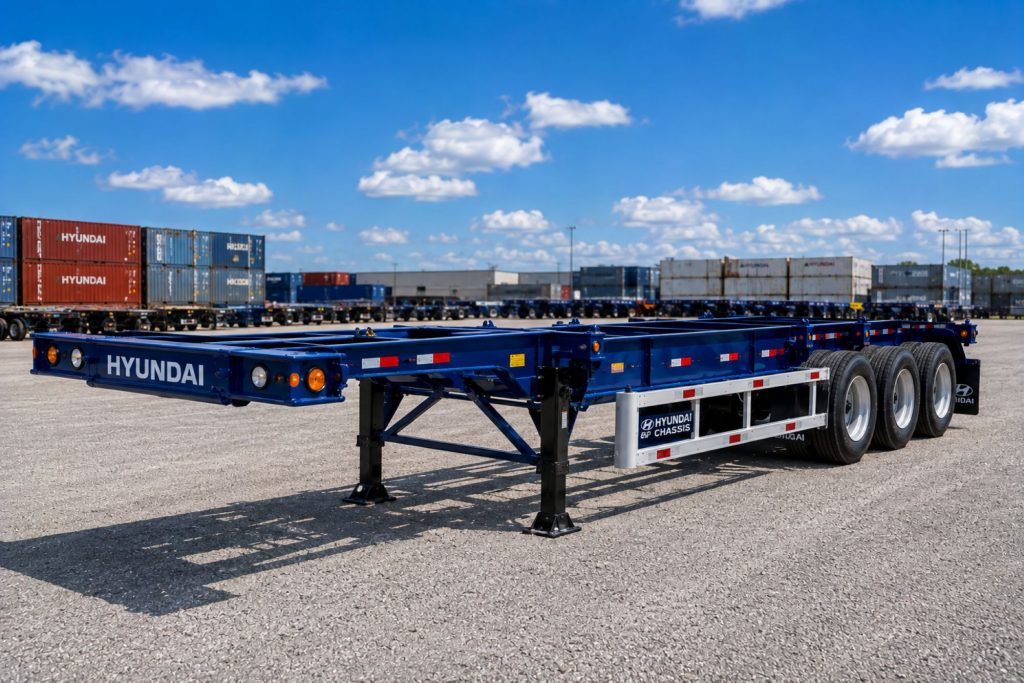
The Hyundai Chassis Trailer is an intermodal container chassis designed to transport standardized shipping containers between ports, rail terminals, warehouses, distribution centers, and customer facilities. Unlike an enclosed trailer, the chassis uses an open steel frame equipped with container locks that secure the container directly to the trailer.
Hyundai Translead chassis have been offered in fixed-length and extendable configurations for different container sizes. Depending on the model, a chassis may carry a single 20-foot container, a 40-foot container, a 45-foot container, or a 53-foot domestic intermodal container.
Combination and extendable chassis provide additional flexibility for fleets that handle containers of different lengths. These configurations can reduce the number of specialized chassis a fleet needs, although they introduce additional locking mechanisms and moving components that require regular inspection.
Key Characteristics
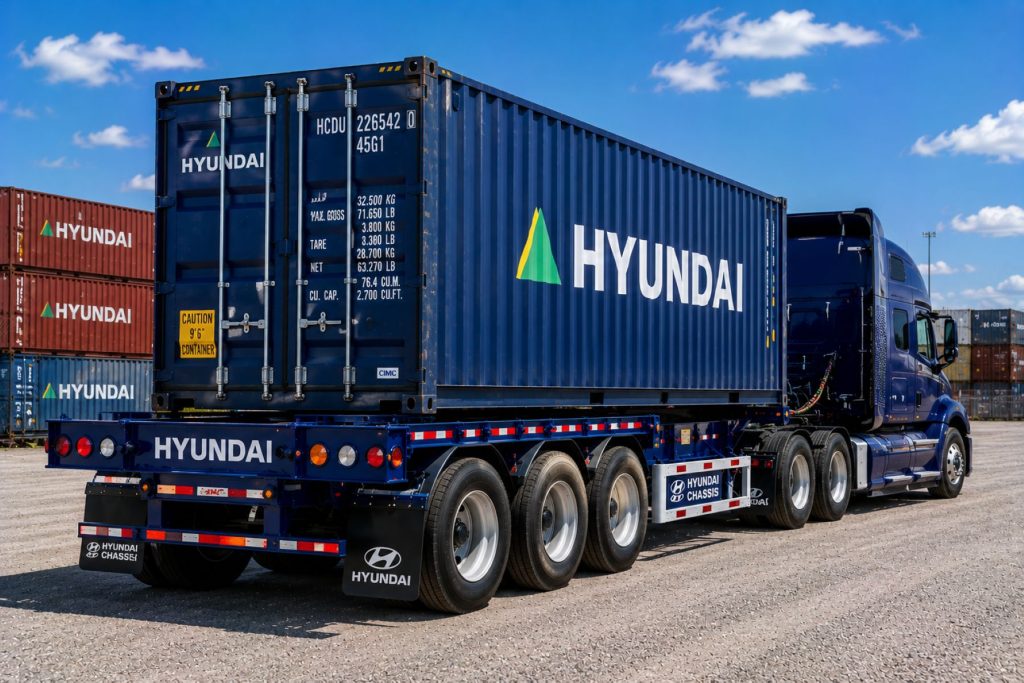
Hyundai chassis trailers are designed around the dimensional and securement requirements of intermodal containers. Their open-frame construction reduces unnecessary body weight while providing support at the container’s structural corner castings.
A major characteristic of the chassis is its twist-lock securement system. These locks engage the container’s corner castings and prevent the container from shifting or separating from the chassis during transportation.
Fixed chassis offer a comparatively simple design for fleets that primarily handle one container length. Extendable and combination chassis provide greater flexibility by allowing the frame or locking positions to be adjusted for multiple container sizes.
Additional characteristics may include tandem or tri-axle configurations, mechanical or air-ride suspension, rear underride protection, LED lighting, air-operated brakes, and corrosion-resistant finishes.
Common Specifications
Container Compatibility
Hyundai chassis configurations may be designed for 20-foot, 40-foot, 45-foot, or 53-foot containers. Exact compatibility depends on the model, frame length, axle placement, and locking arrangement.
Frame Construction
The chassis commonly uses fabricated high-strength steel main beams and crossmembers. The open-frame structure is engineered to support a loaded container at its designated structural points.
Axle Configurations
Tandem-axle configurations are common for standard intermodal operations. Tri-axle models may be used when additional load distribution or greater legal payload flexibility is required.
Suspension
Mechanical spring suspension is widely used because of its durability and straightforward maintenance. Air-ride suspension may be available on certain configurations for improved ride quality and cargo protection.
Brakes and ABS
Commercial air brakes and a trailer antilock braking system are normally installed. Brake specifications and ABS configurations vary by model year and fleet order.
Container Locks
Twist locks or locking pins secure the container at its corner castings. Extendable chassis include additional locking mechanisms that hold the frame in the selected operating position.
Landing Gear
Two-speed landing gear supports the front of the chassis when it is disconnected from the tractor. Operators should verify that the landing gear has adequate ground support before uncoupling a loaded chassis.
Tires and Wheels
Common specifications include commercial trailer tires on steel or aluminum wheels. Tire size, wheel material, inflation systems, and wide-base tire availability depend on the chassis configuration.
Electrical System
The electrical system supplies the required clearance lights, marker lights, brake lights, turn signals, and ABS warning functions. LED lighting is common on newer equipment.
Capacity
Gross vehicle weight and payload capacity depend on the chassis model, container position, axle arrangement, component ratings, and applicable weight laws. The certification label should be used to determine the ratings of an individual chassis.
Common Applications
- Port drayage
- Rail terminal operations
- International container transportation
- Domestic intermodal transportation
- Import and export freight
- Warehouse and distribution transfers
- Container repositioning
- Regional container delivery
- Industrial freight transportation
- Dedicated intermodal routes
Advantages
- Compatible with standardized intermodal containers
- Faster container transfer between ships, trains, and trucks
- Open-frame design reduces unnecessary trailer body weight
- Fixed and adjustable configurations are available
- Combination chassis can handle multiple container lengths
- Tandem and tri-axle configurations support different operating needs
- Durable steel construction
- Standardized container securement system
- Suitable for high-volume port and rail operations
- Can reduce cargo handling during transfers between transportation modes
Limitations or Considerations
- Designed primarily for containers rather than loose freight
- Container compatibility must be confirmed before loading
- Twist locks and extension mechanisms require frequent inspection
- Corrosion can develop in port and coastal environments
- Empty chassis can produce a firm or bouncing ride
- Improper container positioning can create axle-weight problems
- Extendable configurations contain more moving and locking components
- Availability may depend on local chassis pools and terminal arrangements
- Operators must comply with port, terminal, and intermodal inspection requirements
- A container chassis cannot replace a standard platform trailer for most non-containerized cargo
Driver and Operator Considerations
Drivers should verify the chassis configuration and container length before accepting a load. A container placed on an incompatible chassis can create securement, clearance, axle-weight, and handling problems.
Every twist lock should be visually inspected after the container is mounted. Drivers should confirm that each required lock is fully engaged and that no locking handle, pin, or retainer is damaged or missing.
On extendable chassis, the frame must be completely positioned and locked before the container is loaded. Operators should never rely on the container itself to hold an improperly secured extension mechanism in place.
Container weight distribution also affects vehicle handling. Heavy containers can place substantial weight on the tractor drive axles or chassis axles, particularly when the container or sliding components are positioned incorrectly.
A complete pre-trip inspection should cover the tires, wheels, brakes, suspension, frame, lights, container locks, landing gear, mudflaps, underride guard, and extension mechanisms.
Maintenance and Ownership Notes
Container chassis frequently operate in demanding environments that include ports, rail yards, uneven pavement, tight turns, salt air, road chemicals, and repeated coupling cycles. Preventive maintenance is therefore essential.
Twist locks should be cleaned, lubricated, and inspected for bending, cracking, corrosion, or incomplete engagement. Damaged locks should be repaired before the chassis returns to service.
Extendable frame rails and locking pins require additional attention. Dirt, corrosion, or damaged components can prevent the chassis from extending properly or locking securely.
Brake chambers, air lines, slack adjusters, drums or rotors, ABS components, and electrical connections should be inspected according to the fleet’s maintenance program. Tire pressure and irregular tire wear can reveal axle alignment, suspension, or loading problems.
The steel frame should be inspected for cracks, impact damage, loose crossmembers, corrosion, and previous repairs. Coastal and winter operations may justify more frequent washing and corrosion protection.
Buying Considerations
- Confirm which container lengths the chassis can legally and safely carry.
- Review the gross vehicle weight rating and individual axle ratings.
- Determine whether a fixed, extendable, or combination chassis best fits the operation.
- Inspect the frame for cracks, corrosion, distortion, and questionable repairs.
- Operate every twist lock and locking pin.
- Test the extendable frame in every intended operating position.
- Inspect the suspension, brakes, tires, wheels, and electrical system.
- Check the condition and rating of the landing gear.
- Verify that the vehicle identification number and certification label are readable.
- Review maintenance records when purchasing used equipment.
- Confirm parts availability for the model and year.
- Consider the operating environment and required corrosion protection.
- Verify compatibility with terminal, port, and chassis-pool requirements.
Common Brands or Manufacturers
- Hyundai Translead
- CIMC Intermodal Equipment
- CIE Manufacturing
- Cheetah Chassis
- Dorsey Intermodal
- Pratt Industries
- Stoughton Trailers
- Chassis King
- Strick Trailers
- K-Line Trailers
Variants and Related Configurations
- 20-Foot Fixed Container Chassis
- 40-Foot Gooseneck Container Chassis
- 45-Foot Extendable Container Chassis
- 53-Foot Domestic Container Chassis
- 20/40 Tandem-Axle Combination Chassis
- 20/40 Tri-Axle Combination Chassis
- 40/45 Extendable Container Chassis
- Sliding-Bogie Chassis
- Tridem Container Chassis
- Lightweight Container Chassis
- Heavy-Duty Container Chassis
- Generator-Set Chassis for Refrigerated Containers
Comparison to Similar Trailers
Compared with a Flatbed Trailer, the Hyundai chassis has a much more specialized purpose. A flatbed can carry machinery, building materials, steel, lumber, and many other commodities, while a chassis is engineered primarily to support an intermodal container at its corner castings.
Compared with a fixed-length container chassis, a Hyundai extendable or combination chassis can handle more than one container size. That flexibility can improve equipment utilization, but it also increases mechanical complexity and maintenance requirements.
A 20/40 combination chassis can serve operations that regularly handle both 20-foot and 40-foot containers. A dedicated 40-foot or 53-foot chassis may be a simpler choice when nearly every container in the operation is the same length.
Tri-axle chassis can provide better load distribution for heavy containers, but they generally cost more, weigh more, and require additional tires, brakes, suspension components, and maintenance.
Best Fit For
- Port drayage carriers
- Intermodal trucking companies
- Rail terminal operators
- Import and export operations
- Container leasing companies
- Distribution centers receiving containerized freight
- Fleets handling multiple container lengths
- Regional container transportation
- Dedicated port-to-warehouse routes
- Operations moving international or domestic intermodal containers
Related Equipment
- Brake Systems
- Suspension Systems
- Axles and Differentials
- Tires and Wheels
- Electrical Systems
- Safety Systems
- Telematics and ELD Systems
- Container Twist Locks
- Chassis Extension and Locking Systems
- Trailer Landing Gear
- Trailer ABS Systems
- Container Generator Sets
Related Freight Types
- Specialized and Niche Freight
- Intermodal and Container Freight
- Import and Export Freight
- Retail Freight
- Consumer Goods Freight
- Manufacturing Freight
- Automotive Freight
- Refrigerated Container Freight
- Industrial Freight
- Warehouse and Distribution Freight
Related Trailer Types
- Chassis Trailers
- Container Chassis
- Extendable Container Chassis
- 20-Foot Container Chassis
- 40-Foot Container Chassis
- 53-Foot Container Chassis
- Flatbed Trailers
- Specialty Trailers
Related Trailer Models
- CIMC Chassis Trailer
- CIE Pioneer 20/40 City Combo
- CIE Pioneer 20/40 Combo Tridem
- Cheetah 20/40 Combo Chassis
- Dorsey Intermodal Chassis
- Pratt Container Chassis
- Stoughton Container Chassis
- Chassis King 40-Foot Gooseneck Chassis
- Hyundai 20/40 Tandem Combination Chassis
- Hyundai 20/40 Tri-Axle Combination Chassis
- Hyundai 40/45 Extendable Chassis
Related Guides
- Complete Guide to Trailer Types
- Choosing the Right Trailer for Your Freight
- Complete Guide to Freight Types
Regulatory and Compliance Notes
A Hyundai chassis must comply with applicable federal and state commercial vehicle regulations. Requirements include functioning brakes, trailer ABS, required lamps and reflectors, compliant tires and wheels, rear-impact protection where applicable, and properly secured intermodal containers.
The chassis certification label provides the gross vehicle weight rating and gross axle weight ratings for that specific unit. Operators must remain within those ratings as well as federal bridge-formula limits and state axle-weight requirements.
Intermodal containers must be secured with the appropriate twist locks or locking devices before entering a public roadway. Drivers should verify securement personally rather than assuming the terminal loading equipment completed the process correctly.
International containers and chassis may also be subject to port, rail-terminal, customs, safety-inspection, and interchange requirements. Operators should follow the procedures established by the equipment owner and the Intermodal Association of North America when applicable.
Real World Operating Notes
In real-world drayage service, chassis condition can vary considerably. Drivers may receive equipment from a shared chassis pool rather than operating the same trailer every day, making a careful pre-trip inspection especially important.
Tire damage, defective lights, air leaks, worn brakes, damaged mudflaps, twist-lock problems, and landing-gear issues are common reasons a chassis may need repair before leaving a terminal.
Extendable Hyundai chassis can improve fleet flexibility when container sizes change throughout the day. However, drivers and maintenance teams must understand the correct extension procedure and confirm that every locking pin is fully seated.
Tight port and rail yards place additional stress on tires, wheels, suspension components, and frame connections. Slow maneuvering, proper tire inflation, and avoiding curb strikes can reduce preventable damage.
Frequently Asked Questions
What is a Hyundai Chassis Trailer used for?
It is used to transport standardized intermodal containers between ports, rail terminals, warehouses, distribution centers, and customer facilities.
Can one Hyundai chassis carry different container sizes?
Some Hyundai fixed chassis are designed for one container length, while combination and extendable models can accommodate multiple sizes. Compatibility must be confirmed for the individual chassis.
How is the container secured to the chassis?
The container is secured through twist locks or locking pins that engage the container’s corner castings.
What is the difference between a tandem and tri-axle chassis?
A tandem chassis has two axles, while a tri-axle chassis has three. The additional axle can improve weight distribution but adds weight, cost, tire wear, and maintenance requirements.
Can a Hyundai chassis transport ordinary flatbed cargo?
It is primarily designed for intermodal containers. It generally lacks the continuous deck and cargo-securement systems needed to replace a conventional flatbed trailer.
Are Hyundai chassis available with air-ride suspension?
Suspension options vary by model and fleet specification. Some chassis use mechanical spring suspension, while other configurations may be equipped with air ride.
What should be inspected before using an extendable chassis?
The driver should inspect the extension rails, locking pins, release mechanisms, container locks, air and electrical connections, frame, tires, brakes, suspension, lights, and landing gear.
Why is container positioning important?
Incorrect positioning can affect twist-lock engagement, axle weights, tractor drive-axle loading, vehicle stability, and legal compliance.
Availability and Where to Find
Hyundai chassis trailers may be available through Hyundai Translead dealers, intermodal equipment dealers, trailer leasing companies, fleet-equipment sales, auctions, and used commercial trailer marketplaces.
New-model availability and current chassis configurations should be confirmed directly with Hyundai Translead or an authorized dealer. Used availability varies by chassis length, axle configuration, operating history, region, and previous service in port or rail operations.
Support Trucking Families
Truck Equipment Atlas supports the mission of Grey Cross, a nonprofit dedicated to helping families of truck drivers who lose their lives while on the road. As the site grows, part of its mission is to bring awareness and support to these families.
Podcast or Video Section
Learn More Through Audio and Video
Truck Equipment Atlas will continue expanding with podcast episodes, interviews, and equipment breakdowns to help drivers and fleets better understand trucks and equipment.
Follow the Growth of Truck Equipment Atlas
Truck Equipment Atlas continues to expand with new truck profiles, trailer coverage, diesel engine pages, equipment system resources, manufacturer information, and educational guides.
Visit our Site Updates page to explore recent additions, project milestones, and upcoming resources as we continue building one of the industry’s growing commercial trucking equipment reference libraries.
View the Latest Site Updates: Truck Equipment Atlas Site Updates