
Merritt Hopper
Quick Facts
- Manufacturer: Merritt Trailers
- Model Family: Heritage Commodity Trailer
- Trailer Type: Hopper-Bottom Grain / Commodity Trailer
- Common Construction: Aluminum Body with Steel Structural Components
- Common Length: 42 ft
- Common Width: 96 inches
- Common Sidewall Height: Approximately 68 inches
- Number of Hoppers: Two
- Common Axle Configuration: Fixed Tandem Axle
- Suspension Options: Single-Leaf Spring or Hendrickson Air Ride
- Hopper Operation: Manual, Direct-Drive, or Electric Operation depending on configuration
- Tarp Options: Manual or Electric Roll Tarp
- Primary Applications: Grain, Corn, Wheat, Soybeans, Rice, Feed Ingredients, and Other Free-Flowing Agricultural Commodities
- Production Status: New and Used Availability Varies
Overview
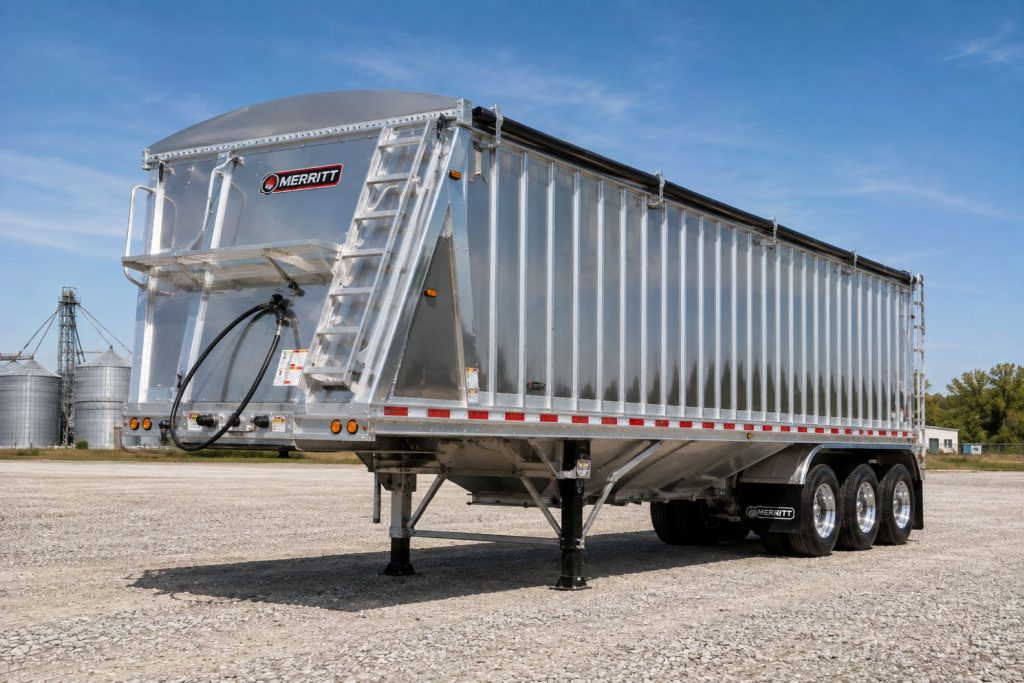
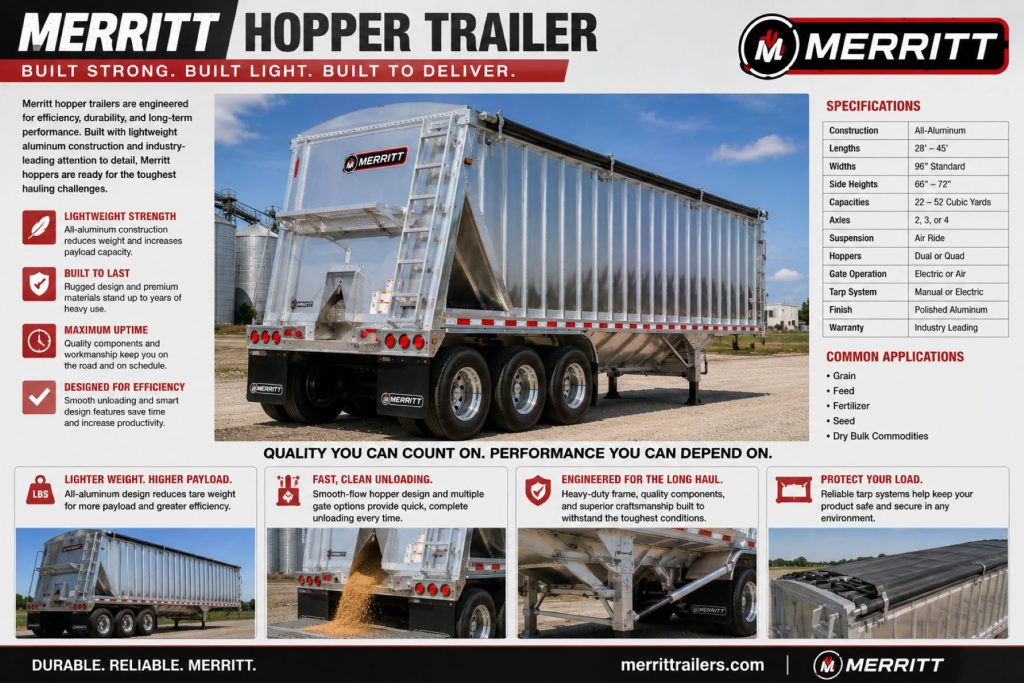
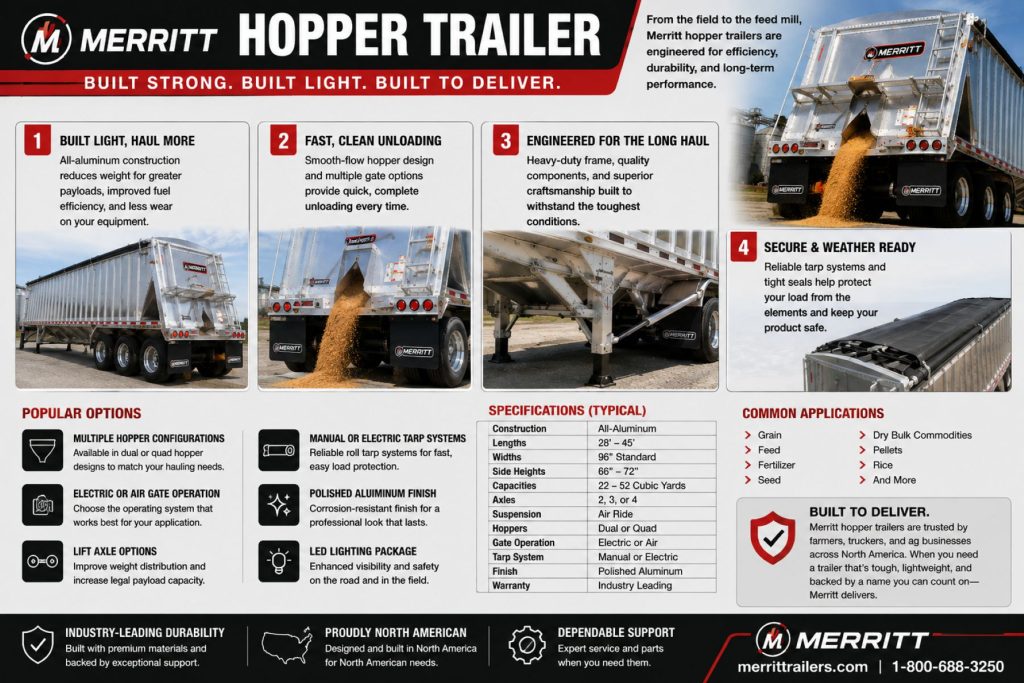
The Merritt Hopper is an aluminum hopper-bottom trailer designed primarily for transporting grain and other free-flowing agricultural commodities. Merritt has manufactured grain and livestock trailers for decades, and its hopper trailers are commonly found in farm, grain-elevator, feed-mill, and commercial agricultural hauling operations.
The Merritt Heritage commodity trailer is a representative modern configuration. It combines approximately 68-inch sidewalls with two bottom-discharge hoppers, a roll-over tarp, tandem axles, and either spring or air-ride suspension.
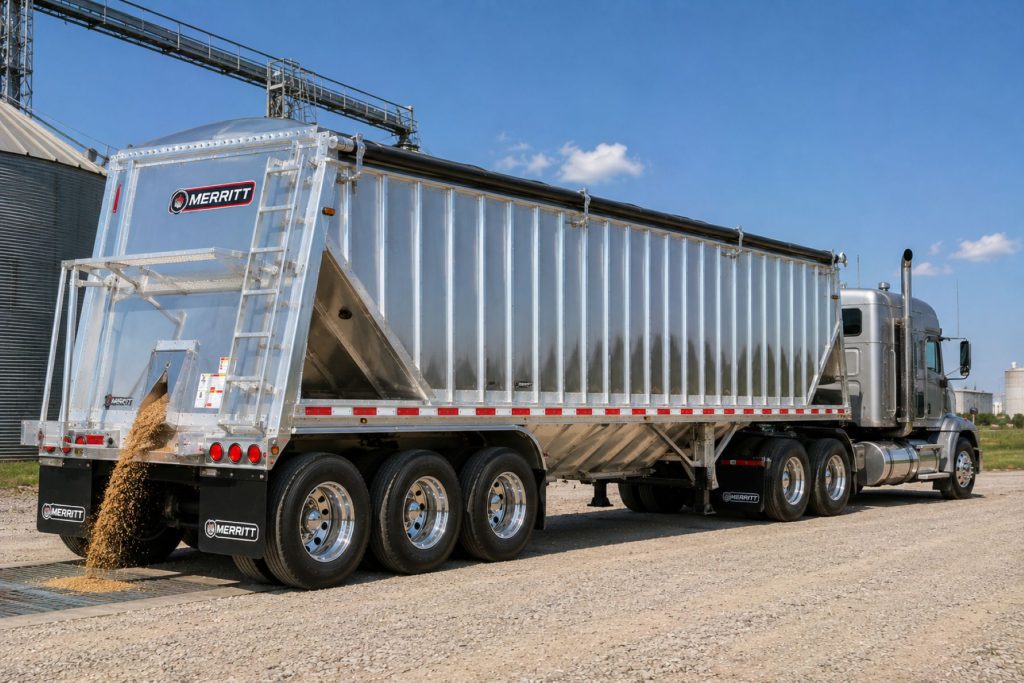
Material is loaded through the open top of the trailer and protected by a rolling tarp during transportation. At the destination, the operator opens the hopper doors and allows the commodity to unload by gravity into a pit, auger, conveyor, or receiving system.
The aluminum body reduces empty weight while providing corrosion resistance for agricultural service. Steel components are used in selected high-stress structural areas.
Key Characteristics
The Merritt Hopper uses two separate hoppers located beneath the main commodity body. Sloped interior surfaces direct material toward the hopper openings during unloading.
The double-hopper arrangement allows the operator to control the front and rear portions of the load independently. This can help maintain trailer balance and control the flow of material into receiving equipment.
A rolling tarp protects the cargo from rain, snow, debris, and product loss. Depending on the trailer, the tarp and hopper doors may be operated manually or with electric systems and wireless controls.
The Heritage design commonly provides approximately 23 inches of hopper clearance. This supports unloading over many agricultural pits, swing-away augers, and portable conveyor systems.
Merritt uses a corrosion-resistant barrier between aluminum and steel components to reduce the possibility of galvanic corrosion.
Common Specifications
Construction
Merritt hopper trailers commonly use aluminum sidewalls, hopper components, and other body panels.
Steel structural components may be used around the kingpin, suspension, frame, and other high-stress locations.
A corrosion-resistant barrier separates aluminum from direct contact with steel in selected areas.
Length
A 42-foot overall length is common.
Other lengths may exist among older trailers or special configurations.
Width
A 96-inch width is commonly found on Merritt grain trailers.
Buyers should verify the actual body and overall width because dimensions can vary by year and model.
Sidewall Height
Approximately 68-inch sidewalls are common.
The sidewall height, trailer length, hopper shape, and front and rear slopes determine the available cubic capacity.
Hopper Configuration
Most Merritt grain trailers use two bottom-discharge hoppers.
Each hopper serves a portion of the trailer body and can be opened independently.
Hopper Construction
Heritage hoppers may use approximately 0.125-inch-thick aluminum material with vertical stiffeners.
The stiffeners help the hopper walls withstand product pressure and repeated loading cycles.
Hopper Doors
A representative full-size hopper opening measures approximately 27½ by 31¼ inches.
Available operating systems may include:
- Manual crank operation
- Direct-drive manual operation
- Electric hopper-door operation
- Wireless remote operation
Hopper Clearance
Approximately 23 inches of ground clearance beneath the hopper is available on certain Heritage configurations.
Actual clearance depends on suspension setting, tires, wheels, trailer loading, and ordered equipment.
Tarp System
An aluminum roll-over tarp system is commonly installed.
Available tarp operation includes:
- Manual roll tarp
- Electric roll tarp
- Wireless remote-controlled tarp
Suspension
Single-leaf spring suspension is available on traditional agricultural configurations.
Hendrickson air-ride suspension is available for operators seeking improved ride quality and cargo protection.
Axles
Two 22,500-pound, five-inch round axles are used on certain configurations.
The actual axle ratings and legal carrying capacity should be confirmed using the trailer certification plate.
Brakes and ABS
Commercial air brakes with automatic slack adjusters are commonly installed.
A Meritor WABCO 4S/2M antilock braking system is available on representative Heritage configurations.
Wheels and Tires
Steel, aluminum, or combination wheel arrangements may be available.
Common tire sizes on used trailers include:
- 11R22.5
- 11R24.5
- Low-profile commercial trailer tires
Lighting and Wiring
LED marker and identification lights are commonly installed.
A sealed wiring harness with internal grounding helps protect the electrical system from moisture, dust, fertilizer residue, and road contaminants.
Final specifications vary by year and original order. Buyers should confirm all dimensions, capacities, ratings, and equipment using the trailer’s VIN plate and build documentation.
Common Applications
- Corn transportation
- Wheat transportation
- Soybean transportation
- Rice transportation
- Oat transportation
- Barley transportation
- Sorghum transportation
- Sunflower seed transportation
- Dry feed ingredient transportation
- Soybean meal transportation
- Distillers grain transportation
- Fertilizer transportation when approved
- Seed transportation
- Farm-to-elevator hauling
- Elevator-to-processing-plant hauling
- Commercial agricultural freight
Advantages
- Lightweight aluminum construction
- Two-hopper design supports controlled unloading
- Gravity discharge does not require a trailer-mounted unloading conveyor
- Approximately 68-inch sidewalls provide useful commodity volume
- Available spring or air-ride suspension
- Manual and electric hopper controls are available
- Manual and electric tarp systems are available
- Approximately 23 inches of hopper clearance on representative models
- Large hopper doors support efficient unloading
- Roll tarp protects commodities from weather
- Corrosion barrier separates aluminum and steel components
- Simple agricultural design can provide a long service life
- Strong availability in the used agricultural trailer market
- Suitable for farm and commercial grain-hauling operations
Limitations or Considerations
- Designed primarily for dry, free-flowing commodities
- Moist or sticky products may not clean out completely
- Payload is limited by commodity density and legal axle weights
- High-volume crops can fill the trailer before reaching the legal weight limit
- Dense commodities can reach the legal weight limit before filling the trailer
- Manual trap doors can become difficult to operate under load
- Dust exposure can affect mechanical and electrical components
- Aluminum floors and hopper sheets can be damaged by corrosive products
- Certain fertilizers require a complete material-compatibility review
- The trailer requires compatible pits, augers, or conveyors for efficient unloading
- Roll tarps require maintenance and can be damaged by wind
- Older trailers may have corrosion around steel and aluminum connection points
Driver and Operator Considerations
Drivers must understand how commodity density affects payload. Corn, wheat, soybeans, feed ingredients, fertilizer, and other materials do not have the same weight per cubic foot.
The driver should confirm the expected commodity weight before loading and monitor axle weights throughout the loading process.
The trailer should remain positioned on level, stable ground during unloading. Hopper doors should be opened gradually so the receiving pit, auger, or conveyor is not overloaded.
The front and rear hoppers should be unloaded in an order that maintains trailer stability. Removing all the material from one end while leaving the other end fully loaded can change kingpin and axle weights significantly.
Before moving the trailer, the driver must confirm that both hopper doors are fully closed and secured and that the tarp is correctly positioned.
Maintenance and Ownership Notes
Hopper doors, rollers, bearings, gears, shafts, chains, crank handles, electric motors, and remote controls should be inspected regularly.
Grain dust and fertilizer residue should be removed from moving components. Accumulated material can cause corrosion, binding, premature wear, and inaccurate door operation.
The hopper sheets and interior slopes should be checked for cracks, dents, abrasion, loose fasteners, and areas where material can collect.
The tarp fabric, bows, end caps, cables, motor, and stops should be inspected for wear and correct alignment.
Areas where aluminum and steel components meet should be checked for corrosion and failure of the protective barrier.
Suspension components, brakes, ABS equipment, tires, wheels, wheel ends, lights, and the trailer’s electrical system require routine preventive maintenance.
Buying Considerations
- Confirm the overall trailer length and width
- Verify the sidewall height
- Determine the trailer’s cubic capacity
- Confirm the number and size of hopper openings
- Operate both hopper doors under no-load conditions
- Inspect door rollers, gears, shafts, and crank mechanisms
- Test electric traps and remote controls when equipped
- Inspect the hopper sheets for cracks and abrasion
- Examine the interior slopes for product buildup
- Check the tarp fabric and operating system
- Inspect the aluminum sidewalls for cracks and buckling
- Examine the kingpin and fifth-wheel plate area
- Check steel and aluminum connection points for corrosion
- Verify the suspension and axle ratings
- Inspect the brakes, ABS components, tires, and wheel ends
- Review previous cargo and cleaning practices
- Check for damage caused by fertilizer or corrosive material
- Verify the empty weight and legal payload
- Review maintenance and repair records
- Confirm all specifications using the VIN and certification plate
Common Brands or Manufacturers
- Merritt Trailers
- Timpte
- Wilson Trailer
- JET Company
- Cornhusker 800
- Timmins
- Stoughton
- Lode King
- Prestige Trailers
- Neville Built
Variants and Related Configurations
- Merritt Heritage commodity trailer
- Merritt Payload hopper trailer
- 42-foot double-hopper trailer
- 96-inch-wide grain trailer
- 68-inch-side hopper trailer
- Spring-suspension hopper trailer
- Air-ride hopper trailer
- Manual-trap hopper trailer
- Electric-trap hopper trailer
- Manual-tarp hopper trailer
- Electric-tarp hopper trailer
- Remote-controlled hopper trailer
- Agricultural-clearance hopper trailer
- Standard-clearance hopper trailer
- Grain and feed commodity trailer
Comparison to Similar Trailers
Compared with a steel hopper trailer, the Merritt aluminum hopper generally provides lower empty weight and better corrosion resistance. Steel trailers may offer a lower initial purchase price and different structural characteristics.
Compared with an end-dump trailer, the Merritt Hopper unloads through bottom doors without raising the trailer body. This reduces overhead-clearance concerns and can provide greater stability during unloading.
Compared with a belt trailer, the Merritt Hopper has a simpler gravity-unloading design. Belt trailers can handle a broader range of commodities, including certain products that do not flow easily through hopper doors.
Compared with a walking-floor trailer, the Merritt Hopper is more specialized for grain and free-flowing bulk commodities. Walking-floor trailers can unload bulk products without requiring hopper pits.
Comparable grain trailers include the Timpte Super Hopper, Wilson Pacesetter Hopper, and JET Hopper Trailer.
Best Fit For
- Farmers transporting harvested grain
- Commercial grain haulers
- Agricultural cooperatives
- Grain elevators
- Feed mills
- Seed companies
- Commodity brokers with transportation fleets
- Regional agricultural carriers
- Seasonal harvest operations
- Farm-to-market transportation
- Operators using swing-away augers
- Fleets requiring lightweight aluminum hopper trailers
Related Equipment
- Brake Systems
- Suspension Systems
- Axles and Differentials
- Tires and Wheels
- Electrical Systems
- Safety Systems
- Telematics and ELD Systems
- Roll Tarp Systems
- Electric Hopper-Door Systems
- Grain Augers
- Commodity Conveyors
Related Freight Types
- Agricultural Freight
- Grain Freight
- Corn Freight
- Wheat Freight
- Soybean Freight
- Feed Ingredient Freight
- Seed Freight
- Dry Bulk Agricultural Freight
- Fertilizer Freight
- Farm-to-Market Freight
- Specialty and Niche Freight
Related Trailer Types
- Hopper Trailers
- Grain Trailers
- Commodity Trailers
- Belt Trailers
- Walking-Floor Trailers
- End-Dump Trailers
- Side-Dump Trailers
- Dry Bulk Tank Trailers
- Specialty Trailers
Related Trailer Models
- Timpte Super Hopper
- Wilson Pacesetter Hopper
- JET Hopper Trailer
- Cornhusker 800 Hopper Trailer
- Lode King Grain Trailer
- Prestige Hopper Trailer
Related Guides
- Complete Guide to Trailer Types
- Complete Guide to Freight Types
- Choosing the Right Trailer for Your Freight
Regulatory and Compliance Notes
The Merritt Hopper must comply with federal, state, provincial, and local regulations governing trailer dimensions, axle weights, brakes, ABS equipment, lighting, tires, and commercial vehicle inspections.
Commodity volume does not determine legal payload. Operators must account for the actual weight and density of the loaded material.
Federal bridge-formula requirements and state axle-weight regulations affect how much cargo can be carried. Weight should be distributed properly between the tractor drives and trailer axles.
Agricultural exemptions may apply in certain jurisdictions and operating situations, but they should not be assumed. Requirements vary according to vehicle ownership, cargo, distance traveled, and route.
Food and feed commodities may be subject to cleanliness, contamination-control, and recordkeeping requirements.
Trailers used to transport fertilizer or treated products should be cleaned thoroughly before carrying grain intended for food or animal feed.
Real World Operating Notes
The Merritt Hopper is commonly used during harvest when fast loading, highway transport, and efficient unloading are essential.
The trailer can be loaded directly from a grain cart, combine-support operation, elevator, silo, or overhead commodity bin.
Correct positioning over the receiving pit or auger is important. Drivers should verify that the hopper opening is centered before releasing material.
Electric tarps and trap doors can reduce physical effort and improve unloading speed. Manual overrides should remain functional in case of electrical failure.
Grain dust can accumulate around door mechanisms, lights, wiring, brakes, and suspension components. Regular cleaning helps prevent mechanical problems and fire hazards.
Frequently Asked Questions
What is a Merritt Hopper used for?
It is primarily used to transport grain and other free-flowing agricultural commodities such as corn, wheat, soybeans, seed, and feed ingredients.
How long is a Merritt Hopper trailer?
A 42-foot overall length is common, although dimensions vary by year and configuration.
How many hoppers does it have?
Most Merritt grain trailers use two bottom-discharge hoppers.
Is the trailer made from aluminum?
Many Merritt hopper trailers use aluminum body construction with steel components in selected structural areas.
How does the trailer unload?
The operator opens the bottom hopper doors, allowing the commodity to flow by gravity into a pit, auger, conveyor, or receiving system.
Are electric hopper doors available?
Yes. Depending on the trailer, hopper doors may be operated manually or through an electric system with remote controls.
Does the trailer include a tarp?
A roll-over tarp is commonly installed. Manual and electric tarp systems are available.
Can a Merritt Hopper carry fertilizer?
Certain dry fertilizers may be transported when the trailer materials and equipment are compatible. The trailer should be cleaned thoroughly to prevent corrosion and cargo contamination.
What is the difference between spring and air-ride suspension?
Spring suspension provides a simple agricultural configuration, while air ride can improve ride quality and allow more control over suspension height.
What should buyers inspect on a used Merritt Hopper?
Buyers should inspect the hopper sheets, trap doors, tarp, sidewalls, kingpin area, aluminum-to-steel connections, suspension, axles, brakes, tires, and electrical equipment.
Availability and Where to Find
Merritt Hopper trailers can be found through agricultural equipment dealers, commercial trailer dealerships, farm-equipment auctions, fleet sales, and online truck-and-trailer marketplaces.
New availability and current specifications should be confirmed directly through Merritt Trailers or an authorized dealer.
Used models are widely available in agricultural regions. Common used configurations include 42-foot, 96-inch-wide, double-hopper trailers with 68-inch sidewalls.
Before purchasing, buyers should verify the trailer’s structural condition, hopper-door operation, tarp condition, suspension, brakes, previous cargo, corrosion history, empty weight, and legal carrying capacity.
Support Trucking Families
Truck Equipment Atlas supports the mission of Grey Cross, a nonprofit dedicated to helping families of truck drivers who lose their lives while on the road. As the site grows, part of its mission is to bring awareness and support to these families.
Podcast or Video Section
Learn More Through Audio and Video
Truck Equipment Atlas will continue expanding with podcast episodes, interviews, and equipment breakdowns to help drivers and fleets better understand trucks and equipment.
Follow the Growth of Truck Equipment Atlas
Truck Equipment Atlas continues to expand with new truck profiles, trailer coverage, diesel engine pages, equipment system resources, manufacturer information, and educational guides.
Visit our Site Updates page to explore recent additions, project milestones, and upcoming resources as we continue building one of the industry’s growing commercial trucking equipment reference libraries.
View the Latest Site Updates: Truck Equipment Atlas Site Updates