
Rogers Brothers Detachable Lowboy
Quick Facts
- Manufacturer: Rogers Brothers Corporation
- Trailer Type: Detachable Gooseneck Lowboy / Lowbed Trailer
- Primary Model Series: Ultima Series
- Additional Model Series: CobraNeck Series, Modular Series, and Custom Trailers
- Common Production Capacities: 35 to 55 tons
- Available Custom Capacities: 35 to More Than 100 Tons
- Common Deck Lengths: Approximately 22 to 28 ft, depending on model
- Common Loaded Deck Height: Approximately 15 to 23 inches, depending on deck configuration
- Common Deck Width: 8 ft 6 in, with wider specialized configurations available
- Common Axle Configurations: Tandem Axle, Tri-Axle, Removable Axle, Booster, Jeep, and Multi-Axle Configurations
- Common Suspension: Air-Ride Suspension
- Primary Applications: Excavators, Bulldozers, Pavers, Rollers, Loaders, Cranes, Agricultural Equipment, and Heavy Industrial Machinery
- Production Status: Active Production
Overview
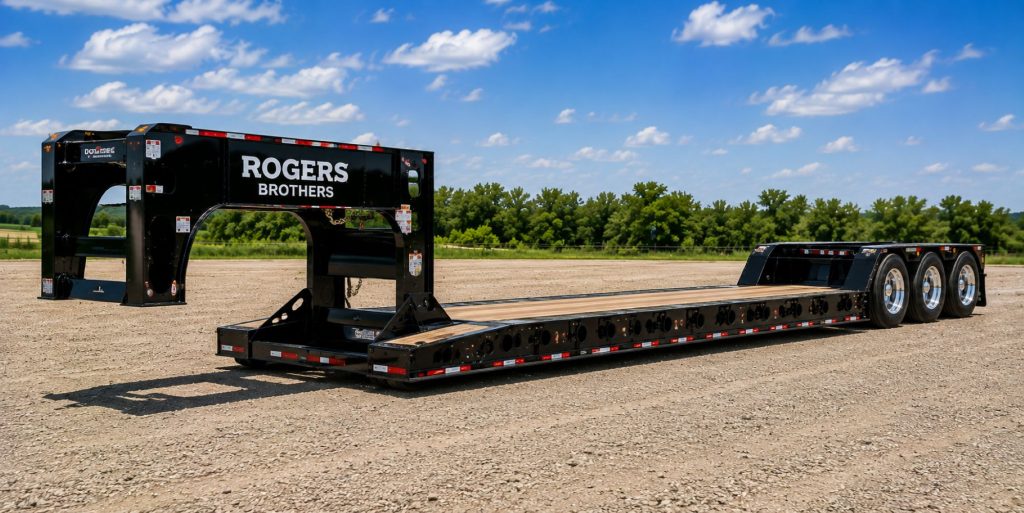
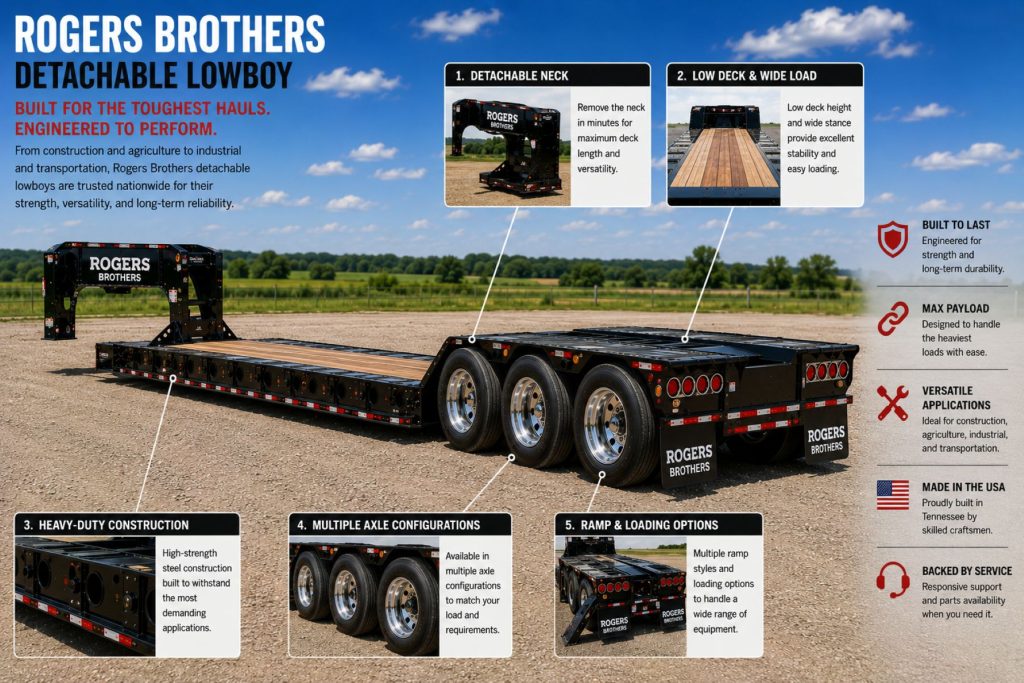
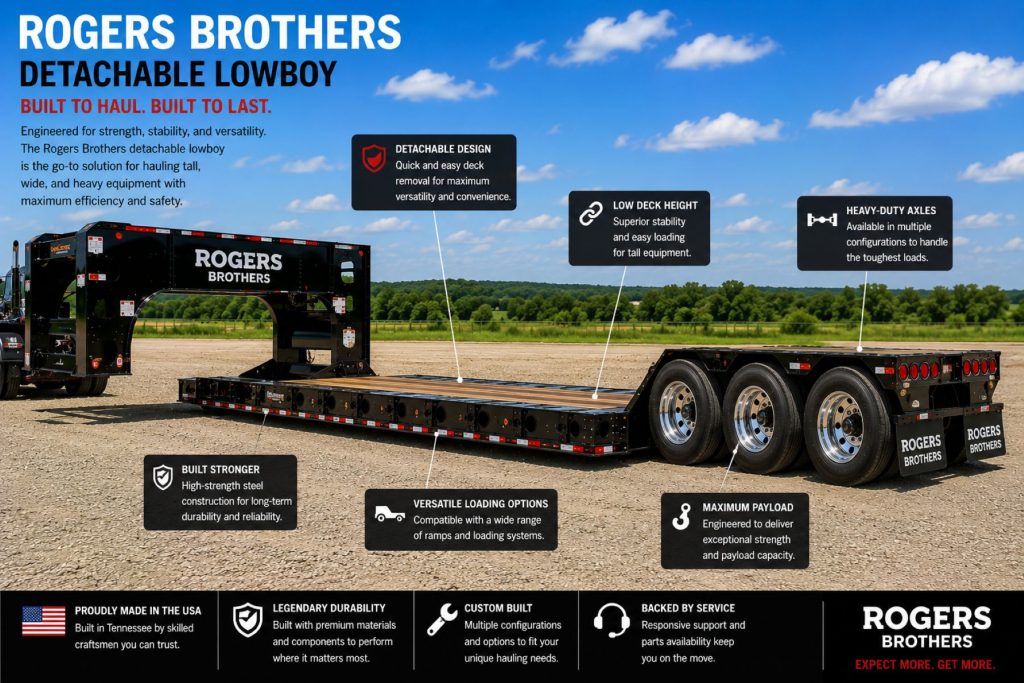
The Rogers Brothers Detachable Lowboy is a heavy-equipment trailer designed for transporting construction machinery, agricultural equipment, industrial components, and oversized loads. Its detachable gooseneck allows the front of the trailer deck to be lowered to the ground, creating a gradual loading path for tracked and wheeled equipment.
Rogers Brothers offers detachable lowboy trailers through several product families. The Ultima Series includes commonly configured production models, while the CobraNeck and Modular Series provide additional flexibility for specialized operations. Custom trailers can be engineered for loads exceeding 100 tons.
Many Rogers lowboys use the company’s No Foot non-ground-bearing detachable gooseneck. This system raises and lowers the trailer without placing a hydraulic foot directly against the ground, making it useful on soft, uneven, paved, or obstruction-filled loading areas.
The low deck position, detachable front connection, and available heavy-capacity configurations make the Rogers Brothers trailer an important option within the lowboy and RGN trailer category.
Key Characteristics
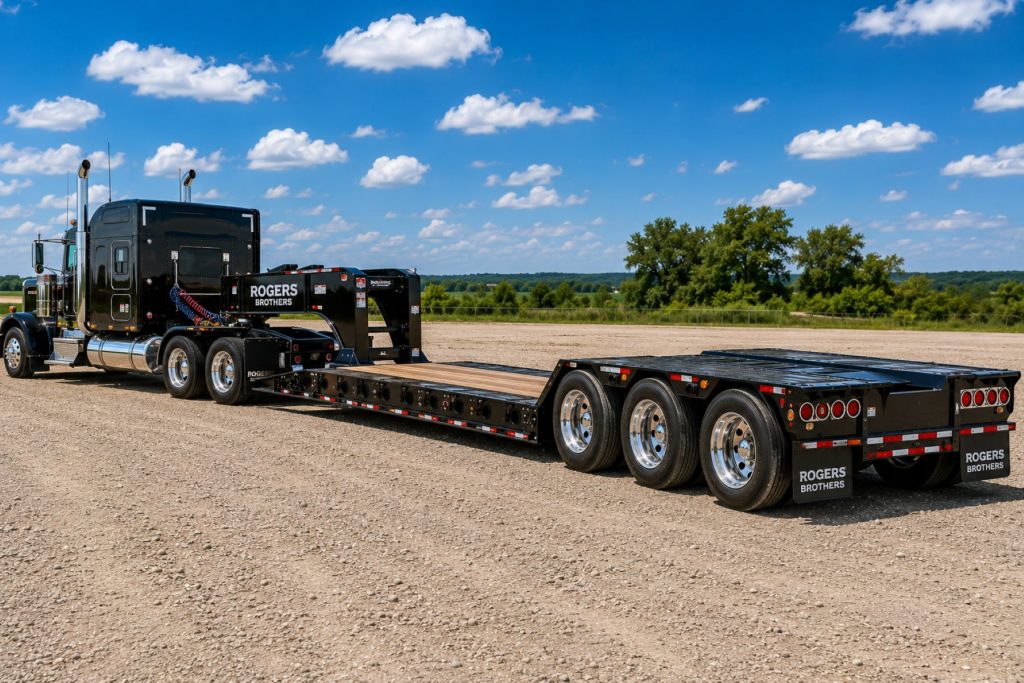
The primary characteristic of the Rogers Brothers Detachable Lowboy is its hydraulically detachable front gooseneck. After the neck is disconnected, the front of the main deck rests near ground level so equipment can be driven onto the trailer.
Rogers uses high-strength steel to provide the structural capacity required for concentrated machinery loads while controlling the trailer’s empty weight.
The company’s Croucher front deck design uses tapered beams and concealed connection hooks to create a low approach angle. This reduces the likelihood of tracked equipment, pavers, rollers, and other low-clearance machinery becoming caught during loading.
Available deck styles include platform decks, Gentle Riser configurations, drop-side decks, beam decks, and specialized modular decks.
Rogers trailers can also be configured with removable axles, boosters, jeeps, stingers, wheel wells, bucket pockets, boom troughs, and other equipment for managing extremely heavy or oversized loads.
Common Specifications
Construction
Rogers detachable lowboys use high-strength fabricated steel construction. Ultima models commonly use steel with a minimum yield strength of approximately 100,000 psi.
Specialized trailers may use 100,000-psi or 130,000-psi minimum-yield steel, depending on capacity and design requirements.
Capacity Range
Common production models are available in capacities ranging from approximately 35 to 55 tons.
Selected production and specialized models are available at 60 tons.
Custom Ultima and CobraNeck trailers can be configured from approximately 50 to more than 100 tons.
Specialized custom Rogers trailers may reach capacities of approximately 150 tons.
Actual capacity depends on the model, deck style, axle configuration, load concentration, and operating conditions.
Deck Length
Common production deck lengths range from approximately 22 to 28 ft.
Examples include 24-foot decks on several 35-, 40-, and 50-ton models and longer decks on certain specialized configurations.
Deck Width
A deck width of 8 ft 6 in is common on production models.
Nine-foot-wide and other specialized deck widths may be available for specific machinery and oversized-load applications.
Loaded Deck Height
Many platform and Gentle Riser models have a loaded deck height of approximately 20 inches.
Certain drop-side models can provide a loaded deck height near 15 inches.
Other specialized configurations may have deck heights around 21 to 23 inches.
Detachable Gooseneck
Many Ultima models use Rogers’ No Foot direct-push or tower-style detachable gooseneck. The system is designed to lift the rated trailer load without placing a supporting ram foot on the ground.
A hydraulic gooseneck jack supports the neck during connection and disconnection. Tractor PTO hydraulics commonly provide operating power.
Deck Styles
- Platform deck
- Gentle Riser deck
- Drop-side deck
- I-beam deck
- Modular deck
- Sloper deck
- Custom machinery deck
Flooring
Air-dried oak or Apitong hardwood decking is commonly installed. The deck may use open center sections, removable center boards, or fixed center boards according to the intended equipment.
Axles
Smaller production models may use two axles, while 40-, 50-, 55-, and 60-ton configurations commonly use three axles.
Available heavy-haul equipment may include removable fourth axles, axle lifts, boosters, stingers, jeep dollies, and multi-axle rear frames.
Suspension
Air-ride suspension is common on production detachable lowboys. Many configurations use suspension and axles rated at approximately 25,000 pounds per axle.
Brakes and ABS
Commercial air brakes, spring parking brakes, and an antilock braking system are commonly installed.
The exact brake and ABS arrangement depends on the number of axles and ordered configuration.
Tires and Wheels
Low-profile commercial trailer tires help maintain a low deck and rear-frame height.
Steel wheels are common, with aluminum wheels available on many configurations.
Cargo-Securement Equipment
Standard and optional equipment may include lashing D-rings, chain slots, outriggers, side brackets, bucket pockets, boom troughs, wheel wells, and removable deck components.
Final measurements and capacities vary by model. Buyers should confirm specifications through Rogers Brothers’ current construction-trailer lineup.
Common Applications
- Excavators
- Bulldozers
- Wheel loaders
- Motor graders
- Pavers
- Compaction rollers
- Crushers and screening equipment
- Forestry machinery
- Agricultural tractors
- Harvesting equipment
- Cranes and crane components
- Industrial machinery
- Mining equipment
- Demolition equipment
- Military equipment
- Construction and aggregate freight
- Heavy haul and oversized freight
- Specialty and niche freight
Advantages
- Detachable gooseneck provides front-loading access
- No Foot system does not require a hydraulic foot to press against the ground
- Low deck height provides additional vertical clearance
- Suitable for tracked and wheeled machinery
- Available in numerous capacity levels
- Production and fully customized configurations are available
- High-strength steel construction supports concentrated equipment loads
- Croucher front design provides a low loading angle
- Concealed beam hooks reduce interference during loading
- Available bucket pockets can lower an excavator bucket
- Available boom troughs can reduce the overall height of excavators
- Removable axles and boosters allow the trailer to handle heavier loads
- Multiple deck styles support different machinery types
- Modular configurations can be adapted for specialized operations
Limitations or Considerations
- Heavier and more complex than a conventional flatbed or step deck
- Requires a compatible tractor hydraulic system or another hydraulic power source
- Drivers need training to connect and disconnect the gooseneck safely
- Ground conditions must still be evaluated before loading heavy machinery
- Longer multi-axle configurations require more turning space
- Heavy loads may require permits, escorts, and route surveys
- Axle weights can change significantly according to machinery position
- Specialized configurations carry higher purchase and maintenance costs
- Low deck and frame components require care around railroad crossings and steep entrances
- Hydraulic systems introduce additional maintenance requirements
- Deck capacity varies according to the length over which the weight is distributed
- Not every trailer configuration can legally carry its full structural capacity on public roads
Driver and Operator Considerations
Operators must understand the correct procedure for detaching, lowering, reconnecting, and securing the gooseneck. The tractor and trailer should be aligned on stable ground before the loading process begins.
The trailer’s brakes should be applied, and the loading area should remain clear of unnecessary personnel. Drivers should never stand between moving trailer components during connection or disconnection.
Equipment should approach the deck slowly and remain centered over the trailer’s main structural members. A spotter may be required when the operator has limited visibility.
Machinery position has a major effect on kingpin weight, axle weight, and overall combination balance. The machine may need to be repositioned after initial loading to achieve legal weight distribution.
Attachments such as booms, buckets, blades, and counterweights must be positioned and secured properly. Bucket pockets and boom troughs can help reduce loaded height when the trailer is equipped with them.
Maintenance and Ownership Notes
The detachable gooseneck connection should be inspected for wear, damage, proper alignment, and secure engagement.
Hydraulic cylinders, hoses, fittings, valves, and PTO connections should be checked for leaks, abrasion, contamination, and deterioration.
Main beams, side beams, crossmembers, deck transitions, wheel areas, and axle mounts should be inspected for cracks, distortion, corrosion, and evidence of overloading.
Oak or Apitong decking should be checked for rot, splitting, loose fasteners, and damage caused by tracked machinery.
Air suspension, air lines, brakes, ABS components, wheel ends, tires, and lighting require routine inspection and preventive maintenance.
Removable axles, boosters, jeeps, outriggers, ramps, center boards, bucket pockets, and other specialized components should be inspected whenever they are installed or removed.
Structural repairs should be performed by a qualified heavy-haul trailer repair facility using manufacturer-approved procedures.
Buying Considerations
- Identify the exact Rogers model and series
- Confirm the rated capacity
- Verify the rated load concentration and required distribution length
- Measure the usable deck length and width
- Confirm the loaded deck height
- Determine whether the deck style suits the intended machinery
- Inspect the detachable gooseneck and connection hooks
- Operate the hydraulic system and check for leaks
- Confirm compatibility with the tractor’s PTO and hydraulic equipment
- Inspect the main beams and deck for previous repairs
- Check the condition of the hardwood flooring
- Verify the axle count and suspension ratings
- Determine whether removable axles or boosters are included
- Inspect brakes, ABS components, wheel ends, tires, and wheels
- Check all D-rings and cargo-securement points
- Confirm whether bucket pockets, boom troughs, or wheel wells are included
- Review maintenance records and previous hauling applications
- Compare the trailer’s empty weight with the expected payload
- Verify the VIN plate and manufacturer documentation
- Confirm that the configuration can be permitted in the intended operating jurisdictions
Common Brands or Manufacturers
- Rogers Brothers
- Trail King
- Talbert Manufacturing
- Fontaine Specialized
- XL Specialized Trailers
- Landoll
- Load King
- Etnyre
- Faymonville
- Kalyn Siebert
Variants and Related Configurations
- Ultima Series
- CobraNeck Series
- Modular Series
- 35-ton tandem-axle lowboy
- 40-ton detachable lowboy
- 50-ton tri-axle lowboy
- 55-ton detachable lowboy
- 60-ton heavy-haul lowboy
- Platform-deck configuration
- Gentle Riser configuration
- Drop-side deck
- I-beam deck
- Sloper deck
- Trailer with removable fourth axle
- Trailer with rear booster
- Trailer with jeep dolly
- Trailer with bucket pocket
- Trailer with boom trough
- Custom multi-axle heavy-haul configuration
Comparison to Similar Trailers
Compared with a step deck trailer, the Rogers Detachable Lowboy provides a lower deck and easier drive-on loading for tracked and wheeled machinery. A step deck is generally lighter and more practical for mixed open-deck freight.
Compared with a conventional flatbed trailer, the Rogers lowboy provides substantially more vertical clearance. However, the detachable lowboy is heavier, more expensive, and more specialized.
Compared with a fixed-neck lowboy, the Rogers detachable gooseneck allows equipment to be loaded from the front. A fixed-neck trailer typically requires rear ramps or lifting equipment.
Compared with a hydraulic tail trailer, the Rogers lowboy provides a lower central deck and can be configured for considerably heavier equipment. Hydraulic tail trailers may be more convenient for frequent loading and unloading of lighter machines.
Comparable detachable lowboy models include the Trail King Hydraulic RGN, Talbert RGN Series, and Fontaine Magnitude RGN.
Best Fit For
- Heavy-equipment contractors
- Construction companies
- Heavy-haul carriers
- Equipment-rental fleets
- Mining operations
- Road-building contractors
- Agricultural machinery transporters
- Demolition contractors
- Crane and rigging companies
- Industrial machinery movers
- Fleets hauling tracked equipment
- Operators requiring front-loading capability
- Carriers transporting permitted oversized or overweight loads
Related Equipment
- Brake Systems
- Suspension Systems
- Axles and Differentials
- Tires and Wheels
- Electrical Systems
- Safety Systems
- PTO Systems
- Hydraulic Systems
- Removable Axles and Boosters
- Cargo-Securement Systems
Related Freight Types
- Heavy Haul and Oversized Freight
- Construction and Aggregate Freight
- Specialty and Niche Freight
- Construction Equipment Freight
- Agricultural Equipment Freight
- Mining Equipment Freight
- Industrial Machinery Freight
- Crane and Rigging Freight
- Military Equipment Freight
Related Trailer Types
- Lowboy and RGN Trailers
- Step Deck Trailers
- Flatbed Trailers
- Specialty Trailers
- Double Drop Trailers
- Hydraulic Tail Trailers
- Multi-Axle Heavy-Haul Trailers
- Modular Platform Trailers
Related Trailer Models
- Trail King Hydraulic RGN
- Trail King TK Series Lowboy Trailer
- Talbert RGN Series
- Fontaine Magnitude RGN
- Fontaine Magnitude Lowboy Trailer
Related Guides
- Heavy Haul Freight Guide
- Oversize Load Transportation Guide
- Choosing the Right Trailer for Your Freight
Regulatory and Compliance Notes
Rogers Brothers detachable lowboys must comply with federal, state, provincial, and local regulations governing trailer dimensions, axle weights, brakes, tires, lighting, cargo securement, and commercial vehicle inspections.
Many loads transported on these trailers exceed normal legal dimensions or weights. These movements may require oversize or overweight permits, route surveys, escort vehicles, restricted travel times, warning signs, flags, lighting, and coordination with state or local authorities.
The trailer’s structural capacity does not determine the amount of weight that can legally be carried on public roads. Legal capacity depends on axle spacing, tire ratings, bridge laws, permit conditions, tractor configuration, and the number of load-distributing components.
Removable axles, jeeps, and boosters must be installed and operated according to their approved configurations. Adding axles does not automatically make a load legal without proper weight distribution.
Heavy machinery must be secured in compliance with applicable cargo-securement regulations. Articulating components, booms, buckets, blades, and attachments may require separate restraints.
Real World Operating Notes
In real-world heavy-haul operations, the Rogers detachable lowboy is valued for its low loading angle, front-loading access, and ability to support concentrated machinery loads.
The No Foot gooseneck can be useful where soft ground, pavement restrictions, debris, or limited ground clearance make a ground-bearing hydraulic foot inconvenient. The system still requires correct alignment and an operator familiar with its controls.
Equipment position often requires adjustment after loading. Moving a machine only a short distance can significantly change weight on the tractor drives, trailer axles, jeep, or booster.
Low deck height helps control overall cargo height, but the trailer must be driven carefully over railroad crossings, construction entrances, crowned roads, and abrupt elevation changes.
Frequently Asked Questions
What is a Rogers Brothers Detachable Lowboy used for?
It is primarily used to transport excavators, bulldozers, pavers, loaders, cranes, agricultural machinery, and other heavy or oversized equipment.
How does the detachable gooseneck work?
The gooseneck disconnects from the main trailer deck, allowing the front of the deck to lower toward the ground. Machinery can then be driven onto the trailer before the gooseneck is reconnected.
What is the Rogers No Foot gooseneck?
The No Foot system is a non-ground-bearing detachable gooseneck that raises and lowers the deck without pressing a hydraulic support foot directly against the ground.
What capacities are available?
Common production models range from approximately 35 to 55 tons. Higher-capacity production and custom configurations can exceed 100 tons.
How low is the trailer deck?
Many Rogers production models have loaded deck heights around 20 inches. Certain drop-side models may provide deck heights near 15 inches, while other configurations may be slightly higher.
Does the trailer require tractor hydraulics?
Many Rogers detachable lowboys use a tractor PTO hydraulic system to operate the gooseneck. Buyers should confirm the hydraulic requirements of the specific model.
Can the trailer carry an excavator?
Yes. Rogers offers models with bucket pockets, boom troughs, and other features that help position excavators and reduce their loaded height.
Is a detachable lowboy the same as an RGN?
The terms are frequently used interchangeably. RGN stands for removable gooseneck, which describes a lowboy trailer whose front gooseneck can be detached for loading.
Can additional axles be added?
Certain configurations support removable axles, boosters, stingers, jeeps, and other axle arrangements. Compatibility depends on the trailer’s original design.
What should buyers inspect on a used Rogers lowboy?
Buyers should inspect the gooseneck connection, hydraulic system, main beams, deck, flooring, suspension, axles, brakes, tires, securement points, and any removable load-distribution equipment.
Availability and Where to Find
New Rogers Brothers Detachable Lowboy trailers are available through Rogers Brothers and its authorized dealer network. Production availability depends on model, capacity, deck style, axle arrangement, and selected options.
Custom trailers can be engineered for unusual machinery, concentrated loads, additional axles, specialized deck dimensions, and jurisdiction-specific heavy-haul requirements.
Used trailers can be found through heavy-equipment dealers, specialized trailer dealers, equipment auctions, fleet sales, and commercial truck-and-trailer marketplaces.
Before purchasing, buyers should verify the model number, VIN, structural capacity, concentrated-load rating, deck dimensions, axle arrangement, hydraulic requirements, empty weight, maintenance history, and included removable equipment.
Support Trucking Families
Truck Equipment Atlas supports the mission of Grey Cross, a nonprofit dedicated to helping families of truck drivers who lose their lives while on the road. As the site grows, part of its mission is to bring awareness and support to these families.
Podcast or Video Section
Learn More Through Audio and Video
Truck Equipment Atlas will continue expanding with podcast episodes, interviews, and equipment breakdowns to help drivers and fleets better understand trucks and equipment.
Follow the Growth of Truck Equipment Atlas
Truck Equipment Atlas continues to expand with new truck profiles, trailer coverage, diesel engine pages, equipment system resources, manufacturer information, and educational guides.
Visit our Site Updates page to explore recent additions, project milestones, and upcoming resources as we continue building one of the industry’s growing commercial trucking equipment reference libraries.
View the Latest Site Updates: Truck Equipment Atlas Site Updates