
Freightliner Classic
Quick Facts
Manufacturer: Freightliner Trucks
Truck Class: Class 8 Highway Truck
Common Configurations: Day Cab, Mid-Roof Sleeper, Raised-Roof Sleeper, Tandem Axle, Owner-Operator Configurations
Primary Applications: Long Haul Freight, Regional Freight, Flatbed Operations, Refrigerated Freight, Tanker Operations, Livestock Hauling, Heavy Haul
Common Engine Options: Detroit Diesel Series 60, Caterpillar C12, Caterpillar C13, Caterpillar C15, Cummins N14, Cummins ISX
Typical Transmission Options: Eaton Fuller 9-Speed, 10-Speed, 13-Speed, 15-Speed, and 18-Speed Manual Transmissions
Common Axle Setups: 6×4, 6×2, Tandem Axle Configurations
GVWR Range: Up to 80,000 lbs GCWR depending on configuration
Front Axle Capacity: Commonly 12,000 to 14,600 lbs depending on configuration
Rear Axle Capacity: Commonly 40,000 to 46,000 lbs depending on axle setup
Cab Style: Conventional Long-Hood Aluminum Cab with Day Cab and Sleeper Options
Production Status: Discontinued
Overview
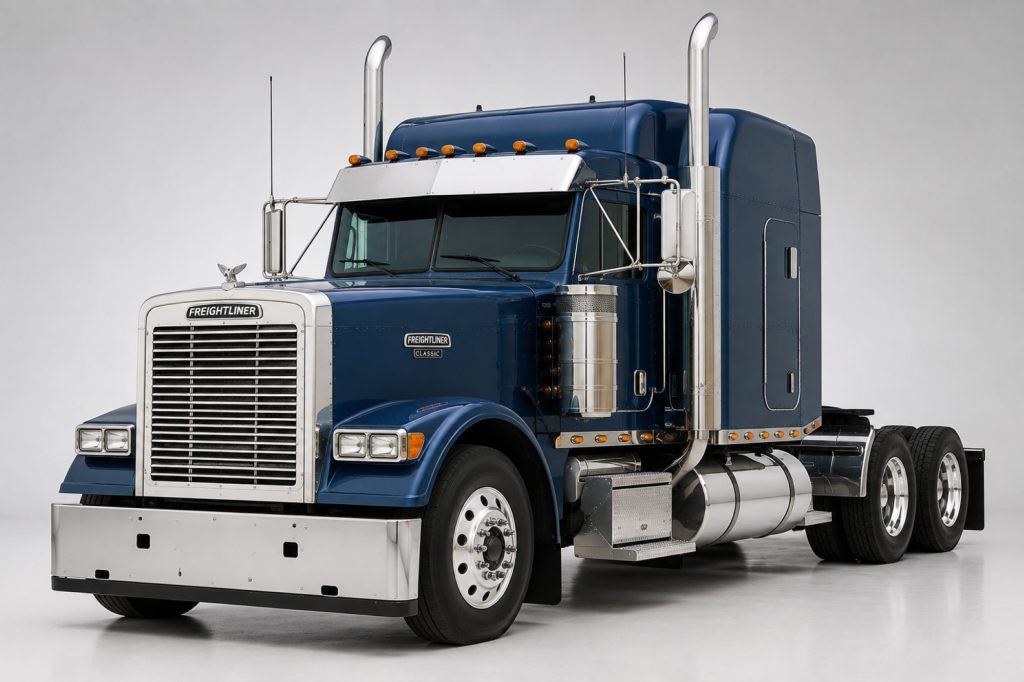
The Freightliner Classic is one of the most recognizable traditional Class 8 trucks produced by Freightliner. Built from 1989 through 2010, the model combined long-hood styling, broad engine availability, durable chassis configurations, and comfortable sleeper options for long-distance trucking operations.
The Classic became especially popular with owner-operators, specialized carriers, and drivers who preferred a traditional truck design rather than the aerodynamic styling used on newer highway tractors.
Its conventional hood provided excellent access to the engine compartment, while available Detroit Diesel, Caterpillar, and Cummins engines allowed buyers to configure the truck for long haul freight, heavy haul work, flatbed operations, refrigerated freight, tanker service, and other demanding applications.
Although the Freightliner Classic is no longer in production, many remain in operation throughout North America. Well-maintained examples continue to attract drivers who value serviceability, traditional styling, and proven drivetrain combinations.
Key Characteristics
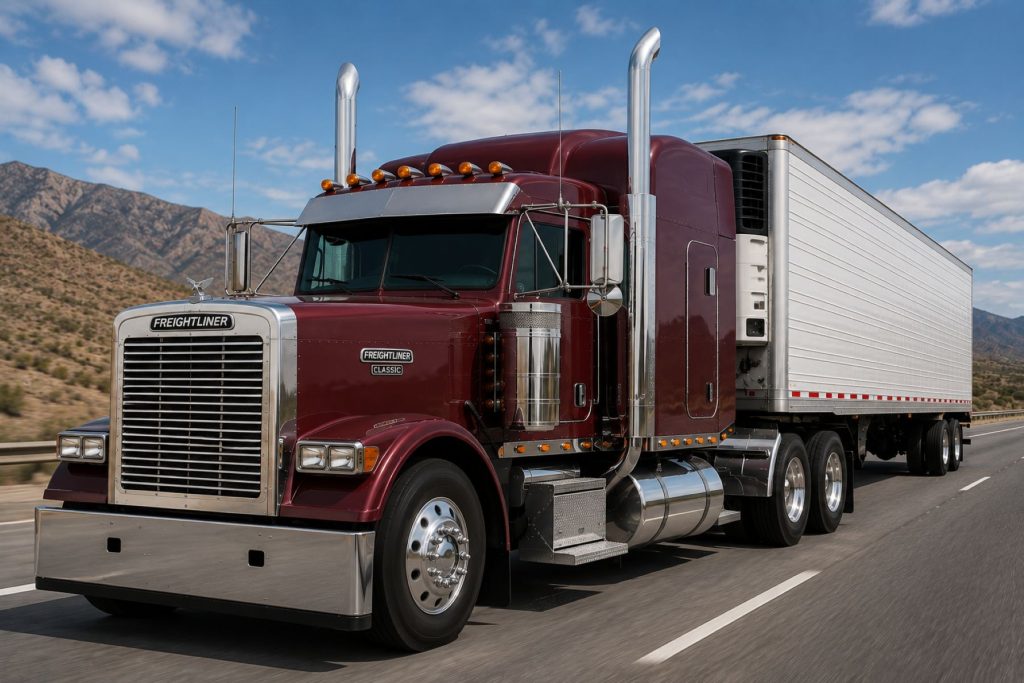
The Freightliner Classic was built around durability, driver comfort, serviceability, and customization.
Its long conventional hood gave technicians and operators easier access to major engine components compared with many aerodynamic cab designs. The truck was also offered with a wide range of wheelbases, sleeper sizes, axle configurations, engines, and transmissions.
Key characteristics include:
- Traditional long-hood styling
- Aluminum cab construction
- Multiple day cab and sleeper configurations
- Broad Detroit Diesel, Caterpillar, and Cummins engine availability
- Eaton Fuller manual transmission options
- Strong aftermarket parts support
- Custom interior and exterior options
- Tandem axle configurations for highway and heavy-duty applications
- Strong appeal among owner-operators
- Proven durability in long-distance service
The Freightliner Classic also became known for chrome accessories, custom paint schemes, large sleepers, polished fuel tanks, and other owner-operator focused upgrades.
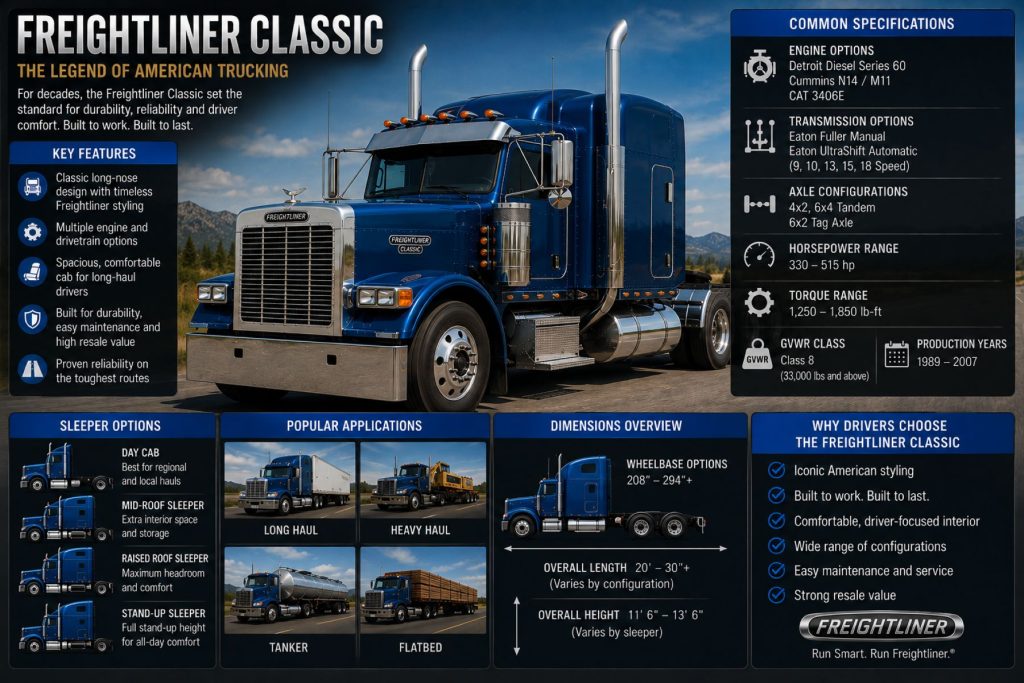
Common Specifications
Engine Options
The Freightliner Classic was available with several of the trucking industry’s most widely used heavy-duty diesel engines.
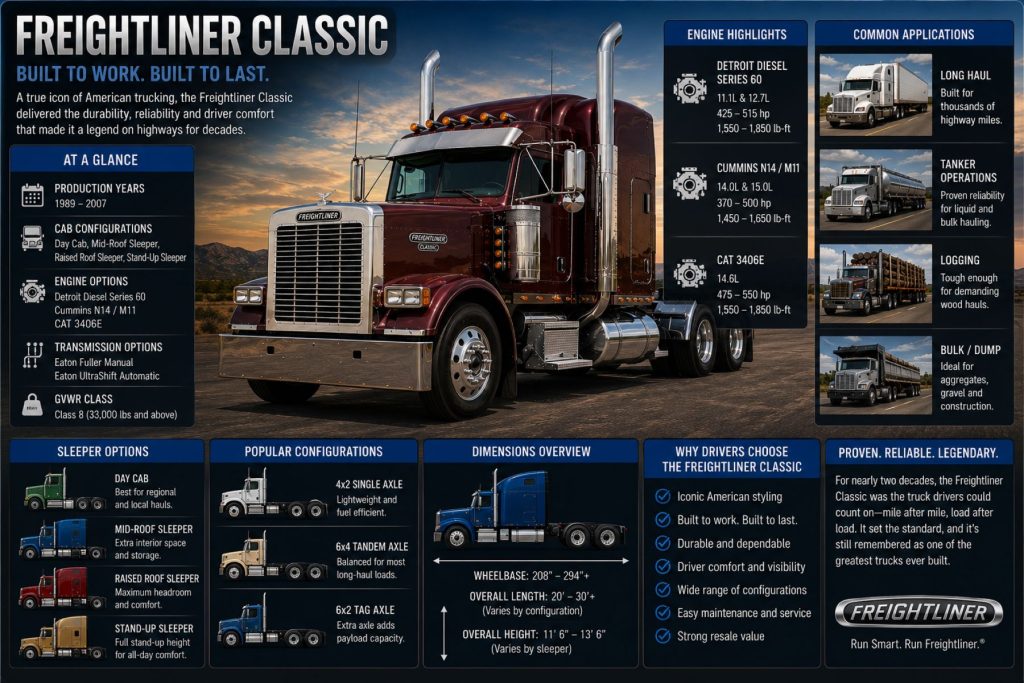
Common engine options included:
- Detroit Diesel Series 60
- Caterpillar C10
- Caterpillar C12
- Caterpillar C13
- Caterpillar C15
- Caterpillar C16
- Cummins N14
- Cummins ISM
- Cummins ISX
Engine availability depended on model year, emissions requirements, original customer specifications, and intended application.
Horsepower commonly ranged from approximately 350 to 600 horsepower, while torque output varied significantly depending on engine model and rating.
Transmission Options
Most Freightliner Classic trucks were equipped with Eaton Fuller manual transmissions.
Common transmission options included:
- Eaton Fuller 9-Speed
- Eaton Fuller 10-Speed
- Eaton Fuller 13-Speed
- Eaton Fuller 15-Speed
- Eaton Fuller 18-Speed
The 10-speed and 13-speed transmissions were widely used in general freight operations, while 18-speed transmissions were commonly selected for heavy haul and specialized applications.
Some later trucks may also be found with automated transmission configurations, although traditional manual transmissions remain the most common.
Axle Configurations
Common axle configurations included:
- 6×4 tandem axle
- 6×2 configurations
- Single rear axle configurations
- Heavy-duty tandem axle setups
- Lift axle configurations on specialized trucks
The 6×4 tandem axle configuration was the most common setup for long haul, flatbed, refrigerated, tanker, and heavy-duty freight operations.
Sleeper Options
The Freightliner Classic was offered with multiple sleeper configurations.
Common options included:
- Day cab
- Mid-roof sleeper
- Raised-roof sleeper
- Single-bunk sleeper
- Double-bunk sleeper
- Extended sleeper configurations
- Owner-operator interior packages
Sleeper models often included storage cabinets, wardrobe space, under-bunk storage, climate controls, lighting, and preparation for refrigerators or entertainment equipment.
Wheelbase Range
Wheelbase length varied depending on cab configuration, sleeper size, axle setup, fuel capacity, and intended application.
Day cab models generally used shorter wheelbases for improved maneuverability, while large sleeper trucks used longer wheelbases to accommodate additional living space and fuel capacity.
Custom owner-operator and heavy-haul configurations may have significantly longer wheelbases than standard fleet specifications.
Common Applications
The Freightliner Classic was commonly used in:
- Long haul freight
- Regional freight operations
- Dry van freight
- Refrigerated freight
- Flatbed freight
- Tanker operations
- Livestock transportation
- Heavy haul operations
- Logging operations
- Specialized equipment hauling
- Oversize load transportation
- Owner-operator trucking
- Dedicated freight operations
Its broad engine, transmission, axle, and sleeper availability allowed the truck to be configured for both standard highway freight and demanding specialized applications.
Advantages
The Freightliner Classic offers several advantages that continue to support its popularity among owner-operators, collectors, and used-truck buyers.
- Traditional long-hood styling
- Excellent engine access
- Proven diesel engine options
- Wide manual transmission availability
- Comfortable sleeper configurations
- Strong aftermarket parts support
- Durable chassis construction
- Extensive customization potential
- Broad application flexibility
- Strong owner-operator appeal
- Large used-truck parts network
- Familiar mechanical systems
- Strong resale interest among enthusiasts
The truck’s conventional design can make some repairs and inspections easier than on tightly packaged aerodynamic tractors.
Limitations or Considerations
Despite its strong reputation, the Freightliner Classic also has several operational tradeoffs.
- Lower aerodynamic efficiency than modern highway tractors
- Reduced fuel economy compared with newer trucks
- Larger turning radius in long-wheelbase configurations
- Increasing age of available trucks
- Potential electrical problems on older examples
- Age-related air system leaks
- Interior trim and sleeper component wear
- Older emissions systems may restrict operation in certain areas
- Some model-specific body and trim parts may be harder to locate
- High-mileage examples may require substantial mechanical investment
- Limited modern driver-assistance technology
Buyers should carefully evaluate the condition of older trucks rather than relying only on appearance or engine reputation.
Driver and Operator Experience
The Freightliner Classic was designed for drivers who spend extended periods on the road.
The cab provides a traditional driving position with clear analog gauges, straightforward controls, and a commanding view over the long hood. Many drivers appreciate the truck’s solid road feel and the direct mechanical character associated with older conventional trucks.
Sleeper models can provide substantial living space, particularly in raised-roof and extended-sleeper configurations. Depending on the original specification, interiors may include multiple storage compartments, wardrobes, climate controls, larger bunks, refrigerators, and entertainment equipment.
The Freightliner Classic is especially popular with drivers who prefer manual transmissions and traditional truck styling.
However, ride quality, cab noise, insulation, and interior refinement may vary considerably depending on model year, suspension setup, maintenance history, and previous modifications.
Maintenance and Ownership Notes
Maintenance on the Freightliner Classic is generally supported by broad parts availability and extensive industry familiarity with Freightliner components.
The conventional hood provides good access to the engine, cooling system, belts, hoses, filters, and other major service points.
Important maintenance areas include:
- Engine oil and filter service
- Fuel filter replacement
- Cooling system inspection
- Charge-air cooler inspection
- Air compressor and air system maintenance
- Brake inspections
- Suspension bushing inspection
- Steering linkage inspection
- Wheel bearing service
- Transmission and differential fluid service
- Electrical connection inspection
- Cab mount inspection
- Exhaust and emissions system inspection
- Fuel tank and mounting strap inspection
Because most available trucks are now older, age-related deterioration can be as important as mileage.
Rubber hoses, air lines, wiring, seals, cab mounts, interior components, and suspension parts should be inspected carefully even when the truck has relatively low mileage.
Buying Considerations
When purchasing a Freightliner Classic, buyers should evaluate the complete truck rather than focusing only on engine brand or exterior appearance.
Important buying considerations include:
- Engine condition
- Engine rebuild history
- Transmission operation
- Clutch condition
- Maintenance records
- Engine hours
- Mileage documentation
- Cooling system condition
- Oil leaks
- Blow-by
- Frame condition
- Suspension wear
- Steering play
- Brake condition
- Air system leaks
- Electrical system condition
- Cab and sleeper condition
- Rust and corrosion
- Tire condition
- Differential noise
- Emissions equipment condition
A professional pre-purchase inspection is strongly recommended.
Buyers should also confirm whether the truck’s emissions configuration complies with regulations in the areas where it will operate.
Older pre-emissions engines may be desirable to some operators because of their mechanical simplicity, but regulatory restrictions can affect where those trucks may be used.
Variants and Configurations
The Freightliner Classic platform was available in multiple configurations designed for different commercial operations.
- Day cab version
- Mid-roof sleeper
- Raised-roof sleeper
- Single-bunk sleeper
- Double-bunk sleeper
- Owner-operator configurations
- Fleet configurations
- Regional haul configurations
- Long haul configurations
- Heavy-haul configurations
- Flatbed specifications
- Tanker specifications
- Livestock-hauling configurations
- Custom show-truck configurations
Individual trucks may vary substantially because many were ordered with customer-specific engines, transmissions, sleepers, wheelbases, axle ratios, fuel tanks, suspension systems, and interior packages.
Comparison to Similar Trucks
The Freightliner Classic is commonly compared to trucks such as the Peterbilt 379, Kenworth W900, International 9900i, Mack CH, and other traditional long-hood Class 8 tractors.
Compared with the Peterbilt 379 and Kenworth W900, the Freightliner Classic often provided competitive drivetrain availability and a broad service network while typically being more affordable on the used market.
Compared with modern aerodynamic tractors such as the Freightliner Cascadia, Volvo VNL, Kenworth T680, and Peterbilt 579, the Classic generally offers easier engine access and more traditional styling but lower fuel efficiency and fewer modern safety systems.
The Freightliner Classic remains especially attractive to operators who prioritize mechanical familiarity, customization, appearance, and proven manual drivetrain combinations.
Best Fit For
The Freightliner Classic is best suited for:
- Owner-operators
- Drivers who prefer traditional long-hood trucks
- Long haul freight operations
- Flatbed operations
- Heavy haul applications
- Tanker operations
- Livestock transportation
- Specialized freight
- Operators seeking proven engine platforms
- Buyers comfortable maintaining older equipment
- Truck collectors and show-truck builders
- Small fleets with in-house maintenance capability
It may be less suitable for fleets focused primarily on maximum fuel efficiency, advanced safety technology, standardized automated transmissions, and the lowest possible maintenance variability.
Regulatory and Compliance Notes
Freightliner Classic emissions equipment varies significantly by model year and engine.
Earlier trucks may use pre-EGR diesel engines, while later models may include exhaust gas recirculation and other emissions-related systems introduced to meet changing EPA requirements.
Buyers should verify:
- Engine model year
- Emissions label information
- Original engine configuration
- Whether the engine has been replaced
- Whether emissions equipment has been modified
- State and regional operating restrictions
- Weight and axle compliance
- Brake and safety inspection requirements
Older trucks may not meet current emissions requirements in certain jurisdictions.
Any emissions modifications should be reviewed carefully for legality, reliability, and inspection compliance.
Real World Operating Notes
In real-world operation, the Freightliner Classic has developed a reputation for durability, strong highway performance, and driver appeal.
Many examples remain in commercial service despite their age, particularly trucks equipped with the Detroit Diesel Series 60, Caterpillar C15, and Cummins N14.
Fuel economy varies considerably depending on engine, gearing, load, speed, trailer type, maintenance, and driving conditions. In general, the Classic is less aerodynamic than newer fleet tractors and may consume more fuel during highway operation.
The truck’s strengths are most apparent in applications where engine access, drivetrain choice, durability, and operator preference matter more than maximum aerodynamic efficiency.
Condition varies widely across the used market. A properly maintained truck with documented repairs may be more valuable than a lower-priced example requiring extensive mechanical and cosmetic work.
Related Truck Types
- Sleeper Trucks
- Day Cab Trucks
- Class 8 Trucks
- Conventional Trucks
- Long-Hood Trucks
- Heavy-Haul Trucks
Related Freight Types
- Dry Van Freight
- Refrigerated Freight
- Flatbed Freight
- Tanker Freight
- Livestock Freight
- Heavy Haul Freight
- Specialized Freight
Related Trailer Types
- Dry Van Trailers
- Refrigerated Trailers
- Flatbed Trailers
- Tank Trailers
- Lowboy Trailers
- Livestock Trailers
- Step Deck Trailers
Related Equipment Systems
- Diesel Engines
- Truck Transmissions
- Air Suspension Systems
- Air Brake Systems
- Steering Systems
- Cooling Systems
- Fuel Systems
- Electrical Systems
Related Guides
- Most Reliable Semi Truck Engines
- How to Choose the Right Commercial Truck
- Day Cab vs Sleeper Truck: Which Is Right for Your Operation?
Frequently Asked Questions
When was the Freightliner Classic produced?
The Freightliner Classic was produced from 1989 through 2010.
What engines were available in the Freightliner Classic?
Common engine options included the Detroit Diesel Series 60, Caterpillar C12, Caterpillar C13, Caterpillar C15, Caterpillar C16, Cummins N14, Cummins ISM, and Cummins ISX.
Is the Freightliner Classic still in production?
No. Freightliner discontinued the Classic in 2010.
Is the Freightliner Classic a good used truck?
A well-maintained Freightliner Classic can still be a capable used truck. Buyers should closely evaluate engine condition, maintenance history, frame condition, suspension, air systems, electrical systems, and emissions compliance.
Is the Freightliner Classic fuel efficient?
The Freightliner Classic can provide reasonable fuel economy when properly configured and maintained, but it is generally less aerodynamic and less fuel efficient than newer highway tractors.
What transmissions were commonly used?
Eaton Fuller 9-speed, 10-speed, 13-speed, 15-speed, and 18-speed manual transmissions were commonly used.
Is the Freightliner Classic popular with owner-operators?
Yes. The Classic remains popular with owner-operators because of its traditional styling, engine access, drivetrain options, sleeper configurations, and customization potential.
What replaced the Freightliner Classic?
The Freightliner Coronado served as Freightliner’s primary traditional-style highway tractor after the Classic, while the Freightliner Cascadia became the company’s dominant aerodynamic highway platform.
Availability and Where to Find
The Freightliner Classic is available through used commercial truck dealers, independent sellers, fleet liquidation sales, truck auctions, specialty truck dealers, and major commercial truck marketplaces throughout North America.
Available trucks vary widely in mileage, mechanical condition, sleeper configuration, engine, transmission, wheelbase, and previous application.
Buyers should compare maintenance history and overall condition rather than selecting a truck based only on price, paint, chrome, or engine brand.
Support Trucking Families
Truck Equipment Atlas supports the mission of Grey Cross, a nonprofit dedicated to helping families of truck drivers who lose their lives while on the road.
As the site grows, part of its mission is to bring awareness and support to these families.
Podcast or Video Section
Learn More Through Audio and Video
Truck Equipment Atlas will continue expanding with podcast episodes, interviews, equipment breakdowns, and educational videos to help drivers, owner-operators, fleets, technicians, and students better understand commercial trucks and trucking equipment.
Follow the Growth of Truck Equipment Atlas
Truck Equipment Atlas continues to expand with new truck profiles, trailer coverage, diesel engine pages, equipment system resources, manufacturer information, and educational guides.
Visit our Site Updates page to explore recent additions, project milestones, and upcoming resources as we continue building one of the industry’s growing commercial trucking equipment reference libraries.
View the Latest Site Updates: Truck Equipment Atlas Site Updates