
Deloupe Log Trailer
Quick Facts
- Manufacturer: Deloupe
- Trailer Type: Log Trailer
- Model: Deloupe Log Trailer
- Common Lengths: 40 ft, 45 ft, 48 ft, 53 ft
- Common Width: 96 to 102 inches
- Trailer Construction: High-Strength Steel
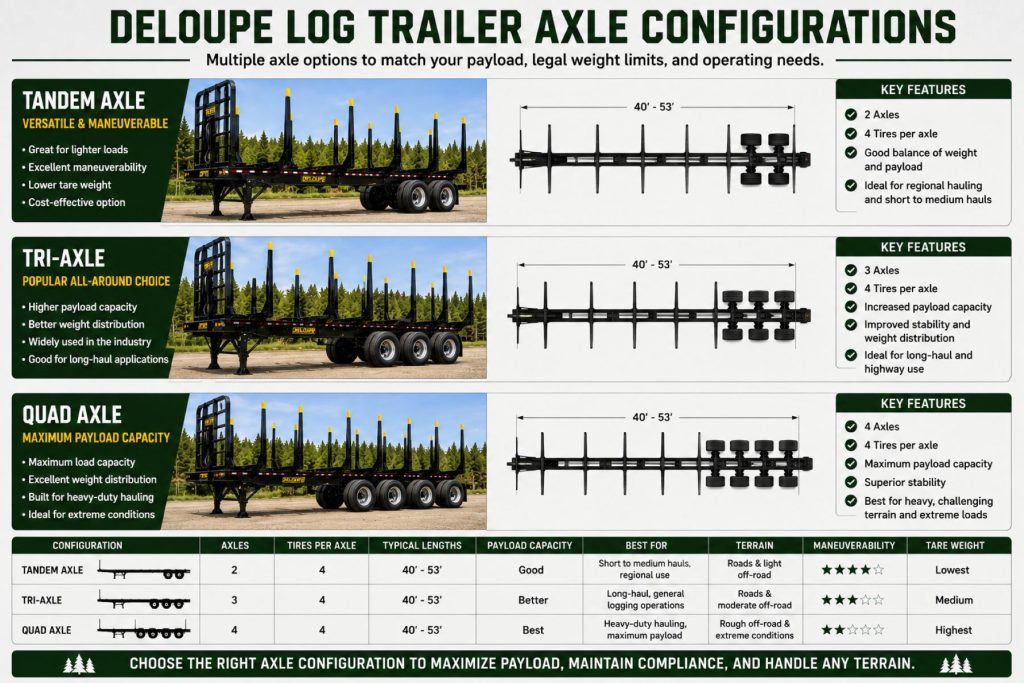
- Common Axle Configurations: Tandem Axle, Tri-Axle, Quad Axle
- Typical Capacity: Varies by configuration and regional weight regulations
- Primary Applications: Logging, Timber Harvesting, Forestry Operations, Sawmill Deliveries
- Common Freight Types: Logs, Timber, Pulpwood, Hardwood Logs, Softwood Logs, Utility Poles
- Load Securement: Adjustable Stakes and Bunks
- Suspension Options: Air Ride or Spring Ride
- Production Status: In Production
Overview
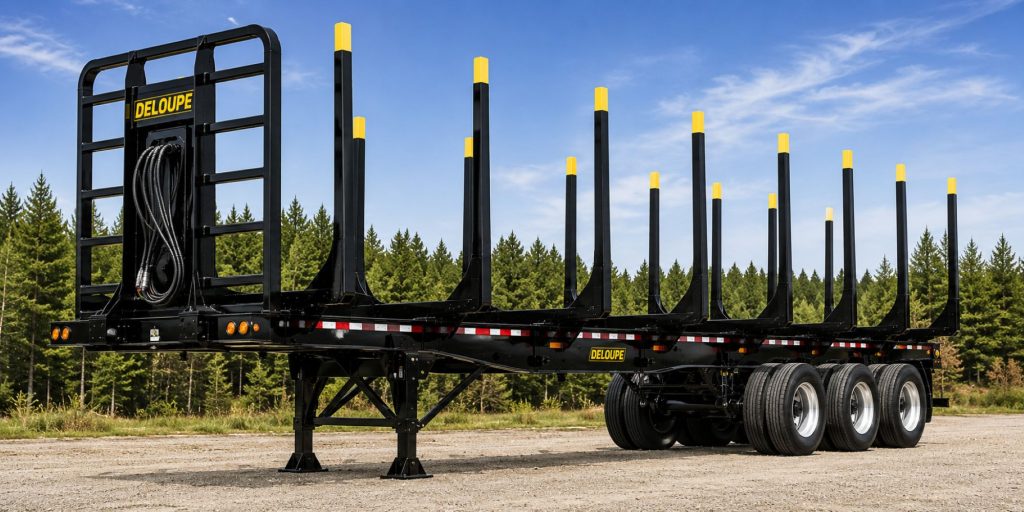
The Deloupe Log Trailer is a highly respected forestry trailer designed for demanding logging operations throughout North America. Known for its combination of durability, payload efficiency, and innovative engineering, Deloupe trailers are commonly used by logging contractors, forestry fleets, timber companies, and owner-operators hauling forest products from harvesting sites to mills and processing facilities.
Deloupe has built a strong reputation for producing trailers that balance structural strength with weight savings, allowing operators to maximize payload while maintaining long-term durability. These trailers are frequently found in both highway and off-road forestry applications where dependable performance is critical.
The Deloupe Log Trailer is particularly popular among operators seeking lightweight designs that can handle heavy timber loads while remaining compliant with regional weight regulations.
Key Characteristics
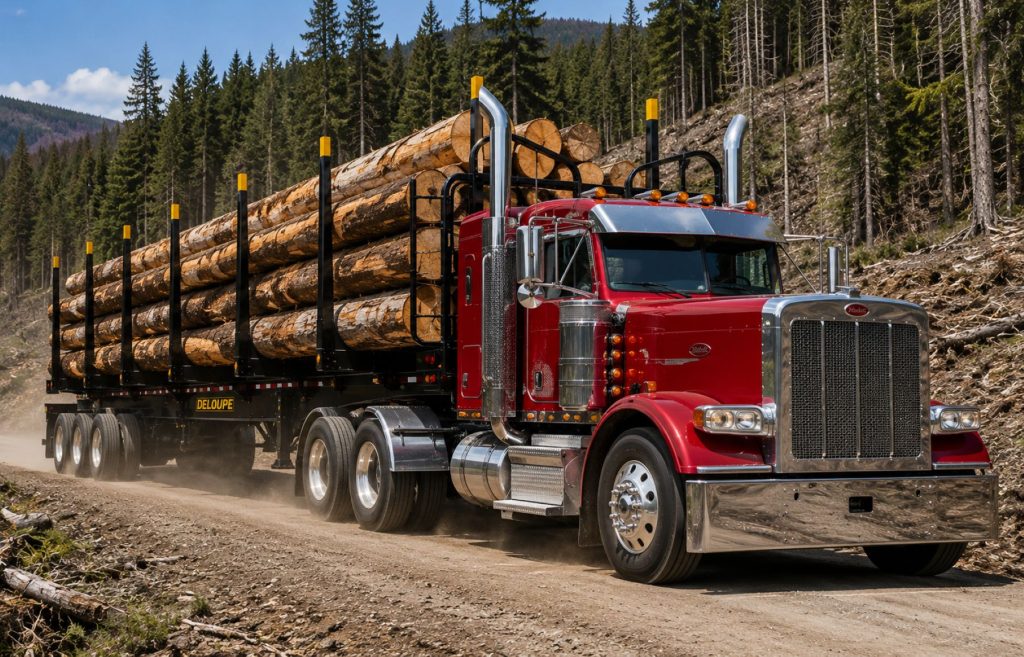
The Deloupe Log Trailer is engineered specifically for the challenges of forestry transportation.
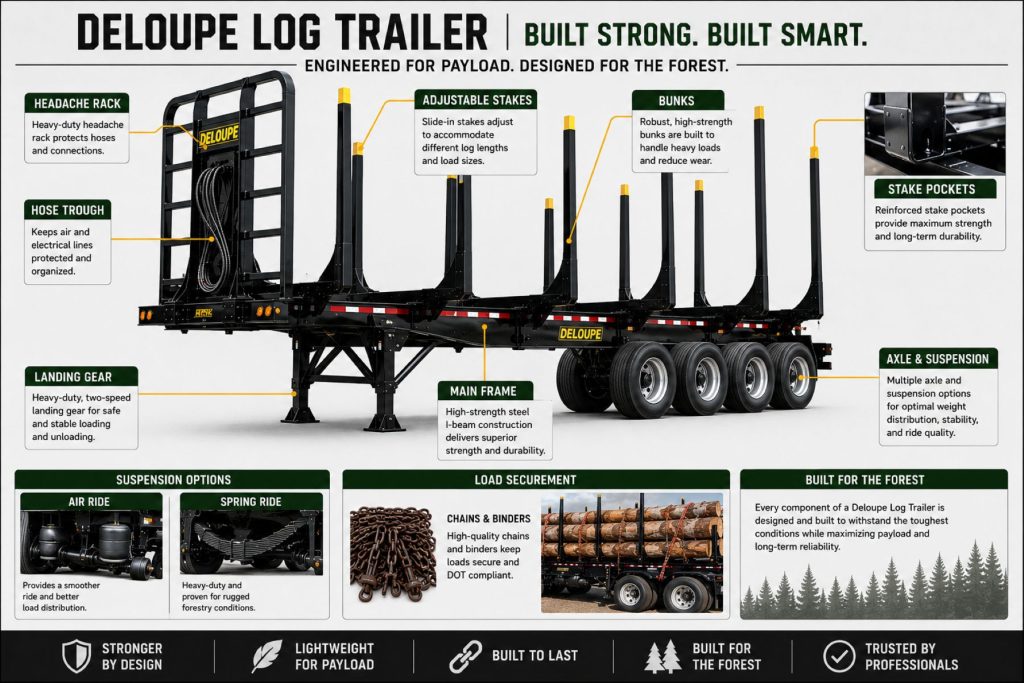
Its high-strength steel construction provides durability while maintaining competitive empty trailer weights. Adjustable bunks and stakes allow operators to haul a variety of log lengths and diameters while maintaining load stability and securement.
Designed for both highway and off-road use, Deloupe trailers are built to handle rough forestry conditions while maximizing payload capacity and operating efficiency.
Common Specifications
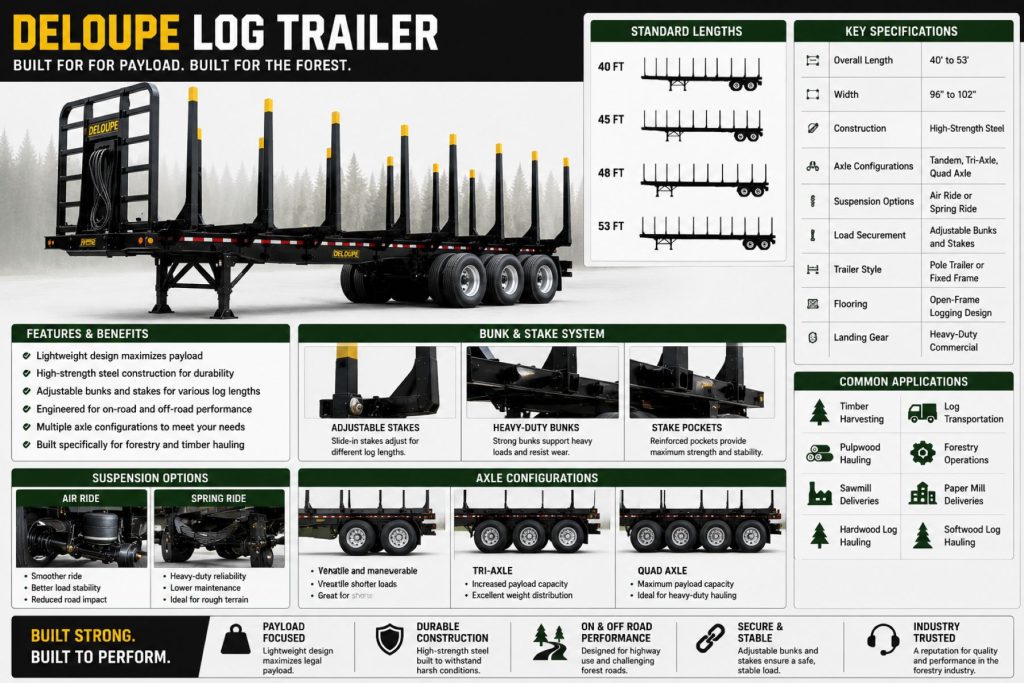
Overall Length
Typically 40 to 53 feet.
Width
96 to 102 inches.
Construction
High-strength steel construction.
Capacity
Varies by configuration and local weight regulations.
Axle Configurations
Tandem axle, tri-axle, and quad axle.
Suspension
Air ride or spring ride systems.
Load Securement
Adjustable bunks and stakes.
Trailer Style
Pole trailer or fixed-frame log trailer.
Flooring
Open-frame logging design.
Landing Gear
Heavy-duty commercial landing gear.
Common Applications
- Timber Harvesting
- Log Transportation
- Pulpwood Hauling
- Forestry Operations
- Sawmill Deliveries
- Paper Mill Deliveries
- Utility Pole Transportation
- Hardwood Log Hauling
- Softwood Log Hauling
- Forest Product Transportation
Advantages
- Lightweight design improves payload capacity
- Strong reputation throughout the forestry industry
- Durable high-strength steel construction
- Adjustable bunks accommodate varying log lengths
- Excellent balance between weight and durability
- Available in multiple axle configurations
- Designed specifically for logging applications
- Strong resale value
Limitations or Considerations
- Limited use outside forestry applications
- Requires specialized loading equipment
- Heavy forestry use can accelerate component wear
- Load securement requires regular attention
- Rough terrain increases maintenance requirements
- Forestry operations can be seasonal in some regions
- Higher purchase price than some general-purpose trailers
- Not suitable for standard freight applications
Driver and Operator Considerations
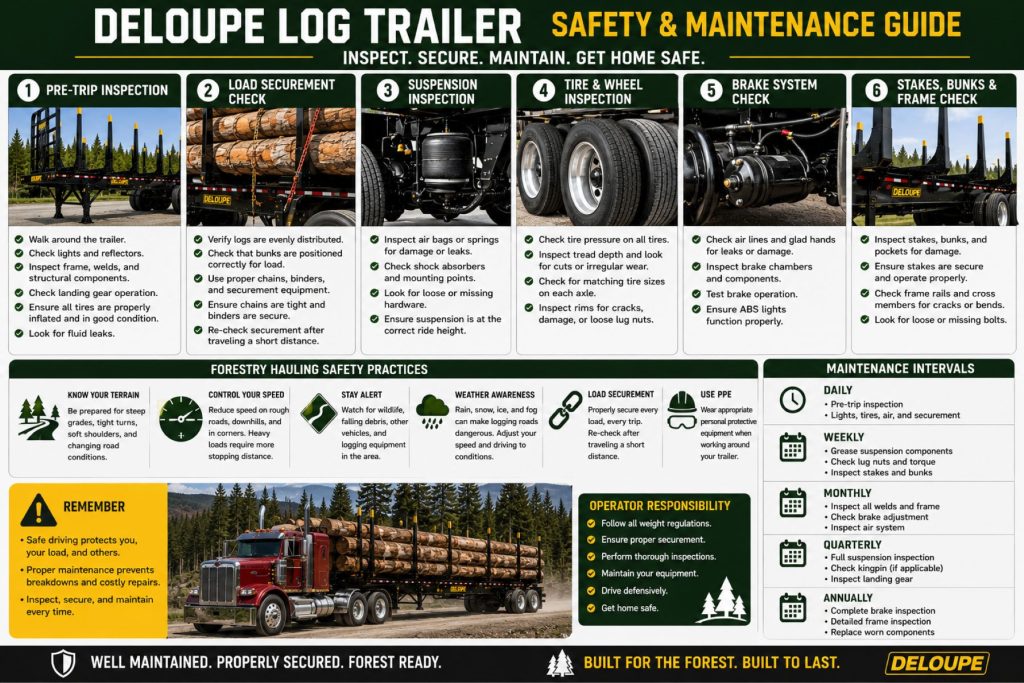
Drivers operating Deloupe Log Trailers must pay close attention to load securement, weight distribution, and changing road conditions. Logging operations frequently involve steep grades, rough terrain, and unpaved roads that place significant demands on equipment and operators.
Routine inspections of stakes, bunks, chains, binders, suspension components, tires, and braking systems are critical for safe operation. Proper loading practices help maximize payload while maintaining stability during transport.
Maintenance and Ownership Notes
Routine maintenance includes inspection of bunks, stakes, chains, binders, suspension components, wheel ends, brakes, tires, frame welds, and lighting systems.
Particular attention should be given to structural stress points, bunk assemblies, stake pockets, suspension mounts, and securement equipment. Regular inspections help identify wear before costly repairs become necessary.
Buying Considerations
- Payload requirements
- Log lengths being hauled
- Operating terrain
- Axle configuration requirements
- Suspension preferences
- State weight regulations
- New versus used pricing
- Forestry application requirements
- Maintenance history
- Fleet compatibility
Common Brands or Manufacturers
- Deloupe
- Pitts Trailers
- Peerless Limited
- Fontaine Specialized
- Doepker
- Trail King
- Prentice
Variants and Related Configurations
- Fixed Frame Log Trailer
- Pole Log Trailer
- Tri-Axle Log Trailer
- Quad Axle Log Trailer
- Forestry Trailer
- Pulpwood Trailer
- Heavy-Duty Timber Trailer
Comparison to Similar Trailers
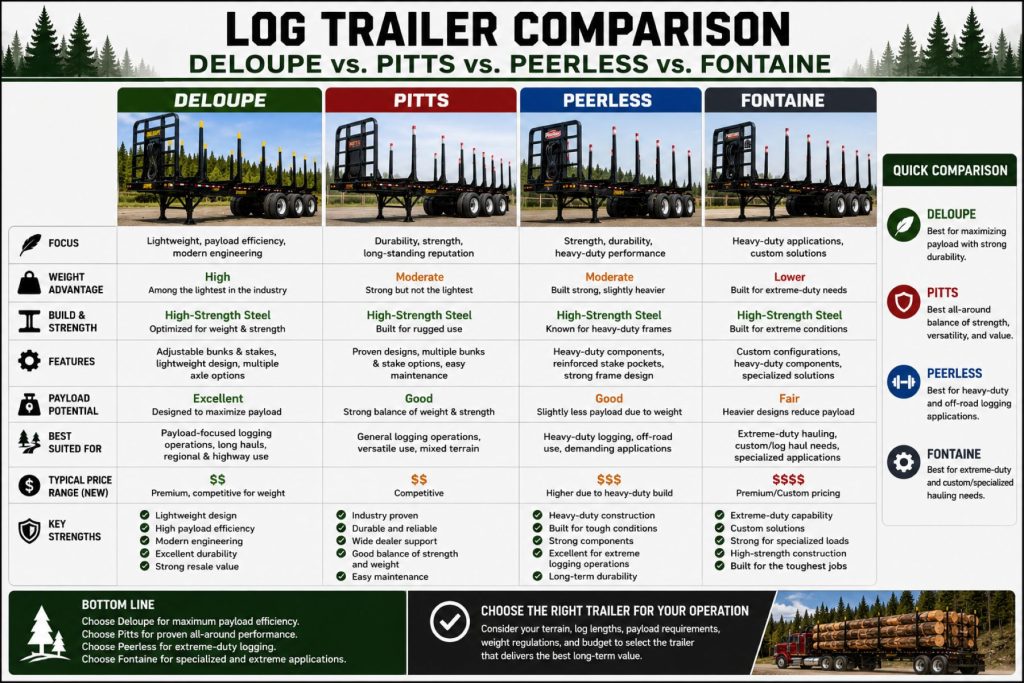
The Deloupe Log Trailer is commonly compared to the Pitts Log Trailer, Peerless Log Trailer, and Fontaine Forestry Trailer. Compared to Pitts, Deloupe often emphasizes lightweight engineering and payload efficiency while still maintaining excellent durability. Compared to Peerless, Deloupe typically offers weight savings that can improve hauling efficiency. Against Fontaine forestry trailers, Deloupe is often favored by operators seeking a combination of payload optimization, durability, and modern trailer design. The Deloupe remains a popular choice among forestry fleets focused on maximizing payload without sacrificing long-term reliability.
Best Fit For
- Logging contractors
- Timber harvesting operations
- Forestry fleets
- Owner-operators specializing in timber hauling
- Paper mills
- Sawmill suppliers
- Regional timber transportation
- Payload-focused forestry operations
Related Equipment
- Kenworth W900
- Kenworth T800
- Peterbilt 389
- Peterbilt 567
- Western Star 4900
- Mack Granite
- Log Loaders
- Knuckleboom Cranes
- Forestry Equipment
- Harvesters
Related Freight Types
- Hardwood Logs
- Softwood Logs
- Pulpwood
- Timber
- Utility Poles
- Forest Products
- Raw Lumber Materials
- Wood Fiber Products
Related Trailer Types
- Log Trailers
- Pole Trailers
- Forestry Trailers
- Flatbed Trailers
- Heavy-Haul Trailers
- Timber Trailers
- Specialty Forestry Equipment
Related Trailer Models
- Pitts Log Trailer
- Peerless Log Trailer
- Fontaine Forestry Trailer
- Doepker Log Trailer
- Trail King Forestry Trailer
- Pitts Pole Trailer
Related Guides
- Complete Guide to Freight Types
- Complete Guide to Trailer Types
- Choosing the Right Trailer for Your Freight
Regulatory and Compliance Notes
Deloupe Log Trailers must comply with federal, state, provincial, and local transportation regulations governing axle weights, gross vehicle weights, lighting requirements, brake systems, and cargo securement. Operators must ensure logs are properly secured using approved chains, binders, and securement devices to meet applicable transportation standards.
Compliance with forestry transportation regulations is especially important because allowable weights and operating requirements often vary by region.
Real World Operating Notes
Deloupe Log Trailers are commonly found throughout major timber-producing regions in Canada and the United States. Operators frequently choose Deloupe because of its reputation for balancing durability and payload efficiency. Many fleets utilize Deloupe trailers in both long-haul timber transportation and demanding off-road forestry operations.
Proper maintenance, load securement, and routine inspections play an important role in maximizing trailer longevity and operational reliability.
Frequently Asked Questions
What is a Deloupe Log Trailer used for?
Deloupe Log Trailers are designed to transport logs, timber, pulpwood, utility poles, and other forestry products from harvesting sites to mills and processing facilities.
Are Deloupe trailers only used in logging?
Primarily yes. They are specifically designed for forestry and timber transportation applications.
What axle configurations are available?
Depending on the model, tandem axle, tri-axle, and quad axle configurations are commonly available.
Are Deloupe Log Trailers good for rough forestry roads?
Yes. Deloupe trailers are engineered to handle demanding forestry environments while maintaining payload efficiency and durability.
Who commonly operates Deloupe Log Trailers?
Logging contractors, forestry fleets, timber companies, owner-operators, paper mills, and sawmill suppliers commonly use Deloupe Log Trailers.
Availability and Where to Find
Deloupe Log Trailers can be purchased through authorized Deloupe dealers, forestry equipment dealerships, commercial trailer dealers, equipment auctions, fleet liquidation sales, online commercial truck marketplaces, and private sellers. Buyers considering used Deloupe trailers should carefully inspect the frame, bunks, stake pockets, suspension components, brakes, tires, lighting systems, and structural welds to ensure the trailer remains suitable for demanding forestry applications.
Support Trucking Families
Truck Equipment Atlas supports the mission of Grey Cross, a nonprofit dedicated to helping families of truck drivers who lose their lives while on the road. As the site grows, part of its mission is to bring awareness and support to these families.
Podcast or Video Section
Learn More Through Audio and Video
Truck Equipment Atlas will continue expanding with podcast episodes, interviews, and equipment breakdowns to help drivers and fleets better understand trucks and equipment.
Follow the Growth of Truck Equipment Atlas
Truck Equipment Atlas continues to expand with new truck profiles, trailer coverage, diesel engine pages, equipment system resources, manufacturer information, and educational guides.
Visit our Site Updates page to explore recent additions, project milestones, and upcoming resources as we continue building one of the industry’s growing commercial trucking equipment reference libraries.
View the Latest Site Updates: Truck Equipment Atlas Site Updates