
Quick Facts
- Manufacturer: Phillips Industries
- Product Family: STA-DRY QCMS2
- Official Product Type: Seven-way plug-and-socket hybrid connection system
- Common Installation: Tractor-side electrical cable connection using a compatible QCS or QCS2 boot
- Connector Configuration: Seven-way commercial tractor-and-trailer electrical connection
- Mating Connection: Phillips QCS or QCS2 molded harness boot
- Trailer-Side Connection: Phillips QCP quick-change plug on applicable cable assemblies
- Electrical Cable Options: Straight ABS LECTRAFLEX, coiled ABS LECTRACOIL, and combination electrical-and-air assemblies
- Common Conductor Configuration: One 8-gauge, two 10-gauge, and four 12-gauge conductors on specified ABS assemblies
- Published Temperature Range: As low as minus 82 degrees Fahrenheit and as high as 195 degrees Fahrenheit on specified LECTRACOIL configurations
- Applicable Standards: SAE J560, J2394, and J2222 on specified assemblies
- Primary Applications: Commercial tractors, semitrailers, electrical cables, and three-in-one or four-in-one connection assemblies
- Primary Benefit: Creates a semi-permanent sealed tractor-side connection that reduces repeated exposure to moisture and road contaminants
- Production Status: Current Phillips connection technology offered in multiple cable configurations
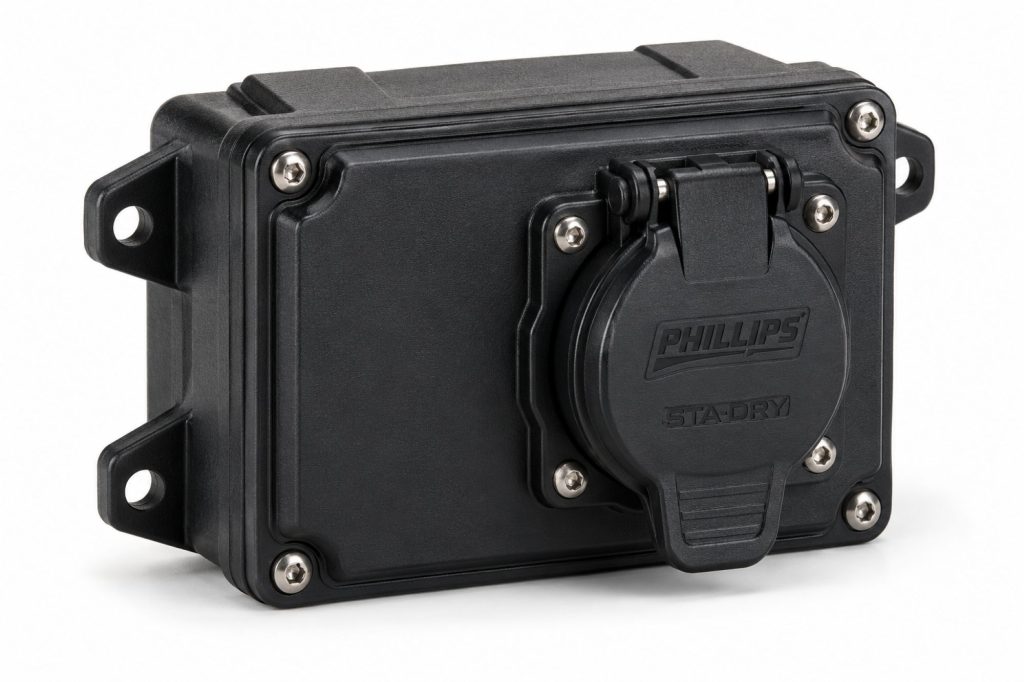
Overview
The Phillips STA-DRY QCMS2 is a seven-way plug-and-socket hybrid designed to reduce corrosion at the tractor-side electrical connection. Instead of using a conventional socket that is repeatedly exposed whenever the electrical cable is removed, the QCMS2 connects directly to a compatible Phillips QCS or QCS2 boot.
Once installed, the tractor-side QCMS2 connection is rarely removed. This reduces the number of times the protected electrical interface is opened to water, road salt, chemical deicers, dirt, and other contaminants.
The opposite end of applicable electrical cables may use Phillips’ QCP quick-change plug. This gives the cable a semi-permanent protected tractor connection and a field-serviceable trailer-side contact cartridge.
QCMS2 technology is available on straight and coiled electrical cables and on selected Phillips three-in-one and four-in-one electrical-and-air combination assemblies.
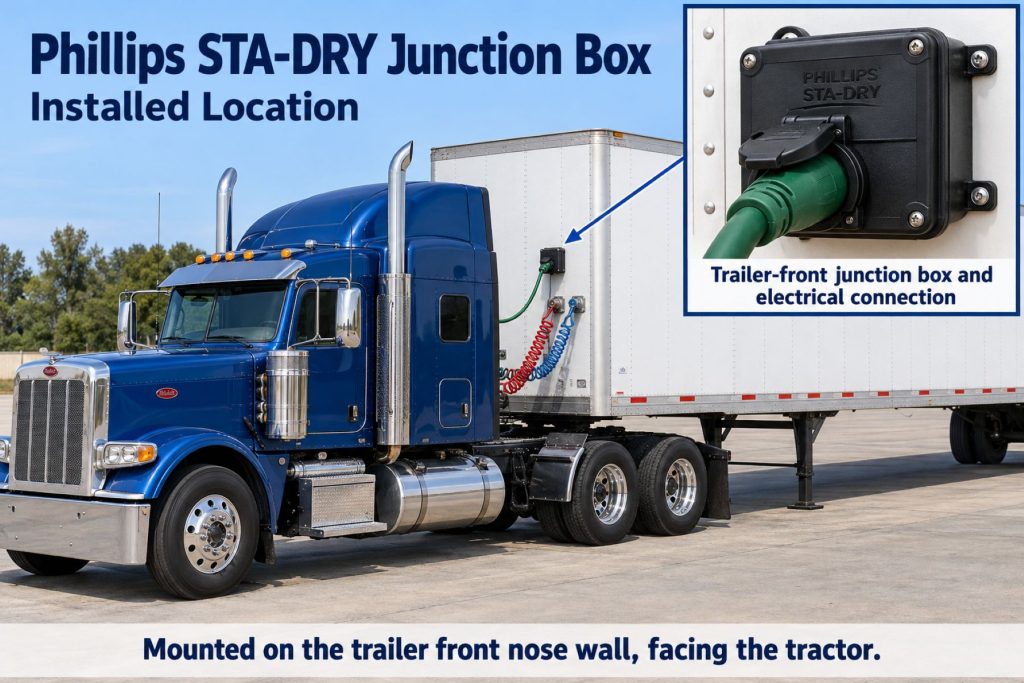
Key Characteristics
- Seven-way plug-and-socket hybrid
- Semi-permanent tractor-side connection
- Connects directly to a QCS or QCS2 harness boot
- Replaces a conventional removable tractor socket
- STA-DRY environmental seal
- Designed to lock out moisture and road contaminants
- Reduced connection exposure during trailer changes
- Compatible with QCP-equipped cable assemblies
- Available on straight and coiled ABS electrical cables
- Available on electrical-and-air combination assemblies
- Built-in theft deterrence from semi-permanent installation
- Application-specific cable lengths and lead configurations
- Designed for heavy-duty commercial service
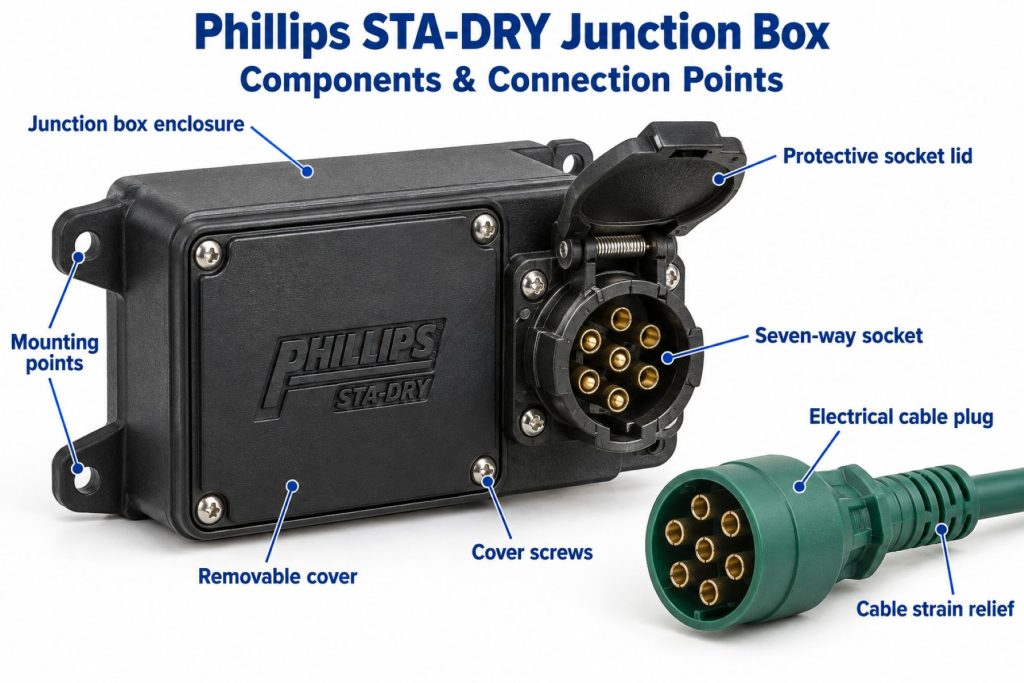
Major Components
- QCMS2 plug-and-socket hybrid
- Seven electrical contacts
- STA-DRY sealing surfaces
- Tractor mounting and retention hardware
- Compatible QCS or QCS2 boot
- Color-coded electrical conductors
- Overmolded cable connection
- Electrical cable jacket
- Strain-relief structure
- Trailer-side QCP plug on applicable assemblies
- QCP replaceable cartridge on equipped cables
- Cable-support hardware
- Optional air lines and spiral wrap on combination assemblies
Product Type and Construction
The QCMS2 combines functions normally divided between a cable plug and a fixed socket. Its tractor-side connector installs into the tractor’s electrical connection and mates directly with the protected harness boot behind the original socket location.
The electrical cable is permanently integrated with the QCMS2 connector. Overmolded components and STA-DRY sealing surfaces protect internal conductors and contacts against environmental contamination.
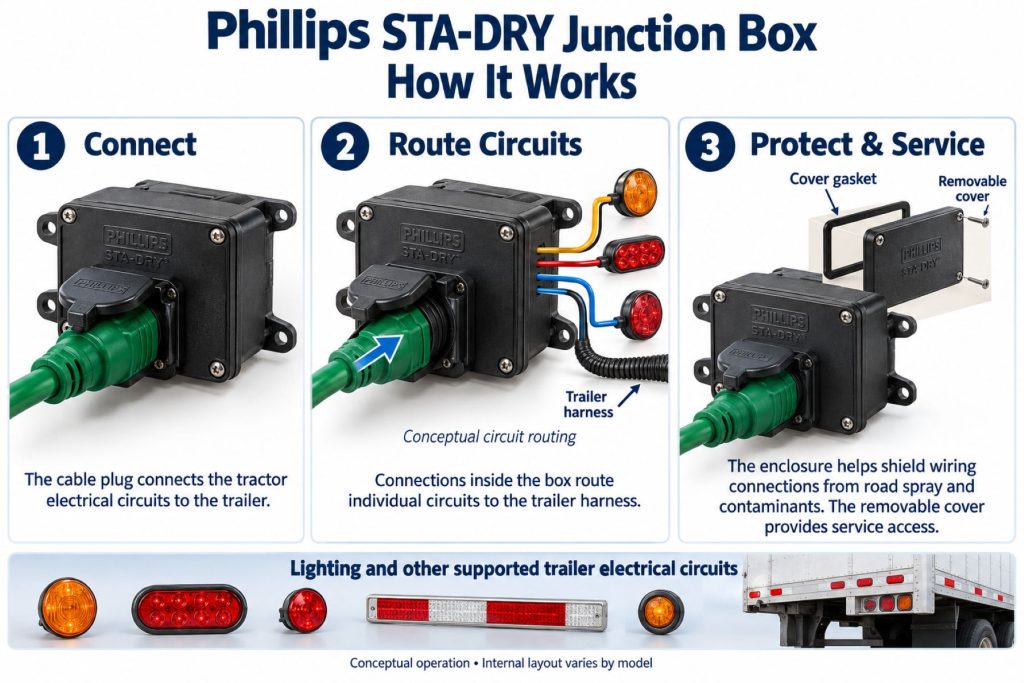
How the Electrical Component or System Works
The QCMS2 is installed at the tractor-side electrical connection and mates directly with a compatible QCS or QCS2 wiring boot. Mounting hardware secures the connection so it normally remains installed when trailers are changed.
The electrical cable extends from the QCMS2 connector to the trailer’s seven-way socket. Power, ground, lighting signals, ABS power, and auxiliary circuits pass through the seven conductors.
Because the tractor-side interface remains sealed and connected, the trailer-side end becomes the primary daily coupling point. On QCP-equipped assemblies, damaged trailer-side pins can be replaced through the removable QCP cartridge.
Position and Function Within the Vehicle
The QCMS2 is positioned at the rear of the tractor cab where a conventional seven-way electrical socket would normally be installed. It connects the tractor’s electrical harness directly to the tractor-to-trailer cable.
The cable extends rearward to the trailer’s electrical connection. A tracker bar, pogo stick, spring kit, or similar support should carry the cable and prevent its weight from pulling against either connector.
Common Specifications
- Connector Type: Seven-way plug-and-socket hybrid
- Installation Side: Tractor side
- Harness Interface: Phillips QCS or QCS2 boot
- Typical Trailer-Side Connector: Phillips QCP quick-change plug
- Common Conductors: One 8-gauge, two 10-gauge, and four 12-gauge conductors on specified ABS cables
- Common Straight-Cable Lengths: 12, 15, and 20 feet
- Common Coiled-Cable Lengths: 12 and 15 feet, with application-specific extended leads available
- Common Coiled-Cable Part Number: 30-9934 for a 15-foot assembly with a 48-inch lead, QCMS2, and QCP
- Common Straight-Cable Part Numbers: 30-2055, 30-2075, and 30-2095 for specified 12-, 15-, and 20-foot configurations
- Specified Coiled-Cable Temperature Range: Minus 82 to 195 degrees Fahrenheit
- Specified Straight-Cable Temperature Range: Application-specific; verify the exact LECTRAFLEX cable construction
- Applicable Standards: SAE J560 and J2394, with SAE J2222 applying to specified coiled assemblies
- Patent: Phillips identifies U.S. Patent 6,483,200 for the applicable connection technology
Operating Capacity and Performance
The system’s electrical capacity depends on conductor sizes, cable construction, connector condition, vehicle voltage, circuit protection, and the loads assigned to each circuit.
QCMS2 connection technology does not increase circuit capacity. Its primary performance benefit is protecting the tractor-side connection against environmental exposure and repeated removal.
Installation Position and System Function
The QCMS2 should be installed at a compatible tractor connection where it can remain securely mounted and protected. The attached cable must have sufficient working length for full tractor-and-trailer articulation.
The cable should be supported above the tractor deck and routed away from the fifth wheel, driveline, exhaust components, tires, frame edges, and other potential damage points.
System Voltage and Electrical Architecture
The QCMS2 is commonly used within 12-volt North American commercial tractor-and-trailer electrical systems. Seven conductors provide separate paths for ground, lighting, ABS power, and application-specific auxiliary functions.
The connector does not generate or regulate voltage. It forms the protected interface between the tractor harness and the trailer electrical cable.
Electrical Input, Output, and Power Function
Electrical power and control signals enter the QCMS2 through the tractor harness and travel through the attached cable to the trailer.
- Ground circuit
- Tail and marker lamp circuit
- Left-turn and stop-lamp circuit
- Right-turn and stop-lamp circuit
- ABS or continuous auxiliary-power circuit
- Application-specific auxiliary circuit
- Application-specific brake or control circuit
Exact circuit assignments should be confirmed through the applicable wiring diagram and connector standard.
Voltage, Current, and Electrical Load Management
Every circuit must remain within the capacity of the QCMS2 contacts, cable conductors, trailer-side connector, tractor wiring, trailer harness, and protective devices.
High-current equipment should not be added to a seven-way circuit unless the complete electrical path has been approved for that load. Liftgate charging and other high-current equipment may require separate connectors.
Plug-and-Socket Hybrid Design
The QCMS2 removes the conventional separable plug-and-socket union from the tractor side. It combines those functions into a connector that attaches directly to the protected QCS or QCS2 boot.
This reduces the gap through which moisture and road chemicals can enter the electrical system. The connection is intended to remain installed instead of being separated during each trailer change.
QCS and QCS2 Boot Integration
The QCMS2 is designed to mate with compatible Phillips QCS or QCS2 molded harness boots. The boot contains the protected tractor wiring interface that would otherwise connect to a removable socket.
Compatibility must be verified before installation because harness generations, terminal arrangements, cable configurations, and replacement components can differ.
Cable and Trailer-Side Connector Design
QCMS2 assemblies may use straight ABS LECTRAFLEX or coiled ABS LECTRACOIL electrical cable. Selected three-in-one and four-in-one assemblies combine the electrical cable with tractor-to-trailer air lines or charging cables.
The trailer-side end commonly uses the Phillips QCP replaceable plug cartridge. This permits the exposed trailer-side pins to be serviced without rewiring or replacing an otherwise usable cable.
Internal Components and Electrical Design
Internal conductors are sealed within the cable and connector structure. The seven electrical contacts align with the circuits inside the compatible QCS or QCS2 boot.
Overmolding, sealing surfaces, contact retention, and cable strain relief work together to protect the connection and prevent conductor movement.
Materials and Component Construction
- Molded connector housing
- Seven conductive contacts
- Insulated copper conductors
- Chemical- and abrasion-resistant cable jacket
- STA-DRY sealing components
- Overmolded cable connection
- Metal mounting and retention hardware
- Application-specific strain relief
- Glass-filled nylon QCP cartridge on equipped assemblies
- Machined brass QCP pins on the trailer-side connection
Wiring, Terminals, Connectors, and Grounding
The QCMS2 connection, tractor harness, cable conductors, trailer plug, trailer socket, trailer harness, and grounds should be inspected as one complete system.
A poor ground can produce dim lamps, ABS warnings, controller resets, overheating, or backfeeding through unrelated trailer circuits even when the QCMS2 connection remains sealed.
Circuit Protection and Electrical Safety
Circuits passing through the QCMS2 should be protected by the correctly rated fuses, circuit breakers, or electronic protection specified by the vehicle manufacturer.
A repeatedly opening protective device indicates a short circuit, overload, wiring fault, or defective component. Increasing the protection rating can overheat the connector and wiring.
Controls, Monitoring, and Diagnostics
The QCMS2 has no independent driver controls or electronic monitoring. It transfers electrical power and signals generated by the tractor’s lighting, ABS, brake-control, and auxiliary systems.
Diagnosis can include visual inspection, connector-temperature checks, loaded voltage testing, ground-circuit testing, circuit continuity testing with power disconnected, and comparison with a known-good cable or trailer.
Electronic Controls and Driver-Assistance Integration
The connection can supply electrical power and ground paths required by trailer ABS, electronic lighting controls, telematics equipment, monitoring systems, and approved trailer electronics.
Low voltage or intermittent continuity can create warning messages or faults that appear unrelated to the tractor-to-trailer connection.
Power Demand, Capacity, and Energy Management
Trailer lighting, ABS, monitoring equipment, and auxiliary loads must remain within the capacity of the applicable seven-way circuits.
When higher current is required, a separate single-pole or dual-pole charging cable should be used rather than overloading a standard seven-way circuit.
Heat, Efficiency, and Electrical Loss Management
A clean, sealed, properly installed QCMS2 connection helps limit resistance and voltage loss. Loose hardware, damaged contacts, contamination, poor grounding, or electrical overloading can still create heat.
Discoloration, melted material, burned insulation, an electrical odor, or unusual connector temperature requires immediate inspection.
Environmental Sealing and Contamination Protection
Environmental protection is the QCMS2’s primary design purpose. The connector mates directly with the QCS or QCS2 boot to create a tight STA-DRY seal around the tractor-side electrical interface.
The seal reduces exposure to rain, road spray, salt, chemical deicers, conductive dirt, and pressure-washing contaminants. Damaged sealing surfaces or improper installation can compromise this protection.
Duty Cycle and Operating Conditions
The system is intended for commercial vehicles exposed to repeated trailer changes, vibration, temperature extremes, moisture, road chemicals, dust, abrasion, and articulation.
Its semi-permanent tractor-side installation is especially useful for fleets operating in areas where road salt and liquid deicing chemicals create frequent connector corrosion.
Mounting and Installation
The QCMS2 should be connected to a verified compatible QCS or QCS2 boot and secured using the specified hardware. The sealing surfaces must be clean, correctly aligned, and fully seated.
The cable should be routed and supported so its weight does not pull against the tractor connector. Phillips recommends appropriate tracker-bar or pogo-stick support for assemblies with longer leads.
Wiring, Grounding, and Installation Requirements
- Disconnect tractor electrical power before installation
- Confirm QCS or QCS2 boot compatibility
- Inspect the boot contacts and sealing surfaces
- Align the QCMS2 connection correctly
- Use the specified mounting hardware
- Confirm the connector is fully seated and retained
- Route the cable away from heat and moving components
- Install the appropriate cable support
- Verify ground-circuit continuity
- Test every trailer electrical circuit
- Verify trailer ABS operation after installation
Vehicle and Electrical-System Compatibility
Compatibility depends on the tractor’s harness boot, connector series, vehicle voltage, circuit arrangement, cable length, conductor sizes, ABS requirements, trailer-side socket, and required cable support.
A standard seven-way socket or cable should not be assumed interchangeable with QCMS2 technology. The complete tractor connection and cable part number must be confirmed.
Harness, Boot, and Trailer Compatibility
The QCMS2 must mate with a compatible Phillips QCS or QCS2 boot. Differences in harness generations, terminal arrangements, and system construction can prevent interchangeability.
The trailer-side QCP or other plug must match the trailer’s seven-way socket. Connector condition and contact alignment should be inspected before installation.
Related Component and System Compatibility
- Phillips QCS harness boots
- Phillips QCS2 harness boots
- Phillips QCP quick-change plugs
- SAE J560-compatible trailer sockets
- ABS LECTRACOIL electrical cables
- ABS LECTRAFLEX electrical cables
- Phillips three-in-one combo assemblies
- Phillips four-in-one combo assemblies
- Trailer ABS systems
- Trailer lighting systems
- Tracker-bar and pogo-stick cable supports
Common Applications
- Highway tractors
- Regional-haul tractors
- Day-cab tractors
- Vocational tractors
- Dry van trailers
- Refrigerated trailers
- Flatbed trailers
- Tank trailers
- Container chassis
- Converter dollies
- Three-in-one connection assemblies
- Four-in-one liftgate charging assemblies
Advantages
- Reduces tractor-side connector exposure
- Creates a sealed STA-DRY connection
- Helps prevent moisture and chemical intrusion
- Remains installed during normal trailer changes
- Reduces repeated wear at the tractor connection
- Supports QCP trailer-side field service
- Available on straight and coiled cables
- Available on three-in-one and four-in-one assemblies
- Built-in theft deterrence
- Supports standardized fleet connection systems
- Can reduce corrosion-related downtime
Limitations or Considerations
- Requires a compatible Phillips QCS or QCS2 boot
- Not a universal replacement for every tractor socket
- Installation is more permanent than a conventional plug
- Incorrect installation can compromise the seal
- A damaged boot may require harness repair
- Cable length must match the tractor and trailer geometry
- The complete cable may require replacement if the tractor-side connector is damaged
- The system cannot correct poor grounds or trailer wiring faults
- High-current equipment may require separate connectors
- Part-number verification is necessary before ordering
Driver and Operator Experience
The driver normally leaves the QCMS2 attached to the tractor. Trailer changes are completed by disconnecting and reconnecting the trailer-side electrical plug rather than removing the tractor-side connection.
The cable should remain properly supported, clear of the tractor deck, and long enough for full articulation. Trailer lighting and ABS operation should be checked after every connection.
Controls, Indicators, and Driver Feedback
The QCMS2 has no independent control or status indicator. Drivers identify possible connection problems through trailer-light failures, ABS warnings, auxiliary-equipment problems, or visible cable damage.
A complete pre-trip test remains necessary because one circuit can fail while the remaining electrical circuits continue operating.
Common Electrical Tests and Diagnostic Information
- Visual QCMS2 housing inspection
- Mounting-hardware inspection
- Boot and sealing-surface inspection
- Trailer-light operational test
- Trailer ABS power and warning-lamp test
- Ground-circuit voltage-drop test
- Individual loaded-circuit voltage test
- Cable continuity test with power disconnected
- Trailer-side plug and socket inspection
- Cable movement and intermittent-fault test
- Connector-temperature inspection
Inspection and Wear Points
- QCMS2 connector housing
- Mounting and retaining hardware
- STA-DRY sealing surfaces
- QCS or QCS2 boot
- Electrical contacts
- Overmolded cable entry
- Cable strain relief
- Electrical cable jacket
- Coiled cable sections
- Trailer-side QCP cartridge
- Trailer socket contacts
- Cable-support springs and clamps
- Signs of heat, corrosion, abrasion, cracking, or moisture
Cooling, Ventilation, and Environmental Requirements
The QCMS2 does not require active cooling. Electrical loading and connection resistance must remain within approved limits to prevent overheating.
The connector and cable should be protected against direct exhaust heat, impact, abrasive contact, improper pressure washing, and movement against the tractor frame or deck.
Component Service Life and Replacement
Service life depends on installation quality, sealing integrity, cable support, electrical loading, articulation, vibration, chemical exposure, and road environment.
The QCP cartridge at the trailer-side end can be replaced independently on equipped assemblies. Damage to the QCMS2 housing, overmolded connection, cable conductors, or main cable jacket may require replacement of the complete cable assembly.
Maintenance and Ownership Notes
The semi-permanent tractor-side connection should still be inspected during preventive maintenance. A sealed connection can be damaged by loose mounting hardware, cable strain, impact, heat, or improper installation.
- Inspect the QCMS2 mounting and seal
- Keep the electrical cable properly supported
- Check for adequate turning clearance
- Inspect the cable jacket for abrasion
- Test the ground circuit
- Inspect the trailer-side plug and socket
- Maintain approved corrosion protection
- Replace worn QCP cartridges promptly
- Investigate repeated electrical faults
- Test all trailer circuits after service
Common Electrical-System Problems
- Moisture inside the connection: Damaged sealing surfaces, incorrect installation, loose mounting hardware, an incompatible boot, or housing damage may compromise the STA-DRY seal.
- Intermittent trailer lighting: Cable damage, worn trailer-side contacts, poor grounds, loose terminals, or faults elsewhere in the trailer harness may interrupt circuits.
- Trailer ABS warning: Loss of continuous power, voltage drop, poor grounding, cable damage, or an unrelated ABS fault may activate the warning.
- Overheated connection: Loose contacts, corrosion, electrical overloading, poor engagement, or damaged conductors can generate excessive resistance.
- Connector moves at the tractor: Loose hardware, damaged mounting features, an incorrect installation, or cable tension may prevent the semi-permanent connection from remaining secure.
- Repeated cable damage: Inadequate support, incorrect cable length, contact with the tractor deck, severe articulation, or damaged support hardware may be responsible.
- QCP cartridge wears quickly: A damaged or misaligned trailer socket, excessive cable tension, corrosion, or inadequate contact pressure may repeatedly damage the trailer-side pins.
- Multiple trailer circuits behave incorrectly: A poor ground can cause voltage instability or backfeeding between lighting and auxiliary circuits.
Safety and Service Precautions
Tractor electrical power should be disconnected before the QCMS2 connection, harness boot, cable, or mounting hardware is serviced.
- Disconnect electrical power before service
- Confirm circuit identity before testing wiring
- Do not probe contacts with tools that can spread or damage them
- Do not operate with loose mounting hardware
- Replace melted or overheated connectors
- Do not bypass circuit protection
- Support the cable before articulation testing
- Keep the cable away from tires and driveline components
- Test required trailer lighting and ABS functions after service
- Follow Phillips and vehicle-manufacturer instructions
Identification Information
Identification may be found on the connector housing, electrical cable jacket, product label, packaging, tractor build records, or fleet maintenance records.
- Phillips manufacturer name
- QCMS2 product identification
- Complete cable-assembly part number
- Straight or coiled cable type
- Overall and working length
- Extended-lead length
- Electrical conductor sizes
- QCS or QCS2 boot type
- Trailer-side connector type
- ABS application information
- Combination-assembly configuration
- Applicable product date or manufacturing code
The assembly should not be identified by connector appearance alone. Similar QCMS2-equipped cables may have different lengths, jackets, lead dimensions, conductors, and opposite-end connectors.
Buying Considerations
- Confirm that the tractor uses a compatible QCS or QCS2 boot
- Record the complete Phillips cable part number
- Select straight or coiled cable construction
- Choose the correct overall and working length
- Verify extended-lead requirements
- Confirm conductor sizes and electrical capacity
- Check ABS compatibility
- Identify the trailer-side plug
- Determine whether a three-in-one or four-in-one assembly is required
- Verify tracker-bar or pogo-stick support requirements
- Inspect the trailer socket before installing a new cable
- Review current warranty and service information
Variants and Configurations
- 12-foot straight cable with QCMS2 and QCP
- 15-foot straight cable with QCMS2 and QCP
- 20-foot straight cable with QCMS2 and QCP
- 12-foot coiled cable with QCMS2 and QCP
- 15-foot coiled cable with QCMS2 and QCP
- 15-foot coiled cable with a 48-inch lead
- Three-in-one electrical-and-air combo assembly
- Four-in-one assembly with single-pole charging cable
- Four-in-one assembly with dual-pole charging cable
- ABS LECTRACOIL construction
- ABS LECTRAFLEX construction
- Application-specific extended-lead configurations
Comparison to Similar Equipment
Compared with a conventional tractor-side seven-way plug and socket, the QCMS2 forms a semi-permanent sealed connection and eliminates the routinely opened tractor-side union.
Compared with the Phillips STA-DRY QCS2 Electrical Connection System, the QCMS2 attaches directly to the QCS2 boot and replaces the conventional socket. QCS2 uses a replaceable female socket.
Compared with the Phillips QCP Quick-Change Electrical Plug, the QCMS2 is normally the semi-permanent tractor-side connection. QCP is commonly used as the removable trailer-side plug with a replaceable contact cartridge.
Compared with the Phillips STA-DRY S7 Seven-Way Connection System, the QCMS2 is mounted on the tractor cable. The S7 is a swiveling trailer-side socket and nosebox system.
Best Fit For
- Tractors equipped with compatible QCS or QCS2 boots
- Fleets experiencing tractor-side connector corrosion
- Vehicles operating in areas using road salt and deicing chemicals
- Highway and regional tractors
- High-coupling-cycle fleet operations
- ABS-equipped tractor-and-trailer combinations
- Fleets wanting a semi-permanent tractor electrical connection
- Operations using QCP trailer-side plugs
- Three-in-one and four-in-one combo-assembly applications
Related Vehicle and Trailer Types
- Highway and Regional Tractors
- Dry Van Trailers
- Refrigerated Trailers
- Flatbed Trailers
- Tank Trailers
- Container Chassis Trailers
- Converter dollies
- Double-trailer combinations
- Vocational semitrailers
Related Truck and Trailer Models
- Freightliner Cascadia
- Kenworth T680
- Peterbilt 579
- Volvo VNL
- International LT Series
- Mack Anthem
- Wabash DuraPlate Dry Van Trailer
- Utility 3000D Dry Van Trailer
- Great Dane Champion Dry Van Trailer
Related Electrical System Types
- Wiring, Connectors & Power Distribution
- Truck & Trailer Lighting Systems
- Seven-way tractor-and-trailer connections
- Trailer ABS electrical connections
- Straight electrical cables
- Coiled electrical cables
- Combination electrical-and-air assemblies
- Liftgate charging connections
- Back-of-cab cable-management systems
Related Electrical Products
- Phillips STA-DRY QCS2 Electrical Connection System
- Phillips QCP Quick-Change Electrical Plug
- Phillips STA-DRY S7 Seven-Way Connection System
- Phillips 3-in-1 Electrical and Air Combo Assembly
- Phillips 4-in-1 Electrical and Air Combo Assembly
- Phillips ABS LECTRACOIL Electrical Cable
- Phillips ABS LECTRAFLEX Electrical Cable
- Phillips QWIK-CHANGE Power Air Kit
Related Equipment Systems
- Electrical Systems
- Brake Systems
- Fifth Wheels & Coupling Equipment
- Telematics & ELD Systems
- Safety Systems
- Trailer ABS systems
- Trailer lighting systems
- Tractor and trailer air-brake systems
Related Guides
- Electrical System Guides
- How Commercial Truck Electrical Systems Work
- How to Inspect and Maintain Truck Wiring and Electrical Connections
- Commercial Truck and Trailer Lighting Systems Explained
- Tractor vs Trailer Brake Systems
- How Truck ABS and Electronic Stability Control Work
Regulatory and Compliance Notes
Commercial trailer lighting, ABS power, connector wiring, and cable support are subject to applicable vehicle-safety and inspection requirements.
The installed assembly must preserve the specified circuit assignments, conductor capacity, electrical protection, connector compatibility, and required trailer equipment operation.
Real World Operating Notes
The QCMS2 reduces tractor-side exposure because the connection normally remains installed. It does not eliminate the need to inspect cable support, the trailer-side connection, vehicle grounds, and the remaining trailer wiring.
When converting from a conventional plug-and-socket arrangement, the tractor harness boot and mounting location should be identified before a cable is ordered.
A QCMS2 assembly with an extended lead may require additional support. Unsupported cable weight can loosen the tractor connection or damage the cable during articulation.
Frequently Asked Questions
What is the Phillips STA-DRY QCMS2?
It is a seven-way plug-and-socket hybrid that connects directly to a compatible tractor-side QCS or QCS2 wiring boot.
Is the QCMS2 a conventional junction box?
No. Phillips officially classifies it as a plug-and-socket hybrid connection. It may be installed as part of the tractor’s rear electrical connection and wiring-distribution arrangement.
Why does it replace the tractor socket?
Connecting directly to the QCS or QCS2 boot removes the routinely opened plug-and-socket gap where moisture and road chemicals can enter.
Is the QCMS2 removed during every trailer change?
No. It is designed to remain connected to the tractor, while the trailer-side plug is disconnected during normal trailer changes.
What is normally installed at the trailer end?
Many QCMS2 cable assemblies use a Phillips QCP quick-change plug at the trailer-side connection.
Can the QCMS2 fit every tractor?
No. The tractor must have a compatible QCS or QCS2 harness boot, suitable mounting arrangement, correct circuit layout, and appropriate system voltage.
Is it available on coiled and straight cables?
Yes. Phillips offers QCMS2 technology on specified straight LECTRAFLEX and coiled LECTRACOIL assemblies.
Can it be used on a three-in-one assembly?
Yes. Premium Phillips three-in-one assemblies are available with a QCMS2 tractor connection and QCP trailer-side plug.
What causes a QCMS2 connection to overheat?
Possible causes include loose mounting, damaged contacts, electrical overloading, poor grounding, contamination, or conductor damage.
How can the correct assembly be identified?
Use the complete Phillips part number, cable construction, length, lead dimensions, conductor sizes, harness-boot type, trailer-side connector, and ABS requirements.
Availability and Where to Find
Phillips STA-DRY QCMS2 cable assemblies are available through Phillips distributors, commercial-truck dealers, trailer dealers, heavy-duty parts suppliers, fleet-maintenance providers, and truck-parts retailers.
Availability depends on cable construction, length, lead dimensions, conductor sizes, tractor-side boot, trailer-side connection, and whether the cable is part of a three-in-one or four-in-one assembly.
Current specifications, product literature, technical support, and distributor resources are available through the Phillips Industries website.
Support Trucking Families
Truck Equipment Atlas supports the mission of Grey Cross, a nonprofit dedicated to helping families of truck drivers who lose their lives while on the road. As the site grows, part of its mission is to bring awareness and support to these families.
Podcast or Video Section
Learn More Through Audio and Video
Truck Equipment Atlas will continue expanding with podcast episodes, interviews, and equipment breakdowns to help drivers and fleets better understand trucks and equipment.
Follow the Growth of Truck Equipment Atlas
Truck Equipment Atlas continues to expand with new truck profiles, trailer coverage, diesel engine pages, equipment system resources, manufacturer information, and educational guides.
Visit our Site Updates page to explore recent additions, project milestones, and upcoming resources as we continue building one of the industry’s growing commercial trucking equipment reference libraries.
View the Latest Site Updates: Truck Equipment Atlas Site Updates