
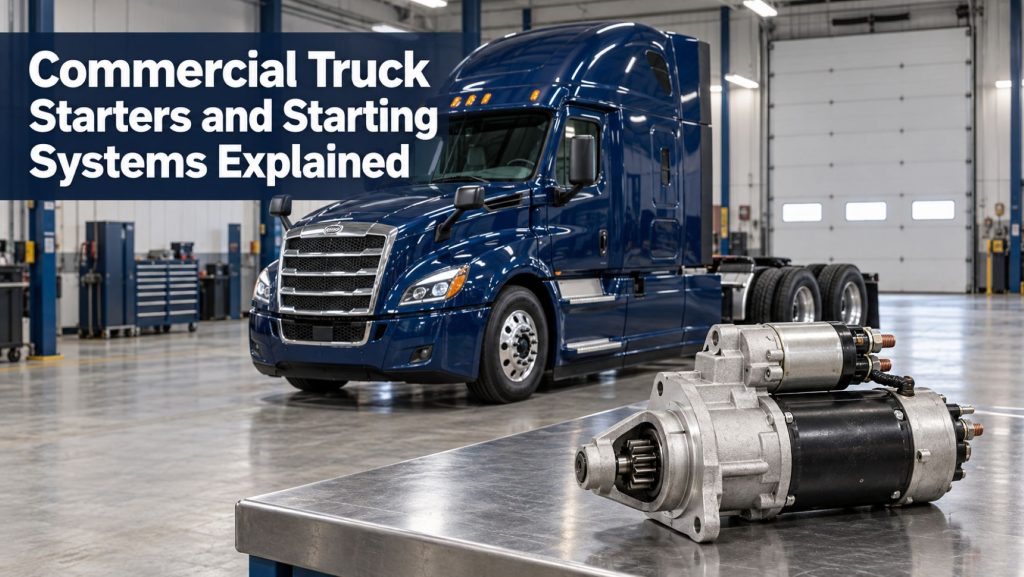
Commercial truck starters and starting systems convert stored battery energy into the mechanical rotation needed to crank a diesel engine. The starter must produce high torque, often in cold weather and against substantial engine compression, while cables, switches, relays, solenoids, batteries, and electronic controls deliver the correct current at the correct time.
A no-crank or slow-crank complaint is not always caused by the starter itself. Weak batteries, corroded connections, damaged cables, poor grounds, control-circuit faults, incorrect engine oil, and mechanical engine resistance can create similar symptoms. This guide explains how commercial truck starting systems work, the major components involved, common starter designs, warning signs, testing methods, and maintenance considerations.
What a Commercial Truck Starting System Does
The starting system uses electrical energy from the batteries to rotate the engine fast enough for combustion to begin. When the driver turns the key or presses the start control, a low-current control circuit activates a relay or magnetic switch. That device supplies current to the starter solenoid, which engages the starter pinion with the engine flywheel and closes the high-current starter circuit.
The starter motor then turns the flywheel and crankshaft. Once the engine starts and the operator releases the control, the solenoid opens the electrical circuit and retracts the pinion from the flywheel. The complete sequence depends on the battery, charging, wiring, grounding, control, and mechanical systems described in How Commercial Truck Electrical Systems Work.
How a Heavy-Duty Starter Motor Works
A starter motor uses electromagnetic force to create rotation. When high current flows through the motor’s field and armature circuits, magnetic fields interact and turn the armature. The armature shaft transfers this rotation through the starter drive to a pinion gear.
The pinion gear meshes with the much larger flywheel ring gear. This gear reduction multiplies torque so the starter can rotate the engine. The starter must overcome engine compression, internal friction, oil resistance, accessory loads, and cold-temperature effects while maintaining sufficient cranking speed.
A starter is designed for short operating periods. Extended cranking creates extreme heat in the motor, solenoid, cables, and connections. Manufacturers specify maximum cranking times and cooling periods to prevent damage.
Major Starting-System Components
Battery Bank
Commercial trucks commonly use several batteries connected in parallel to increase cranking current and reserve capacity while maintaining a 12-volt system. Battery condition, state of charge, temperature, construction, and bank balance directly affect starting performance. Learn more in Commercial Truck Batteries Explained.
Starter Motor
The starter motor converts electrical energy into mechanical rotation. Major internal parts may include the armature, field coils or permanent magnets, brushes, commutator, bearings or bushings, reduction gears, drive mechanism, and housing.
Starter Solenoid
The solenoid performs two jobs. It moves the starter drive so the pinion engages the flywheel, and it closes heavy electrical contacts that connect battery power to the starter motor. Worn contacts, damaged windings, mechanical binding, or low control voltage can prevent correct engagement.
Starter Drive and Pinion
The starter drive transfers motor rotation to the flywheel ring gear. An overrunning clutch allows the pinion to drive the flywheel during cranking but prevents the running engine from overspeeding the starter. Damaged teeth, a slipping clutch, or a binding drive can cause grinding, free-spinning, or intermittent engagement.
Flywheel Ring Gear
The ring gear is attached to the engine flywheel and meshes with the starter pinion. Teeth may wear or break in the positions where the engine frequently stops. Ring-gear damage can cause intermittent grinding or failure to engage even when the starter operates.
Starter Relay or Magnetic Switch
A starter relay allows a low-current ignition or controller circuit to operate the higher-current solenoid circuit. Some heavy trucks use a separate magnetic switch near the starter to shorten the control-current path and improve solenoid performance.
Cables and Grounds
Large positive and negative cables carry several hundred amps during cranking. Their size, length, routing, terminal condition, and connections are critical. Resistance that appears small on an ohmmeter can create a major voltage drop when starter current flows.
Start Controls and Safety Interlocks
The ignition switch, push-button control, engine controller, transmission neutral switch, clutch switch, parking-brake input, remote-start system, and body controller may all participate in start authorization. Modern trucks may also prevent cranking because of security, network, or engine-protection conditions.
Direct-Drive vs Gear-Reduction Starters
| Starter Type | How It Works | Key Characteristics |
|---|---|---|
| Direct-drive starter | The armature shaft drives the pinion with little or no internal speed reduction | Traditional heavy construction, high motor current, and larger overall size |
| Gear-reduction starter | Internal gears allow a faster motor to drive the pinion at a lower speed with greater torque | Often lighter, more compact, and efficient while providing strong cranking torque |
| Offset gear-reduction starter | The motor axis is offset from the pinion and connected through reduction gears | Compact packaging and common in many modern heavy-duty applications |
| Planetary gear-reduction starter | A planetary gearset reduces motor speed and multiplies torque | High torque-to-weight capability with a compact design |
A replacement must match the engine, flywheel, electrical-system voltage, mounting arrangement, pinion specifications, rotation, and control design. Physical fit alone does not confirm compatibility.
The Starting Sequence
- The driver requests a start using the ignition switch or start button.
- Safety interlocks and electronic controllers confirm that starting is permitted.
- The starter relay or magnetic switch closes.
- Current energizes the starter solenoid.
- The solenoid moves the pinion toward the flywheel ring gear.
- The solenoid’s main contacts close and connect battery power to the motor.
- The motor turns the pinion, flywheel, and engine crankshaft.
- The engine control system supplies fuel and manages combustion.
- When the engine starts or the request ends, the starter circuit opens.
- The drive retracts and the overrunning clutch protects the starter as the engine accelerates.
A fault at any step may produce a no-crank, slow-crank, click-only, intermittent, or grinding complaint. Following the sequence helps isolate the failed part instead of replacing the starter based only on the symptom.
Why Diesel Engines Require Powerful Starting Systems
Diesel engines use high compression ratios and require adequate cranking speed to develop heat for ignition. Large displacement, cold oil, low ambient temperature, and accessory resistance increase the torque needed from the starter.
Cold weather affects both sides of the system. Engine oil becomes more resistant to movement while battery chemical activity and available current decrease. A battery bank that starts the truck easily in warm weather may struggle when temperatures fall if it is only partially charged or has lost capacity.
How the Charging System Affects Starting
The alternator must replace the energy removed during cranking and support vehicle loads. Chronic undercharging leaves the battery bank below full capacity, leading to slow cranking and repeated no-start events. Overcharging can damage batteries and connections.
Short trips, extended key-off loads, high accessory demand at idle, belt slip, cable resistance, or an undersized alternator can prevent complete recovery after starting. The guide Commercial Truck Alternators and Charging Systems Explained covers alternator output, regulation, and charging diagnosis.
Voltage Drop in Starting Circuits
Starter current creates a measurable voltage loss across every cable and connection. Excessive resistance on the positive side reduces voltage reaching the starter. Excessive resistance on the negative side restricts the return path to the batteries. Either condition can cause slow cranking, clicking, overheating, or complete failure to crank.
Voltage-drop testing evaluates the circuit while the starter is operating. A meter is connected across the section being tested, and the reading shows how much voltage is being lost through that section. Testing smaller portions of the circuit can locate a corroded terminal, damaged cable, loose connection, faulty switch, or poor ground.
Visual inspection remains important, but corrosion can develop inside cable insulation or between mating surfaces. Detailed inspection practices are covered in How to Inspect and Maintain Truck Wiring and Electrical Connections.
Common Starting-System Symptoms
| Symptom | Possible Causes |
|---|---|
| No sound when start is requested | Open control circuit, failed switch or relay, safety-interlock condition, discharged batteries, poor connection, or controller fault |
| Single heavy click | Low battery voltage, high-resistance cable, poor ground, failed solenoid contacts, seized starter, or mechanical engine resistance |
| Rapid clicking | Low battery state of charge, weak battery bank, loose terminal, or severe voltage drop |
| Slow cranking | Weak batteries, cold temperature, cable resistance, worn starter, incorrect oil, excessive starter current, or engine problem |
| Starter spins without turning engine | Drive not engaging, damaged pinion or ring gear, slipping overrunning clutch, or incorrect starter |
| Grinding during engagement | Damaged gear teeth, incorrect alignment, loose mounting, drive problem, or incorrect pinion clearance |
| Intermittent operation | Worn brushes, damaged commutator, loose connection, failing relay, solenoid fault, or damaged wiring |
| Starter remains engaged | Sticking solenoid, welded contacts, control fault, damaged drive, or incorrect installation |
| Hot cable or terminal | Loose connection, corrosion, undersized cable, excessive current, or damaged lug |
How a Commercial Truck Starting System Is Tested
- Confirm the complaint. Note whether the system is silent, clicks, cranks slowly, grinds, or operates intermittently.
- Check battery condition. Measure state of charge and test each battery individually when required.
- Inspect cables and connections. Look for corrosion, loose terminals, damaged insulation, overheated lugs, poor routing, and missing grounds.
- Verify start authorization. Check the ignition circuit, relay, neutral or clutch switch, controller commands, security system, and related fault codes.
- Measure cranking voltage. Monitor voltage at the batteries and starter while the engine is cranking.
- Perform positive-side voltage-drop testing. Test from battery positive to the starter motor terminal under load.
- Perform negative-side voltage-drop testing. Test from the starter housing or specified ground point to battery negative.
- Measure starter current draw. Compare current with cranking speed, voltage, temperature, and manufacturer specifications.
- Inspect mechanical engagement. Check starter mounting, pinion condition, flywheel ring gear, alignment, and unusual noise.
- Verify charging performance. After the engine starts, confirm that the alternator can restore the battery bank and support vehicle loads.
Interpreting Cranking Voltage and Current
Cranking voltage shows how well the battery bank and circuit maintain electrical pressure under starter load. Current draw shows how much current the starter is using. Neither measurement should be interpreted alone.
- Low voltage with high current may indicate excessive starter load or mechanical engine resistance.
- Low voltage with low current may indicate weak batteries or high circuit resistance.
- Normal voltage with low current and no cranking may indicate an open motor circuit, worn brushes, or poor internal contact.
- Normal current with low cranking speed may point toward mechanical resistance, incorrect oil, starter wear, or gear problems.
Temperature, engine size, battery rating, starter design, and test location affect the readings. Always compare results with the correct vehicle and component service information.
Starter Over-Crank Protection
Some commercial trucks use over-crank protection to limit starter operating time and provide a cooling interval between attempts. Electronic controls may also disengage the starter automatically when engine speed indicates that combustion has begun.
Bypassing protection or repeatedly operating the starter beyond its duty cycle can overheat windings, damage the commutator and brushes, weld solenoid contacts, soften insulation, and shorten cable and battery life. Persistent long cranking should be diagnosed as an engine, fuel, electrical, or control problem.
Starting-System Inspection and Maintenance
- Keep the battery bank fully charged and properly matched.
- Secure batteries and maintain clean, tight terminal connections.
- Inspect positive cables, negative cables, engine grounds, and frame grounds.
- Protect wiring from exhaust heat, moving parts, sharp edges, water, and road chemicals.
- Check starter mounting fasteners and brackets for looseness or damage.
- Investigate grinding, clicking, slow cranking, and intermittent operation promptly.
- Follow specified cranking and cooling intervals.
- Correct oil-viscosity, fuel, and engine problems that cause extended cranking.
- Verify alternator performance after battery or starter repairs.
- Use manufacturer-approved starter, cable, and protection specifications.
Starter Removal and Installation Considerations
Starter circuits are connected directly to the battery bank and can release extremely high current if a tool or cable creates a short. Battery power must be isolated according to the truck manufacturer’s procedure before starter service begins.
The replacement starter should be compared for voltage, mounting pattern, nose housing, pinion, rotation, terminal locations, control connections, and applicable electronic features. Mounting surfaces must be clean and undamaged because starter alignment and grounding can depend on correct installation.
Cables should be supported so their weight does not stress the starter terminals. Terminal hardware must be tightened to specification without allowing the studs to rotate. Protective boots, heat shields, brackets, and wiring retainers should be reinstalled.
Factors That Shorten Starter Life
- Low battery voltage and repeated slow cranking
- Extended cranking without proper cooling periods
- Loose, corroded, or undersized cables
- Worn batteries that force repeated starting attempts
- Incorrect starter model or voltage
- Loose mounting or incorrect gear alignment
- Engine problems that delay starting
- Oil that is too heavy for operating temperatures
- Oil, fuel, water, dirt, or road-salt contamination
- Excessive exhaust heat near the starter
- Sticking solenoid or control circuit that keeps the starter engaged
- Damaged flywheel ring-gear teeth
Starting Systems on Automatic and Automated Trucks
Trucks with automatic or automated manual transmissions typically require a valid neutral signal before cranking is permitted. A transmission fault, selector problem, communication failure, or incorrect range indication may prevent starter operation even when the batteries and starter are healthy.
Modern controllers may also use engine-speed, brake, clutch, parking-brake, hood, remote-start, or security inputs. Diagnostic trouble codes and live data can help determine whether the starter command is being requested, permitted, and delivered.
Lighting and Accessory Loads During Starting
Some circuits are temporarily reduced or disconnected during cranking so more battery capacity remains available to the starter. Other essential controls must remain powered for the engine to start. Incorrect accessory wiring can bypass load management and contribute to low cranking voltage.
Truck and trailer lamps also affect the total electrical demand placed on the battery and alternator systems. Their wiring, controls, and maintenance are discussed in Commercial Truck and Trailer Lighting Systems Explained.
Frequently Asked Questions
Why does the starter click but not crank?
The solenoid may be operating without enough voltage or current to turn the motor. Common causes include discharged batteries, loose or corroded connections, excessive cable voltage drop, damaged solenoid contacts, a failed starter, or a mechanically locked engine.
Why does the starter turn slowly with new batteries?
New batteries will not correct corroded cables, poor grounds, a worn starter, excessive current draw, incorrect battery connections, heavy oil, cold-temperature resistance, or a mechanical engine problem.
Can a bad starter drain truck batteries?
A starter can remove excessive energy if it draws too much current or requires long cranking. A stuck solenoid or wiring fault may also create an unwanted draw, although key-off battery discharge often originates elsewhere and requires parasitic-draw testing.
What causes a starter to grind?
Possible causes include damaged pinion or ring-gear teeth, loose mounting, incorrect starter alignment, a binding drive, improper engagement depth, low voltage, or an incorrect replacement starter.
Should a starter be tested before replacement?
Yes. Battery condition, control signals, voltage drop, cranking voltage, current draw, mounting, and engine resistance should be evaluated. Removing a starter before testing can hide the actual circuit or control problem.
The Role of the Starting System in Truck Reliability
The starting system must deliver high current and torque reliably every time the truck is placed into service. Its performance depends on healthy batteries, low-resistance connections, correct controls, a properly matched starter, sound flywheel teeth, and an engine capable of starting without excessive cranking.
Testing the complete system prevents unnecessary starter replacement and helps identify battery, cable, ground, control, charging, and mechanical problems before they cause roadside downtime. Regular inspection and early correction of slow cranking, heat, corrosion, unusual noise, and intermittent operation can extend the life of the starter and the equipment supporting it.