
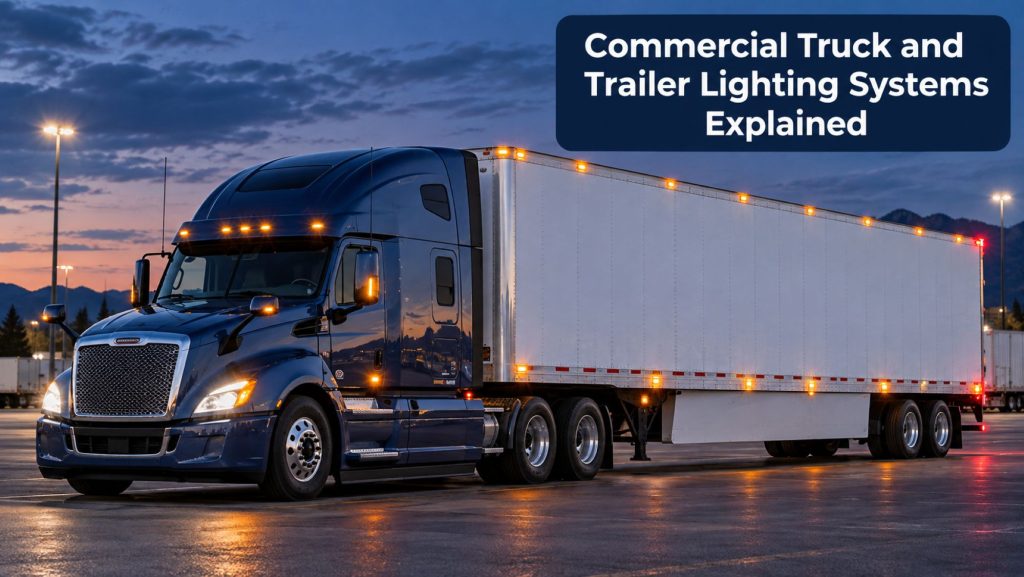
Commercial truck and trailer lighting systems help drivers see the road, communicate vehicle movement, identify the size and position of equipment, illuminate work areas, and make trucks and trailers more visible to other road users. These systems include far more than headlights and taillights. Marker lamps, clearance lamps, identification lamps, turn signals, stop lamps, license-plate lamps, work lights, warning lights, reflectors, wiring, connectors, controls, and circuit protection must all operate together.
Lighting systems face vibration, moisture, road salt, temperature changes, impact, flexing, and repeated tractor-trailer connections. This guide explains the major types of commercial truck and trailer lighting, how the circuits operate, the differences between LED and incandescent lamps, common problems, inspection methods, maintenance practices, and replacement considerations.
What Commercial Vehicle Lighting Systems Do
Commercial vehicle lighting performs several separate functions. Forward lighting helps the driver see. Signaling lamps communicate braking and turning. Clearance, marker, and identification lamps show the vehicle’s presence and general dimensions. Reflective materials improve visibility without electrical power. Work lights illuminate loading, coupling, inspection, and jobsite areas.
Lighting circuits depend on batteries, alternator output, switches, electronic controllers, wiring harnesses, connectors, grounds, fuses, circuit breakers, and truck-to-trailer connections. For a broader explanation of these relationships, see How Commercial Truck Electrical Systems Work.
Major Types of Truck and Trailer Lighting
Headlamps
Headlamps provide low-beam and high-beam forward illumination. Modern trucks may use halogen, high-intensity-discharge, or LED headlamp assemblies. Their performance depends on correct aim, clean lenses, secure mounting, proper voltage, compatible controls, and undamaged reflectors or optics.
Daytime Running Lamps
Daytime running lamps increase vehicle visibility during daylight operation. Depending on the truck, they may use dedicated lamps, reduced-intensity headlamps, or another approved lighting configuration controlled automatically by the vehicle.
Front and Rear Turn Signals
Turn signals communicate the driver’s intention to change direction or lanes. The circuits may also support hazard-warning operation. Modern electronic flashers and body controllers monitor lamp load differently from older thermal flashers, so replacement lamp compatibility matters.
Stop, Turn, and Tail Lamps
Rear combination lamps may provide tail, stop, and turn functions in one assembly. Separate-function systems use different lamps or circuits for braking and turn signaling. Correct operation depends on the tractor controls, trailer connection, harness, grounds, lamp modules, and circuit design.
Clearance Lamps
Clearance lamps are mounted near the outer edges of a wide vehicle to indicate its overall width. Front clearance lamps are generally amber, while rear clearance lamps are generally red. Their placement is distinct from side-marker and identification lamps.
Identification Lamps
Identification lamps are typically arranged as a group of three near the centerline at the front or rear of qualifying vehicles. They help identify a large commercial vehicle when viewed from a distance.
Side-Marker Lamps
Side-marker lamps show the presence and length of a vehicle when viewed from the side. Their color and position depend on whether they mark the front, intermediate area, or rear portion of the truck or trailer.
License-Plate Lamps
License-plate lamps illuminate the rear registration plate. These small lamps are easily overlooked during daytime inspection and often fail because of corrosion, damaged wiring, or water entry.
Backup Lamps
Backup lamps provide rearward illumination and indicate reverse operation. Their control may come from a transmission switch, range sensor, body controller, or electronic data network.
Work and Utility Lights
Work lights illuminate coupling areas, cargo spaces, loading zones, tool compartments, equipment controls, and jobsite areas. They should be aimed and controlled so they serve the task without creating glare for other road users.
Warning and Beacon Lights
Vocational, service, construction, recovery, and oversize-load vehicles may use warning beacons, strobes, light bars, or directional warning lamps. Color, placement, and permitted use vary by jurisdiction and application.
Lighting-System Components
| Component | Function |
|---|---|
| Lamp assembly | Produces and directs light for illumination, signaling, or identification |
| Lens and optics | Control color, beam pattern, intensity distribution, and visibility |
| Switch or control input | Requests lighting operation manually or automatically |
| Relay or electronic driver | Controls electrical power to the lamp circuit |
| Fuse or circuit breaker | Protects wiring from excessive current |
| Harness and connectors | Carry power, ground, control, and communication signals |
| Ground circuit | Provides the return path to the electrical source |
| Flasher or body controller | Creates turn-signal timing and may monitor lamp operation |
| Truck-to-trailer cable | Transfers lighting and auxiliary circuits between tractor and trailer |
| Reflector or conspicuity material | Returns external light to improve visibility without electrical power |
How Truck Lighting Circuits Operate
Traditional lighting circuits route battery or ignition power through a fuse, switch, relay, wiring, lamp, and ground. Newer trucks often use electronic controllers. A dashboard switch may send only a low-current request to a body controller, which then powers or commands the lamp circuit.
Electronic systems may monitor current, detect open or shorted circuits, store fault codes, and communicate with other modules. Pulse-width modulation may control brightness or reduce electrical consumption. Because a digital meter can display an average rather than the complete waveform, some lighting problems require a scan tool, oscilloscope, or manufacturer-specific test procedure.
How Trailer Lighting Circuits Operate
Trailer lighting power and control pass from the tractor through the electrical receptacle, plug, and cable into the trailer junction box and harness. Individual branches supply clearance, marker, tail, stop, turn, license, and auxiliary circuits. Ground may return through a dedicated conductor and approved bonding points.
A fault at the tractor socket can affect every connected trailer, while a fault within one trailer appears only with that unit. Substituting a known-good tractor or trailer can help isolate the side of the connection, but direct testing should confirm the diagnosis.
LED vs Incandescent Commercial Vehicle Lighting
| Characteristic | LED Lighting | Incandescent Lighting |
|---|---|---|
| Light source | Solid-state light-emitting diodes | Heated wire filament inside a bulb |
| Electrical demand | Generally lower for comparable function | Generally higher |
| Service life | Often longer when electronics and sealing remain sound | Shorter because filaments wear and break |
| Vibration resistance | No fragile filament; usually well suited to vehicle vibration | Filament can fail from vibration and shock |
| Failure pattern | Individual diodes, driver circuit, connector, or complete module may fail | Filament usually opens and bulb stops operating |
| Compatibility | May require compatible flashers, controllers, resistors, or monitoring strategy | Typically matches older load-based circuit designs |
| Heat behavior | Produces less forward radiant heat but electronics still require heat management | Produces significant heat at the bulb and socket |
LED lamps can reduce maintenance and electrical load, but quality, sealing, thermal design, connector condition, voltage compatibility, beam performance, and regulatory compliance remain important. An LED replacement should not be selected solely because it fits the opening.
Lighting Loads and the Charging System
A truck and trailer may operate dozens of lamps at the same time. Headlamps, marker lamps, work lights, warning equipment, cab lighting, and trailer lighting add to HVAC, electronic, and accessory demand. At low engine speed, total demand may approach or exceed available alternator output.
Repeated operation with inadequate output can discharge the batteries even while the engine runs. High-output lighting installations should be evaluated with alternator capacity, idle output, battery reserve, cable size, circuit protection, and control strategy. See Commercial Truck Alternators and Charging Systems Explained.
Common Truck and Trailer Lighting Problems
| Symptom | Possible Causes |
|---|---|
| One lamp does not work | Failed lamp, damaged socket, poor local ground, open wire, corroded connector, or control fault |
| Several lamps on one circuit fail | Blown fuse, failed relay, open feed, shared ground problem, controller fault, or disconnected harness |
| All trailer lights fail | Tractor socket fault, disconnected cable, poor main ground, open power feed, junction-box problem, or damaged cord |
| Lamp is dim | Low voltage, high resistance, weak ground, incorrect lamp, damaged connector, or charging-system problem |
| Lamp flickers | Loose terminal, broken conductor, vibration, poor ground, failing lamp electronics, or intermittent control |
| Fuse repeatedly opens | Short to ground, damaged harness, water intrusion, incorrect lamp, overloaded circuit, or wiring modification |
| Turn signal flashes incorrectly | Failed lamp, incompatible LED conversion, incorrect flasher load, controller fault, or wiring problem |
| Water inside lamp | Cracked lens, damaged seal, blocked vent, loose mounting, or failed housing |
| Lamps fail frequently | Overvoltage, vibration, poor mounting, water entry, heat, incorrect lamp, or connector damage |
| Wrong lamps operate together | Poor ground, crossed wiring, connector contamination, backfeed, or incorrect repair |
Why Poor Grounds Cause Unusual Lighting Symptoms
When a lamp loses its normal ground path, current may attempt to return through another filament, lamp, circuit, or control module. This can make several lamps glow dimly, cause turn signals to affect marker lights, or make stop lamps behave unpredictably.
Ground connections should be tested under load. A continuity beep with the lamps off does not prove that the path can carry operating current. Inspect shared grounds when several nearby lamps show related symptoms.
Inspecting Truck and Trailer Lighting
- Walk around the complete combination. Operate low beams, high beams, daytime running lamps, turn signals, hazard lamps, tail lamps, stop lamps, clearance lamps, side markers, identification lamps, backup lamps, license lamps, and required work or warning lights.
- Check lenses and housings. Look for cracks, fading, missing pieces, water intrusion, loose mounting, and impact damage.
- Check lamp position and aim. Confirm that assemblies are secure, correctly oriented, unobstructed, and aimed where applicable.
- Inspect wiring and connectors. Look for abrasion, stretching, corrosion, damaged seals, missing clips, and overheated terminals.
- Inspect grounds. Check local lamp grounds, trailer grounds, frame bonds, and the main truck-to-trailer ground circuit.
- Inspect the tractor receptacle and trailer plug. Check pins, sockets, cable strain relief, cover, seal, and mounting.
- Check the trailer junction box. Inspect cable entries, terminals, grounds, seals, and cover condition.
- Inspect reflective equipment. Confirm that reflectors and conspicuity material are present, clean, visible, and securely attached.
- Verify dashboard indications. Check turn indicators, high-beam indicator, warning messages, and stored lighting faults.
- Retest after repairs. Operate every affected function and confirm that no other circuit was disturbed.
Testing a Failed Lighting Circuit
Begin by confirming the exact failure. Determine whether one lamp, one side, one function, the entire trailer, or several unrelated circuits are affected. Use the wiring diagram to identify shared power feeds, grounds, connectors, splices, and controls.
- Verify the correct switch or control request.
- Check the proper fuse or circuit breaker.
- Confirm voltage at the lamp or connector while the circuit is commanded on.
- Test the ground side under load.
- Measure voltage drop across suspicious connectors, wires, switches, and grounds.
- Inspect terminal fit and connector sealing.
- Check controller commands and fault codes on electronically controlled circuits.
- Substitute a known-good lamp only when it is compatible and safe to do so.
- Repair the underlying wiring, connection, control, or mounting problem.
- Operate all related lighting functions after the repair.
Detailed methods for connector inspection, voltage-drop testing, harness repair, and corrosion control are covered in How to Inspect and Maintain Truck Wiring and Electrical Connections.
Truck-to-Trailer Electrical Connections
The tractor socket, trailer plug, electrical cable, and junction box form the bridge between truck controls and trailer lamps. The cable must be long enough for turns but supported so it does not drag, stretch, kink, or become trapped between equipment.
- Keep plug and socket contacts clean and correctly tensioned.
- Replace cracked housings, damaged covers, and worn seals.
- Secure strain relief around the cable jacket.
- Support the cable with the approved spring or hanger.
- Prevent contact with the catwalk, exhaust, sharp edges, and air-line hardware.
- Inspect the cable for hidden conductor damage after stretching or snagging.
- Keep the trailer junction box closed, sealed, and securely mounted.
Headlamp Aim and Lens Condition
Headlamp output depends on more than bulb brightness. Incorrect aim can reduce the driver’s usable view and create glare for oncoming traffic. Aim can change after collision repair, suspension changes, lamp replacement, mounting damage, or adjustment.
Clouded lenses, internal condensation, damaged reflectors, dirty covers, and incorrect bulbs can reduce performance. Replace or restore components using approved procedures, then verify aim on appropriate equipment and a level surface.
Lighting-System Maintenance
- Clean lenses, reflectors, and reflective material regularly.
- Replace cracked, faded, loose, or water-filled lamp assemblies.
- Maintain correct headlamp aim.
- Inspect harness clips, grommets, loom, and routing.
- Keep connectors sealed and protected from direct pressure washing.
- Repair corrosion and loose terminals before heat damage develops.
- Maintain clean, secure grounds and bonding straps.
- Use the correct lamp type, color, mounting position, and electrical rating.
- Support truck-to-trailer cables so they cannot drag or stretch.
- Verify every lighting function after body, trailer, wiring, or electrical repairs.
- Investigate repeated lamp failure instead of continually replacing the lamp.
Replacing or Upgrading Commercial Vehicle Lights
A replacement lamp should match the required function, color, intensity, beam pattern, mounting orientation, connector, voltage, environmental rating, and applicable vehicle requirements. The housing must fit securely and remain sealed in its installed position.
When converting from incandescent to LED lighting, check compatibility with flashers, body controllers, lamp-out monitoring, dimming, connectors, polarity, and circuit protection. Adding resistors to imitate incandescent load creates heat and should only be done as part of an approved design.
Additional work or warning lights require correctly sized wiring, switches or relays, grounds, mounting, and overcurrent protection. The new load must also be considered when evaluating alternator output and battery capacity.
How Batteries Affect Lighting Performance
Low battery voltage can produce dim, unstable, or unavailable lighting when the engine is off or during starting. A damaged battery connection can affect multiple lighting and control circuits. High voltage caused by charging-system problems can shorten lamp and electronic-driver life.
Battery condition, construction, bank configuration, and connection maintenance are explained in Commercial Truck Batteries Explained. Starting-system voltage drop is covered in Commercial Truck Starters and Starting Systems Explained.
Frequently Asked Questions
Why are trailer lights dim even though they work?
Dim lighting usually indicates low voltage at the lamps, excessive resistance in the power or ground circuit, corroded connectors, an overloaded circuit, incorrect lamps, or a charging-system problem. Test voltage drop while the lamps are operating.
Why do trailer lights work with one tractor but not another?
The trailer may be functional while the second tractor has a socket, fuse, control, wiring, or ground fault. Differences in electronic lamp monitoring or LED compatibility can also matter. Test each circuit at the tractor receptacle.
Why do turn signals flash rapidly after an LED conversion?
The flasher or controller may interpret the lower LED current as a failed lamp. Use lamps and control equipment designed to work together rather than adding unapproved load devices.
Does condensation mean a lamp has failed?
A small amount of temporary condensation may occur in some vented designs, but standing water, persistent fogging, corrosion, or loss of light output indicates a sealing, venting, mounting, or housing problem that needs attention.
Can a bad ground make the wrong lights illuminate?
Yes. Current may return through another lamp circuit when the normal ground path has excessive resistance. This can cause dim lamps, cross-feeding, or several functions operating together.
The Role of Lighting in Commercial Vehicle Safety
Commercial truck and trailer lighting helps drivers see, signals vehicle movement, communicates equipment size and position, and improves visibility during darkness, poor weather, loading, and roadside work. One failed lamp may appear minor, but shared wiring or ground problems can disable several safety functions at once.
A consistent inspection routine, sound wiring, clean connections, correct grounds, properly matched lamps, and prompt repair of water intrusion or heat damage help keep the vehicle visible and predictable. Testing circuits under load is the most reliable way to separate a failed lamp from an underlying wiring, power, control, or ground problem.