
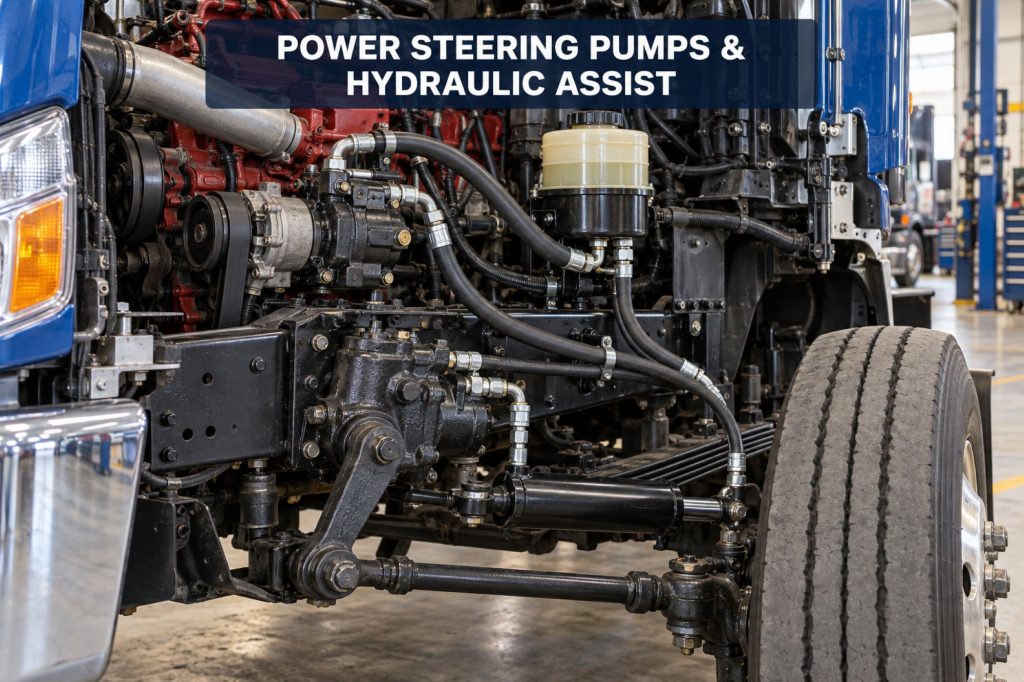
Power steering pumps and hydraulic-assist systems provide the hydraulic pressure needed to reduce steering effort in commercial trucks, buses, motorhomes, and vocational vehicles. These systems help drivers control heavily loaded steer axles while maneuvering, turning at low speeds, and operating in demanding conditions.
This section of Truck Equipment Atlas covers engine-driven power steering pumps, hydraulic reservoirs, pressure and return lines, steering-assist cylinders, flow-control components, and related hydraulic steering equipment.
How Commercial Truck Power Steering Works
A commercial truck’s power steering pump draws hydraulic fluid from a reservoir and sends pressurized fluid to the steering gear. When the driver turns the steering wheel, a control valve inside the steering gear directs pressure to the appropriate side of an internal piston.
The hydraulic force assists the driver in moving the pitman arm, drag link, steering arm, steering knuckles, and steer tires. Fluid then returns to the reservoir through the steering system’s return circuit.
The amount of assistance depends on pump output, system pressure, steering-gear design, engine speed, steer-axle loading, tire contact, and vehicle configuration.
Power Steering Pumps
The power steering pump is normally driven by the truck’s engine through a gear, shaft, belt, or application-specific accessory drive. It must deliver sufficient hydraulic flow and pressure throughout the engine’s operating range.
Commercial-vehicle power steering pumps may use vane, roller, gear, or other positive-displacement designs. The correct pump must match the steering gear, hydraulic circuit, engine installation, mounting arrangement, rotation direction, shaft configuration, and required pressure and flow.
Hydraulic Steering Assist
Hydraulic steering assist supplements the primary steering gear when one steering gear alone cannot provide the force required by the vehicle’s front-axle configuration.
Depending on the system, assistance may be provided by a second steering gear, a hydraulic assist cylinder, or another power-assisted steering component. These arrangements are commonly used on trucks with high-capacity steer axles, wide front tires, multiple steering axles, or severe vocational operating requirements.
The primary and assisting components must operate together without binding, unequal travel, excessive pressure, or incorrect steering geometry.
Major Power Steering System Components
- Engine-driven power steering pump
- Hydraulic fluid reservoir
- Reservoir cap and breather
- Hydraulic filter or strainer
- High-pressure supply hose
- Low-pressure return hose
- Hydraulic fittings and adapters
- Pressure-relief valve
- Flow-control valve
- Primary steering gear
- Auxiliary steering gear or assist cylinder
- Hydraulic fluid cooler when equipped
- Temperature, pressure, or fluid-level sensors when equipped
Common Power Steering Configurations
Commercial trucks use several power-assisted steering arrangements based on their axle capacity, chassis design, and operating application.
- Single power steering pump with one integral steering gear
- Single pump supplying a primary and auxiliary steering gear
- Primary steering gear with a hydraulic assist cylinder
- Dual-steering-gear systems for high-capacity steer axles
- Multiple-steer-axle hydraulic systems
- Engine-driven pump with an external reservoir
- Remote-reservoir and fluid-cooler configurations
- Emergency or backup steering-assist systems on applicable vehicles
Pressure, Flow, and Steering Performance
Hydraulic pressure provides steering force, while fluid flow influences how quickly the steering system can respond. Both must remain within the requirements established for the pump, steering gear, hoses, valves, and assisting components.
Insufficient pressure can increase steering effort. Inadequate flow may make the steering feel slow or unresponsive, particularly at low engine speed. Excessive pressure or flow can create heat, noise, seal damage, unstable steering response, and premature component wear.
Reservoirs, Filtration, and Fluid Cooling
The hydraulic reservoir stores steering fluid, allows air to separate from the fluid, and helps manage temperature changes. Some reservoirs include replaceable filters or internal strainers that remove contaminants from the return flow.
Vehicles exposed to high steering loads, repeated low-speed maneuvering, severe heat, or demanding vocational service may use a fluid cooler. Clean fluid, correct fluid level, proper filtration, and adequate cooling are essential to steering-system life.
Common Applications
- Highway tractors
- Regional and local-delivery trucks
- Dump trucks
- Concrete mixers
- Refuse trucks
- Heavy-haul tractors
- Recovery and towing vehicles
- Fire apparatus
- Transit and school buses
- Motorhomes and specialty vehicles
- Crane, utility, and construction trucks
- Vehicles with high-capacity or multiple steer axles
Vehicle and System Compatibility
A replacement power steering pump or hydraulic-assist component must be matched to the complete vehicle and steering system. Similar-looking components may use different operating pressures, flow rates, rotation directions, mounting patterns, shaft designs, ports, fittings, or internal calibrations.
Compatibility may depend on the truck manufacturer, model, model year, engine, accessory drive, steer-axle capacity, steering-gear model, pump mounting, hydraulic-line routing, reservoir design, and original vehicle specification.
Inspection and Maintenance
Power steering systems should be inspected for fluid loss, hose damage, loose fittings, pump noise, reservoir contamination, excessive temperature, and changes in steering effort.
- Check the reservoir fluid level and fluid condition
- Inspect the pump, reservoir, steering gear, and assist components for leaks
- Inspect pressure and return hoses for abrasion, cracking, swelling, and heat damage
- Verify that hydraulic lines do not contact exhaust, driveline, suspension, or steering components
- Replace filters according to the applicable service schedule
- Inspect pump mounting hardware and drive components
- Check assist-cylinder mounts and bushings when equipped
- Use only the approved hydraulic fluid
- Bleed trapped air after opening or servicing the hydraulic circuit
Common Power Steering Problems
Changes in steering effort or hydraulic-system behavior should be investigated promptly. Common power steering problems include:
- Low hydraulic fluid
- External fluid leaks
- Air trapped in the system
- Contaminated or incorrect fluid
- Restricted reservoir filter or return line
- Worn or damaged power steering pump
- Incorrect pump pressure or flow
- Loose or slipping pump drive
- Overheated hydraulic fluid
- Damaged pressure or return hoses
- Internal steering-gear leakage
- Binding linkage or steering knuckles
- Incorrect adjustment between primary and assisting steering components
Power Steering and Hydraulic-Assist Products
Truck Equipment Atlas is expanding its coverage of commercial power steering pumps and hydraulic-assist equipment. Product pages in this section will include:
- ZF TRW PS Series Power Steering Pump
- ZF TRW EV Series Power Steering Pump
- Eaton Vickers V20 Power Steering Pump
- ZF TRW RCH Hydraulic Assist Cylinder
Related Driveline and Steering Categories
- Commercial Truck Driveshafts
- Universal Joints, Slip Yokes & Center Bearings
- Steering Gears & Steering Linkage
- Steering Columns & Driver Controls
- Advanced Steering & Lane-Keeping Systems
Related Equipment Systems
- Drivelines & Steering Systems
- Axles & Differentials
- Suspension Systems
- Tires & Wheels
- PTO & Hydraulic Systems
- Brake Systems
Related Guides
- How Commercial Truck Steering Systems Work
- Hydraulic vs Electric-Assisted Commercial Truck Steering
- Common Commercial Truck Driveline Vibrations and Steering Problems
- Driveline & Steering System Guides
Explore Drivelines & Steering Systems
Visit the Drivelines & Steering Systems hub to explore commercial truck driveshafts, universal joints, steering gears, steering pumps, driver controls, hydraulic-assist systems, and advanced steering technologies.
Follow the Growth of Truck Equipment Atlas
Truck Equipment Atlas continues to expand with new truck profiles, trailer coverage, diesel engine pages, equipment-system resources, manufacturer information, and educational guides.
Visit our Site Updates page to explore recent additions, project milestones, and upcoming resources as we continue building one of the industry’s growing commercial trucking equipment reference libraries.
View the Latest Site Updates: Truck Equipment Atlas Site Updates