
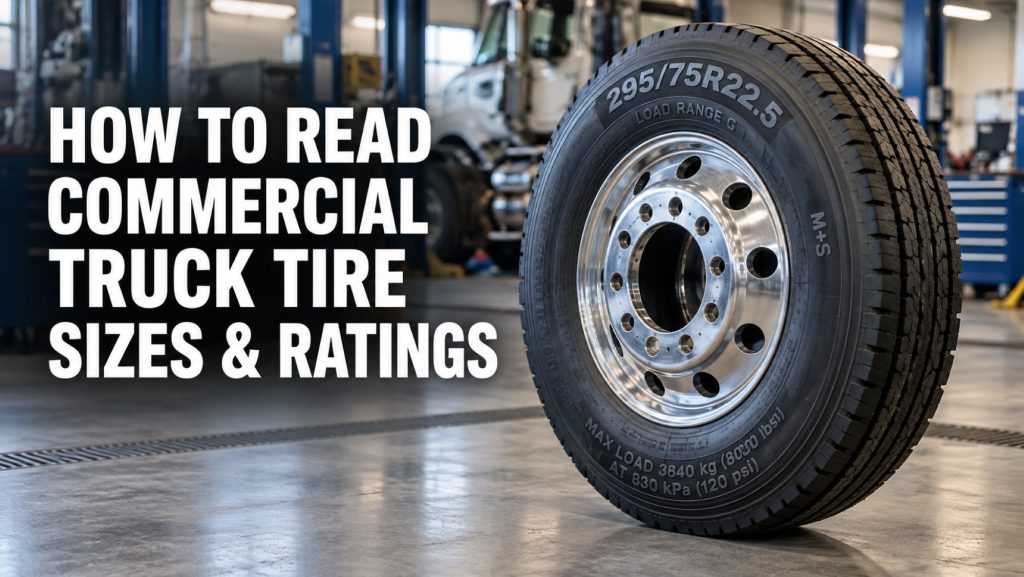
Commercial truck tire sidewalls contain the information needed to confirm size, capacity, construction, and operating limits—but the mix of numbers and letters can be difficult to interpret. A marking such as 295/75R22.5 144/142L identifies much more than the tire’s width. It also describes its profile, construction, wheel fitment, load indexes, and speed symbol.
Correctly reading these markings helps fleets and owner-operators avoid fitment problems, overloaded tires, dual-tire mismatches, and incorrect inflation decisions. It is also important when comparing replacement tires because two products with the same basic size may have different load ranges, approved wheel widths, speed limits, or application requirements.
This guide explains the most common commercial truck tire size formats and ratings. Always confirm the final selection with the vehicle requirements, wheel specifications, and the tire manufacturer’s current data book and load-and-inflation tables.
Why Commercial Truck Tire Markings Matter
A tire must do more than physically fit the wheel. It must also support the actual axle load, provide adequate clearance, match the intended axle position and service, and remain within the limits of the wheel, valve, and vehicle.
- Size markings identify the tire’s nominal dimensions and required rim diameter.
- Load range and load index indicate capacity categories that must be checked against manufacturer tables.
- Single and dual ratings show how capacity changes with the mounting configuration.
- Speed symbols identify a tested maximum-speed category under specified conditions.
- DOT and date markings help identify the tire and determine when it was manufactured.
Matching only the large size marking on the sidewall is not enough. The complete tire specification must suit the truck, wheel, load, route, and duty cycle.
A Commercial Truck Tire Size Example
Consider this representative sidewall description:
295/75R22.5 144/142L — Load Range G
| Marking | General Meaning |
|---|---|
| 295 | Nominal section width in millimeters |
| 75 | Aspect ratio; sidewall height is approximately 75% of the nominal section width |
| R | Radial construction |
| 22.5 | Required wheel rim diameter in inches |
| 144/142 | Load indexes for single and dual use |
| L | Speed symbol; consult the manufacturer’s rating table |
| Load Range G | Strength and load-carrying category for that tire size and design |
These markings describe separate characteristics. Do not treat the size, load range, load index, or speed symbol as interchangeable pieces of information.
How to Read a Metric Truck Tire Size
Metric sizes such as 295/75R22.5, 315/80R22.5, and 255/70R22.5 follow the same basic pattern.
295: Nominal Section Width
The first number is the tire’s nominal section width in millimeters. In a 295/75R22.5 tire, the nominal width is 295 millimeters. This is not a guaranteed measurement of the tread face. Actual section width can vary by tire model, approved measuring rim, inflation, and load.
75: Aspect Ratio
The second number is the aspect ratio. It expresses sidewall height as a percentage of the nominal section width. For a 295/75 tire, the sidewall height is approximately 75% of 295 millimeters. This ratio helps determine the tire’s overall diameter, but the manufacturer’s specification sheet provides the correct published dimensions.
R: Radial Construction
The letter R means the tire uses radial construction. Nearly all modern over-the-road commercial truck tires are radial. A different construction type should never be substituted or mixed without confirming that the vehicle and tire manufacturers permit it.
22.5: Wheel Diameter
The final number identifies the nominal rim diameter in inches. A 295/75R22.5 tire requires a compatible 22.5-inch commercial truck wheel. Rim diameter alone does not establish compatibility; the wheel width, flange profile, offset, capacity, and condition also matter.
How to Read a Conventional Numeric Size
Commercial tires are also commonly marked with conventional sizes such as 11R22.5 or 12R22.5.
- 11 is the nominal section-width designation in inches.
- R identifies radial construction.
- 22.5 identifies the required nominal rim diameter in inches.
Unlike a metric size, the conventional marking does not display a separate aspect-ratio number. Do not estimate interchangeability by comparing the printed width alone. Use published overall diameter, section width, loaded radius, approved rim width, and revolutions-per-mile data.
| Feature | 295/75R22.5 | 11R22.5 |
|---|---|---|
| Format | Metric | Conventional numeric |
| Width designation | Millimeters | Inches |
| Aspect ratio shown | Yes | No separate ratio shown |
| Construction | Radial | Radial |
| Rim diameter | 22.5 inches | 22.5 inches |
| Direct substitutes? | Not automatically; compare the complete specifications and vehicle requirements | |
Other Commercial Tire Size Formats
The same reading method applies to many highway, regional, vocational, and trailer tires:
- 315/80R22.5: A metric radial size with a taller profile than many 70- or 75-series tires.
- 255/70R22.5: A narrower metric size often encountered in lower-profile applications.
- 425/65R22.5 and 445/50R22.5: Wide-base sizes used in selected steer, drive, trailer, and vocational configurations.
- 17.5- and 19.5-inch sizes: Common on medium-duty trucks, delivery vehicles, trailers, and specialized equipment.
A size family does not identify an axle position by itself. Review the tire’s service description and application information, then compare steer, drive, and trailer tire requirements.
Load Range and Ply Rating
Load range is a strength and capacity category shown by a letter, such as Load Range G, H, J, or L. The correct load range depends on the tire size, construction, intended service, inflation, and required capacity.
Ply rating is an older strength classification that may still appear in product literature or on a sidewall. It is a relative rating—not a literal count of the physical fabric plies inside a modern tire. For example, a tire described with a high ply rating does not necessarily contain that number of body plies.
Do not assume that every tire carrying the same load-range letter has the same capacity or inflation requirement. Always look up the exact size and product in the manufacturer’s current commercial tire data book.
Understanding Load Index and Service Description
A service description may appear after the size, as in 144/142L. The numerical values are load indexes, and the letter is the speed symbol.
The First Load Index: Single Use
The first number generally applies when one tire is installed at each end of the axle. This is called a single configuration.
The Second Load Index: Dual Use
The second number generally applies to each tire when two tires are installed together at each axle end. It is usually lower because dual assemblies introduce load-sharing, spacing, matching, and heat considerations.
Converting the Index to Capacity
A load index is a code, not the load in pounds or kilograms. Convert it using the applicable tire manufacturer’s load-index table and verify the capacity at the intended cold inflation pressure. Do not simply multiply the printed index number by the number of tires.
Single Versus Dual Tire Capacity
Single and dual ratings describe different mounting configurations:
- Single: One tire at each end of the axle.
- Dual: Two tires mounted side by side at each end of the axle.
For a dual assembly, use the per-tire dual capacity from the correct table and multiply it by the number of tires only after confirming pressure, matching, spacing, and wheel capacity. Both tires in a dual pair should be compatible in size, construction, and overall diameter. A significant mismatch can force one tire to carry more of the load and generate excess heat.
How to Read the Speed Symbol
The final letter in a service description—such as the L in 144/142L—is a speed symbol. It corresponds to a maximum-speed category under defined load, inflation, and test conditions. It is not a recommended cruising speed and does not override posted limits, vehicle ratings, road conditions, or the tire maker’s service restrictions.
Some vocational, mixed-service, off-road, and special-application tires have reduced speed limits or load adjustments. Check the exact product data rather than applying a general passenger-tire chart to a commercial truck tire.
MAX LOAD and MAX PRESS Markings
The sidewall may state a maximum load at a specified cold inflation pressure. These values identify tire limits; they are not automatically the truck’s correct everyday operating pressure.
Determine operating pressure from reliable axle weights and the tire manufacturer’s load-and-inflation table, while observing every applicable vehicle, wheel, valve, and tire limit. The pressure printed on a vehicle placard or specified by the vehicle manufacturer also remains important. Never exceed the lowest-rated component in the assembly.
Pressure should be checked cold with an accurate commercial tire gauge. Tire pressure monitoring or automatic inflation equipment can help identify pressure loss, but it does not replace regular inspection. Learn more in the tire pressure monitoring and inflation systems guide.
DOT Identification and Tire Date Codes
A DOT Tire Identification Number contains codes used to identify the manufacturing plant and tire characteristics. The final four digits of the complete code identify the manufacturing date. For example, 2325 means the tire was manufactured during the 23rd week of 2025.
The complete DOT code may appear on only one sidewall, so the inward-facing side may need to be inspected. A date code does not by itself determine whether a tire is serviceable. Evaluate age together with casing condition, maintenance history, exposure, damage, repairs, and manufacturer or fleet policy.
Other Sidewall Markings to Know
Tubeless
A Tubeless marking identifies a tire designed to operate without an inner tube on the correct tubeless wheel assembly. It does not mean every wheel of the same diameter is suitable.
Regroovable
A Regroovable marking indicates that the tire was designed with sufficient material for regrooving when the procedure is allowed and performed according to the tire manufacturer’s instructions and applicable regulations. It is not permission to cut any tread to an arbitrary depth.
M+S and 3PMSF
M+S generally identifies a mud-and-snow tread designation based on tread geometry. The three-peak mountain snowflake symbol, often abbreviated 3PMSF, indicates that the tire met a defined snow-traction performance test. Neither marking eliminates the need to follow chain laws, route restrictions, and fleet winter-equipment policies.
Directional and Mounting Markings
Directional tires may carry an arrow showing the intended direction of rotation. Some products have markings such as Outside and Inside. Incorrect mounting can interfere with the intended wear, water evacuation, or performance characteristics.
Construction Materials
Sidewall text may list the number and material of plies in the tread and sidewall. These construction statements are separate from the legacy ply-rating concept and should not be used alone to calculate load capacity.
Information Found in the Tire Data Book
The sidewall does not contain every dimension needed for a fitment decision. Manufacturer data books commonly provide:
- Approved and measuring rim widths
- Overall diameter and section width
- Static loaded radius
- Revolutions per mile
- Maximum load and inflation values
- Minimum dual spacing
- Tread depth, weight, and application recommendations
- Speed or service restrictions
Use data for the exact tire model. Published dimensions can differ between products that carry the same size designation.
Matching the Tire to the Wheel
A correct tire size still requires a compatible wheel. Verify the rim diameter, approved rim width, wheel load and pressure ratings, contour, offset, mounting system, and valve equipment. Inspect the wheel for cracks, deformation, corrosion, damaged fastener seats, and other service issues.
Wide-base tires and higher-capacity applications deserve particular attention because wheel width, offset, bearing load, fender clearance, and track width may change. Review the commercial truck wheels guide before combining unfamiliar tire and wheel specifications.
What to Check Before Changing Tire Size
Changing from the original tire size can affect more than ground clearance. Before approving a change, verify:
- Front, rear, and gross axle weight requirements
- Wheel width, offset, load rating, and inflation rating
- Fender, suspension, brake, tie-rod, and body clearance through the full steering and suspension range
- Minimum spacing and diameter matching for dual assemblies
- Vehicle ride height, driveline angle, and fifth-wheel or trailer clearance where applicable
- Revolutions per mile and possible effects on the speedometer, odometer, gearing, ABS, and electronic controls
- Manufacturer approval, warranty terms, and fleet standardization
Never use a smaller or lower-rated replacement solely because it fits the wheel. The replacement tire’s size, load capacity, speed capability, and service designation should meet or exceed the requirements established for the vehicle and application.
Common Tire-Mark Reading Mistakes
- Treating MAX PRESS as the recommended operating pressure: Operating pressure must be established from load and approved tables without exceeding component limits.
- Using the single rating for a dual installation: The two load indexes serve different mounting configurations.
- Assuming ply rating is a literal ply count: It is a strength classification.
- Choosing by size alone: Identical size markings can appear on tires with different load ranges, tread designs, dimensions, and service restrictions.
- Ignoring wheel limitations: The wheel or valve may have a lower pressure or load rating than the tire.
- Mixing poorly matched duals: Differences in diameter, inflation, or wear can overload one tire.
- Reading only the outward sidewall: The complete DOT identification or mounting information may be on the other side.
Commercial Truck Tire Verification Checklist
- Record the complete size, load range, service description, and sidewall load information.
- Confirm whether the installation is single or dual.
- Obtain accurate axle weights for the vehicle in representative loaded service.
- Use the exact manufacturer’s load-and-inflation table for the tire size and configuration.
- Verify wheel dimensions, load rating, pressure rating, valve equipment, and condition.
- Check clearances, dual spacing, and tire matching.
- Confirm the tire is approved for the axle position, route, speed, and duty cycle.
- Inspect the DOT date code, casing condition, tread, sidewalls, bead area, and previous repairs.
- Document the selected cold inflation pressure and inspection schedule.
Frequently Asked Questions
What does 295/75R22.5 mean?
It identifies a tire with a nominal 295-millimeter section width, a sidewall height approximately 75% of that width, radial construction, and a 22.5-inch rim diameter.
What does 144/142L mean on a truck tire?
The first number is generally the single-use load index, the second is the dual-use load index, and the letter is the speed symbol. Use the tire manufacturer’s current tables to convert those codes and confirm applicable conditions.
Are 11R22.5 and 295/75R22.5 tires interchangeable?
Not automatically. They use different size formats and may differ in overall diameter, width, loaded radius, revolutions per mile, capacity, and approved rims. A qualified tire professional should verify the complete application before a substitution.
Does a higher load range always carry more weight?
A higher load range generally represents a higher strength or pressure category within an applicable size, but the exact capacity must come from the manufacturer’s table. Do not compare the letter without also checking size, inflation, and single or dual use.
Is the maximum pressure on the sidewall the pressure I should use?
No. It identifies a limit associated with the sidewall load statement. Determine operating pressure using actual loads, manufacturer tables, and vehicle requirements while staying within all tire, wheel, valve, and vehicle limits.
Can steer, drive, and trailer tires have the same size?
Yes. The same basic size can be available in multiple tread designs and applications. Size alone does not establish the correct axle position. Review the tread design, casing, service description, application guidance, and fleet operating conditions.
Explore Commercial Truck Tire Guides
- Commercial Truck Tire Types Explained
- Steer vs Drive vs Trailer Tires
- Steer Tires
- Drive Tires
- Trailer Tires
- Vocational and Severe-Service Tires
Explore the Tires & Wheels Library
Visit the Tires & Wheels guide library for more information about commercial tire applications, truck wheels, tire-pressure systems, selection, inspection, and maintenance.
Related Guide Libraries
Continue Exploring Truck Equipment Atlas
Truck Equipment Atlas publishes practical guides covering commercial truck components, specifications, selection, inspection, and maintenance. Visit Site Updates to find newly published and recently updated resources.