
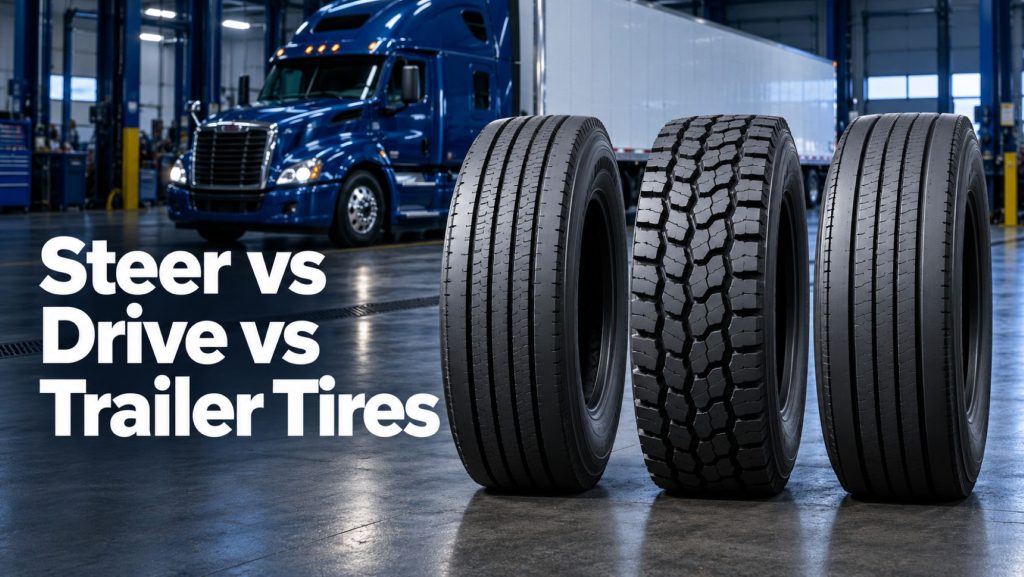
Steer, drive, and trailer tires may share the same basic size, but they are designed for different wheel positions and operating forces. Each position places its own demands on tread design, casing construction, traction, handling, wear resistance, and fuel efficiency.
Steer tires help control vehicle direction. Drive tires transfer engine power to the road. Trailer tires support cargo while resisting lateral scrub and free-rolling wear. Using the correct tire in each position helps protect handling, traction, braking, casing life, and overall operating cost.
This guide compares the three primary commercial truck tire positions, explains how their designs differ, and identifies the factors drivers, fleets, technicians, and equipment buyers should consider when selecting them.
Why Tire Position Matters
Every axle position creates a different combination of vertical load, side force, torque, braking force, heat, and road contact. Tire manufacturers develop tread patterns and casing features around those conditions.
- Steer position: Prioritizes directional control, predictable handling, water evacuation, and even wear.
- Drive position: Prioritizes traction, torque transfer, braking grip, and resistance to tread movement.
- Trailer position: Prioritizes load support, low rolling resistance, scrub resistance, and durability during tight turns.
A tire should be installed only in wheel positions approved by its manufacturer. Similar appearance or matching size does not guarantee position compatibility.
Steer Tires Explained
Steer tires are mounted on the front steering axle of a tractor or straight truck. They influence how accurately the vehicle tracks, responds to steering input, handles wet pavement, and communicates road conditions to the driver.
Common Steer-Tire Design Features
- Continuous circumferential ribs
- Straight or slightly angled grooves
- Stable shoulder ribs
- Water-evacuation channels
- Compounds balanced for mileage and wet traction
- Designs intended to resist irregular shoulder wear
- Casings engineered for steering loads and possible retreading
Rib-style tread helps a steer tire roll smoothly and maintain directional stability. Grooves channel water away from the footprint, while shoulder design affects cornering, scrub, and wear.
Steer-Tire Priorities
- Steering response
- Highway stability
- Wet braking and water evacuation
- Predictable cornering
- Even wear across the tread
- Ride quality and low vibration
- Protection against irregular wear caused by alignment or suspension problems
Because steer tires directly affect vehicle control, damage, underinflation, excessive wear, or an unsuitable tread design can create serious handling concerns.
Drive Tires Explained
Drive tires are mounted on powered axles. They transfer engine torque to the road and provide traction during acceleration, climbing, braking, and operation on wet, snowy, loose, or uneven surfaces.
Common Drive-Tire Design Features
- Lug, block, or combination tread patterns
- Numerous biting edges
- Open or closed shoulder designs
- Deeper tread than many steer or trailer tires
- Sipes for wet or winter traction
- Stone-ejection and casing-protection features
- Compounds designed to manage torque, heat, and wear
Open-shoulder drive tires can provide strong traction in snow, mud, or loose material. Closed-shoulder designs may support more even highway wear, reduced tread movement, and lower rolling resistance.
Drive-Tire Priorities
- Acceleration and climbing traction
- Braking grip
- Wet, snow, or off-road performance
- Resistance to torque-related wear
- Heat control
- Fuel efficiency
- Long tread and casing life
The most aggressive drive tread is not automatically the best choice. Long-haul fleets may prioritize rolling resistance and even wear, while vocational fleets may need deeper tread, open shoulders, and greater cut or chip resistance.
Trailer Tires Explained
Trailer tires are used on non-powered trailer axles. They support cargo weight and roll freely, but they also experience braking forces, lateral scrub, curb contact, tight-turn stress, and long periods of inactivity.
Common Trailer-Tire Design Features
- Rib-style or shallow tread patterns
- Scrub-resistant compounds
- Reinforced shoulder areas
- Low-rolling-resistance designs
- Grooves that promote stable free rolling
- Casings designed for load support and retread potential
- Application-specific protection for spread axles or mixed service
Trailer tires can experience severe lateral scrub because trailer axles do not steer through a turn. The problem becomes more noticeable on spread-axle trailers, multi-axle groups, city routes, and equipment that regularly makes tight turns.
Trailer-Tire Priorities
- Load support
- Scrub resistance
- Low rolling resistance
- Stable tracking
- Resistance to irregular shoulder wear
- Casing durability
- Compatibility with trailer axle and suspension geometry
Steer vs Drive vs Trailer Tire Comparison
| Feature | Steer tire | Drive tire | Trailer tire |
|---|---|---|---|
| Primary job | Control direction and handling | Transfer power and provide traction | Support trailer load and roll efficiently |
| Common tread | Rib | Lug, block, or combination | Rib or scrub-resistant pattern |
| Main forces | Steering, cornering, braking | Torque, traction, braking | Load, braking, lateral scrub |
| Key priority | Stability and predictable control | Traction and torque transfer | Scrub resistance and rolling efficiency |
| Typical shoulder | Stable, wear-resistant rib | Open or closed depending on service | Reinforced for scrub resistance |
| Common wear concern | Shoulder or rib irregularity | Heel-and-toe or torque wear | Scrub and shoulder wear |
| Fuel-efficiency focus | Important | Important under load and torque | Especially important across multiple axles |
How Tread Patterns Differ
The tread pattern helps reveal a tire’s intended function, although appearance alone cannot confirm approved use.
Steer-Tire Tread
Long circumferential ribs support straight tracking and smooth steering. Channels evacuate water while stable shoulders help control cornering and irregular wear.
Drive-Tire Tread
Transverse lugs and blocks create biting edges that transmit torque. Shoulder openness, tread depth, and siping vary according to highway, winter, regional, or vocational service.
Trailer-Tire Tread
Trailer patterns often use ribs that roll freely and resist sideways movement. Compounds and shoulder designs may be optimized for scrub, especially on trailers that make frequent tight turns.
Can One Tire Be Used in Multiple Positions?
Some commercial tires are classified as all-position tires and may be approved for steer, drive, trailer, or selected vocational positions. They can simplify fleet inventory and work well in applications that value flexibility.
However, an all-position tire may not deliver the same specialized performance as a dedicated product. A drive tire may offer better traction, a trailer tire may resist scrub more effectively, and a steer tire may provide more precise handling.
Always confirm the exact manufacturer-approved axle positions, load, inflation, speed rating, and service application before moving a tire to another position.
What Happens When the Wrong Tire Is Used?
- A drive tread on a steer axle may reduce steering precision or create irregular handling if the product is not approved for steering use.
- A steer tire on a drive axle may not provide the traction needed for the route or operating environment.
- A tire not designed for trailer scrub may develop rapid shoulder wear.
- An urban tire used in continuous high-speed service may build excessive heat if the manufacturer restricts that application.
- A deep severe-service tread used in long-haul service may increase rolling resistance and tread movement.
- An incorrectly rated tire may be overloaded even when its physical size appears correct.
Incorrect tire application can shorten tread and casing life, reduce fuel efficiency, compromise handling or traction, and increase the risk of road failure.
Position-Specific Wear Patterns
Common Steer-Tire Wear
- One-sided wear from alignment problems
- Shoulder wear related to inflation or turning forces
- Feathering caused by toe or axle conditions
- Cupping associated with imbalance, looseness, or suspension problems
Common Drive-Tire Wear
- Heel-and-toe wear across lugs
- Rapid wear from wheel spin
- Irregular wear caused by mismatched duals
- Torque-related wear and tread tearing
Common Trailer-Tire Wear
- Shoulder scrub
- Diagonal wear from alignment or axle-tracking problems
- Flat spotting after extended parking or brake lockup
- Rapid wear caused by spread-axle turning forces
Tire wear is often a symptom rather than the original problem. Inflation, alignment, wheel condition, suspension wear, brake drag, bearings, load distribution, and route conditions should also be inspected.
Inflation and Load Requirements
Steer, drive, and trailer tires must be inflated according to the actual load and approved load-and-inflation information for the exact tire size and application. The pressure molded into the sidewall is not automatically the correct operating pressure for every vehicle.
- Weigh loaded axle positions whenever possible.
- Use the tire manufacturer’s current load-and-inflation tables.
- Maintain equal cold pressure across tires on the same axle.
- Never exceed the pressure or load limits of the tire, wheel, valve, axle, or vehicle.
- Correct the cause of repeated pressure loss instead of repeatedly adding air.
- Inspect dual tires for matched diameter, pressure, and spacing.
Visit Tire Pressure Monitoring & Inflation Systems for information about monitoring and automatic-inflation technologies.
New Tires and Retreads by Position
New tires are commonly used in all three positions. Retreaded casings are widely used on drive and trailer axles when the casing, repair history, tread design, retread process, and application meet fleet and regulatory requirements.
Federal rules place additional restrictions on regrooved, recapped, or retreaded tires used on the front wheels of certain commercial passenger-carrying vehicles. Fleets must follow all applicable regulations and tire-manufacturer guidance.
A casing program should track tire identity, previous positions, repairs, removals, retreads, and reasons for failure. Good casing management can materially affect total tire cost.
How to Select Tires for Each Position
Selecting Steer Tires
- Confirm steer-position approval.
- Match the maximum steer-axle load.
- Evaluate wet handling and water evacuation.
- Consider alignment sensitivity and shoulder wear.
- Compare highway, regional, urban, or vocational designs.
Selecting Drive Tires
- Define required traction for weather and terrain.
- Choose open or closed shoulders based on service.
- Balance tread depth with heat and rolling resistance.
- Consider dual matching or wide-base compatibility.
- Evaluate original tread life and retread potential.
Selecting Trailer Tires
- Calculate actual trailer-axle loads.
- Evaluate spread-axle and turning scrub.
- Check resistance to shoulder wear.
- Consider rolling resistance across the complete trailer.
- Match the tire to highway, regional, urban, or mixed service.
Frequently Asked Questions
Can an all-position tire be used on a steer axle?
Yes, when the manufacturer approves that exact tire for steer use and it meets the required size, load, speed, inflation, wheel, and service conditions.
Can steer tires be moved to a trailer?
Only when the tire is approved for trailer use and remains serviceable. A steer-style tread may not provide the scrub resistance needed for every trailer application.
Why are drive tires more aggressive?
Drive axles must transfer engine torque and maintain traction. Lugs, blocks, sipes, and open shoulders create biting edges that help grip the road or loose surfaces.
Why do trailer tires scrub during turns?
Most trailer axles remain parallel and do not steer into the turn. Some tires are therefore pulled slightly sideways across the pavement, especially on tight turns and spread-axle configurations.
Which tire position affects fuel economy most?
Every position contributes to rolling resistance. Because drive and trailer axles use more tires than the steer axle, their combined effect can be substantial. Actual results depend on the complete vehicle, route, load, speed, inflation, and tire design.
Explore Commercial Truck Tire Types
- Commercial Truck Tire Types Explained
- Steer Tires
- Drive Tires
- Trailer Tires
- Vocational & Severe-Service Tires
- Commercial Truck Wheels
- Tire Pressure Monitoring & Inflation Systems
Visit the Tires & Wheels hub for the complete commercial truck and trailer tire, wheel, and inflation-system library.
Related Guide Libraries
Continue Exploring Truck Equipment Atlas
Truck Equipment Atlas continues to expand with commercial truck profiles, trailer coverage, diesel engine information, equipment-system resources, manufacturer pages, freight-sector content, and educational guides.
New tire and wheel resources will continue to be added as the library expands, including tire comparisons, inspection and maintenance guides, wheel information, inflation-system coverage, and individual product profiles.
Visit the Truck Equipment Atlas Site Updates page to explore recent additions, completed milestones, and upcoming resources.