
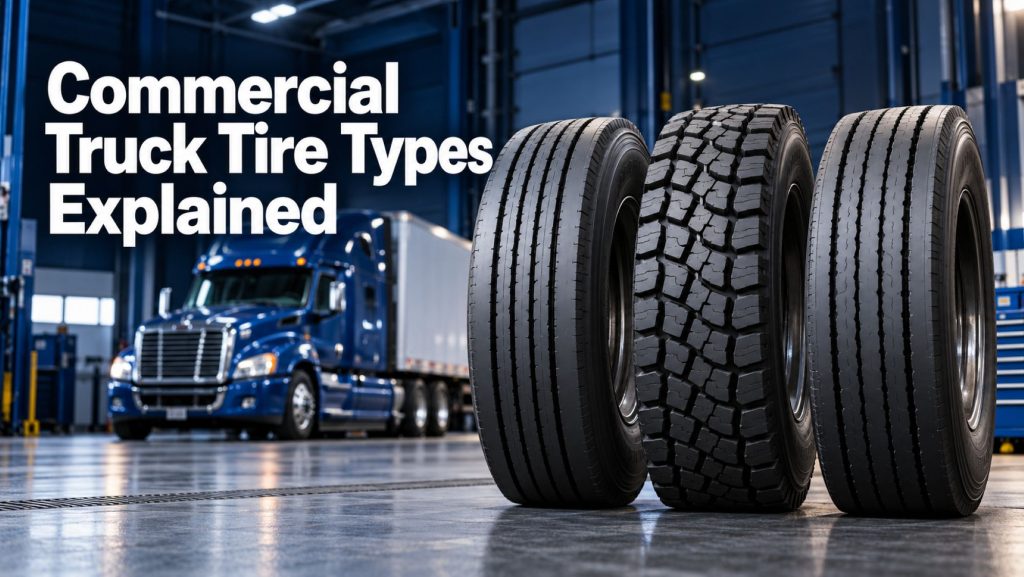
Commercial truck tires are designed around more than size alone. Their construction, tread pattern, casing, load capacity, speed rating, wheel position, and service application all affect how they perform.
A tire intended for a long-haul steer axle has different priorities from a deep-lug drive tire, a high-scrub trailer tire, or a severe-service tire used on construction sites. Selecting the correct type helps support steering response, traction, braking, fuel efficiency, casing life, and predictable wear.
This guide explains the primary commercial truck tire types, how they differ, where they are commonly used, and what drivers, fleets, technicians, and equipment buyers should consider when comparing them.
How Commercial Truck Tires Are Classified
Commercial tires are commonly classified in several overlapping ways:
- Wheel position: steer, drive, trailer, or all-position
- Service application: long-haul, regional, urban, vocational, mixed-service, severe-service, or specialty
- Tread design: rib, lug, block, or combination patterns
- Construction: radial or bias-ply
- Configuration: standard duals, wide-base singles, or specialty arrangements
- Casing status: new tire or retreaded casing
- Size and capacity: section width, aspect ratio, wheel diameter, load range, and approved inflation
These classifications work together. A tire may be described as a radial, wide-base, long-haul drive tire, while another may be an all-position mixed-service tire approved for steer, drive, or trailer use.
Steer Tires
Steer tires are installed on the front steering axle of a tractor or straight truck. They influence directional stability, steering response, braking feel, ride quality, water evacuation, and driver confidence.
Common steer-tire characteristics include:
- Continuous or semi-continuous ribs for stable tracking
- Grooves designed to move water away from the footprint
- Shoulder designs intended to resist irregular wear
- Compounds balanced for mileage, wet traction, and rolling resistance
- Casings engineered for steering loads and retread potential
Steer tires require close attention because a failure or severe irregular wear at the steering axle can directly affect vehicle control. Fleets should use tires specifically approved by the manufacturer for the axle position, load, speed, and application.
Drive Tires
Drive tires transfer engine torque through the powered axles and provide traction for acceleration, climbing, braking, and operation on wet, snowy, loose, or uneven surfaces.
Many drive tires use lug, block, or open-shoulder tread designs. The correct pattern depends on the operating environment:
- Closed-shoulder designs can support stable wear and fuel efficiency in highway service.
- Open-shoulder patterns can improve traction and evacuation in snow, mud, or loose material.
- Deep tread may extend usable life in some applications but can increase movement and heat if used outside its intended service.
- Siping can add biting edges for wet or winter traction.
- Stone ejectors and protective features may help defend the casing in mixed service.
Aggressive tread does not automatically make a tire suitable for every drive axle. Heat, speed, pavement exposure, annual mileage, expected traction, and fuel goals must all be considered.
Trailer Tires
Trailer tires support the trailer and must tolerate free-rolling service, braking forces, lateral scrub, curb contact, tight turns, and extended periods of inactivity.
Trailer applications can create high scrub, especially on spread axles, multi-axle groups, city routes, and trailers that make frequent tight turns. Trailer tires may use shallow or specialized rib patterns, reinforced shoulders, scrub-resistant compounds, or designs optimized for low rolling resistance.
Trailer tire life is strongly affected by inflation, load distribution, alignment, bearing condition, suspension condition, brake drag, axle geometry, and how long the trailer remains parked.
All-Position Tires
All-position tires are designed and approved for use in more than one wheel position. Depending on the specific product, they may be suitable for steer, drive, trailer, or selected vocational positions.
They are commonly used when fleets value flexibility, simplified inventory, or compatibility across several vehicle configurations. Medium-duty trucks, vocational vehicles, buses, and mixed fleets often use all-position products.
“All-position” does not mean ideal for every axle or duty cycle. A dedicated drive tire may provide better traction, while a specialized trailer tire may better resist scrub. Always review the manufacturer’s approved positions and service limits.
Long-Haul Tires
Long-haul tires are intended for sustained highway operation, high annual mileage, relatively consistent speeds, and limited stop-and-go use. Typical priorities include:
- Low rolling resistance
- Long original tread life
- Even wear
- Heat management
- Stable highway handling
- Durable, retreadable casings
- Fuel-efficiency performance
A tire optimized for long, steady highway runs may not tolerate urban curbing, repeated tight turns, construction debris, or off-road traction demands as well as a tire designed for those conditions.
Regional and Super-Regional Tires
Regional tires serve vehicles that combine highway mileage with more frequent starts, stops, turns, terminal visits, and local-road operation. Super-regional service generally blends longer highway segments with hub-and-spoke or regional distribution work.
Compared with dedicated long-haul products, regional tires may emphasize resistance to scrub, irregular wear, curbing, braking forces, and changing road conditions while still controlling rolling resistance and heat.
Urban and Pickup-and-Delivery Tires
Urban and pickup-and-delivery tires are built for frequent stops, sharp turns, curb exposure, low-to-moderate speeds, and high steering input. Applications include delivery trucks, refuse vehicles, transit buses, beverage trucks, and local service fleets.
These tires may use reinforced sidewalls, scrub-resistant compounds, durable shoulders, and tread designs that manage braking and turning wear. An urban tire should not automatically be moved into sustained long-distance service; some products have application restrictions related to speed, heat, and continuous operating time.
Vocational and Severe-Service Tires
Vocational and severe-service tires are designed for demanding applications such as construction, refuse, logging, mining, oil-field work, concrete delivery, aggregate hauling, and heavy equipment support.
Potential design priorities include:
- Cut-, chip-, and puncture-resistant compounds
- Protected casings and reinforced sidewalls
- Stone-ejection features
- Deep or aggressive tread
- Traction on loose and uneven surfaces
- Resistance to impact and high scrub
- Load capacity for vocational equipment
These tires may carry speed, distance, or application limitations. A severe-service tire should be selected according to the percentage of paved versus off-road operation, maximum sustained speed, load, terrain, and manufacturer approval.
Mixed-Service and On/Off-Highway Tires
Mixed-service tires bridge paved-road travel and jobsite operation. They are commonly used on dump trucks, ready-mix vehicles, utility trucks, construction fleets, and other equipment that must travel on highways before entering gravel, dirt, mud, or debris-covered sites.
The design balances highway heat control and stability with casing protection and off-road traction. The correct product depends on how much time the vehicle spends in each environment. A fleet that operates mostly on pavement with occasional site access may need a different tire from one that spends most of its time off road.
Rib, Lug, Block, and Combination Treads
| Tread family | General characteristics | Common uses |
|---|---|---|
| Rib | Continuous circumferential ribs support tracking, water evacuation, and even rolling | Steer, trailer, highway, and all-position service |
| Lug | Transverse elements create biting edges and traction | Drive axles, snow, mud, and vocational service |
| Block | Independent tread blocks provide multidirectional grip | Drive, winter, mixed-service, and off-road applications |
| Combination | Blends ribs, lugs, blocks, shoulders, and sipes | Regional, all-position, variable-weather, and specialized service |
The tread family is only one part of tire selection. Compound, casing design, tread depth, shoulder shape, groove geometry, siping, load, inflation, and operating temperature also influence performance.
Radial vs Bias-Ply Truck Tires
Radial Tires
Radial tires use body cords arranged generally across the tire from bead to bead, with stabilizing belts beneath the tread. They dominate modern North American highway trucking because they can provide good tread life, heat control, fuel efficiency, ride quality, and casing durability.
Bias-Ply Tires
Bias-ply tires use layers of cords crossing diagonally through the casing. They remain available for selected specialty, industrial, agricultural, off-road, and legacy applications where their construction may suit particular impact, sidewall, or operating requirements.
Do not mix radial and bias tires on the same axle. Any mixed fitment across a vehicle must comply with tire, vehicle, fleet, and regulatory guidance.
Standard Dual Tires
Standard dual assemblies place two tires side by side at each end of a drive or trailer axle. They are familiar, widely supported, and allow one tire to remain temporarily after its mate loses air, although continued operation may overload and damage the remaining tire.
Dual assemblies require correctly matched tires, proper spacing, compatible wheels, equal inflation, and attention to stones or debris trapped between the tires. Differences in diameter or inflation can cause one tire to carry more load and wear faster.
Wide-Base Single Tires
Wide-base singles replace a pair of conventional dual tires with one wider tire and compatible wheel at each axle end. Depending on the equipment and application, they can reduce weight, rolling resistance, and the number of tire-and-wheel assemblies.
Selection must account for axle ratings, wheel offset, track width, suspension and hub compatibility, load and inflation requirements, replacement availability, roadside service, trailer use, and any operating restrictions. A wide-base conversion should be approved as a complete wheel-end system.
New Tires and Retreaded Tires
New Tires
A new tire includes a new casing and original tread. Fleets often evaluate the casing as a long-term asset because a durable casing may be retreaded after the original tread is worn.
Retreaded Tires
A retread uses an inspected, serviceable casing that receives new tread material through an approved retreading process. Retreads are widely used in commercial trucking, particularly on drive and trailer positions.
Retread performance depends on casing history, inspection quality, repair condition, retread process, tread design, application, inflation, load, and maintenance. Fleets should use qualified retread suppliers and apply the finished tire only in approved positions and service.
Medium-Duty and Low-Platform Tires
Commercial tires are available for 17.5-inch, 19.5-inch, 22.5-inch, and other wheel diameters. Medium-duty trucks, box trucks, delivery vehicles, buses, low-platform trailers, car haulers, and specialized trailers may use smaller-diameter commercial tires to meet packaging, deck-height, and load requirements.
A smaller wheel diameter does not automatically mean a lighter-duty application. Tire size, load range, wheel rating, inflation, axle load, speed, and service category must all match.
Specialty Commercial Tire Types
- Winter tires: Tread compounds, sipes, and patterns designed for cold, snow, slush, or ice conditions.
- Off-road tires: Heavy-duty products for loose material, rock, mud, and limited paved-road exposure.
- Refuse tires: Tires designed for high scrub, curb contact, frequent starts, and heavy urban cycles.
- Bus and coach tires: Products developed around passenger service, axle position, mileage, maneuvering, and route conditions.
- Emergency-vehicle tires: Tires selected for load, speed, acceleration, braking, and mission requirements.
- Low-rolling-resistance tires: Products designed to reduce energy loss while still meeting position and application requirements.
- Smart or connected tires: Tires or wheel-end systems that work with sensors to monitor pressure, temperature, or related operating data.
How to Choose the Correct Truck Tire Type
- Identify the wheel position. Determine whether the tire will serve a steer, drive, trailer, or approved all-position location.
- Define the application. Record highway percentage, trip length, average and maximum speed, stops, turns, terrain, climate, and annual mileage.
- Determine the load. Use actual loaded axle weights and approved load-and-inflation data.
- Confirm the size. Match tire size, wheel diameter, rim width, load range, clearance, and vehicle approval.
- Set performance priorities. Compare traction, wear, rolling resistance, scrub resistance, casing durability, and retreadability.
- Review operating limits. Check speed, service, axle-position, and on/off-road restrictions.
- Evaluate maintenance support. Consider inspection practices, inflation management, alignment, rotation, roadside availability, and casing programs.
- Confirm the complete fitment. Use tire, wheel, axle, and vehicle manufacturer information before installation.
Commercial Truck Tire Comparison
| Tire type | Primary priority | Common position or service |
|---|---|---|
| Steer | Directional stability, steering response, even wear | Front steering axle |
| Drive | Traction and torque transfer | Powered axles |
| Trailer | Free rolling, scrub resistance, load support | Trailer axles |
| All-position | Fitment flexibility | Manufacturer-approved multiple positions |
| Long-haul | Mileage, heat control, low rolling resistance | Sustained highway operation |
| Regional | Balance of mileage and scrub resistance | Highway plus local delivery |
| Urban | Curb and high-scrub durability | Frequent stops and turns |
| Mixed-service | Highway stability plus jobsite durability | On/off-highway operation |
| Severe-service | Impact, cut, chip, and casing protection | Construction, refuse, logging, mining |
Common Tire Selection Mistakes
- Choosing by price without calculating application and cost per mile
- Using an aggressive tread in sustained high-speed service without approval
- Installing a trailer or drive tire on a steer axle when it is not approved
- Assuming every all-position tire performs equally in every position
- Ignoring actual axle weights and inflation requirements
- Mixing incompatible sizes, constructions, or significantly different diameters
- Using urban tires in continuous long-distance service
- Overlooking wheel width, offset, capacity, and pressure limitations
- Expecting tread design to correct alignment, suspension, or inflation problems
- Discarding a casing program when retreadability could affect total ownership cost
Truck Tire Inspection and Maintenance Basics
Every tire type depends on proper inspection and maintenance. Drivers and maintenance personnel should monitor:
- Cold inflation pressure
- Tread depth and wear pattern
- Cuts, cracks, bulges, exposed material, and impact damage
- Valve stems, caps, extensions, and inflation hardware
- Dual spacing and matched tire diameter
- Wheel and rim condition
- Axle alignment and suspension condition
- Brake drag, bearing condition, and abnormal heat
- Embedded objects and debris between duals
- Pressure-monitoring or automatic-inflation alerts
Visit Tire Pressure Monitoring & Inflation Systems to learn about technologies used to monitor or maintain tire pressure.
Frequently Asked Questions
Can drive tires be used on a steer axle?
Only if the tire manufacturer specifically approves the product for steer-axle use and the tire meets every size, load, speed, wheel, and vehicle requirement. Many dedicated drive tires are not intended for steering positions.
Are all-position tires the same as steer tires?
No. Some all-position tires are commonly used on steer axles, but the label indicates approved versatility rather than identical design or performance. Check the manufacturer’s position recommendations.
Are wide-base singles better than dual tires?
Neither arrangement is automatically better for every fleet. Wide-base singles can reduce weight and rolling resistance, while duals offer widespread service familiarity and redundancy characteristics. The best choice depends on the vehicle, route, load, wheel-end system, maintenance program, and roadside support.
Are retreaded truck tires safe?
Properly inspected, processed, applied, inflated, and maintained retreads are widely used in commercial trucking. Casing condition, retreader quality, application approval, and fleet maintenance are essential.
What causes irregular truck tire wear?
Potential causes include incorrect inflation, axle misalignment, worn suspension or steering parts, wheel imbalance, mismatched duals, brake or bearing problems, excessive scrub, improper tire selection, and route conditions.
Explore the Tires and Wheels Library
The Tires & Wheels hub provides access to commercial truck and trailer tire categories, wheel information, inflation technologies, individual product profiles, and related educational resources.
- Steer Tires
- Drive Tires
- Trailer Tires
- Vocational & Severe-Service Tires
- Commercial Truck Wheels
- Tire Pressure Monitoring & Inflation Systems
Related Guide Libraries
Continue Exploring Truck Equipment Atlas
Truck Equipment Atlas continues to expand with commercial truck profiles, trailer information, diesel engines, equipment-system resources, manufacturer coverage, and practical guides for drivers, fleets, technicians, and equipment buyers.
Visit the Truck Equipment Atlas Site Updates page to explore recent additions, completed milestones, and upcoming resources.