
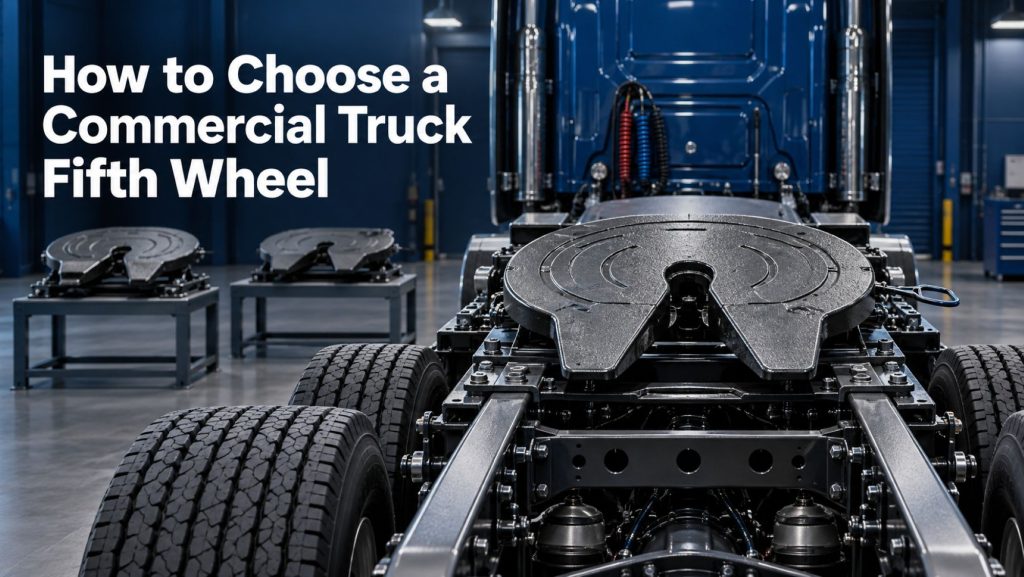
A commercial truck fifth wheel must do more than fit between the tractor frame rails. It must match the trailer kingpin, support the expected vertical load, withstand the forces created by acceleration and braking, provide adequate tractor-to-trailer clearance, and suit the vehicle’s operating environment.
The correct choice depends on the complete tractor-and-trailer combination. A fifth wheel that performs well in ordinary highway freight may not be suitable for heavy haul, logging, mining, oil-field work, repeated yard spotting, or severe off-road service.
This guide explains the major selection factors for conventional commercial tractors and semitrailers. Final selection and installation should be confirmed by the fifth-wheel manufacturer, vehicle manufacturer, qualified installer, and any applicable fleet or regulatory requirements.
What a Commercial Truck Fifth Wheel Must Do
The fifth wheel connects the tractor to the semitrailer through the trailer kingpin. It supports the front portion of the trailer, transfers pulling and braking forces, and allows the combination to turn and move over changes in road angle.
A correctly selected assembly must provide:
- Compatibility with the trailer kingpin
- Adequate vertical-load capacity
- Adequate drawbar-pull or horizontal-load capacity
- A mounting system approved for the tractor frame
- Correct installed fifth-wheel height
- Enough cab, frame, tire, landing-gear, and trailer clearance
- Appropriate fore-and-aft adjustment when needed
- Suitable articulation for the operating environment
- Reliable locking, release, inspection, and maintenance access
- Durability for the vehicle’s duty cycle and expected service life
Start With the Complete Application
Begin by defining what the tractor will pull, where it will operate, and how it will be used. Do not choose the fifth wheel as an isolated component.
- Tractor make, model, frame configuration, suspension, and axle ratings
- Trailer type, kingpin size, upper-coupler design, and loaded weight
- Expected kingpin load and gross combination weight
- Highway, vocational, severe-duty, off-road, or yard use
- Number and type of trailers the tractor will pull
- Required axle-weight adjustment range
- Cab type, sleeper length, exhaust, fairings, ramps, fenders, and other clearance concerns
- Expected coupling frequency and driver workflow
- Climate, contamination, road salt, dust, mud, and washing practices
- Maintenance capabilities, parts support, and intended trade cycle
Choose the Correct Kingpin Compatibility
The fifth-wheel locking mechanism must be designed for the trailer’s kingpin size and configuration. Standard North American highway semitrailers commonly use a 2-inch kingpin, while some specialized and higher-capacity applications use a 3.5-inch kingpin.
Do not assume that a larger or higher-capacity fifth wheel automatically accepts every kingpin. Confirm the exact top-plate model, lock design, kingpin standard, trailer upper coupler, and application approval.
Understand Fifth-Wheel Load Ratings
Vertical Load Rating
The vertical rating is the maximum approved downward load carried through the trailer upper coupler onto the fifth wheel. It must exceed the maximum expected kingpin load for the application, subject to the manufacturer’s conditions and duty classification.
Drawbar-Pull or Horizontal Rating
The horizontal rating addresses forces transferred through the coupling as the tractor pulls, accelerates, brakes, climbs grades, and operates over uneven terrain. Manufacturers may describe this as drawbar pull, horizontal load, or another application rating.
A fifth wheel must satisfy both its vertical and horizontal requirements. Selecting only by vertical capacity ignores the longitudinal forces applied to the locking mechanism, top plate, brackets, and tractor frame.
Allow for Duty Severity
Continuous maximum loading, rough terrain, repeated shock loads, steep grades, high coupling frequency, and severe vocational work can justify additional capacity or a model specifically approved for severe duty. More capacity is useful only when the complete mounting system and vehicle are also approved for the application.
Fixed vs Sliding Fifth Wheels
Choose a Fixed Fifth Wheel When
- The tractor operates with a predictable trailer and load configuration.
- The correct axle loading and clearance can be established at one mounting position.
- Minimum weight, cost, and mechanical complexity are priorities.
- Fore-and-aft adjustment is not required during normal operation.
Choose a Sliding Fifth Wheel When
- The tractor pulls trailers with different dimensions or kingpin settings.
- Axle-weight distribution must be adjusted for changing loads.
- Additional cab-to-trailer or landing-gear clearance may be needed.
- The operation benefits from repositioning the coupling along the tractor frame.
A slider adds rails, locking plungers, stops, and a release system that require inspection and maintenance. Its travel range must be useful without allowing a position that creates interference, improper axle loading, or an unsafe frame location.
For a complete comparison, visit Fixed vs Sliding Fifth Wheels.
Determine the Correct Installed Height
Installed fifth-wheel height is measured from the tractor frame or mounting reference to the top surface of the fifth wheel, according to the manufacturer’s method. Mounting brackets are available in different heights to match tractor and trailer geometry.
The chosen height affects:
- Overall loaded vehicle height
- Whether the trailer runs level
- Trailer and drive-axle load distribution
- Clearance above tractor tires and frame components
- Landing-gear and frame clearance during turns
- Driveline and suspension geometry
- Approach to docks, ramps, and uneven terrain
A fifth wheel that is too tall may raise the trailer above legal or operational limits and change load distribution. One that is too low may allow trailer interference with tires, fenders, frame equipment, or other tractor components. Calculate the complete loaded combination rather than copying the height from another truck.
Check Tractor-to-Trailer Clearance
Clearance must be evaluated throughout the full range of steering, articulation, suspension movement, and slider positions.
- Cab clearance: The trailer nose must clear the cab, sleeper, fairings, exhaust, antennas, and accessories during tight turns.
- Landing-gear clearance: The landing gear and braces must clear the tractor frame, ramps, fenders, tanks, and tires.
- Trailer-to-tire clearance: The trailer underside must remain clear of the drive tires through suspension travel and uneven terrain.
- Frame clearance: The upper coupler must not contact frame-mounted equipment or slider components.
- Swing clearance: The combination must accommodate the intended trailer width, kingpin setback, and operating turn angles.
Do not treat forward placement as automatically better for axle loading or rearward placement as automatically safer for cab clearance. Every position changes several relationships at once.
Select the Mounting System
The top plate, brackets, slider, mounting angles, fasteners, and tractor frame work as one system. Choose components that are approved together and compatible with the frame width, frame material, hole pattern, reinforcement, suspension, and axle arrangement.
Common arrangements include stationary mounts, outboard or inboard sliding mounts, and specialized severe-duty or removable systems. Installation must follow the instructions for the exact tractor and fifth-wheel assembly. Unauthorized drilling, welding, mixing of brackets, or modification of the frame can weaken the installation and affect warranties or approvals.
Consider Articulation and Oscillation
Standard fifth wheels pivot primarily to accommodate fore-and-aft pitch as the tractor and trailer move over grades and road transitions. Certain severe-duty and off-road applications may require additional side-to-side oscillation.
Fully oscillating designs can reduce twisting forces on uneven terrain, but they are not automatically appropriate for ordinary highway use or every trailer. Some operations use restricted-tilt or no-tilt arrangements for particular equipment. Select the articulation system only through the manufacturer’s application guidance.
Choose the Release System
Manual Release
A manual release uses a handle and mechanical linkage at the fifth wheel. It is simple, familiar, and widely supported, but the driver must access the release safely and keep the linkage inspected and lubricated.
Air Release
An air-release system allows the lock to be opened through a controlled pneumatic mechanism. It may improve convenience in high-cycle operations, but it adds cylinders, valves, hoses, controls, and interlocks that must be compatible with the tractor and maintained correctly.
Electronic Monitoring
Some fifth wheels offer sensors or in-cab indicators that monitor kingpin or lock position. These features can add useful information, but they do not eliminate the driver’s required direct visual inspection of the coupling.
Standard-Lube vs Low-Lube Designs
Traditional fifth wheels use grease on the top plate and at specified locking and pivot points. Low-lube designs may use replaceable wear liners or specialized materials to reduce grease on the main contact surface.
When comparing them, consider:
- Coupling frequency and annual mileage
- Fleet lubrication and cleaning practices
- Operating temperature and contamination
- Liner inspection and replacement cost
- Trailer upper-coupler compatibility
- Required lubrication at locks, pivots, or other points
- Availability of trained service and replacement parts
“Low lube” does not mean “no inspection” or “no maintenance.” Follow the service instructions for the specific system.
Match the Fifth Wheel to the Duty Cycle
| Application | Selection priorities |
|---|---|
| General highway freight | Weight, durability, standard kingpin compatibility, service access, fixed or sliding needs |
| Regional and multi-trailer fleet | Slider travel, varying trailer geometry, frequent coupling, parts support |
| Vocational and construction | Higher shock loading, contamination resistance, mounting strength, articulation and clearance |
| Heavy haul | Verified vertical and horizontal capacity, specialized kingpin, tractor-frame approval, engineered mounting |
| Logging, mining, and oil field | Severe-duty approval, off-road articulation, impact loading, inspection access, robust construction |
| Yard spotting | Very high coupling frequency, release convenience, serviceability, compatibility with yard-tractor geometry |
These are general priorities, not product approvals. Specialized applications require direct confirmation from the equipment manufacturers or a qualified vehicle engineer.
Evaluate Weight, Durability, and Service Life
Lightweight fifth wheels and mounting systems can improve available payload, but the lightest option is not always the best value. Compare the complete assembly weight with its approved duty class, capacity, rebuildability, wear components, and expected service life.
A heavier severe-duty model can be unnecessary for a routine highway tractor, while a lightweight highway model may be unsuitable for repeated impact or off-road loading. Choose the lightest system that fully satisfies the application rather than selecting by weight alone.
Compare Maintenance and Ownership Costs
- Initial top-plate and mounting-system price
- Installation labor and frame preparation
- Lubrication requirements and service intervals
- Availability and cost of rebuild kits and wear parts
- Time required for inspection, adjustment, and repair
- Dealer and fleet-shop familiarity
- Warranty terms and application limitations
- Downtime risk and parts distribution
- Expected trade cycle and future tractor use
A lower purchase price can be outweighed by difficult service, limited parts support, frequent adjustment, or a design poorly matched to the duty cycle.
Commercial Truck Fifth-Wheel Selection Checklist
- Identify every tractor and trailer configuration the fifth wheel will serve.
- Confirm kingpin size and upper-coupler compatibility.
- Calculate maximum expected vertical load.
- Determine the required drawbar-pull or horizontal rating.
- Classify the application as highway, vocational, severe duty, off-road, or specialized.
- Choose fixed or sliding mounting based on adjustment needs.
- Determine usable slider travel and safe positions.
- Calculate installed height and total combination height.
- Verify cab, landing-gear, tire, frame, and swing clearances.
- Confirm tractor-frame and mounting-system compatibility.
- Select appropriate articulation or oscillation.
- Choose manual, air, or monitored release features.
- Compare standard-lube and low-lube maintenance requirements.
- Evaluate weight, rebuildability, parts support, and ownership cost.
- Obtain written manufacturer or engineering approval for unusual applications.
Common Fifth-Wheel Selection Mistakes
- Choosing by price or weight before defining the application
- Checking vertical capacity but ignoring horizontal loading
- Assuming all 2-inch kingpin systems are interchangeable
- Copying the fifth-wheel height from a different tractor
- Ignoring trailer-nose, landing-gear, tire, or frame clearance
- Selecting a slider without calculating a safe usable travel range
- Using highway-duty equipment in an unapproved severe-duty application
- Mixing top plates, brackets, rails, or fasteners without approval
- Treating an air release or sensor as a substitute for visual inspection
- Overlooking maintenance access and replacement-parts availability
Frequently Asked Questions
Is a higher-capacity fifth wheel always better?
No. Extra capacity can provide useful margin in an approved application, but it may add weight and cost. The mounting system, tractor frame, axles, suspension, kingpin, and trailer structure must also be compatible with the load.
Does every road tractor need a sliding fifth wheel?
No. A fixed fifth wheel can be appropriate when trailer geometry, axle loading, and clearance remain consistent. A slider is useful when operating conditions require controlled fore-and-aft adjustment.
Can the fifth-wheel height change trailer height?
Yes. Installed fifth-wheel height contributes to the trailer’s ride attitude and total vehicle height. It can also affect axle loading and component clearance.
Are low-lube fifth wheels maintenance-free?
No. They still require inspection, cleaning, wear evaluation, and maintenance of the lock, pivots, liners, and other model-specific components.
Who should approve a fifth wheel for heavy-haul or off-road use?
Use the application process specified by the fifth-wheel, tractor, and trailer manufacturers. A qualified vehicle engineer or authorized upfitter may also be required for specialized combinations.
Related Fifth Wheel and Coupling Guides
- How Commercial Truck Fifth Wheels Work
- Fixed vs Sliding Fifth Wheels
- How to Couple and Uncouple a Semi-Trailer Safely
- How to Inspect and Maintain a Fifth Wheel and Kingpin
Visit the Fifth Wheel & Coupling Equipment Guides hub for the complete guide library.
Explore Fifth Wheels and Coupling Equipment
Truck Equipment Atlas provides educational resources covering fifth wheels, kingpins, upper couplers, slider assemblies, pintle hooks, drawbar couplings, and related tractor-trailer connection equipment.
Continue exploring the Fifth Wheels & Coupling Equipment hub for equipment categories, individual product profiles, and additional reference material.