
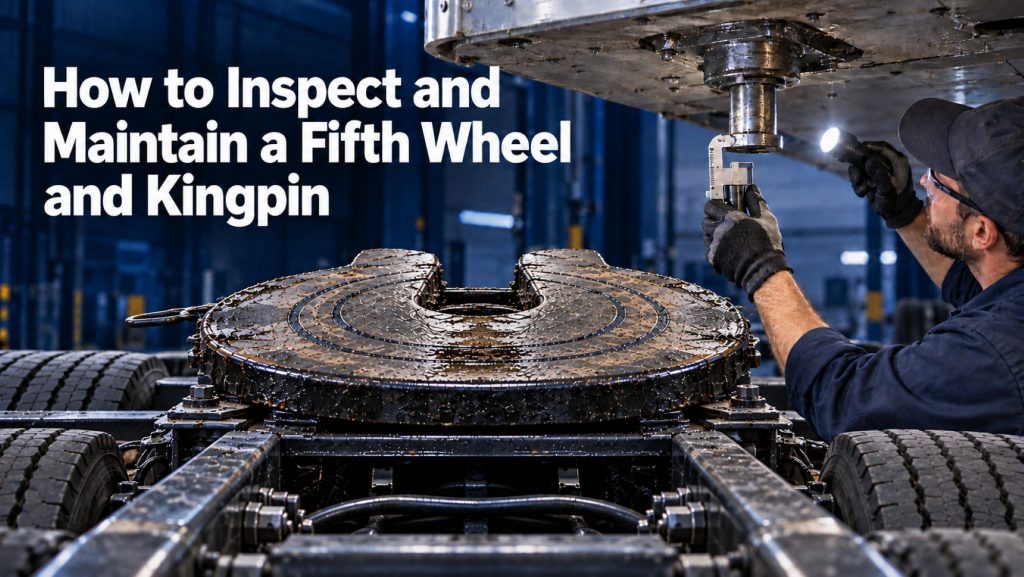
The fifth wheel and trailer kingpin form the primary mechanical connection between a road tractor and semitrailer. They support vertical trailer load, transfer acceleration and braking forces, and allow the combination to articulate during turns and over changes in road grade.
Because a worn, damaged, poorly lubricated, or incorrectly adjusted coupling can create excessive movement or contribute to trailer separation, the fifth wheel and kingpin require regular inspection and model-specific maintenance.
This guide explains general inspection and maintenance practices. It does not replace the instructions, wear limits, gauges, service intervals, or repair procedures published by the fifth-wheel, tractor, and trailer manufacturers. Adjustment, rebuilding, welding, kingpin replacement, and structural repairs should be completed only by qualified personnel.
Why Fifth-Wheel and Kingpin Condition Matters
A properly maintained coupling should lock securely around the kingpin while still allowing the tractor and trailer to pivot. Normal operation produces friction, impact loading, vibration, contamination, and gradual wear.
Inspection and maintenance help identify conditions such as:
- Incomplete or unreliable locking
- Excessive movement between the kingpin and lock
- Dry or contaminated bearing surfaces
- Cracked, bent, loose, or missing components
- Worn kingpin or locking parts
- Loose fifth-wheel mounting hardware
- Slider pins that do not fully engage
- Restricted top-plate articulation
- Damaged release handles, secondary locks, brackets, or air-release components
- Trailer upper-coupler damage or distortion
Know the Components Being Inspected
Fifth-Wheel Top Plate
The top plate supports the trailer upper coupler. Its throat guides the kingpin into the locking mechanism, while its upper surface permits articulation and carries vertical load.
Locking Mechanism
Depending on the design, jaws, wedges, lock bars, plungers, springs, and related parts close around the kingpin. The exact inspection points and acceptable movement vary by model.
Release Handle and Secondary Lock
The release system opens the lock for uncoupling. A manual, air-assisted, or electronic release may also use a secondary latch or safety lock that must return to its proper position.
Mounting Brackets and Pivot Points
Brackets, pins, bushings, cushions, and mounting hardware secure the top plate while allowing it to pitch as the tractor and trailer move over uneven surfaces.
Slider Assembly
A sliding fifth wheel adds rails, stops, locking plungers, linkages, and a manual or pneumatic release system. These parts must hold the assembly securely in its selected position.
Kingpin and Trailer Upper Coupler
The kingpin extends downward from the trailer upper coupler and provides the surface captured by the fifth-wheel lock. The surrounding upper-coupler plate transfers trailer weight onto the fifth wheel.
Before Beginning an Inspection
Park on a firm, level surface when possible. Secure the tractor and trailer against movement, follow lockout or shop procedures, and use adequate lighting. Never place any part of the body between or beneath equipment that is not properly secured and supported.
Clean enough dirt, old grease, ice, and debris from the inspection area to expose the parts being evaluated. Heavy grease can conceal cracks, loose fasteners, metal fragments, and abnormal wear.
Pre-Trip Fifth-Wheel Inspection
A driver’s routine inspection should evaluate the visible condition of the coupling before travel and after coupling.
- Inspect the top plate. Look for cracks, distortion, broken material, severe scoring, contamination, and abnormal wear.
- Check lubrication. Confirm that the upper surface and required locking or pivot points are lubricated as specified for the model.
- Inspect the mounting system. Look for loose, missing, damaged, or improperly seated mounting parts and evidence of movement at the frame or mounting plate.
- Check the release system. Inspect the release handle, safety latch, linkage, cable, or air-release components for damage and proper position.
- Inspect a sliding mount. Confirm that the rails and stops are sound and that all required locking plungers are fully engaged through the rail openings.
- Inspect the trailer connection. Confirm that the fifth wheel and trailer plate are in full contact without an improper gap.
- Visually verify the lock. Look beneath the trailer and confirm that the kingpin is inside the lock and that the model-specific locking parts are fully closed.
- Perform the approved pull test. A controlled tug can help confirm engagement, but it does not replace direct visual inspection.
Do not operate the combination if the connection cannot be positively verified or if any critical component appears damaged, loose, incompletely engaged, or unsafe.
Detailed Fifth-Wheel Inspection
Top Plate and Throat
After cleaning the component, inspect the full top plate, throat, approach ramps, and underside. Look for cracks, deformation, gouges, sharp wear steps, heat damage, damaged casting or plate material, and contact marks that may indicate high coupling or interference.
Cracked structural material should be treated as a serious defect. Do not weld, grind, heat, or reshape a fifth wheel unless the manufacturer specifically authorizes the procedure and it is performed by qualified personnel.
Locking Parts
Inspect accessible jaws, wedges, lock bars, springs, pins, and linkage for wear, corrosion, damage, binding, or missing parts. Operate the lock only through the method approved by the manufacturer. Never place fingers inside the throat or locking mechanism.
Excessive fore-and-aft movement between the kingpin and fifth wheel can indicate wear or incorrect adjustment. Measure lock condition with the manufacturer’s approved test kingpin, wear gauge, or other specified tool. Visual judgment alone is not a substitute for the required measurement.
Mounting Brackets, Pins, and Bushings
Inspect brackets, pivot pins, retainers, cushions, bushings, welds, mounting angles, bolts, and frame attachments. Look for elongated holes, missing retainers, abnormal looseness, cracked welds, shifted components, fretting, rust trails, and polished areas that suggest movement.
The top plate must articulate as designed without binding or excessive looseness. Torque checks and fastener replacement must follow the correct installation manual because specifications vary by mounting system.
Release Handle and Safety Lock
Confirm that the release handle is straight, securely attached, and able to move through its designed travel. Check that it returns to the proper locked position and that the secondary lock or latch functions correctly. Inspect air cylinders, hoses, wiring, cables, and indicators on equipped systems.
Sliding Fifth-Wheel Assembly
Inspect both slide rails, end stops, brackets, crossmembers, locking plungers, springs, linkage, and release actuator. Look for bent rails, cracked parts, damaged teeth or holes, corrosion, debris, and unequal plunger engagement.
After any slider adjustment, verify that every required plunger is fully engaged before moving the vehicle at road speed. Never attempt to reposition a sliding fifth wheel while the combination is moving.
How to Inspect a Trailer Kingpin
Inspect the kingpin and surrounding upper-coupler structure whenever access permits and as required by the trailer’s maintenance program.
- Clean the kingpin enough to expose its working surfaces.
- Look for cracks, gouges, necking, flat spots, excessive wear, corrosion, impact damage, or deformation.
- Check whether the kingpin appears bent, loose, or incorrectly positioned.
- Inspect the attachment area and surrounding upper-coupler plate for cracks, distortion, broken welds, loose fasteners, and separation.
- Look for damage caused by high coupling, repeated impact, or operation with inadequate lubrication.
- Measure the kingpin with the correct approved gauge at the locations specified by the kingpin or trailer manufacturer.
A worn kingpin and worn fifth-wheel lock can create excessive slack together. Both sides of the coupling must therefore be evaluated. A lock adjustment should not be used to conceal a kingpin that has reached its replacement limit.
Kingpin replacement involves a safety-critical trailer structure. Do not weld, build up, straighten, grind, or replace a kingpin outside the trailer and kingpin manufacturer’s approved repair procedure.
Lubricating a Fifth Wheel
Lubrication reduces friction between the fifth wheel and trailer upper coupler, supports smooth articulation, and limits wear in the locking mechanism and pivot areas. The lubricant type, application points, and service interval depend on the fifth-wheel design and operating conditions.
- Identify the fifth-wheel make, model, and lubrication instructions.
- Secure and uncouple the equipment using approved procedures when access to the top plate is required.
- Remove incompatible contamination and excessive hardened grease without damaging the component.
- Inspect the cleaned surfaces before covering them with new lubricant.
- Apply the specified lubricant to the top plate, lock, pivots, grease fittings, or other listed points.
- Distribute lubricant across the required contact area rather than leaving isolated deposits.
- Confirm that grease passages and fittings accept lubricant and are not damaged or blocked.
- Record the service when required by the maintenance program.
Severe rain, road spray, pressure washing, dust, winter chemicals, frequent coupling, and off-road service can remove or contaminate lubricant and may require more frequent attention. Some low-lube or no-lube top-plate systems use replaceable liners or special components; service them according to their own instructions rather than applying conventional grease automatically.
Adjustment and Wear Measurement
Some fifth-wheel locks can be adjusted to compensate for a defined amount of normal wear. Others use replaceable parts or different service procedures. Adjustment is model-specific and should occur only after the fifth wheel and kingpin have been cleaned, inspected, and measured.
A qualified technician should:
- Identify the exact fifth-wheel model and current service instructions.
- Use the manufacturer’s specified test kingpin, wear gauge, tools, and sequence.
- Inspect the kingpin before adjusting the lock.
- Confirm that the wear remains within the adjustable range.
- Replace worn or damaged parts instead of over-adjusting the mechanism.
- Verify correct locking, release, secondary-lock function, and operating clearance after service.
- Document the repair and perform the required final safety check.
Do not tighten an adjustment simply to remove all perceptible movement. Incorrect adjustment can cause binding, prevent complete locking, interfere with release, or accelerate wear.
Common Warning Signs
- Release handle will not remain in the proper locked position
- Locking parts do not close fully around an approved test kingpin
- Unusual clunking or excessive movement during acceleration or braking
- Difficulty coupling or uncoupling after trailer height and alignment are corrected
- Visible cracks, distortion, missing material, or broken welds
- Loose mounting brackets, bolts, pins, or retainers
- Slider plungers that fail to engage equally or completely
- Top plate that binds or has abnormal pivot movement
- Persistent dry contact, metal particles, or unusually rapid grease loss
- Kingpin wear, bending, looseness, or upper-coupler damage
- Air leaks or incomplete operation in an air-release or air-slider system
- Evidence of high coupling or repeated impact damage
Any condition that prevents positive locking, compromises structural attachment, exceeds a published wear limit, or makes the coupling’s condition uncertain requires the equipment to remain out of service until it is evaluated and corrected.
Inspection and Maintenance Schedule
There is no single interval that fits every fifth wheel. Establish the schedule from the manufacturer’s manual, vehicle maintenance program, mileage or operating hours, duty cycle, coupling frequency, environment, and inspection findings.
| Inspection level | Typical focus | Responsible person |
|---|---|---|
| Before and after coupling | Lock engagement, plate contact, handle position, visible damage, mounting security, slider engagement | Driver or operator |
| Routine preventive maintenance | Cleaning, lubrication, detailed visual inspection, functional checks, fasteners, pivots, release and slider systems | Qualified maintenance personnel |
| Periodic wear inspection | Lock and kingpin measurement with specified gauges, adjustment range, rebuild or replacement decision | Qualified technician |
| Event-based inspection | Damage after high coupling, collision, overload, severe impact, trailer separation, abnormal handling, or reported malfunction | Qualified technician or authorized repair facility |
Fifth-Wheel and Kingpin Maintenance Checklist
- Identify the fifth-wheel manufacturer and model.
- Obtain the current operation, maintenance, and repair instructions.
- Secure the tractor and trailer before inspection.
- Clean critical areas sufficiently to reveal damage.
- Inspect the top plate, throat, underside, and locking parts.
- Inspect the release handle and secondary lock.
- Inspect brackets, pivots, bushings, retainers, and mounting hardware.
- Inspect slider rails, stops, linkages, actuators, and plungers when equipped.
- Inspect and gauge the kingpin at the prescribed locations.
- Inspect the upper-coupler plate and kingpin attachment area.
- Lubricate every required point with the specified product.
- Use approved gauges and limits for adjustment or replacement decisions.
- Verify lock, release, and slider operation after service.
- Record defects, measurements, repairs, parts, and completed maintenance.
Frequently Asked Questions
How often should a fifth wheel be greased?
Follow the interval and lubricant specified for the exact fifth-wheel model. Coupling frequency, mileage, weather, washing, contamination, and severe-duty service can shorten the practical interval.
Can a driver determine whether a kingpin is worn out by looking at it?
A visual inspection can reveal obvious damage, but dimensional wear normally requires the correct gauge and published limit. A kingpin that appears smooth can still be outside specification.
Can every fifth wheel be adjusted?
No. Designs and service procedures differ. Some provide a defined adjustment method, while others require parts replacement or rebuilding. Use the exact model instructions.
Is a successful tug test enough to verify coupling?
No. The driver should also visually confirm that the kingpin is inside the locking mechanism, the lock is fully closed, the release components are in the proper position, and the fifth wheel is in full contact with the trailer plate.
Should a cracked fifth wheel or kingpin be welded?
Do not make an improvised weld repair. Remove the equipment from service and follow the component and vehicle manufacturer’s approved inspection, replacement, or repair instructions.
Related Fifth Wheel and Coupling Guides
- How Commercial Truck Fifth Wheels Work
- Fixed vs Sliding Fifth Wheels
- How to Couple and Uncouple a Semi-Trailer Safely
- How to Choose a Commercial Truck Fifth Wheel
Visit the Fifth Wheel & Coupling Equipment Guides hub for the complete guide library.
Explore Fifth Wheels and Coupling Equipment
Truck Equipment Atlas provides educational resources covering commercial truck fifth wheels, kingpins, upper couplers, mounting systems, sliders, pintle hooks, drawbar couplings, and related tractor-trailer connection equipment.
Continue exploring the Fifth Wheels & Coupling Equipment hub for equipment categories, component profiles, and additional reference material.