
Dana Spicer eS5700r Electric Drive Axle
Quick Facts
- Manufacturer: Dana Incorporated
- Brand: Spicer Electrified
- Model: eS5700r
- Equipment Type: Integrated electric drive axle
- Axle Position: Rear drive axle
- Primary Vehicle Class: Class 3 commercial vehicles
- Intended Vehicle Weight Range: Approximately 10,000 to 14,000 pounds GVW
- Primary Applications: Electric delivery vans, light commercial trucks, and minibuses
- Maximum Power: 130 kW, approximately 174 horsepower
- Nominal Operating Voltage: 380 VAC
- Maximum Wheel Torque: Approximately 5,700 Nm, depending on configuration
- Cooling System: Water-glycol-cooled motor and inverter
- System Weight: Approximately 305 kg or 672 pounds with disc brakes
- Parking System: Integrated electronically controlled park function
- Installation Design: Adaptable drop-in configuration for compatible suspension layouts
- Product Page Slug: dana-spicer-es5700r-electric-drive-axle
Overview
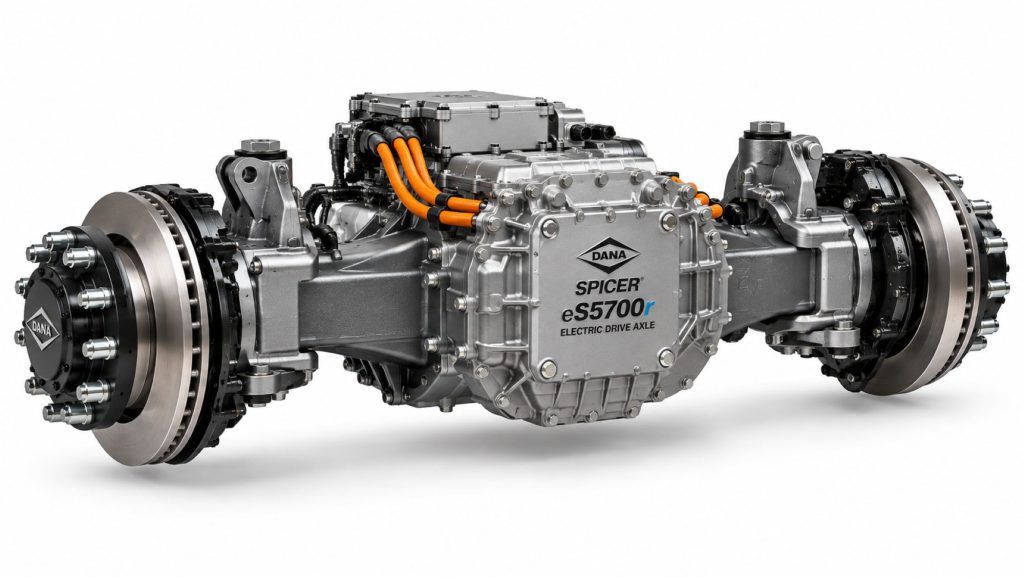
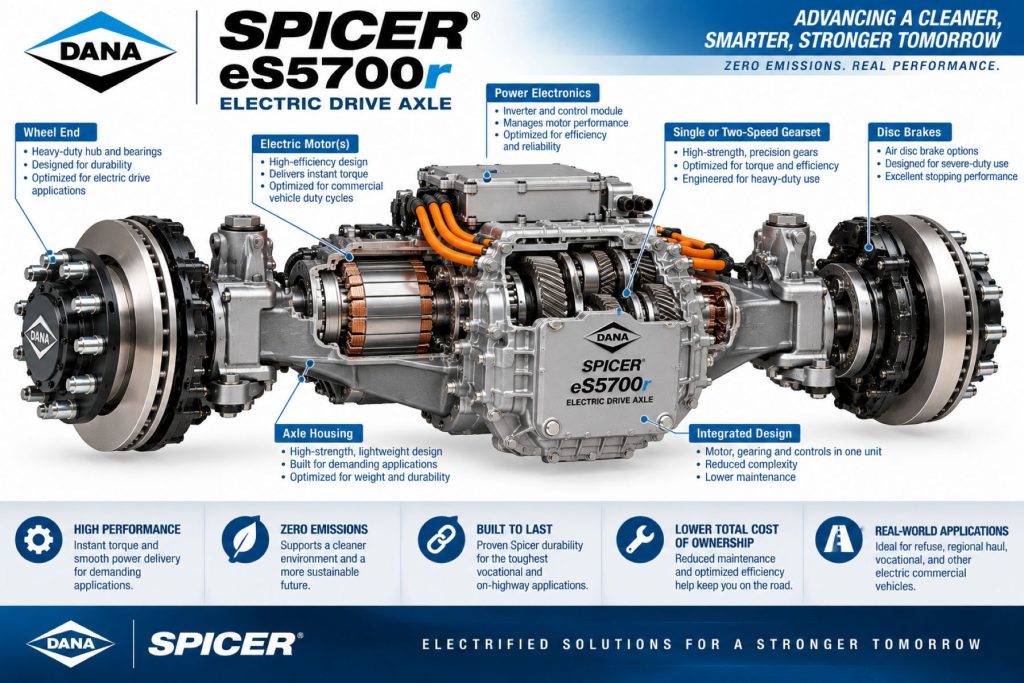
The Dana Spicer eS5700r is an integrated electric drive axle developed primarily for Class 3 commercial vehicles. It combines an electric traction motor, power electronics, reduction gearing, differential, axle structure, and wheel-end drive functions into a compact rear propulsion system.
The axle is intended for medium-duty vans, delivery trucks, minibuses, and other commercial vehicles operating at gross vehicle weights of approximately 10,000 to 14,000 pounds. Its integrated design eliminates the need for a conventional engine-mounted transmission and long driveshaft between a centrally mounted motor and the rear axle.
Dana designed the eS5700r as a configurable system that can be adapted to existing suspension layouts, axle-tube requirements, and braking systems. This approach can help vehicle manufacturers develop battery-electric models without completely redesigning the rear portion of the chassis.
Key Characteristics
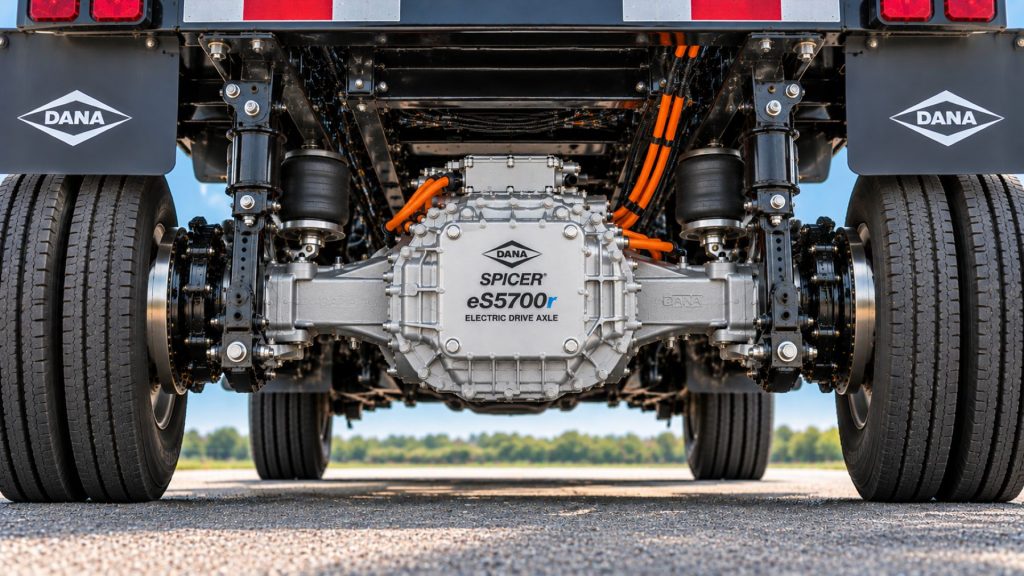
The eS5700r integrates propulsion components directly into the rear axle assembly. Placing the electric motor close to the driven wheels reduces the number of separate driveline components and can free chassis space for battery packs, controllers, cargo structures, or other equipment.
The system produces up to 130 kW of power and operates at a nominal 380 VAC. Both the electric motor and inverter use water-glycol cooling to control operating temperature.
An electronically controlled park feature is integrated into the system. Dana also allows axle-tube and brake configurations to be adapted for different vehicle platforms.
How the Axle or Differential Works
Electrical energy stored in the vehicle’s high-voltage battery is supplied to the inverter. The inverter converts and controls that electrical power according to commands from the vehicle’s propulsion controller.
The electric traction motor converts the controlled electrical energy into rotational force. Integrated reduction gearing lowers motor speed while multiplying torque before sending it through the differential.
The differential divides torque between the left and right axle shafts while allowing the drive wheels to rotate at different speeds during a turn. The axle shafts then transfer torque to the wheel ends and propel the vehicle.
During regenerative braking, the operating process is partially reversed. The drive wheels turn the motor, which operates as a generator and sends recoverable electrical energy back toward the battery system. Actual regeneration behavior depends on vehicle programming, battery condition, traction limits, and brake-system integration.
Axle Position and Function
The eS5700r is installed as a rear drive axle on compatible battery-electric commercial vehicles. It supports rear vehicle weight while also providing propulsion, differential action, reduction gearing, regenerative braking capability, and wheel-end support.
Because the motor is located at the axle, the vehicle may not require a conventional longitudinal driveshaft. This can improve chassis packaging and create additional room for batteries or a lower cargo floor.
The axle must be matched to the vehicle’s suspension, rear gross axle weight rating, tires, wheels, brakes, battery voltage, cooling system, and electronic controls.
Common Specifications
- System Type: Integrated motor and rear drive axle
- Primary Vehicle Class: Class 3
- Intended GVW Range: 4,535 to 6,349 kg
- Approximate GVW Range: 10,000 to 14,000 pounds
- Maximum Power: 130 kW
- Approximate Maximum Power: 174 horsepower
- Nominal Voltage: 380 VAC
- Maximum Wheel Torque: Approximately 5,700 Nm
- Approximate Maximum Wheel Torque: 4,200 lb-ft
- Approximate Maximum Vehicle Speed: 70 km/h or 43 mph, depending on vehicle configuration
- Motor Cooling: Water-glycol cooling
- Inverter Cooling: Water-glycol cooling
- System Weight With Disc Brakes: Approximately 305 kg
- Approximate System Weight With Disc Brakes: 672 pounds
- Parking Feature: Integrated electronically controlled park system
- Brake Configuration: Adaptable according to vehicle application
- Axle Tubes: Configurable for compatible vehicle and suspension requirements
Final vehicle performance depends on tire size, reduction configuration, vehicle weight, battery output, control programming, road speed requirements, and application approval.
Axle Ratios and Gearing
The eS5700r uses integrated reduction gearing to convert the electric motor’s relatively high rotational speed into the lower speed and higher torque required at the drive wheels.
Unlike a conventional diesel truck, the vehicle does not normally need a multispeed mechanical transmission between the motor and axle. Electric motors can operate efficiently across a broad speed range, allowing the integrated reduction system to handle normal propulsion requirements.
Exact reduction ratios and approved tire combinations depend on the vehicle application. The final specification must balance launch performance, gradeability, energy consumption, motor speed, and maximum road speed.
Differential and Traction Options
The eS5700r contains a differential that allows the two rear drive wheels to rotate at different speeds while cornering. This is necessary for predictable handling and reduced tire scrub.
Available differential or traction-control arrangements depend on the production application and vehicle manufacturer. Electronic traction control can manage motor output when wheel slip is detected, but its operation requires coordination among the inverter, vehicle controller, wheel-speed sensors, and braking system.
Buyers should verify whether a specific vehicle uses an open differential, electronically managed traction assistance, or another application-specific traction arrangement.
Brake and Wheel-End Options
Dana designed the eS5700r with adaptable braking configurations. The published system weight of approximately 305 kg includes disc brakes, although the exact brake package depends on the vehicle manufacturer and installation.
Regenerative braking works with the vehicle’s conventional friction brakes. Regeneration can reduce friction-brake use during many operating conditions, but mechanical brakes remain necessary for emergency stopping, low-speed operation, parking, and situations where the battery cannot accept additional energy.
Wheel hubs, bearings, seals, brakes, wheels, and tires must be matched to the axle rating and the vehicle’s intended load. Electric commercial vehicles can place substantial demands on wheel ends because of battery weight, immediate motor torque, and frequent stop-and-start operation.
Common Applications
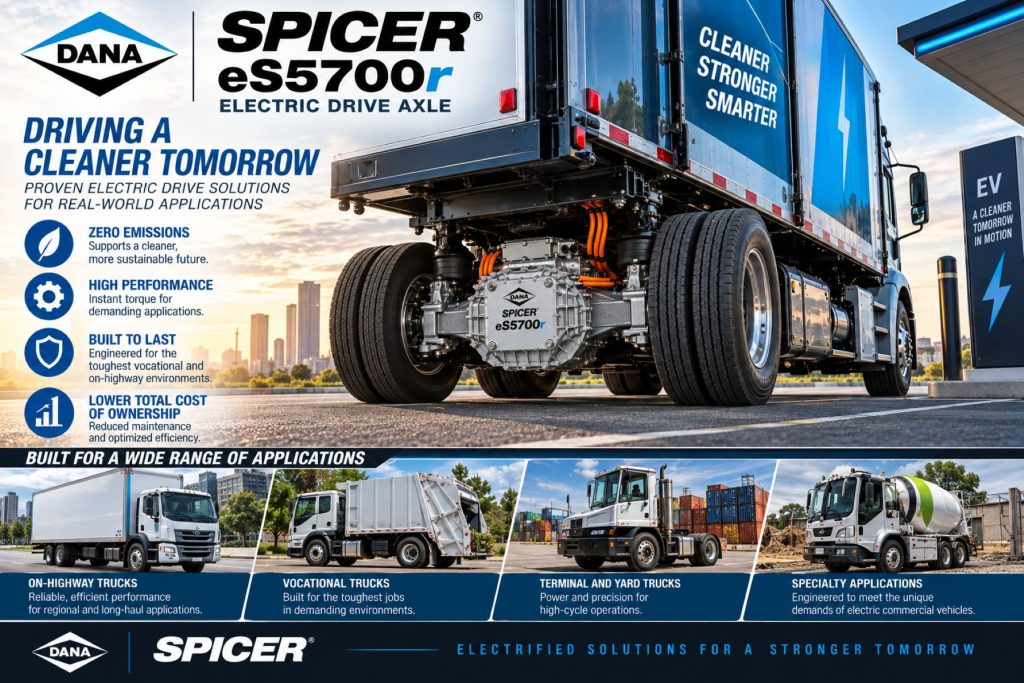
- Battery-electric delivery vans
- Urban parcel-delivery vehicles
- Light commercial box trucks
- Electric minibuses
- Airport and hotel shuttle buses
- Municipal service vehicles
- Campus transportation vehicles
- Utility service vans
- Local food and beverage delivery vehicles
- Low-speed regional distribution vehicles
- Commercial vehicles requiring a low cargo floor
- Fleet vehicles operating on predictable daily routes
Truck, Suspension, and Drivetrain Compatibility
The eS5700r is intended for compatible Class 3 electric vehicle platforms with gross vehicle weights of approximately 10,000 to 14,000 pounds. It is designed to function as a drop-in-style axle for approved suspension layouts, but it is not a universal replacement for every conventional rear axle.
Compatibility depends on suspension mounting points, axle-tube dimensions, track width, brake package, wheel ends, tire size, rear axle loading, battery voltage, inverter controls, cooling capacity, and vehicle electronic architecture.
The complete propulsion system requires a compatible high-voltage battery, battery-management system, vehicle-control unit, charging system, cooling circuit, wiring, contactors, safety disconnects, and low-voltage control network.
Replacing a conventional axle with an eS5700r is not a simple mechanical axle swap. The vehicle must be engineered as a complete electric propulsion and safety system.
Advantages
- Integrated motor and drive-axle design
- Eliminates the need for a conventional longitudinal driveshaft
- Can free chassis space for batteries or cargo equipment
- Maximum output of 130 kW
- Strong low-speed electric torque
- Regenerative braking capability
- Water-glycol-cooled motor and inverter
- Integrated electronically controlled park feature
- Adaptable axle-tube configurations
- Adaptable brake-system configurations
- Designed for compatible existing suspension layouts
- Potentially lower routine drivetrain maintenance than a diesel powertrain
- Quiet operation for urban and residential delivery routes
- No tailpipe emissions during vehicle operation
- Well suited to predictable stop-and-start duty cycles
Limitations or Considerations
- Intended primarily for Class 3 applications
- Maximum road speed may limit suitability for some highway operations
- Requires a compatible high-voltage battery system
- Requires liquid cooling for the motor and inverter
- Vehicle controls must be correctly integrated and calibrated
- Not a universal drop-in replacement for conventional axles
- High-voltage repairs require trained technicians and safety procedures
- Specialized diagnostic equipment may be required
- Replacement components may be more specialized than conventional axle parts
- Battery condition directly affects performance and regenerative braking
- Vehicle range depends heavily on payload, temperature, route, and accessory use
- Charging availability can affect daily fleet utilization
- The axle’s rating does not override tire, wheel, brake, suspension, or frame limits
- Used assemblies require verification of both mechanical and electronic compatibility
Driver and Operator Experience
The eS5700r can provide smooth acceleration because an electric motor produces torque without conventional transmission shifts. Reduced drivetrain vibration and lower propulsion noise can make urban delivery and passenger-service vehicles more comfortable to operate.
Regenerative braking may slow the vehicle when the accelerator is released, depending on vehicle programming. Drivers may need time to become familiar with the amount of deceleration and the transition between regenerative and friction braking.
Vehicle performance can change with battery charge level, battery temperature, payload, terrain, and climate-control use. Operators should understand that reduced power or regenerative braking may be normal when the battery is cold, nearly full, overheated, or at a low state of charge.
Maintenance and Ownership Notes
Routine maintenance includes inspecting the axle housing, mounting points, wheel bearings, hubs, seals, brakes, wiring, electrical connectors, coolant hoses, and cooling-system condition.
Technicians should check for axle lubricant leakage, coolant leakage, damaged high-voltage cables, corroded connectors, loose mounting hardware, unusual bearing noise, and diagnostic fault codes.
The motor and inverter cooling circuit must use the approved coolant and service procedure. Air trapped in the cooling system, restricted flow, or contaminated coolant can cause overheating and reduced propulsion output.
High-voltage components must be isolated and verified safe before service begins. Only technicians trained in electric vehicle systems should open, disconnect, test, or repair high-voltage equipment.
Common Axle or Differential Problems
- Axle lubricant leaks
- Wheel-bearing wear
- Hub or axle-seal leakage
- Differential bearing noise
- Gear wear or abnormal reduction-drive noise
- Damaged high-voltage cables or connectors
- Motor or inverter cooling-system leaks
- Restricted coolant circulation
- Motor or inverter overheating
- Position, speed, or temperature sensor faults
- Communication faults between vehicle controllers
- Inverter or motor-control fault codes
- Electronically controlled park-system problems
- Reduced regenerative braking
- Unexpected propulsion derating
- Corrosion in electrical connections
- Brake wear caused by incorrect regenerative-braking integration
- Noise or vibration from damaged mounts or wheel-end components
Identification Information
- Manufacturer: Dana Incorporated
- Branding: Dana, Spicer, Dana TM4, or Spicer Electrified identification
- Model: eS5700r
- Equipment Description: Integrated rear electric drive axle
- Primary Identification Sources: Product label, axle identification plate, motor label, inverter label, and vehicle build records
- Important Electrical Information: Voltage rating, motor identification, inverter identification, connector configuration, and software calibration
- Important Mechanical Information: Axle configuration, track width, axle-tube design, suspension mounts, brake package, hubs, and wheel ends
- Vehicle Information: Manufacturer, model, year, VIN, gross vehicle weight rating, and original equipment configuration
The complete model, serial numbers, software information, and vehicle build records should be collected before ordering replacement components. Mechanically similar e-axles may use different voltage ranges, connectors, control software, brakes, mounting points, or reduction configurations.
Buying Considerations
- Exact eS5700r model and serial information
- Original vehicle application
- Maximum vehicle and rear axle weight ratings
- Battery-system voltage
- Motor and inverter compatibility
- Vehicle-control software compatibility
- Suspension mounting arrangement
- Axle-tube and track-width dimensions
- Brake-system configuration
- Hub and wheel-end arrangement
- Tire size and required maximum road speed
- Cooling-system requirements
- High-voltage cable and connector condition
- Availability of diagnostic software
- Availability of trained electric-vehicle technicians
- Parts and technical support in the operating region
- Remaining manufacturer or vehicle warranty
- Service history for the axle, motor, inverter, and cooling system
- Evidence of impact damage, overheating, water intrusion, or electrical arcing
- Cost of replacing electronic components compared with conventional axle repairs
Variants and Configurations
- Application-specific axle-tube configurations
- Application-specific suspension mounting arrangements
- Different brake-system configurations
- Different wheel-end arrangements
- Vehicle-specific track widths
- Vehicle-specific electronic controls
- Vehicle-specific inverter calibrations
- Vehicle-specific regenerative-braking programming
- Vehicle-specific parking-system integration
- Different tire and final-drive combinations
- Complete original-equipment installations
- Electric vehicle conversion or specialty-platform installations subject to engineering approval
Comparison to Similar Equipment
Compared with a conventional rear axle, the eS5700r includes its own electric traction motor and associated power electronics. A conventional axle must receive torque from an engine or remotely mounted motor through a transmission and driveshaft.
Compared with a central electric motor arrangement, the eS5700r places the propulsion source at the axle. This can eliminate the driveshaft and free additional chassis space, although it also concentrates motor, inverter, gearing, and axle functions into one specialized assembly.
The eS5700r is designed primarily for Class 3 vehicles. Larger electric commercial vehicles require an e-axle with higher weight, power, torque, thermal, and road-speed capabilities.
The Meritor 14Xe Electric Powertrain is intended for heavier commercial vehicle applications and should not be considered a direct replacement for the smaller eS5700r.
Best Fit For
- Class 3 battery-electric commercial vehicles
- Urban delivery fleets
- Electric vans and light box trucks
- Electric minibuses and shuttle vehicles
- Vehicles operating on predictable daily routes
- Applications with frequent stopping and regenerative-braking opportunities
- Commercial vehicles requiring additional chassis space for batteries
- Vehicles designed around a rear electric drive axle
- Fleets with depot charging
- Operations with trained electric-vehicle service support
- Low-noise delivery operations
- Local routes that remain within the axle’s vehicle-speed capability
Related Truck Types
Related Truck Models
Related Axle and Differential Types
- Electric Drive Axles
- Commercial Truck Drive Axles
- Commercial Truck Axles and Differentials
- Meritor 14Xe Electric Powertrain
Related Equipment Systems
- Electric Truck Powertrains
- Brake Systems
- Suspension Systems
- Tires and Wheels
- Cooling Systems
- Safety Systems
Related Guides
- How Commercial Truck Axles and Differentials Work
- How to Identify a Truck Axle or Differential
- Common Truck Axle and Differential Problems
Regulatory and Compliance Notes
The eS5700r installation must comply with applicable electric-vehicle, high-voltage, braking, electromagnetic-compatibility, functional-safety, and commercial vehicle regulations.
The finished vehicle’s certified weight ratings depend on the complete combination of axle, suspension, brakes, hubs, wheels, tires, frame, and vehicle structure. Installing a higher-capacity component does not independently increase the vehicle’s certified gross or axle weight ratings.
High-voltage warning labels, service disconnects, cable protection, grounding, isolation monitoring, and emergency-response procedures must remain in place and functional.
Battery-electric vehicles may also be subject to local rules for charging equipment, electrical installations, battery transportation, emergency response, and end-of-life component handling.
Real World Operating Notes
The eS5700r is best suited to routes that match its Class 3 weight range, available power, road-speed capability, and charging schedule. Urban delivery and shuttle operations can benefit from frequent regenerative-braking opportunities and predictable daily mileage.
Payload, grades, highway speed, cold weather, hot weather, cabin climate control, and battery age can significantly affect driving range. Fleets should evaluate the complete route rather than relying only on a published battery-range figure.
Regenerative braking may be reduced when the battery is fully charged, very cold, overheated, or unable to accept additional energy. Drivers must always retain sufficient following distance and should not depend on regeneration as a replacement for the friction brakes.
Frequently Asked Questions
What is the Dana Spicer eS5700r?
The eS5700r is an integrated electric rear drive axle for Class 3 commercial vehicles. It combines an electric motor, inverter, reduction gearing, differential, and axle functions in one propulsion system.
How much power does the eS5700r produce?
Dana lists a maximum output of 130 kW, equivalent to approximately 174 horsepower.
What vehicle weight range is it designed for?
It is intended for vehicles with gross weights from approximately 4,535 to 6,349 kg, or about 10,000 to 14,000 pounds.
What voltage does the axle use?
The published nominal operating voltage is 380 VAC. The complete vehicle also requires a compatible high-voltage battery, inverter controls, wiring, protection systems, and cooling equipment.
Does the eS5700r require a transmission?
It uses integrated reduction gearing rather than a conventional multispeed truck transmission. The electric motor’s broad operating range allows the system to provide propulsion without normal transmission shifting.
Does it contain a differential?
Yes. The integrated differential distributes power to the left and right drive wheels while allowing different wheel speeds during turns.
Can it provide regenerative braking?
Yes. The motor can recover energy during deceleration when the vehicle controls, battery condition, and traction conditions permit regeneration.
Can the eS5700r replace any conventional rear axle?
No. Mechanical dimensions, suspension mounts, axle loading, brakes, voltage, cooling, electronic controls, and software must all be compatible. Installation requires vehicle-level engineering.
Is it suitable for highway operation?
Suitability depends on the vehicle’s approved maximum speed, gearing, tire size, payload, battery capacity, and route. Published information associates the system with speeds around 43 mph, so it may be better suited to urban and local service than sustained high-speed highway travel.
How much does the system weigh?
Dana lists a system weight of approximately 305 kg, or 672 pounds, with disc brakes.
What cooling system does it use?
The motor and inverter use a water-glycol cooling circuit.
Can an ordinary axle shop repair it?
Conventional wheel-end, brake, and some mechanical work may be familiar to axle technicians, but motor, inverter, high-voltage, cooling, and electronic-control repairs require appropriate electric-vehicle training and diagnostic equipment.
Availability and Where to Find
The Dana Spicer eS5700r is primarily supplied as an integrated component for approved commercial electric vehicle platforms. Availability can vary by vehicle manufacturer, geographic market, production program, and replacement-parts support.
Complete axles and replacement components may be available through Dana representatives, authorized distributors, electric commercial vehicle manufacturers, specialty electric-drive integrators, and qualified remanufacturing or salvage suppliers.
Before purchasing a used unit, verify the axle’s serial information, voltage, inverter, software calibration, connectors, suspension configuration, brakes, cooling requirements, and original vehicle application.
Current product information and Dana technical resources are available from the Dana eS5700r e-Drive Axle product page.
Support Trucking Families
Truck Equipment Atlas supports the mission of Grey Cross, a nonprofit dedicated to helping families of truck drivers who lose their lives while on the road. As the site grows, part of its mission is to bring awareness and support to these families.
Podcast or Video Section
Learn More Through Audio and Video
Truck Equipment Atlas will continue expanding with podcast episodes, interviews, and equipment breakdowns to help drivers and fleets better understand trucks and equipment.
Follow the Growth of Truck Equipment Atlas
Truck Equipment Atlas continues to expand with new truck profiles, trailer coverage, diesel engine pages, equipment system resources, manufacturer information, and educational guides.
Visit our Site Updates page to explore recent additions, project milestones, and upcoming resources as we continue building one of the industry’s growing commercial trucking equipment reference libraries.
View the Latest Site Updates: Truck Equipment Atlas Site Updates