
Dana Spicer E-Series Steer Axle
Quick Facts
- Manufacturer: Dana Incorporated
- Brand: Spicer
- Product Family: E-Series
- Axle Type: Non-driven front steer axle
- Primary Vehicle Classes: Medium- and heavy-duty commercial vehicles
- Primary Models: E-1002, E-1203, E-1252, E-1322, and E-1462
- GAWR Range: 10,000 to 14,600 lb
- Beam Construction: Lightweight forged-steel I-beam
- Beam Widths: Standard and wide-beam configurations
- Maximum Published Turn Angle: Up to approximately 55 degrees in compatible configurations
- Primary Applications: Linehaul, medium-duty, vocational, and selected heavy-haul trucks
- Wheel-End Options: Conventional hubs and Spicer LMS or LMSi systems
- Notable Options: Integral-arm forged knuckles, multiple beam drops, and central tire inflation compatibility
- Primary Design Goal: Reduce weight while improving steering geometry, durability, braking response, and tire life
Overview
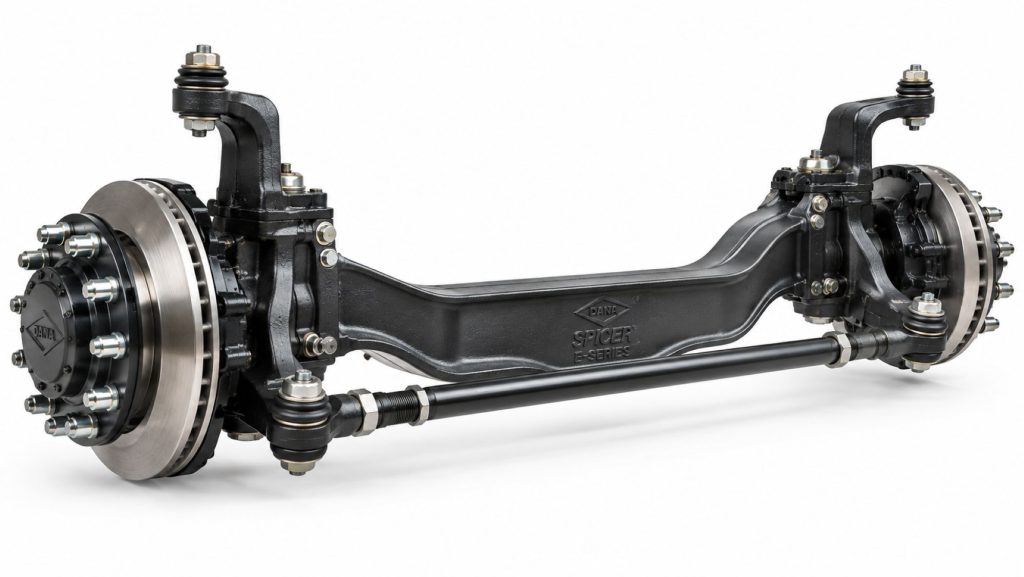
The Dana Spicer E-Series is a family of medium- and heavy-duty commercial truck steer axles with gross axle weight ratings ranging from 10,000 to 14,600 pounds.
Unlike a drive axle, the E-Series does not transmit engine torque to the wheels. Its primary functions are supporting the front of the vehicle, providing steering movement, maintaining wheel alignment, and carrying the front brakes and wheel ends.
Dana offers E-Series axles in standard and wide-beam configurations. Standard-width axles emphasize turning clearance and maneuverability, while wide-beam versions can provide additional stability and wheel clearance.
The E-Series uses a lightweight forged-steel beam designed to combine strength and torsional stiffness. Dana states that selected configurations can reduce vehicle weight by up to approximately 35 pounds compared with earlier models.
Its one-piece forged-knuckle design integrates the steer arm, tie-rod arm, and spindle into a compact component. This reduces the number of separate connections while supporting turn angles of up to approximately 55 degrees in compatible installations.
Key Characteristics
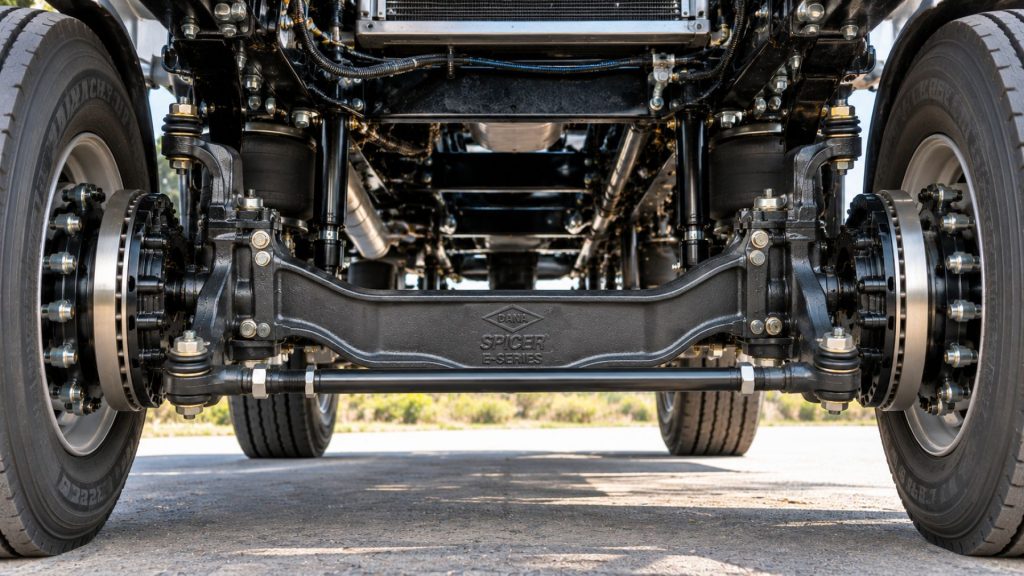
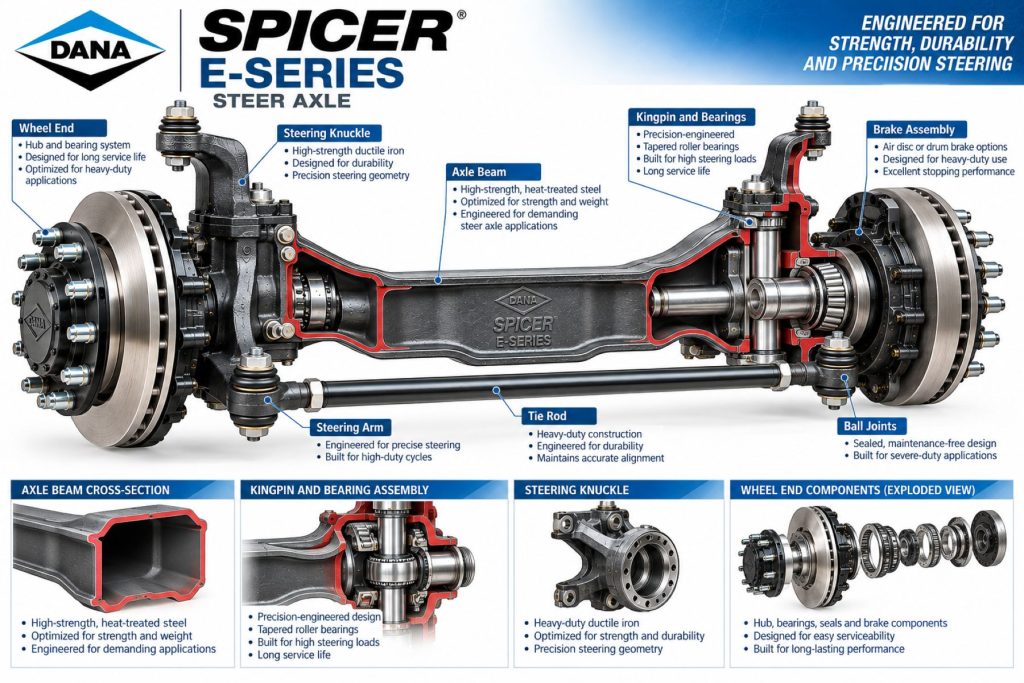
The E-Series uses a forged-steel I-beam as the structural center of the axle. The beam supports the truck’s front weight and resists bending, twisting, braking, and road-impact forces.
Dana’s integral-arm knuckle combines the spindle, steering arm, and tie-rod arm in one forged component. This design reduces separate joints and fasteners while providing a compact steering package.
A large-diameter kingpin and increased bushing area improve load distribution through the steering joint. Dana identifies approximately 15 percent more kingpin-bushing area in its patented configuration.
Sealed kingpin-joint thrust bearings use compressible inserts to help exclude contaminants and maintain joint support.
A two-drawkey kingpin-retention system helps secure the kingpin while supporting camber alignment. Correct camber and kingpin positioning contribute to predictable handling and even tire wear.
The tie-rod ends use sealed boots and grease-purge features intended to reduce contamination and extend component life.
How the Axle or Differential Works
The E-Series is a non-driven axle, so it does not contain a ring gear, pinion, carrier, or differential.
The axle beam spans the front of the truck and connects to the suspension. Steering knuckles pivot around kingpins at each end of the beam.
When the driver turns the steering wheel, movement passes through the steering gear, pitman arm, drag link, steering arm, and knuckle. The tie rod transfers this movement to the opposite wheel.
The steering geometry allows the inside and outside wheels to follow different turning radii. Proper toe, camber, caster, kingpin inclination, and steering-stop adjustment are essential for stable handling and acceptable tire wear.
The wheel hubs rotate on bearings mounted around the knuckle spindles. Brake components at each wheel end slow the vehicle through the front tires.
Because there is no drive gearing or differential, E-Series maintenance focuses on kingpins, bushings, thrust bearings, tie-rod ends, wheel bearings, brakes, alignment, and suspension connections.
Axle Position and Function
The E-Series is normally installed at the front of a medium- or heavy-duty truck.
It supports the front portion of the chassis, including part of the cab, engine, transmission, body, and payload weight.
The axle provides the pivoting wheel ends required to steer the vehicle. It also serves as the mounting structure for the front hubs, bearings, wheels, tires, and brakes.
Front axle loading changes with wheelbase, engine placement, cab design, body or trailer loading, fifth-wheel position, auxiliary axles, and weight transfer during braking.
The selected E-Series model must be rated for the completed vehicle’s maximum front axle load. The axle, suspension, springs, tires, wheels, hubs, brakes, and steering components must all support that load.
Common Specifications
- Axle Type: Non-driven front steer axle
- Construction: Forged-steel I-beam
- Published GAWR Range: 10,000 to 14,600 lb
- E-1002 Rating Class: Approximately 10,000 lb
- E-1203 Rating Class: Approximately 12,000 lb
- E-1252 Rating Class: Approximately 12,500 lb depending on configuration
- E-1322 Rating Class: Approximately 13,200 lb
- E-1462 Rating Class: Approximately 14,600 lb
- Common Beam Widths: Approximately 69, 71, and 71.5 inches measured at the kingpin centers in referenced configurations
- Beam Types: Standard and wide beam
- Beam Drops: Standard and deep-drop configurations depending on model and chassis
- Maximum Published Turn Angle: Up to approximately 55 degrees
- Knuckle Design: One-piece forged spindle, steering arm, and tie-rod arm
- Kingpin Retention: Dual-drawkey retention system
- Kingpin Support: Large bushings and sealed thrust-bearing design
- Wheel-End Options: Conventional or Spicer LMS and LMSi hubs
- Brake Compatibility: Hydraulic or air-operated disc and drum systems depending on the truck specification
- Additional Option: Central tire inflation compatibility in selected applications
Exact dimensions, ratings, and options must be confirmed using the complete axle model and OEM build information.
Axle Ratios and Gearing
The Dana Spicer E-Series does not have an axle ratio because it is a non-driven steer axle.
Axle ratios are created by the ring-and-pinion gears inside a drive axle. The E-Series has no ring gear, pinion gear, carrier, axle shafts, or torque-transmitting differential.
Engine torque travels to the truck’s drive axle or axles rather than through the E-Series.
Although the steer axle has no final-drive gearing, tire size still affects vehicle speed, braking, steering effort, ground clearance, and electronic-system calibration.
When replacing front tires or wheels, the new equipment must match the axle, hub, bearing, brake, suspension, and vehicle ratings.
For general information about drive-axle gearing, see Commercial Truck Axle Ratios Explained.
Differential and Traction Options
The E-Series does not contain a differential because it is not a drive axle.
The left and right wheels rotate independently on separate hub bearings. No internal gear assembly connects the two wheel ends.
Traction is controlled by the vehicle’s rear drive axle or axles, tires, differential system, suspension, and electronic traction controls.
Some trucks use steering-related stability systems that monitor front wheel speed, steering angle, yaw, and braking. These systems may use ABS sensors mounted at the E-Series wheel ends, but they do not make the steer axle a powered axle.
A central tire inflation system may be available in selected E-Series applications. CTIS can help manage tire pressure for different loads, speeds, and road surfaces, but it does not provide driven traction at the front axle.
Brake and Wheel-End Options
The E-Series supports multiple brake and wheel-end configurations. Exact availability depends on axle rating, truck manufacturer, wheel size, vehicle class, and application.
Medium-duty installations may use hydraulic disc brakes, air-operated disc brakes, or drum brakes. Heavy-duty trucks typically use air-disc or S-cam drum brakes.
Spicer LMS and LMSi hub systems are available in selected configurations. These wheel ends are designed to provide controlled bearing adjustment, reduced maintenance, and improved reliability.
ABS wheel-speed sensors and tone rings may be integrated into the wheel-end assembly. Their specifications must remain compatible with the truck’s braking and stability systems.
Wide-beam axles provide additional room for certain wheel, tire, brake, and steering configurations. Standard-width beams may provide tighter turning geometry and reduced component interference.
Brake, hub, bearing, seal, spindle, wheel, and tire parts must be identified using the complete axle and vehicle specifications.
Common Applications
- Class 6 delivery trucks
- Class 7 straight trucks
- Class 8 highway tractors
- Linehaul tractors
- Regional-haul trucks
- Pickup-and-delivery vehicles
- Box trucks
- Refrigerated straight trucks
- School buses
- Transit and shuttle buses
- Municipal trucks
- Utility vehicles
- Dump trucks
- Refuse trucks
- Heavy-haul tractors using approved front axle ratings
- Vocational trucks requiring front axle ratings up to 14,600 pounds
Truck, Suspension, and Drivetrain Compatibility
The E-Series can be used in medium- and heavy-duty trucks with leaf-spring, taper-leaf, air-assisted, or other approved front suspension systems.
Compatibility depends on axle rating, beam width, beam drop, spring-center dimensions, kingpin-center width, steering gear, drag-link geometry, brake package, hubs, wheels, and tires.
The standard-width beam is generally intended to support favorable turn angles and minimize interference with chassis components.
The wide-beam option can provide greater vehicle stability and additional wheel clearance. It may also increase turning width or affect overall tire placement.
The steer axle must be matched with the suspension and steering system as a complete assembly. A physically similar beam may not provide the correct camber, caster, steering-arm position, spring-pad spacing, or brake compatibility.
The E-Series is independent of the truck’s drive-axle ratio, but overall vehicle specifications still affect front axle loading and steering performance.
Advantages
- Available in ratings from 10,000 to 14,600 pounds
- Supports medium- and heavy-duty truck applications
- Lightweight configurations can reduce vehicle weight
- Reduced axle weight can increase available payload
- Forged-steel beam provides strength and torsional stiffness
- Increased stiffness can improve braking response
- Standard and wide-beam configurations provide chassis flexibility
- Standard-width beams support favorable turning geometry
- Wide-beam versions provide additional stability and wheel clearance
- Integral-arm knuckle reduces separate parts and connections
- One-piece forged knuckle provides structural reliability
- Turn angles of up to approximately 55 degrees support maneuverability
- Large kingpin bushings distribute steering-joint loads
- Sealed thrust bearings reduce contaminant entry
- Dual-drawkey kingpin retention supports durability and alignment
- Sealed tie-rod ends help extend service life
- LMS and LMSi wheel ends can reduce maintenance
- Multiple brake packages support diverse applications
Limitations or Considerations
- The E-Series is not a powered front axle
- It does not improve traction through the front wheels
- The axle rating varies by model and configuration
- A 14,600-pound axle does not automatically establish a legal 14,600-pound front load
- Standard and wide beams are not automatically interchangeable
- Beam width affects steering geometry, stability, wheel clearance, and turning radius
- Beam drop must match the chassis and suspension design
- Maximum turn angle depends on wheels, tires, brakes, steering stops, and chassis clearance
- Incorrect caster, camber, or toe can cause rapid tire wear
- Worn kingpins can create steering looseness and alignment problems
- Wheel-end and brake components vary between OEM installations
- Wide tires and larger wheels can increase steering loads
- CTIS adds seals, air lines, valves, and maintenance requirements
- Steer-axle replacement requires precise dimensional and application matching
- The E-Series should not be confused with Dana’s driven D-Series steer axles
Driver and Operator Experience
The E-Series is designed to provide predictable steering response and stable braking in medium- and heavy-duty trucks.
A properly aligned axle with correctly adjusted steering stops can provide a strong turning angle without allowing the tires, wheels, or steering components to contact the chassis.
The wide-beam configuration may provide a more planted feel in certain applications, while a standard beam may support tighter maneuvering.
Worn kingpins, tie-rod ends, drag-link joints, wheel bearings, or suspension bushings can produce steering wander, vibration, irregular tire wear, or excessive steering-wheel movement.
Drivers may notice a pull during braking if brake force, tire pressure, wheel alignment, or suspension loading differs from side to side.
Heavy front axle loads increase steering effort and tire loading. Power-steering condition, tire pressure, alignment, and lubrication therefore have a significant effect on driver experience.
Maintenance and Ownership Notes
The E-Series should be maintained according to Dana’s steer-axle service information and the truck manufacturer’s schedule.
Kingpins and bushings should be lubricated at the specified interval when the installed configuration uses serviceable grease fittings.
Technicians should inspect kingpin end play, bushing wear, thrust bearings, drawkeys, steering arms, tie-rod ends, drag links, steering stops, and spindle condition.
Front wheel bearings must be adjusted or serviced according to the installed hub system. LMS and LMSi wheel ends have specific procedures that should not be replaced with generic bearing-adjustment methods.
Routine inspections should also cover wheel seals, brake components, ABS wiring, hubs, suspension springs, U-bolts, shocks, and steering-gear connections.
Wheel alignment should be checked after kingpin work, suspension repairs, collision damage, tire-wear complaints, or replacement of steering components.
The axle beam should not be heated, bent, drilled, welded, or modified outside approved procedures.
Common Axle or Differential Problems
- Kingpin and bushing wear
- Excessive kingpin end play
- Damaged or contaminated thrust bearings
- Loose or damaged kingpin drawkeys
- Tie-rod-end wear
- Damaged tie-rod boots
- Steering-arm or drag-link wear
- Loose wheel bearings
- Wheel-bearing overheating
- Wheel-seal leakage
- Uneven front tire wear
- Incorrect toe setting
- Incorrect caster
- Camber problems caused by wear, damage, or incorrect components
- Bent axle beam
- Cracked or damaged steering knuckle
- Steering pull during braking
- Brake imbalance between the front wheels
- ABS sensor or tone-ring problems
- Steering-stop misadjustment
- Tire or wheel contact with chassis components
- CTIS air leakage in equipped vehicles
See Common Truck Axle and Differential Problems for a broader diagnostic overview.
Identification Information
- Manufacturer: Dana Incorporated
- Product Family: Spicer E-Series
- Primary Models: E-1002, E-1203, E-1252, E-1322, and E-1462
- Axle Type: Non-driven front steer axle
- Published Rating Range: 10,000 to 14,600 lb
- Identification Sources: Axle tag, beam stampings, knuckle numbers, and OEM build records
- Important Information to Record: Complete model number, serial or specification number, beam width, beam drop, and truck VIN
Model suffixes can identify standard or wide beams, lightweight construction, beam-drop configuration, and other application details.
The complete model number is required because two E-Series axles with the same capacity may have different beam widths, spring centers, knuckles, steering arms, brakes, hubs, or wheel-end equipment.
Kingpin kits, bushings, tie-rod ends, wheel seals, bearings, and brake components should not be selected using only the E-Series family name.
If the identification tag is missing, use the vehicle VIN, OEM build sheet, axle-beam markings, knuckle casting numbers, brake identification, hub numbers, and physical measurements.
Use How to Identify a Truck Axle or Differential before ordering components.
Buying Considerations
- Confirm the complete E-Series model number
- Verify the gross axle weight rating
- Record all suffixes and specification numbers
- Check whether the beam is standard width or wide width
- Measure kingpin-center width
- Measure spring-center spacing
- Confirm the axle-beam drop
- Identify the left and right steering knuckles
- Check steering-arm and tie-rod-arm positions
- Verify the maximum required turn angle
- Confirm wheel, tire, and chassis clearance
- Identify hydraulic, air-disc, or drum brakes
- Confirm hub, bearing, spindle, and seal specifications
- Determine whether LMS or LMSi wheel ends are installed
- Check for ABS sensors and tone rings
- Identify any central tire inflation equipment
- Inspect kingpins, bushings, thrust bearings, and drawkeys
- Inspect tie-rod ends and sealing boots
- Check the spindle threads and bearing surfaces
- Inspect the beam for bends, cracks, collision damage, heating, welding, or unauthorized repairs
- Verify suspension and U-bolt compatibility
- Confirm steering-gear and drag-link geometry
- Use the vehicle VIN and OEM build sheet when possible
- Include alignment, brakes, bearings, seals, and installation labor in the total cost
Variants and Configurations
- E-1002 steer axle
- E-1203 steer axle
- E-1252 steer axle
- E-1322 steer axle
- E-1462 steer axle
- 10,000-pound rating configuration
- 12,000-pound rating configuration
- 12,500-pound rating configuration
- 13,200-pound rating configuration
- 14,600-pound rating configuration
- Standard-width beam
- Wide-width beam
- Standard beam drop
- Deep beam drop
- Integral-arm forged knuckle
- Conventional wheel-end configuration
- Spicer LMS wheel ends
- Spicer LMSi wheel ends
- Hydraulic-disc-brake configuration
- Air-disc-brake configuration
- Drum-brake configuration
- Central tire inflation configuration
- Medium-duty configuration
- Linehaul configuration
- Vocational configuration
- Heavy-haul configuration within approved ratings
Comparison to Similar Equipment
Compared with the Dana Spicer D-Series Steer Axle, the E-Series is a non-driven front axle. The D-Series is designed for applications requiring power at the steering wheels.
Compared with heavier steer axles, the E-Series focuses on ratings from 10,000 to 14,600 pounds and emphasizes reduced weight, steering geometry, and broad medium- and heavy-duty compatibility.
Compared with a drive axle such as the Dana Spicer S140 Series, the E-Series contains no ring-and-pinion gearing or differential. The S140 transmits engine torque, while the E-Series provides steering and front load support.
Compared with a generic replacement steer axle, the correct E-Series configuration must be matched by rating, beam width, beam drop, spring centers, steering geometry, brakes, hubs, and wheel ends.
Best Fit For
- Medium-duty delivery trucks
- Class 6 straight trucks
- Class 7 straight trucks
- Class 8 highway tractors
- Linehaul trucks
- Regional-haul trucks
- Box trucks
- Refrigerated straight trucks
- School and shuttle buses
- Municipal trucks
- Utility vehicles
- Vocational trucks
- Trucks requiring a 10,000-pound steer axle
- Trucks requiring a 12,000- to 13,200-pound steer axle
- Trucks requiring a 14,600-pound steer axle
- Applications prioritizing reduced front-axle weight
- Vehicles requiring standard or wide-beam choices
- Fleets seeking LMS or LMSi wheel-end compatibility
Related Truck Types
Related Truck Models
- Freightliner M2 106
- Freightliner Cascadia
- International LT Series
- Kenworth T680
- Kenworth T880
- Peterbilt 536
- Peterbilt 579
- Volvo VNL
- Western Star 47X
Related Axle and Differential Types
- Dana Spicer D-Series Steer Axle
- Commercial Truck Steer Axles
- Dana Spicer S140 Series
- Axles and Differentials
Related Equipment Systems
- Truck Suspension Systems
- Air Brake Systems
- Commercial Truck Tires and Wheels
- Commercial Truck Steering Systems
- Safety Systems
Related Guides
- How Commercial Truck Axles and Differentials Work
- How to Identify a Truck Axle or Differential
- Common Truck Axle and Differential Problems
Regulatory and Compliance Notes
The E-Series axle rating describes the mechanical capacity of a specific axle configuration. It does not automatically establish the truck’s legal or certified front axle weight.
The allowable front load is limited by the lowest-rated component, which may include the axle, suspension, springs, tires, wheels, hubs, brakes, steering components, or frame.
Steer-axle weight limits vary by jurisdiction, tire width, tire rating, vehicle type, permit status, and road classification.
Replacement steering and brake components must maintain compliance with the completed vehicle’s certification and applicable safety requirements.
Changes to tire size, wheel offset, beam width, steering stops, or suspension height can affect turning clearance, steering geometry, ABS, stability control, and legal vehicle width.
The axle beam and steering knuckles should only be repaired or modified according to Dana and vehicle-manufacturer procedures.
Real World Operating Notes
The standard-width E-Series is generally the better choice when maximum turning angle and compact packaging are priorities.
The wide-beam configuration may be preferable when additional stability or wheel clearance is required.
A higher axle rating does not improve handling if the suspension, tires, wheels, and brakes are not matched to the same load.
Kingpin maintenance has a major effect on E-Series service life. Proper lubrication and early correction of looseness can prevent damage to bushings, knuckles, tires, and steering components.
Front tire wear is often blamed on the axle even when the underlying cause is incorrect toe, worn suspension parts, tire-pressure differences, brake drag, or chassis alignment.
Used E-Series axles can appear similar while having different beam widths, drops, spring centers, knuckles, brakes, and wheel ends. Complete identification and measurement are essential before replacement.
Frequently Asked Questions
What is the Dana Spicer E-Series?
The E-Series is a family of non-driven steer axles for medium- and heavy-duty commercial vehicles.
What weight ratings are available?
Dana identifies E-Series ratings from 10,000 to 14,600 pounds.
What models are included in the E-Series?
Current Dana product information lists the E-1002, E-1203, E-1252, E-1322, and E-1462.
Is the E-Series a drive axle?
No. It is a non-driven steer axle and does not transmit engine torque.
Does the E-Series have a differential?
No. The left and right wheels rotate independently on their wheel bearings without a connecting differential.
Does the E-Series have an axle ratio?
No. Axle ratios apply to powered axles containing ring-and-pinion gearing.
What is the maximum steering angle?
Dana identifies turn angles of up to approximately 55 degrees with compatible knuckles, wheels, tires, brakes, steering stops, and chassis clearances.
What is an integral-arm knuckle?
It is a one-piece forged component that combines the spindle, steering arm, and tie-rod arm.
What is the difference between standard and wide beams?
A standard beam generally emphasizes turning angle and compact packaging. A wide beam provides additional stability and wheel clearance.
What are LMS and LMSi wheel ends?
They are Spicer hub and bearing systems designed to reduce maintenance and improve wheel-end reliability.
Can the E-Series use air-disc brakes?
Yes, air-disc brake configurations may be available. Drum and hydraulic-brake applications also exist depending on the axle and truck.
Can the E-Series use central tire inflation?
CTIS compatibility is available in selected applications and configurations.
What are common E-Series wear points?
Common wear areas include kingpins, bushings, thrust bearings, drawkeys, tie-rod ends, wheel bearings, seals, brakes, and steering joints.
Can one E-Series axle replace another model?
Not automatically. Rating, beam width, beam drop, spring centers, knuckles, steering arms, brakes, hubs, wheels, and chassis geometry must all match.
Is the E-Series the same as the Dana D-Series?
No. The E-Series is a non-driven steer axle. The D-Series includes driven steer-axle configurations for applications requiring front-wheel traction.
Availability and Where to Find
The Dana Spicer E-Series is available through participating commercial truck manufacturers, Dana-authorized distributors, truck dealers, steering and suspension specialists, rebuilders, and aftermarket suppliers.
Replacement beams, knuckles, kingpins, bushings, thrust bearings, tie-rod ends, hubs, bearings, seals, brake components, and wheel-end parts may be available separately.
Complete used steer-axle assemblies may be available from commercial truck recyclers. Buyers should verify the exact model, rating, beam width, beam drop, spring centers, knuckles, brakes, hubs, and condition.
Official specifications, application information, service manuals, and warranty resources are available from the Dana Spicer E-Series product page and the Dana Resource Library.
Support Trucking Families
Truck Equipment Atlas supports the mission of Grey Cross, a nonprofit dedicated to helping families of truck drivers who lose their lives while on the road. As the site grows, part of its mission is to bring awareness and support to these families.
Podcast or Video Section
Learn More Through Audio and Video
Truck Equipment Atlas will continue expanding with podcast episodes, interviews, and equipment breakdowns to help drivers and fleets better understand trucks and equipment.
Follow the Growth of Truck Equipment Atlas
Truck Equipment Atlas continues to expand with new truck profiles, trailer coverage, diesel engine pages, equipment system resources, manufacturer information, and educational guides.
Visit our Site Updates page to explore recent additions, project milestones, and upcoming resources as we continue building one of the industry’s growing commercial trucking equipment reference libraries.
View the Latest Site Updates: Truck Equipment Atlas Site Updates