
How Commercial Truck Axles and Differentials Work
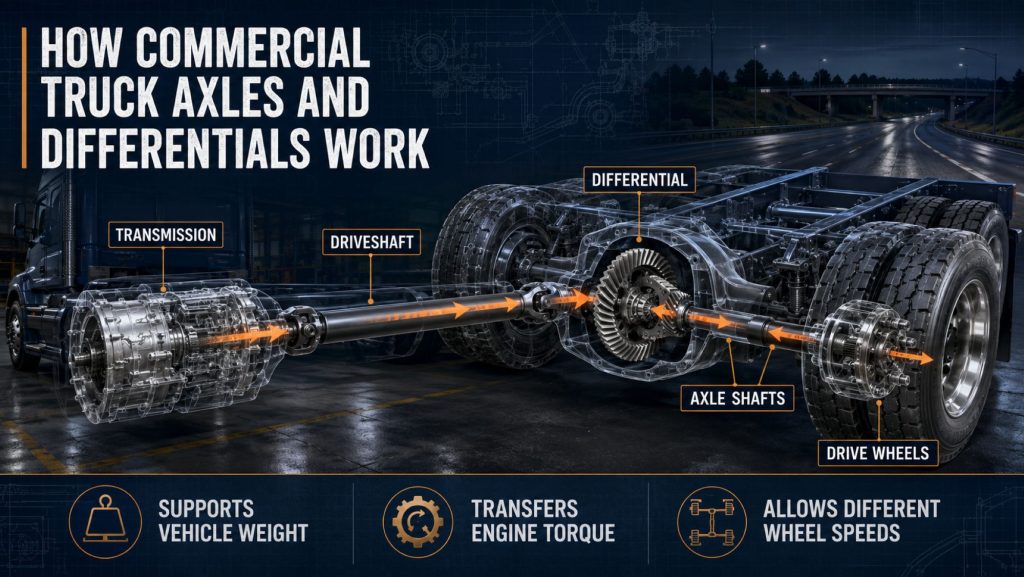
Commercial truck axles support the vehicle’s weight, connect its wheels to the chassis, and—in the case of drive axles—transfer engine torque to the road. Differentials distribute that torque while allowing connected wheels or drive axles to rotate at different speeds.
A commercial vehicle may use steer axles, drive axles, lift axles, auxiliary axles, trailer axles, or integrated electric drive axles. The correct configuration depends on the truck’s weight, powertrain, suspension, application, operating environment, and traction requirements.
This guide explains the principal axle types, how truck differentials work, how power moves through a conventional drivetrain, and how axle ratios affect performance.
What Is a Commercial Truck Axle?
An axle is a structural and mechanical assembly positioned across a vehicle between its wheels.
Depending on its design and location, an axle can perform several functions:
- Support the weight of the truck, trailer, cargo, and mounted equipment
- Connect the wheels to the suspension and chassis
- Maintain wheel alignment
- Carry brakes, hubs, bearings, and wheel-end components
- Allow the wheels to rotate
- Steer the vehicle
- Transfer power to the drive wheels
- Distribute weight across additional tires
- Provide mounting points for suspension components
Not every axle performs every function. A steer axle guides the truck but is not normally powered, while a conventional drive axle transfers engine torque to the wheels. A trailer axle supports weight but ordinarily does not propel the vehicle.
Major Commercial Truck Axle Types
Steer Axles
The steer axle is normally located at the front of a conventional commercial truck. It supports the front of the vehicle and allows the driver to control its direction.
A typical steer-axle assembly includes:
- Axle beam
- Steering knuckles
- Kingpins
- Spindles
- Tie rod
- Steering arms
- Wheel hubs
- Bearings
- Brakes
- Wheels and tires
- Suspension mounting points
Most steer axles are not powered. However, all-wheel-drive and specialized vocational trucks may use driven front steer axles.
Steer-axle capacity must support the truck’s front-end weight, including the engine, cab, driver, fuel, accessories, and any load transferred forward through the chassis.
Drive Axles
A drive axle supports vehicle weight and delivers torque to the drive wheels.
Most conventional drive axles contain:
- Axle housing
- Differential carrier
- Input yoke
- Pinion shaft
- Pinion gear
- Ring gear
- Differential case
- Side gears
- Spider gears
- Axle shafts
- Wheel hubs
- Bearings
- Brakes
- Lubrication system
Drive axles are commonly positioned behind the cab. Depending on the truck, there may be one powered rear axle or two powered axles arranged as a tandem.
Lift Axles and Auxiliary Axles
Lift and auxiliary axles add load-carrying capacity by placing additional tires on the road.
Common types include:
- Pusher axles positioned ahead of the primary rear axle group
- Tag axles positioned behind the primary rear axle group
- Liftable steer axles
- Fixed auxiliary axles
- Self-steering auxiliary axles
A lift axle can be raised when it is not required and lowered when additional weight must be supported.
When properly specified and operated, auxiliary axles can help:
- Distribute vehicle weight
- Increase legal carrying capacity
- Reduce the load carried by other axles
- Support heavy vocational equipment
- Reduce tire wear when raised while unloaded
- Improve maneuverability when raised
Axle-loading and lift-axle rules differ among states, provinces, and other jurisdictions.
Trailer Axles
Commercial trailer axles support the trailer and its cargo. A conventional trailer axle is not connected to the tractor’s engine and does not contain a powered differential.
Trailer-axle configurations include:
- Single axles
- Closed tandems
- Sliding tandems
- Spread axles
- Tridems
- Liftable axles
- Self-steering axles
- Specialized multi-axle arrangements
Trailer axles connect the suspension, brakes, wheel ends, wheels, tires, and frame into a load-bearing system.
Electric Drive Axles
An electric drive axle, commonly called an e-axle, integrates electric propulsion components with the axle assembly.
Depending on the design, an electric drive axle may include:
- One or more electric motors
- Reduction gearing
- Differential
- Axle shafts
- Power electronics
- Electronic controls
- Cooling and lubrication systems
- Regenerative-braking capability
An e-axle produces torque close to the drive wheels and may eliminate the long driveshaft used by a conventional powertrain.
What Is a Truck Differential?
A differential is a gear assembly that divides and transfers torque while allowing connected outputs to rotate at different speeds.
Inside a conventional drive axle, the wheel differential distributes torque between the left and right axle shafts.
During straight-line travel, both drive wheels normally rotate at approximately the same speed. During a turn, the outside wheel travels a longer distance and must rotate faster than the inside wheel.
The differential permits this difference in wheel speed without forcing one tire to slide across the road.
Without differential action, turning would cause:
- Tire scrubbing
- Driveline binding
- Increased steering resistance
- Additional stress on axle shafts
- Increased stress on gears and bearings
- Premature tire and driveline wear
Main Differential Components
A conventional commercial truck differential commonly contains:
- Differential carrier
- Input yoke
- Pinion shaft
- Drive pinion
- Ring gear
- Differential case
- Side gears
- Spider gears
- Cross shaft
- Carrier bearings
- Pinion bearings
- Bearing adjusters
- Axle shafts
- Differential-lock mechanism when equipped
These components work together to change the direction of power, establish the axle ratio, and distribute torque to the drive wheels.
How Power Reaches the Drive Axle
In a conventional diesel-powered truck, power travels through the drivetrain in the following order:
- The engine produces torque.
- The clutch or torque converter transfers that torque into the transmission.
- The transmission selects the gear ratio required for the operating conditions.
- The driveshaft carries torque from the transmission toward the drive axle.
- The input yoke transfers driveshaft rotation to the pinion shaft.
- The pinion gear turns the ring gear.
- The ring gear rotates the differential case.
- The differential gears distribute torque to the axle shafts.
- The axle shafts turn the wheel hubs.
- The wheels and tires transfer torque to the road.
The transmission and axle ratio work together to determine the torque delivered to the wheels and the engine speed required at a given road speed.
Follow the preceding stage of the power flow in How Commercial Truck Transmissions Work. For component matching, see How to Choose a Commercial Truck Transmission.
How the Ring and Pinion Work
The pinion gear is connected to the axle’s input yoke. It meshes with the larger ring gear mounted to the differential case.
This gearset performs two important jobs:
- It changes the direction of power so torque can travel outward toward the wheels.
- It establishes the axle’s final-drive ratio.
If the ring gear has 41 teeth and the pinion has 11 teeth, the axle ratio is approximately 3.73:1.
This means the driveshaft turns approximately 3.73 times for every complete rotation of the drive wheels.
The ring-and-pinion gearset requires precise adjustment. Pinion depth, bearing preload, gear backlash, and tooth-contact pattern must all meet the axle manufacturer’s specifications.
How an Open Differential Works
An open differential is the basic differential design used in many commercial vehicles.
When the truck travels straight, the differential case, spider gears, side gears, and axle shafts rotate together. The drive wheels turn at approximately the same speed.
During a turn, the spider gears rotate within the differential case. This allows one side gear and axle shaft to turn faster while the other turns more slowly.
The primary advantage of an open differential is smooth, predictable operation on paved surfaces.
Its principal limitation occurs when one wheel loses traction. The wheel with less resistance may spin while the wheel on the firmer surface receives insufficient usable torque to move the truck.
How a Locking Differential Works
A locking differential connects the left and right axle shafts so both drive wheels rotate together.
When locked, differential action is restricted or eliminated. This helps the truck continue moving when one wheel is on a slippery, loose, or uneven surface.
Commercial trucks may use:
- Driver-controlled differential locks
- Air-operated differential locks
- Electronically controlled differential locks
- Automatic locking differentials
Locking differentials are commonly used in:
- Construction trucks
- Dump trucks
- Concrete mixers
- Logging trucks
- Oilfield trucks
- Refuse trucks
- Snowplows
- Heavy wreckers
- Heavy-haul tractors
- Severe-service vehicles
A driver-controlled differential lock should normally be engaged before wheelspin becomes severe and released when additional traction is no longer required.
Turning on high-traction pavement with a locked differential can cause tire scrubbing, driveline stress, and difficult handling.
How a Limited-Slip Differential Works
A limited-slip differential allows the left and right wheels to rotate at different speeds while restricting excessive speed differences.
Depending on the design, it may use:
- Clutch packs
- Helical gears
- Torque-sensing gears
- Cones
- Springs
- Other friction or mechanical mechanisms
A limited-slip differential can direct more usable torque toward the wheel with better traction without creating the complete mechanical connection of a fully locked differential.
Limited-slip systems may be used in medium-duty trucks, utility vehicles, buses, municipal trucks, delivery vehicles, and light vocational applications.
How Tandem Drive Axles Work
A tandem-drive truck has two powered rear axles:
- Forward-rear drive axle
- Rear-rear drive axle
Power from the transmission enters the forward-rear axle. An inter-axle differential, sometimes associated with the power-divider assembly, distributes torque between the two drive axles.
Part of the torque remains within the forward-rear axle. The remaining torque travels through an inter-axle driveshaft to the rear-rear axle.
A conventional tandem-drive arrangement normally contains:
- One inter-axle differential between the two drive axles
- One wheel differential inside the forward-rear axle
- One wheel differential inside the rear-rear axle
These are separate differential systems with different functions.
Inter-Axle Differential vs Wheel Differential
The inter-axle differential distributes torque between the two drive axles in a tandem.
The wheel differential distributes torque between the left and right wheels of an individual drive axle.
An inter-axle differential lock connects the forward-rear and rear-rear drive axles so they receive power together.
A wheel differential lock connects the left and right axle shafts within one drive axle.
Engaging the inter-axle lock does not automatically lock the left and right wheels. A truck requires separate wheel differential locks to create that connection.
Depending on its equipment, a tandem-drive truck may have:
- An inter-axle differential lock only
- A wheel differential lock on one drive axle
- Wheel differential locks on both drive axles
- A combination of inter-axle and wheel differential locks
- Automatic or limited-slip traction systems
Single-Axle and Tandem-Axle Trucks
Single-Drive-Axle Trucks
A single-drive-axle truck has one powered rear axle.
This configuration generally offers:
- Lower vehicle weight
- Fewer tires
- Fewer brakes and wheel ends
- Lower maintenance requirements
- Better maneuverability
- Lower purchase cost
Single-drive axles are commonly found on medium-duty trucks, local delivery vehicles, utility trucks, straight trucks, and lighter tractor applications.
Tandem-Drive-Axle Trucks
A tandem-drive truck has two powered rear axles.
This configuration can provide:
- Greater load-carrying capacity
- More drive tires
- Improved traction
- Better torque distribution
- Increased durability for heavy applications
- Compatibility with higher combination weights
Tandem drives are common on highway tractors, dump trucks, mixers, logging trucks, heavy wreckers, refuse trucks, and heavy-haul vehicles.
The additional axle also adds weight, tires, brakes, bearings, lubrication requirements, and maintenance costs.
Understanding Axle Ratios
The axle ratio compares the rotational speed of the driveshaft with the rotational speed of the drive wheels.
A numerically lower ratio, such as 2.64:1, generally reduces engine rpm during highway cruising when used with the appropriate transmission and tire size.
A numerically higher ratio, such as 4.56:1, provides greater torque multiplication but causes the driveshaft and engine to turn faster at the same road speed.
Numerically lower ratios are often associated with:
- Highway operation
- Lower cruising rpm
- Direct-drive transmissions
- Fuel-efficiency-focused specifications
- Lighter or moderate operating weights
Numerically higher ratios are often associated with:
- Heavy-haul operation
- Vocational trucks
- Steep terrain
- Off-highway use
- Severe-service applications
- Greater startability requirements
- Lower operating speeds
The axle ratio must be matched with:
- Engine torque curve
- Transmission gearing
- Direct-drive or overdrive configuration
- Tire size
- Gross combination weight
- Desired highway speed
- Operating terrain
- Startability requirements
- Gradeability requirements
- Duty cycle
Axle ratio should never be selected without considering the complete powertrain.
Axle Shafts and Wheel Ends
Axle shafts transfer torque from the differential side gears to the drive wheels.
Most heavy commercial drive axles use full-floating axle designs. In this arrangement, the axle shaft primarily transfers torque, while the wheel hub and bearings support the vehicle’s weight.
The wheel end may include:
- Spindle
- Inner and outer bearings
- Hub
- Wheel seal
- Lubricant
- Brake drum or rotor
- Wheel-speed sensor
- Wheels and tires
- Hubcap or axle-shaft flange
Wheel-end condition is critical because bearing, seal, lubrication, or adjustment problems can lead to overheating, wheel damage, brake contamination, or wheel separation.
Axle Capacity and Weight Ratings
Axles are assigned capacity ratings based on their design and intended use.
Important ratings and limits may include:
- Gross axle weight rating
- Gross vehicle weight rating
- Gross combination weight rating
- Suspension capacity
- Brake capacity
- Wheel-end capacity
- Wheel rating
- Tire load rating
- Frame capacity
- Manufacturer certification limits
An axle’s published mechanical capacity does not automatically establish how much weight a vehicle may legally carry.
Legal axle loading may also depend on:
- Axle spacing
- Number of axles
- Tire width
- Bridge formulas
- State or provincial law
- Road restrictions
- Permit requirements
- Seasonal weight restrictions
The lowest-rated component can limit the allowable capacity of the complete axle system.
Axles, Suspension, and Brakes
An axle does not function independently from the rest of the chassis.
The suspension connects the axle to the truck or trailer frame. It carries weight, controls axle movement, maintains alignment, and helps absorb road inputs.
Commercial axles may be paired with:
- Leaf-spring suspension
- Walking-beam suspension
- Rubber-block suspension
- Air-ride suspension
- Taper-leaf suspension
- Multi-link suspension
- Specialized vocational systems
The axle also provides mounting locations for drum or disc brakes. Brake capacity must match the axle rating, vehicle weight, tire size, application, and applicable safety requirements.
Improper alignment, worn suspension components, or incorrect ride height can affect axle performance and cause uneven tire wear.
Differential Lubrication
Drive-axle gears and bearings operate under heavy loads and require the correct lubricant.
Axle lubricant helps:
- Reduce friction
- Control operating temperature
- Protect gear teeth
- Lubricate bearings
- Prevent corrosion
- Carry wear particles toward the drain area or magnetic plug
The correct lubricant type, viscosity, specification, and service interval depend on the axle manufacturer, duty cycle, operating temperature, and vehicle application.
Maintenance may include:
- Checking lubricant level
- Inspecting for leaks
- Changing lubricant at the required interval
- Cleaning magnetic drain plugs
- Inspecting lubricant for metal particles
- Checking axle breathers
- Examining seals and gaskets
- Monitoring operating temperature
Mixing incompatible lubricants or using an incorrect specification can reduce protection and damage axle components.
Common Signs of Axle or Differential Trouble
Possible warning signs include:
- Humming or whining
- Gear howl during acceleration or deceleration
- Clunking when power is applied
- Excessive driveline backlash
- Vibration
- Wheel-end noise
- Lubricant leaks
- Overheating
- Burning odor
- Metal particles in the lubricant
- Differential lock failing to engage
- Differential lock failing to release
- ABS or traction-system warning lights
- Uneven or accelerated tire wear
- Changes in steering or handling
These symptoms can also originate elsewhere in the drivetrain, suspension, brakes, wheels, or tires. Proper diagnosis is necessary before replacing components.
Basic Axle and Differential Inspection
A routine visual and operational inspection may include:
- Checking axle housings for cracks or physical damage
- Looking for lubricant leaks
- Inspecting wheel seals
- Checking the differential carrier and housing joints
- Inspecting axle-shaft flanges
- Checking driveshafts and universal joints
- Examining suspension mounting points
- Inspecting torque rods and bushings
- Checking wheel-end temperature
- Listening for unusual gear or bearing noise
- Confirming differential-lock operation
- Checking air lines and electrical connections
- Inspecting tires for irregular wear
- Verifying correct ride height and axle alignment
Internal repairs require the correct service information, measuring tools, lifting equipment, and safety procedures.
Choosing the Correct Axle and Differential Configuration
Commercial truck axles should be selected as part of the complete vehicle specification.
Important considerations include:
- Truck or trailer type
- Vehicle class
- Gross axle weight ratings
- Gross vehicle weight
- Gross combination weight
- Engine torque
- Transmission gearing
- Axle ratio
- Tire size
- Single- or tandem-drive configuration
- Highway or vocational operation
- Terrain and grades
- Road surfaces
- Required traction
- Differential-lock configuration
- Brake system
- Suspension type
- Wheel-end equipment
- Desired ground clearance
- Operating territory
- Service support
- Replacement-parts availability
A long-haul tractor operating primarily on interstate highways requires a different configuration from a dump truck, logging truck, refuse vehicle, heavy wrecker, or oilfield truck.
Related Axle and Differential Categories
- Commercial Truck Drive Axles
- Commercial Truck Steer Axles
- Lift Axles and Auxiliary Axles
- Truck Differentials
- Electric Drive Axles
- Commercial Trailer Axles
Related Equipment Resources
- Axles and Differentials
- Transmissions
- Engines
- Suspension Systems
- Brake Systems
- Tires and Wheels
- Safety Systems
Explore More Axle and Differential Guides
Visit Axle and Differential Guides to explore additional resources covering axle configurations, axle ratios, differential types, equipment identification, and common axle and differential problems.