
Lift Axles and Auxiliary Axles
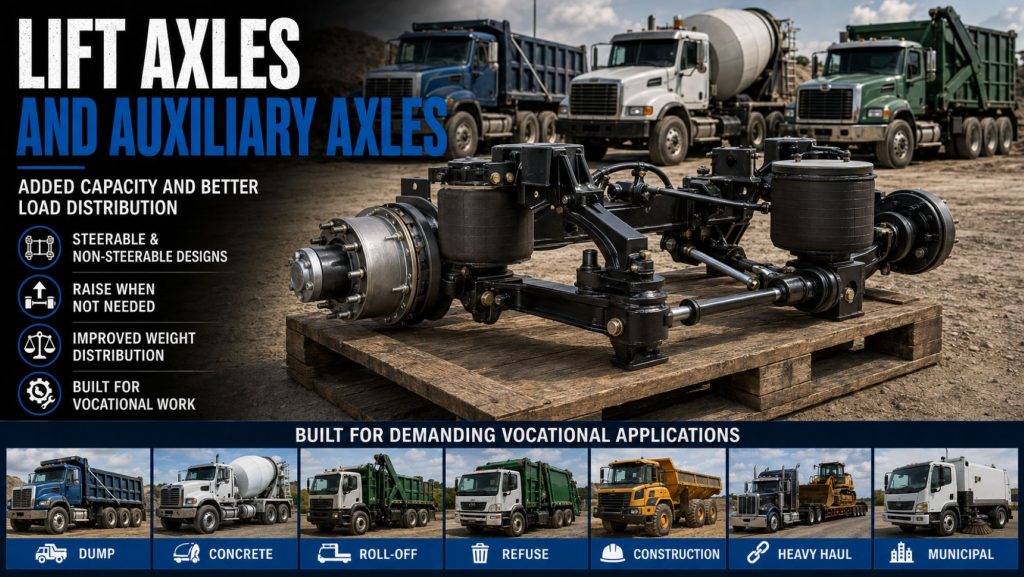
Lift axles and auxiliary axles provide additional load-carrying and weight-distribution capacity for commercial trucks operating in demanding vocational, construction, refuse, concrete, heavy-haul, and specialized applications.
Unlike a truck’s permanently loaded steer and drive axles, many auxiliary axles can be raised when additional capacity is unnecessary and lowered when the vehicle is carrying a heavier load. This helps distribute weight across more tires and axle positions while reducing unnecessary tire wear when the truck is empty or lightly loaded.
Auxiliary-axle configurations include pusher axles, tag axles, steerable lift axles, non-steerable lift axles, booster axles, and specialized multi-axle systems. The correct design depends on the truck chassis, body equipment, intended load, axle-spacing requirements, operating territory, and applicable weight laws.
This section of Truck Equipment Atlas covers the different types of lift and auxiliary axles, how they operate, where they are used, and what fleets should consider when specifying or maintaining them.
Lift Axles and Auxiliary Axles on Truck Equipment Atlas
Hendrickson Lift Axles
Hendrickson COMPOSILITE EXS Lift Axle
Additional Hendrickson COMPOSILITE, TOUGHLIFT, steerable, non-steerable, roll-off, Super Dump, and severe-duty auxiliary-axle profiles will be added as the equipment library expands.
Additional Lift-Axle Manufacturers
Truck Equipment Atlas will continue adding lift and auxiliary axle systems from manufacturers serving commercial truck, vocational, refuse, concrete, construction, and specialized transportation markets.
What Is a Lift Axle?
A lift axle is an additional axle that can be lowered to support the vehicle when extra load capacity or weight distribution is needed. When the truck is empty or lightly loaded, the axle can often be raised so its tires no longer contact the road.
Most modern commercial lift-axle systems use air suspension to raise and lower the axle. Air controls, pressure regulators, valves, suspension components, mounting brackets, brakes, wheels, and tires work together as a complete auxiliary-axle system.
A lift axle does not automatically increase the truck’s legal payload by its full mechanical rating. Legal capacity depends on gross vehicle weight limits, axle ratings, axle spacing, bridge-formula requirements, tire ratings, chassis ratings, permits, and state or provincial laws.
What Is an Auxiliary Axle?
An auxiliary axle is any additional axle installed to help support or distribute vehicle weight beyond the truck’s standard steer and drive axles.
Many auxiliary axles are liftable, but some specialized auxiliary axles remain on the ground during operation. Depending on the installation, an auxiliary axle may be positioned ahead of the drive axles, behind them, beneath specialized body equipment, or at the rear of a vehicle or trailer.
Auxiliary axles are commonly used on vehicles whose loaded weight or concentrated body load cannot be adequately supported by a standard single- or tandem-drive configuration.
How Lift and Auxiliary Axles Work
When additional carrying capacity is required, the driver or an automatic control system directs air pressure into the auxiliary axle’s suspension springs. The axle lowers until its tires contact the road and begin supporting part of the vehicle’s weight.
Regulated suspension pressure determines how much weight the axle carries. Increasing pressure generally transfers more weight onto the auxiliary axle, while reducing pressure shifts weight back toward the truck’s other axles.
When the truck is empty or the axle is not required, the suspension air can be exhausted and a lifting mechanism raises the axle away from the road.
Some systems include automatic controls that lower or raise the axle based on vehicle load, speed, direction, or operating conditions. Other systems rely primarily on driver-operated controls.
Learn more in the Lift Axles Explained guide.
Pusher Axles
A pusher axle is installed ahead of the truck’s drive axle or tandem-drive group. It helps distribute weight carried by the chassis, body, and cargo across an additional axle position.
Pusher axles are common on dump trucks, concrete mixers, refuse trucks, roll-off trucks, heavy wreckers, construction vehicles, and other vocational trucks.
A pusher axle may be steerable or non-steerable. Steerable designs generally provide better maneuverability and reduced tire scrubbing when the axle remains deployed during turns.
Tag Axles
A tag axle is positioned behind the truck’s drive axle or tandem-drive group. Like a pusher axle, it supports additional weight and helps distribute the vehicle’s load.
Tag axles are found on certain concrete mixers, heavy wreckers, specialty vehicles, motor coaches, heavy-haul tractors, and trucks with rear-mounted equipment.
Because the axle is positioned behind the drive group, it can affect turning behavior, rear overhang, load transfer, frame stress, and maneuverability. The complete chassis and body installation must be engineered for the axle’s location and intended loading.
Steerable Lift Axles
A steerable lift axle allows its wheels to turn in response to vehicle direction. The axle follows the truck through a turn instead of forcing its tires to slide laterally across the road surface.
Steerable lift axles can reduce tire scrubbing, improve maneuverability, and limit stress on suspension and mounting components. They are frequently selected for trucks that must make tight turns while the auxiliary axle remains lowered.
Certain steerable systems automatically center or lock their wheels when the vehicle reverses. Drivers must understand how the individual axle behaves during backing and low-speed maneuvering.
Common steerable lift-axle applications include:
- Dump trucks
- Concrete mixers
- Refuse trucks
- Roll-off trucks
- Construction vehicles
- Municipal trucks
- Heavy wreckers
- Specialized vocational trucks
Non-Steerable Lift Axles
A non-steerable lift axle keeps its wheels aligned in a fixed forward position. Its simpler design can be durable and suitable for applications where the axle can be raised before tight turns or where operating conditions do not require frequent sharp maneuvering.
If a fixed axle remains lowered during a tight turn, its tires may scrub across the pavement. This can accelerate tire wear and place lateral stress on the axle, suspension, mounts, and truck frame.
Regulations governing when a non-steerable axle may be raised or must remain lowered differ by jurisdiction. Operators should understand the rules in every state or province where the vehicle will operate.
Single-Tire and Dual-Tire Configurations
Lift and auxiliary axles may use single tires or dual tires depending on axle capacity, available space, application, and legal requirements.
Single-Tire Configurations
Single-tire lift axles can reduce component weight and require less space beneath the chassis. They are often suitable for lower-capacity systems and applications where installation clearance is limited.
Dual-Tire Configurations
Dual-tire auxiliary axles can provide greater tire capacity and a wider supporting footprint. They are often used in higher-capacity vocational and severe-duty applications.
The axle, hubs, wheels, tires, suspension, brakes, and chassis mounts must all be rated for the intended load. Tire capacity alone does not determine the system’s usable rating.
Common Lift-Axle Capacities
Commercial lift-axle capacity varies substantially by manufacturer, axle design, tire configuration, brake package, suspension system, and application.
Common systems include lighter auxiliary axles designed for moderate load distribution and heavier steerable or non-steerable systems for severe-duty vocational trucks. Certain heavy-duty designs are rated above the capacities normally associated with standard single-tire lift axles.
The system’s published capacity should not be confused with the amount of additional legal payload the truck can carry. Actual allowable weight remains limited by:
- Gross vehicle weight rating
- Gross axle weight ratings
- Truck-frame capacity
- Suspension capacity
- Wheel and tire ratings
- Brake-system capacity
- Axle spacing
- Federal bridge-formula limits
- State and provincial regulations
- Permit conditions
Air Controls and Load Distribution
Most lift axles use an air-pressure control system to regulate how much load the axle supports. The system may include air springs, pressure regulators, gauges, solenoid valves, control switches, height-control valves, and load-sensing components.
Correct air pressure is critical. Too little pressure may leave the truck’s primary axles overloaded, while excessive pressure can overload the auxiliary axle or remove too much weight from the drive or steer axles.
Removing excessive weight from the drive axles can reduce traction. Shifting too much weight away from the steer axle can affect steering control. The truck should be weighed with the auxiliary axle deployed to confirm the actual weight carried at every axle position.
Construction and Dump-Truck Applications
Dump trucks frequently use lift axles to distribute the weight of gravel, soil, asphalt, demolition material, and other dense commodities.
A pusher axle installed ahead of the drive tandem is common on vocational dump trucks. Certain multi-axle dump configurations use several lift axles to achieve greater legal payload within applicable axle-spacing rules.
Super Dump configurations may combine multiple pusher axles with a trailing axle or load-bearing system behind the body. These trucks require careful engineering, load management, and regulatory review.
Roll-Off and Waste Applications
Roll-off trucks carry concentrated container loads that change during loading, transport, and unloading. A properly configured auxiliary axle can help distribute the loaded container’s weight across the chassis.
Refuse trucks may use lift axles to support heavy body equipment and changing payloads collected throughout a route. Frequent turns, backing, curb approaches, and stop-and-go operation make axle steerability and control behavior especially important.
Concrete Mixer Applications
Concrete mixer trucks carry a dense load that changes as material is discharged. Auxiliary axles can help keep individual axle weights within permitted limits while the truck travels to a job site.
The axle system must be compatible with the mixer body, chassis layout, discharge equipment, suspension, and operating environment. Job-site access, soft surfaces, tight turns, and frequent backing affect the best axle configuration.
Heavy-Haul and Specialized Applications
Auxiliary axles may be used on heavy-haul tractors, heavy wreckers, crane carriers, oilfield vehicles, specialty construction trucks, and other vehicles transporting unusually heavy equipment.
These applications may require custom frame reinforcement, additional braking capacity, specialized suspension controls, and careful engineering of axle spacing and load transfer.
Auxiliary axles may also work with trailers, jeep dollies, boosters, and other weight-distribution equipment in permitted heavy-haul combinations.
Common Applications
- Dump trucks
- Super Dump trucks
- Concrete mixer trucks
- Roll-off trucks
- Refuse trucks
- Heavy wreckers
- Crane carriers
- Municipal trucks
- Construction trucks
- Oilfield vehicles
- Logging trucks
- Heavy-haul tractors
- Specialized vocational trucks
- Bulk-material trucks
- Severe-service vehicles
Advantages
- Distributes vehicle weight across additional axle positions
- Can increase legal payload when axle spacing and regulations allow
- Helps prevent overloading the truck’s primary axles
- Can be raised when the vehicle is empty or lightly loaded
- Reduces unnecessary tire contact when the axle is not needed
- Supports dense vocational loads
- Available in steerable and non-steerable configurations
- Can be configured with single or dual tires
- Supports specialized multi-axle truck designs
- Provides additional flexibility for changing operating loads
- Can improve fleet productivity in weight-sensitive applications
Limitations and Regulatory Considerations
- Adds weight to the empty truck
- Increases purchase and installation costs
- Adds tires, brakes, bearings, suspension components, and controls to maintain
- Improper air pressure can overload another axle
- Non-steerable axles may scrub tires during tight turns
- Lift-axle controls and operating rules differ by jurisdiction
- Some jurisdictions restrict when an axle may be raised
- Certain jurisdictions may regulate the location of axle controls
- Mechanical axle capacity does not guarantee equivalent legal payload
- Poor installation can damage or overstress the truck frame
- Additional axles can affect maneuverability
- Lift mechanisms require adequate chassis clearance
- Raised axles may reduce available ground clearance
- Automatic controls can introduce additional electrical and pneumatic service requirements
Driver and Operator Considerations
Drivers must know when the axle should be lowered, how much pressure it requires, and whether local regulations allow it to be raised under specific conditions.
Before loading, the driver should inspect the air springs, lift mechanism, axle beam, mounting brackets, brakes, tires, wheels, hoses, wiring, control valves, and steering components when equipped.
The operator should verify that the axle lowers completely and carries the intended load. A pressure gauge alone does not confirm legal weight distribution; the truck should be checked on a certified scale.
Drivers should also understand how the axle behaves during turns and while reversing. A steerable axle may need to center or lock before backing, while a non-steerable axle may need to be raised before tight maneuvering when legally permitted.
The axle should not be raised merely to pass a roadside scale or avoid a legal axle-weight requirement. It must be operated according to the vehicle’s approved configuration and the laws of the operating jurisdiction.
Maintenance and Ownership Notes
Lift axles add suspension, brake, wheel-end, tire, steering, pneumatic, electrical, and structural components to the truck’s maintenance program.
Air springs and hoses should be checked for leaks, abrasion, weather damage, and contact with surrounding equipment. Control valves, regulators, gauges, and electrical connections should operate consistently.
Wheel bearings require correct lubrication and end-play adjustment. Brake chambers, slack adjusters, drums or rotors, air lines, and ABS components should be serviced according to the axle and brake manufacturers’ requirements.
Steerable lift axles require inspection of tie rods, steering arms, kingpins, bushings, stops, stabilizers, and centering mechanisms. Loose or worn steering components can cause wandering, tire wear, vibration, or improper tracking.
Mounting brackets, frame reinforcements, fasteners, welds, and crossmembers should be inspected for cracks, corrosion, looseness, and distortion. Trucks operating on construction sites or rough roads may require more frequent inspections.
Proper alignment is essential. An axle that does not track correctly can wear tires rapidly even when its suspension and steering components appear functional.
Choosing a Lift or Auxiliary Axle
Before selecting an auxiliary axle, determine the truck’s actual loaded axle weights and the amount of weight that must be redistributed.
Important considerations include:
- Truck make, model, and frame configuration
- Gross vehicle weight rating
- Front and rear axle ratings
- Body and equipment weight
- Maximum intended payload
- Available axle spacing
- Intended operating states or provinces
- Steerable or non-steerable design
- Single- or dual-tire configuration
- Required axle capacity
- Available frame and underbody clearance
- Brake and ABS compatibility
- Air-system capacity
- Control-system requirements
- Forward and reverse maneuverability
- Dealer and replacement-parts support
- Chassis-manufacturer installation requirements
The completed truck should be evaluated as a complete vehicle. Axle ratings, frame capacity, tires, brakes, suspension, body installation, and legal weight requirements must all support the intended operation.
Related Axle and Differential Categories
- Commercial Truck Drive Axles
- Commercial Truck Steer Axles
- Truck Differentials
- Electric Drive Axles
- Commercial Trailer Axles
- Axle and Differential Guides
Related Equipment Resources
Explore the Complete Axle and Differential Library
Visit the Axles and Differentials hub to explore commercial truck drive axles, steer axles, lift axles, auxiliary axles, differentials, electric drive axles, trailer axles, manufacturer profiles, and educational guides.