
Brenner Chemical Tank Trailer
Quick Facts
- Manufacturer: Brenner Tank
- Current Parent Company: Wabash
- Trailer Type: Chemical Tank Trailer
- Common Cargo Tank Specifications: DOT 407 and Legacy MC 307
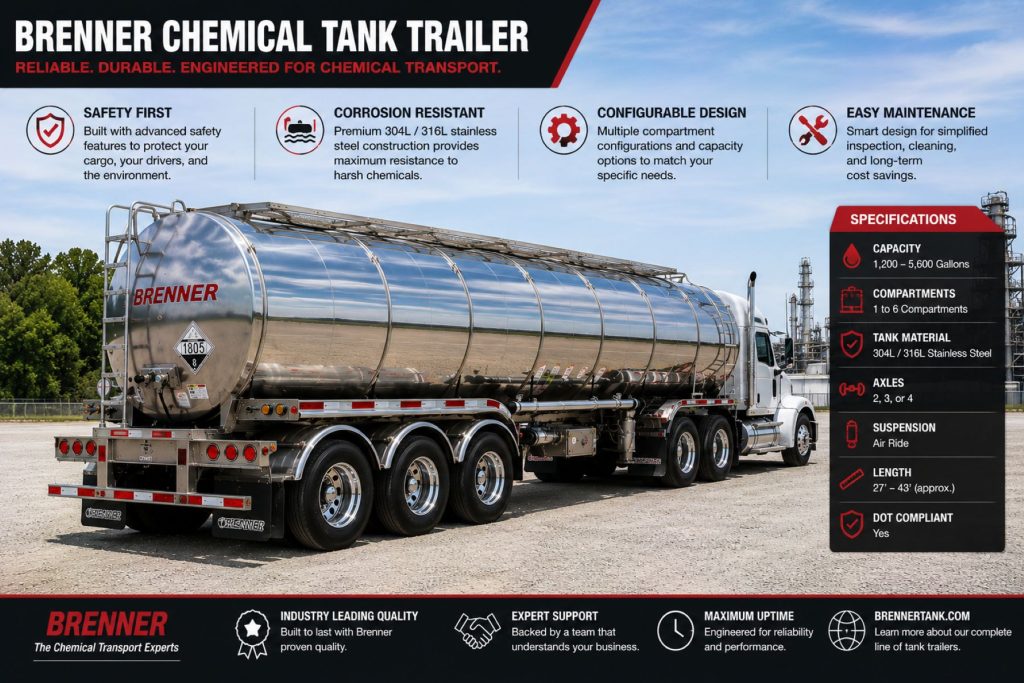
- Common Construction: 316L Stainless Steel
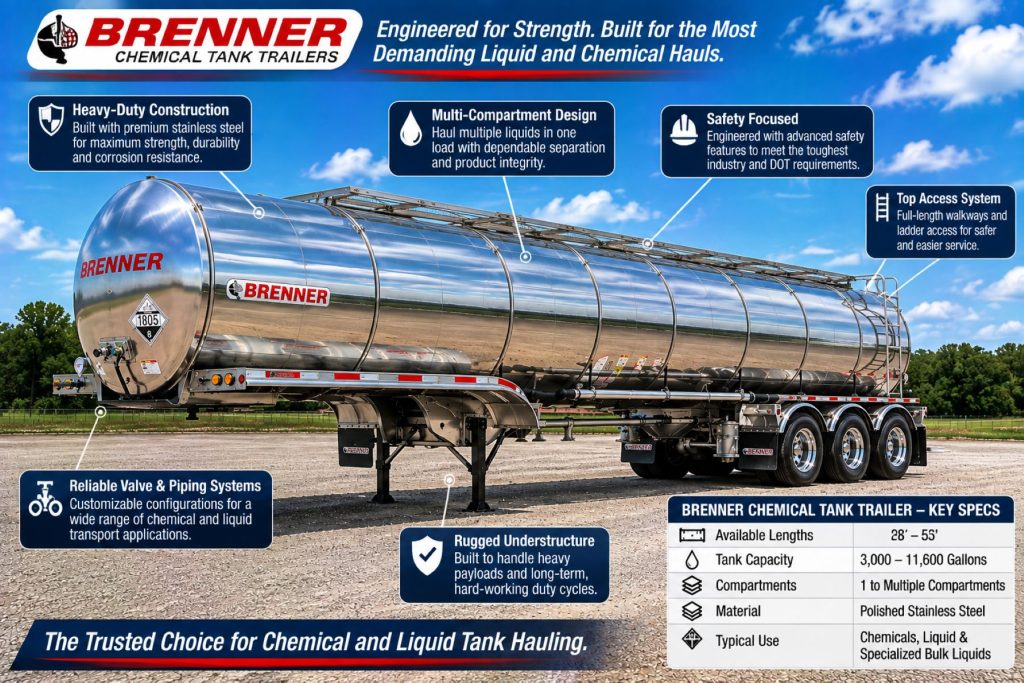
- Typical Capacity Range: Approximately 5,000 to 9,000 Gallons
- Common Configuration: Single-Compartment Smooth-Bore Tank
- Available Configurations: Insulated, Non-Insulated, Heated, Rear Discharge, Center Discharge, and Multi-Compartment
- Common Pressure Rating: Approximately 25 to 40 psi, depending on tank specification
- Common Axle Configuration: Fixed Tandem Axle
- Common Suspension: Air Ride or Spring Ride, depending on model year
- Primary Applications: Industrial Chemicals, Solvents, Petrochemicals, Alcohols, Oils, and Other Compatible Bulk Liquids
- Brand Status: Brenner became part of Wabash, and newer tank products are marketed under the Wabash name
Overview
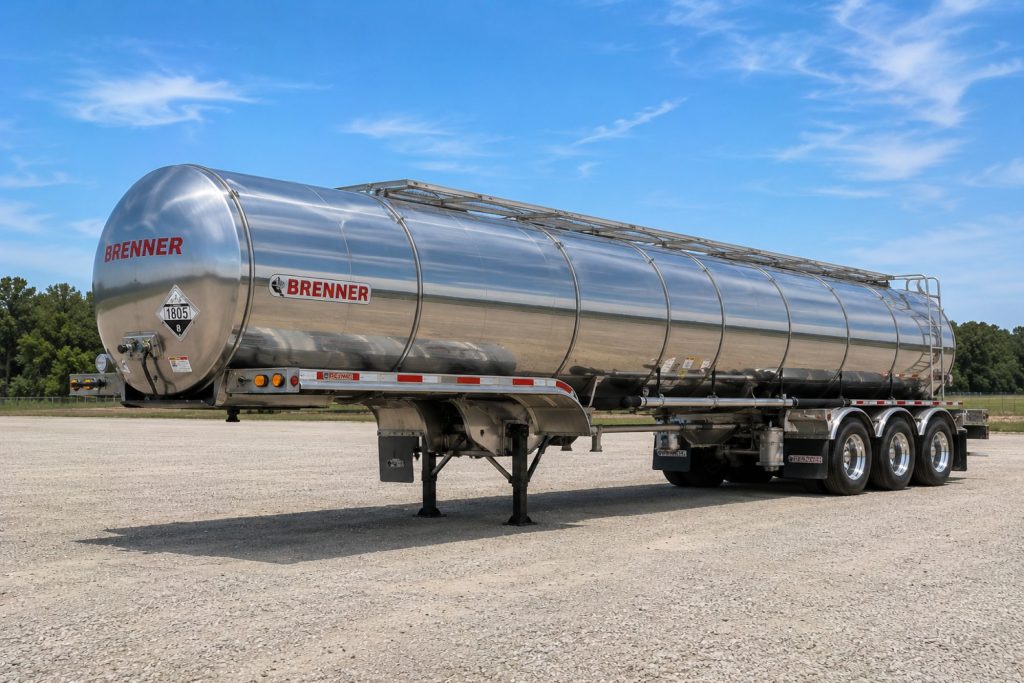
The Brenner Chemical Tank Trailer is a stainless-steel cargo tank designed for transporting industrial chemicals, solvents, petrochemicals, oils, and other compatible bulk liquids. Brenner tankers have been used extensively by chemical carriers, industrial fleets, environmental service companies, and specialized hazmat transportation operations.
Many Brenner chemical trailers were constructed to the MC 307 or DOT 407 cargo tank specification. DOT 407 became the successor to MC 307 and remains a common specification for transporting a wide range of low- to medium-pressure liquid chemicals.
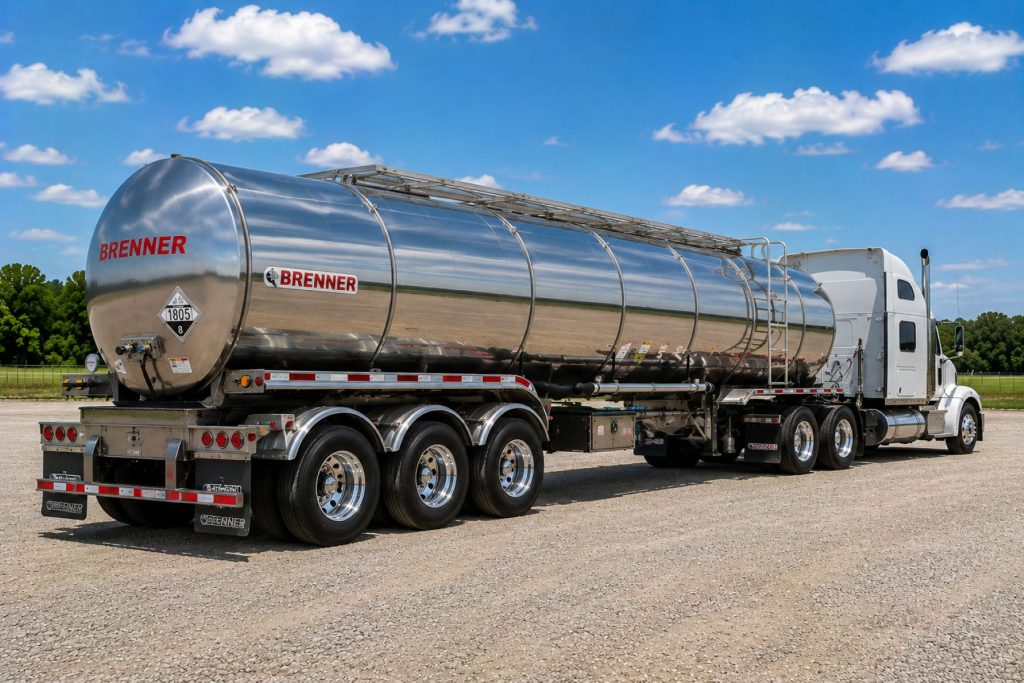
A typical Brenner chemical tanker uses a single-compartment, smooth-bore tank manufactured from 316L stainless steel. Insulation, stainless-steel jacketing, heating channels, vapor-recovery equipment, hydraulic internal valves, hose carriers, and specialized discharge systems may be installed according to the intended product.
The Brenner brand became part of Wabash and is now considered a legacy product name. Brenner-built trailers remain widely available in the used equipment market, while newer tank transportation products are marketed under the Wabash name.
Key Characteristics
Chemical compatibility is one of the most important characteristics of a Brenner tanker. The stainless-steel barrel, gaskets, valves, piping, seals, and hoses must all be compatible with the product being transported.
Many models use a smooth-bore tank without internal baffles. This construction simplifies cleaning and reduces areas where chemical residue can collect, but it also allows significant liquid surge when the tank is partially loaded.
Insulated versions commonly use fiberglass insulation covered by stainless-steel outer jacketing. Steam or in-transit heating systems may be included for products that must remain above a certain temperature.
The tank may use a straight-round, double-conical, or center-sloped design. Tank shape and slope help direct liquid toward a rear or center discharge outlet.
Equipment varies considerably because many Brenner chemical trailers were built to fleet-specific requirements.
Common Specifications
Tank Material
316L stainless steel is commonly used for the tank shell and heads. This material provides corrosion resistance for many industrial liquids, although it is not compatible with every chemical.
Product compatibility must always be verified before loading.
Cargo Tank Specification
Many Brenner chemical tankers were manufactured under the MC 307 or DOT 407 specification.
MC 307 is a legacy specification found on older trailers. DOT 407 is its modern successor and is commonly used for transporting a broad range of liquid chemicals.
Certain Brenner trailers were manufactured to other cargo tank specifications for acids, corrosive products, solvents, petroleum products, or specialized liquids.
Capacity
Common capacities include approximately:
- 5,000 gallons
- 6,000 gallons
- 6,500 gallons
- 6,700 gallons
- 7,000 gallons
- 7,200 gallons
- 7,700 gallons
- 8,000 gallons
- 9,000 gallons
Actual usable capacity depends on the tank’s design, product density, outage requirements, legal weight limits, and permitted filling level.
Compartments
Single-compartment construction is common for chemical service.
Multi-compartment Brenner tankers were also manufactured for operations that needed to carry separate compatible products or smaller quantities.
Tank Shape
Available and historical configurations include:
- Straight-round tank
- Double-conical tank
- Center-sloped tank
- Rear-sloped tank
- Single-compartment tank
- Multi-compartment tank
Pressure Rating
Many DOT 407 and MC 307 Brenner tankers have maximum allowable working pressures around 25 to 40 psi.
The tank’s certification plate provides the actual maximum allowable working pressure, test pressure, design temperature, and cargo tank specification.
Product Density
Chemical tankers may be designed for maximum product densities around 12 or 13 pounds per gallon.
Higher-density products reduce the number of gallons that can be carried without exceeding legal or structural weight limits.
Insulation
Insulated versions commonly use compressed fiberglass insulation covered by stainless-steel jacketing.
Non-insulated configurations are available for products that do not require temperature control.
Heating System
Available heating arrangements may include steam channels and in-transit heat.
Heating systems are used for products that become too viscous to unload or must remain within a specific temperature range.
Loading and Unloading
Loading may take place through the top manway or a closed-loading connection.
Unloading systems may include:
- Rear discharge
- Center discharge
- Gravity unloading
- Pump unloading
- Air-assisted unloading when approved
- Hydraulic internal valve
- Quick-release external valve
- Product piping and hose connections
Suspension and Axles
A fixed tandem-axle configuration is common.
Older Brenner trailers frequently use spring suspension, while later models commonly use air-ride suspension.
Safety Equipment
- Equipment may include:
- Emergency internal shutoff valve
- Remote valve controls
- Pressure-relief devices
- Rollover protection
- Spill containment
- Vapor-recovery connections
- Grounding equipment
- Placard holders
- Hose tubes or trays
- Rear and side lighting
Final specifications vary by year and original order. The trailer’s certification plate, build documents, current inspection records, and repair history should be used to determine its approved operating limits.
Common Applications
- Industrial chemical transportation
- Solvent transportation
- Petrochemical transportation
- Alcohol transportation
- Methanol transportation
- Ethanol transportation
- Transformer oil transportation
- Lubricant transportation
- Liquid resin transportation
- Agricultural chemical transportation
- Industrial cleaning product transportation
- Compatible acid transportation
- Environmental service operations
- Bulk liquid transportation
- Hazardous materials transportation
Advantages
- 316L stainless-steel construction provides broad chemical compatibility
- DOT 407 and MC 307 configurations are widely understood within the tank industry
- Smooth-bore interior simplifies cleaning
- Insulated versions support temperature-sensitive products
- Available heating systems assist with viscous liquids
- Rear- and center-discharge configurations are available
- Single- and multi-compartment models were produced
- Stainless-steel construction can provide a long service life
- Large used-trailer market provides numerous capacity options
- Replacement valves, fittings, hoses, and tank components are widely available
- Specialized repair facilities are familiar with Brenner tankers
- Properly maintained units can remain in service for many years
Limitations or Considerations
- The Brenner name is no longer used for newly marketed Wabash tank trailers
- Older trailers may require extensive inspection or refurbishment
- Stainless steel is not compatible with every chemical
- Smooth-bore tanks can produce significant liquid surge
- Hazardous cargo requires specialized driver training and endorsements
- Tank cleaning can be expensive and time-consuming
- Previous cargo history can affect future product compatibility
- Heating channels and insulation can hide corrosion or damage
- Internal valves, vents, and discharge equipment require specialized maintenance
- Cargo tank testing must remain current
- Maximum gallon capacity does not equal legal payload capacity
- Product density can significantly reduce the permitted fill volume
- Tank repairs must be completed by qualified cargo tank facilities
Driver and Operator Considerations
Operating a Brenner Chemical Tank Trailer requires an understanding of liquid surge, chemical hazards, loading procedures, unloading procedures, emergency equipment, and cargo tank regulations.
Smooth-bore tanks allow liquid to move during acceleration, braking, and cornering. Drivers should accelerate gradually, brake early, maintain additional following distance, and reduce speed before curves.
Before loading, the carrier must confirm that the tank, piping, valves, gaskets, hoses, and seals are compatible with the product. The previous cargo and cleaning documentation should also be reviewed.
Drivers should inspect the manway, pressure-relief devices, internal valve, external discharge valve, piping, hose connections, spill containment, grounding equipment, and placards before departure.
Personal protective equipment must match the transported chemical and the loading facility’s requirements.
Maintenance and Ownership Notes
Cargo tank maintenance requires more than standard trailer service. The tank shell, heads, welds, manway, vents, pressure-relief devices, internal valve, external valves, piping, hoses, and heating system all require inspection.
Stainless-steel jacketing should be examined for dents, loose seams, punctures, and signs that moisture has entered the insulation.
Moisture trapped beneath the jacket can contribute to hidden corrosion. Suspected damage may require removal of part of the jacket and insulation for further inspection.
Internal surfaces should be inspected for pitting, corrosion, cracking, contamination, and damage caused by previous cargo.
Suspension components, brakes, ABS equipment, tires, wheels, lighting, and the trailer’s electrical system require routine preventive maintenance.
Repairs affecting the cargo tank structure must be performed by properly registered and qualified facilities. Required tests and inspections must be documented.
Buying Considerations
- Verify the cargo tank specification
- Confirm whether the trailer is MC 307 or DOT 407
- Check the tank’s maximum allowable working pressure
- Review the design temperature range
- Confirm the maximum permitted product density
- Verify the tank’s actual gallon capacity
- Determine whether it is single- or multi-compartment
- Identify the tank shell and head material
- Review previous cargo records
- Examine tank cleaning documentation
- Verify current cargo tank test dates
- Inspect the shell, heads, welds, and manway
- Check the stainless-steel jacket for damage
- Inspect beneath the jacket when damage or moisture is suspected
- Test the internal and external valves
- Inspect all piping, hoses, vents, and fittings
- Verify the condition of the heating system
- Check the suspension, brakes, ABS equipment, tires, and wheel ends
- Review repair and alteration records
- Confirm that all identification and certification plates are legible
- Have a qualified cargo tank facility perform a pre-purchase inspection
Common Brands or Manufacturers
- Brenner Tank
- Wabash
- Heil Trailer International
- Polar Tank Trailer
- MAC Trailer
- Tremcar
- Walker Transport
- Bulk Tank International
- LBT
- Fruehauf
Variants and Related Configurations
- DOT 407 chemical tank trailer
- Legacy MC 307 chemical tank trailer
- Insulated chemical tank trailer
- Non-insulated chemical tank trailer
- Heated chemical tank trailer
- Straight-round chemical tank
- Double-conical chemical tank
- Center-discharge chemical tank
- Rear-discharge chemical tank
- Single-compartment chemical tank
- Multi-compartment chemical tank
- Solvent tank trailer
- Acid tank trailer
- Petrochemical tank trailer
- Fiberglass-reinforced plastic tank trailer
- Stainless-steel transport tank
Comparison to Similar Trailers
Compared with a petroleum tank trailer, the Brenner Chemical Tank Trailer commonly uses stainless-steel construction and may have one large smooth-bore compartment. Petroleum trailers frequently use aluminum construction and multiple compartments.
Compared with a food-grade tank trailer, a chemical tanker uses product-specific valves, seals, safety systems, and cargo tank certifications. A chemical tanker should not be placed into food-grade service without a complete compatibility, cleaning, and regulatory evaluation.
Compared with a dry bulk tanker, the Brenner chemical trailer transports liquid cargo. Dry bulk trailers use pneumatic systems to unload powders and granular products.
Compared with a general specialty trailer, the Brenner tanker requires considerably more product-specific inspection, cleaning, testing, and operator training.
Comparable tank trailer models include the Heil Tank Trailer, Polar Tank Trailer, and MAC Tank Trailer.
Best Fit For
- Chemical transportation companies
- Hazardous materials carriers
- Industrial manufacturing fleets
- Petrochemical operations
- Solvent distributors
- Environmental service companies
- Bulk liquid carriers
- Specialized tank truck fleets
- Operations requiring insulated tanks
- Carriers transporting temperature-sensitive liquids
- Fleets with established cargo tank maintenance programs
- Operators with product-specific loading and cleaning procedures
Related Equipment
- Brake Systems
- Suspension Systems
- Axles and Differentials
- Tires and Wheels
- Electrical Systems
- Safety Systems
- Telematics and ELD Systems
- Chemical Transfer Pumps
- Emergency Shutoff Systems
- Vapor-Recovery Systems
- Pressure-Relief Devices
- Cargo Tank Hoses and Fittings
Related Freight Types
- Chemical Freight
- Hazardous Materials Freight
- Petrochemical Freight
- Industrial Liquid Freight
- Bulk Liquid Freight
- Solvent Freight
- Alcohol Freight
- Agricultural Chemical Freight
- Environmental Services Freight
- Energy Sector Freight
- Specialty and Niche Freight
Related Trailer Types
- Tank Trailers
- Chemical Tank Trailers
- Petroleum Tank Trailers
- Food-Grade Tank Trailers
- Acid Tank Trailers
- Dry Bulk Tank Trailers
- Vacuum Tank Trailers
- Insulated Tank Trailers
- Specialty Trailers
Related Trailer Models
- Heil Tank Trailer
- Polar Tank Trailer
- MAC Tank Trailer
- Tremcar Chemical Tank Trailer
- Walker Chemical Tank Trailer
- Bulk Tank International Chemical Trailer
Related Guides
- Complete Guide to Trailer Types
- Complete Guide to Freight Types
- Choosing the Right Trailer for Your Freight
Regulatory and Compliance Notes
Chemical tank trailers are subject to extensive federal, state, and local regulations. Requirements may involve the Federal Motor Carrier Safety Administration, Pipeline and Hazardous Materials Safety Administration, Environmental Protection Agency, Occupational Safety and Health Administration, and state agencies.
Drivers may require a commercial driver’s license with both tanker and hazardous materials endorsements, depending on the product.
Applicable requirements can include shipping papers, placards, security plans, route restrictions, emergency response information, attendance during loading, personal protective equipment, and incident reporting.
Cargo tanks require periodic inspections and tests according to their specification and service. These may include visual inspections, leakage tests, pressure tests, thickness testing, lining inspections, and other product-specific examinations.
Older MC 307 tanks may remain in authorized service when they continue to meet applicable requirements, pass required inspections, and have not been modified or damaged in a way that removes their authorization.
Real World Operating Notes
Brenner Chemical Tank Trailers remain common in the used equipment market because stainless-steel cargo tanks can have long operating lives when properly inspected and maintained.
Two trailers with the same nominal capacity may have very different pressure ratings, design temperatures, insulation, heating systems, valve arrangements, and product compatibility.
A 7,000-gallon tanker cannot necessarily carry 7,000 gallons of every product. Dense chemicals may cause the trailer to reach its legal weight limit before the tank reaches its maximum volume.
Smooth-bore construction improves cleanability but creates noticeable surge. Drivers must account for the changing movement of the liquid, particularly when the tank is partially loaded.
Frequently Asked Questions
What is a Brenner Chemical Tank Trailer?
It is a stainless-steel cargo tank trailer designed to transport compatible industrial chemicals, solvents, petrochemicals, oils, and other bulk liquids.
Are Brenner chemical tank trailers still manufactured?
New tank trailers are no longer marketed under the Brenner brand. Brenner became part of Wabash, which consolidated several legacy product names under the Wabash brand.
What is the typical capacity?
Many Brenner chemical tankers hold approximately 5,000 to 9,000 gallons, with 6,500- and 7,000-gallon configurations being common in chemical service.
What material is used for the tank?
Many Brenner chemical tankers use 316L stainless steel. The exact alloy should be verified using the trailer’s specification and certification records.
What is the difference between MC 307 and DOT 407?
MC 307 is an older cargo tank specification. DOT 407 became its successor and is commonly used for transporting a broad range of liquid chemicals.
Can a Brenner tanker carry any chemical?
No. The tank material, valves, seals, hoses, lining, temperature rating, and pressure rating must all be compatible with the specific product.
Why are many chemical tankers smooth bore?
A smooth-bore interior is easier to clean and provides fewer areas where chemical residue can collect. However, the absence of baffles increases liquid surge.
Do these trailers have heating systems?
Many insulated Brenner tankers include steam channels or in-transit heating systems. Heating equipment varies by trailer.
What should buyers inspect on a used chemical tanker?
Buyers should inspect the tank shell, heads, welds, jacket, insulation, manway, valves, vents, piping, hoses, heating system, suspension, brakes, and all cargo tank inspection records.
Availability and Where to Find
Used Brenner Chemical Tank Trailers are available through tank trailer dealerships, chemical transportation fleets, leasing companies, commercial equipment auctions, and truck-and-trailer marketplaces.
Availability varies according to capacity, cargo tank specification, tank material, compartment arrangement, insulation, heating equipment, discharge location, suspension, and inspection status.
Because Brenner is now a legacy brand, new chemical tank equipment should be sourced through current Wabash sales and service channels.
Before purchasing a used trailer, buyers should have its construction, test history, previous cargo, repairs, alterations, product compatibility, and current regulatory status reviewed by a qualified cargo tank facility.
Support Trucking Families
Truck Equipment Atlas supports the mission of Grey Cross, a nonprofit dedicated to helping families of truck drivers who lose their lives while on the road. As the site grows, part of its mission is to bring awareness and support to these families.
Podcast or Video Section
Learn More Through Audio and Video
Truck Equipment Atlas will continue expanding with podcast episodes, interviews, and equipment breakdowns to help drivers and fleets better understand trucks and equipment.
Follow the Growth of Truck Equipment Atlas
Truck Equipment Atlas continues to expand with new truck profiles, trailer coverage, diesel engine pages, equipment system resources, manufacturer information, and educational guides.
Visit our Site Updates page to explore recent additions, project milestones, and upcoming resources as we continue building one of the industry’s growing commercial trucking equipment reference libraries.
View the Latest Site Updates: Truck Equipment Atlas Site Updates