
Ranco End Dump Trailer
Quick Facts
- Manufacturer: Ranco Trailers
- Primary Model Family: Ranco Anvil
- Trailer Type: End Dump Trailer
- Available Designs: Frameless, Quarter-Frame, Full-Frame, Elliptical, Half-Round, and High-Cube
- Construction Materials: AR400 Steel or Aluminum, depending on model
- Common Lengths: Approximately 22 to 45 ft
- Typical Capacity Range: Approximately 26 to 32 Cubic Yards for Construction Models
- High-Cube Capacity: Up to Approximately 95 Cubic Yards
- Common Axle Configurations: Tandem Axle and Tri-Axle
- Common Suspension: Single-Point or Combination Suspension, depending on configuration
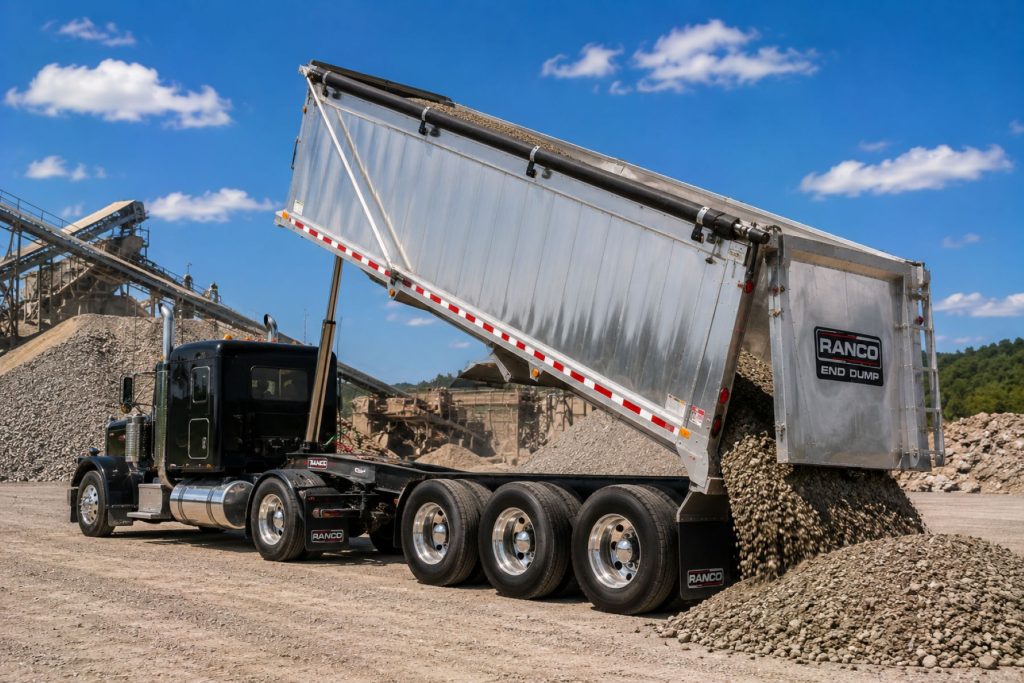
- Maximum Dump Angle: Approximately 46 Degrees Standard and Up to 51 Degrees with Selected Equipment
- Primary Applications: Rock, Gravel, Sand, Demolition Debris, Asphalt, Soil, Aggregate, and Lightweight Bulk Materials
- Production Status: Active Production
Overview
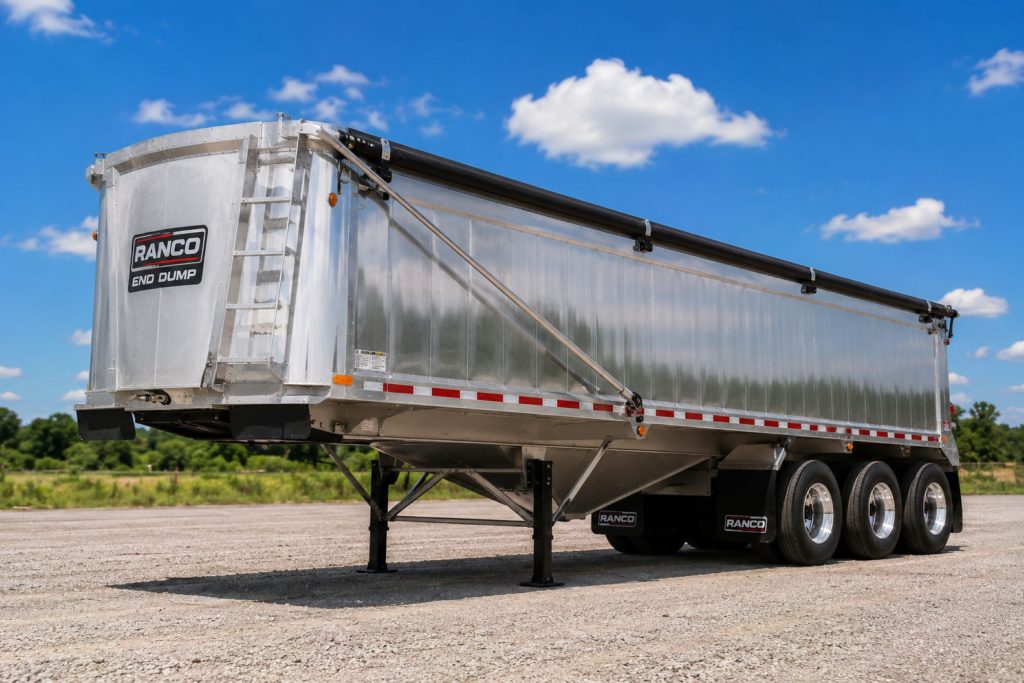
The Ranco End Dump Trailer is a heavy-duty construction trailer designed for transporting and unloading rock, gravel, sand, asphalt, demolition material, soil, and other loose bulk commodities. The company offers multiple end-dump configurations, including steel Anvil models, lightweight aluminum trailers, asphalt trailers, drill-cutting trailers, and high-cube frameless designs.
The Ranco Anvil is one of the company’s best-known end-dump designs. Its constant-radius half-round body helps center the load while reducing the corners and flat surfaces where material can collect.
Construction models commonly use AR400 abrasion-resistant steel to withstand repeated loading with rock, broken concrete, demolition material, and other abrasive commodities.
The trailer unloads by raising the front of the dump body with a multi-stage hydraulic cylinder. As the body rises, the material moves toward the rear tailgate and exits under gravity.
Key Characteristics
The Ranco Anvil uses a constant-radius half-round body intended to improve load centering and reduce off-center weight. The curved design also provides structural strength without requiring the same number of external braces found on some traditional rectangular dump bodies.
An inverted trunnion-style hydraulic cylinder is used on many Anvil configurations. The cylinder moves away from the dump body as it extends, eliminating the need for a large internal doghouse that would otherwise reduce cargo capacity.
The inverted cylinder position also provides external access for service. Dirt-wiper seals at the bottom of each stage help prevent material from collecting around the cylinder sections.
Ranco increases the thickness of the body material near the rear of selected Anvil trailers because the rear section experiences greater abrasion during unloading.
Tailgate options allow the trailer to be configured for rock, aggregate, demolition, asphalt, and other specialized applications.
Common Specifications
Body Design
Available body configurations include:
- Constant-radius half-round body
- Elliptical body
- Frameless body
- Quarter-frame body
- Full-frame body
- High-cube body
- Aluminum double-wall body
Body Material
Heavy-duty Anvil models commonly use AR400 heat-treated alloy steel.
AR400 provides abrasion and impact resistance for loads containing:
- Large rock
- Broken concrete
- Demolition debris
- Aggregate
- Scrap material
- Abrasive construction products
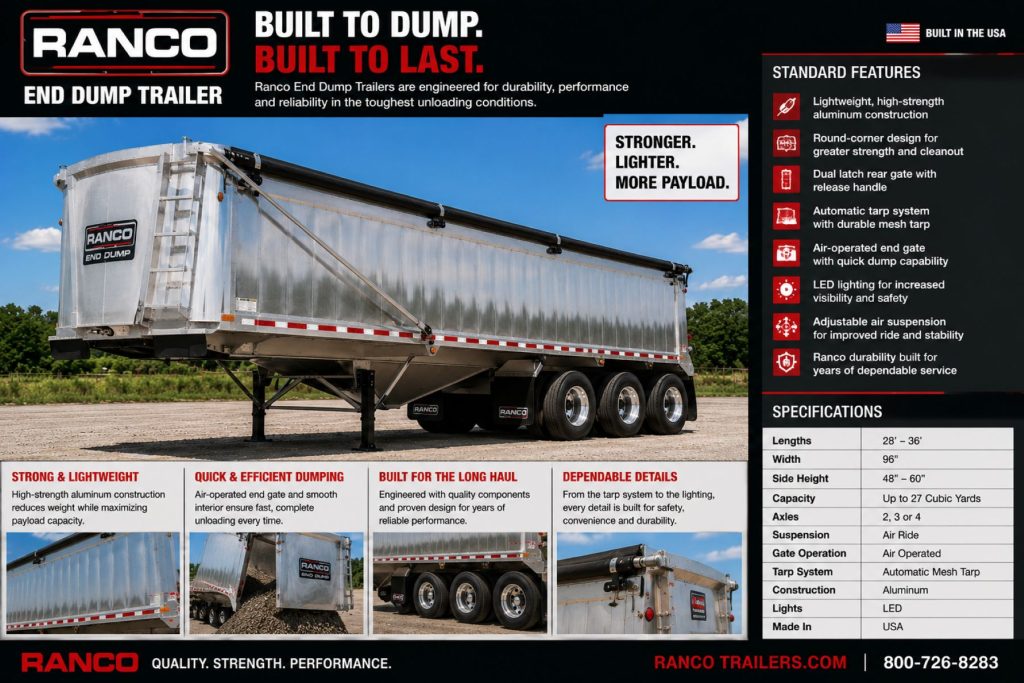
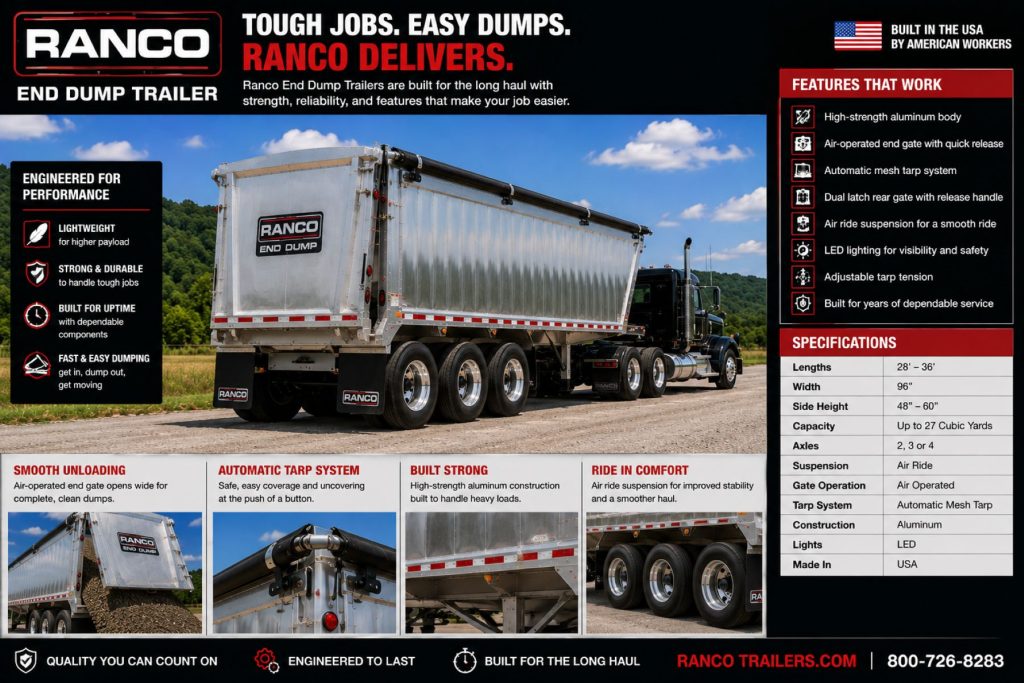
Lightweight aluminum models are available for operations where reducing empty trailer weight is a priority.
Length
Ranco offers multiple trailer and tub lengths.
Representative configurations include:
- 22-foot short construction end dump
- 26-foot asphalt end dump
- 34-foot rock and aggregate end dump
- 36-foot lightweight asphalt end dump
- 45-foot high-cube frameless end dump
Actual overall and tub lengths vary by model.
Capacity
Representative capacities include:
- Approximately 26 cubic yards for selected rock end dumps
- Approximately 28 cubic yards for certain full-frame asphalt models
- Approximately 31 cubic yards with bangboards on selected asphalt configurations
- Approximately 32 cubic yards with bangboards on certain lightweight models
- Up to approximately 95 cubic yards for the frameless high-cube trailer
- Volume capacity does not determine legal payload. Material density and axle-weight limits usually determine the actual load.
Sidewall Height
Available side heights vary by model and commodity.
Representative configurations include:
- 45-inch sides
- 50-inch sides
- 54-inch sides
- 66-inch sides
- 102-inch high walls on high-cube trailers
Width
A 96-inch-wide dump body is common on several models.
Overall axle width may measure approximately 102 inches.
Hydraulic Hoist
Ranco trailers use multi-stage, single-acting hydraulic cylinders.
Available equipment includes:
- Four-stage cylinder
- Five-stage cylinder
- Inverted trunnion mounting
- Standard cylinder providing an approximately 46-degree dump angle
- Optional cylinder providing an angle up to approximately 51 degrees
Dump Angle
The Anvil body commonly dumps at approximately 46 degrees with the standard cylinder.
An optional cylinder can increase the dumping angle to approximately 51 degrees.
The steeper angle assists with unloading material that does not flow freely.
Tailgate Options
Available tailgate arrangements include:
- High-lift tailgate
- Top-hinged gravity tailgate
- Combination gravity and barn-door tailgate
- Barn-door tailgate
- Aluminum lightweight tailgate
- Air-operated gate latches
The appropriate tailgate depends on the commodity and unloading method.
Suspension and Axles
Depending on the model, Ranco uses tandem- or tri-axle configurations.
Heavy construction versions may use:
- Single-point suspension
- Equalized dual-tire arrangement
- 25,000-lb tubular axles
- Air-lift third axle on selected tri-axle models
Brakes and ABS
Commercial air brakes with automatic slack adjusters and an antilock braking system are commonly installed.
Representative systems use 16½-by-7-inch air brakes and a 4S/2M ABS configuration.
Tires and Wheels
Common tire sizes include:
- 11R22.5
- 11R24.5
Cut- and chip-resistant tires may be used for construction and off-road service.
Steel or aluminum wheels are available depending on configuration.
Tarp System
Available tarp systems include:
- Side-roll tarp
- Flip tarp
- Electric tarp
- Manual tarp
- Custom commodity-specific coverings
Final specifications vary substantially among models. Buyers should confirm the exact configuration through Ranco’s current end-dump lineup.
Common Applications
- Rock transportation
- Gravel transportation
- Sand transportation
- Asphalt transportation
- Broken concrete transportation
- Demolition debris transportation
- Construction aggregate transportation
- Soil transportation
- Road-base transportation
- Mining material transportation
- Land-clearing debris transportation
- Scrap material transportation
- Drill-cutting transportation
- Lightweight bulk-material transportation
- Construction and aggregate freight
- Heavy haul and oversized freight
Advantages
- Constant-radius body helps center the load
- Half-round design reduces material collection in corners
- AR400 steel resists abrasion and impact
- Inverted trunnion cylinder provides easier service access
- Cylinder design increases usable body capacity
- Standard dump angle supports efficient unloading
- Optional higher dump angle assists with difficult materials
- Increased rear body thickness improves wear resistance
- Multiple tailgate configurations are available
- Short models provide good maneuverability in urban construction areas
- Aluminum models reduce empty weight
- High-cube models handle lightweight bulk commodities
- Tandem- and tri-axle configurations are available
- Multiple frame styles support different operating applications
Limitations or Considerations
- Raising the dump body creates a high center of gravity
- Uneven ground can cause a rollover during unloading
- Material can freeze or stick inside the body
- Hydraulic failure can prevent unloading
- Overhead power lines and structures create serious hazards
- Strong crosswinds can affect a raised trailer
- Dense material can overload the trailer before the body is full
- Rear unloading requires adequate clearance
- Tailgate and latch failures can release material unexpectedly
- Abrasion eventually wears the body and tailgate
- The trailer requires a compatible tractor hydraulic system
- Low-density high-cube bodies are unsuitable for many heavy aggregates
Driver and Operator Considerations
The trailer should be positioned on firm, level ground before the body is raised. Soft shoulders, uneven fill, potholes, and sloped jobsites can allow the suspension or tires to settle unevenly during unloading.
The tractor and trailer should remain aligned. Raising the body while the tractor is sharply angled increases stress and instability.
Drivers must inspect the unloading area for overhead power lines, bridges, conveyors, trees, buildings, and other obstructions.
The tailgate should be released only after the operator confirms that the discharge area is clear. Personnel should remain away from the trailer’s rear and sides during dumping.
If the body begins leaning, material stops flowing unevenly, or the ground shifts, the driver should lower the body immediately when it is safe to do so.
Maintenance and Ownership Notes
The dump body should be inspected for cracks, dents, abrasion, thinning metal, and damaged welds.
Particular attention should be given to the rear body section, tailgate, hinge points, upper rails, front bulkhead, and areas where rock repeatedly contacts the steel.
The hydraulic cylinder, trunnion bearings, pins, bushings, hoses, fittings, and PTO connections should be inspected for leaks, wear, contamination, and damage.
Grease fittings should be serviced according to the maintenance schedule.
Tailgate hinges, latches, air cylinders, chains, and seals should operate freely and remain correctly adjusted.
Suspension components, axles, brakes, ABS equipment, tires, wheels, lights, and the trailer’s electrical system require routine inspection.
Buying Considerations
- Identify the exact Ranco model
- Determine whether the trailer is frameless, quarter-frame, or full-frame
- Confirm whether the body is steel or aluminum
- Verify the body length and sidewall height
- Determine the cubic-yard capacity
- Match the body material to the intended commodity
- Inspect the body for thinning and abrasion
- Check the rear body section for excessive wear
- Inspect the front bulkhead and upper rails
- Operate the hydraulic cylinder through its full range
- Check the cylinder stages for leaks and scoring
- Inspect the trunnion bearings and pivot points
- Operate the tailgate and latches
- Confirm the axle count and suspension rating
- Inspect the brakes, ABS equipment, tires, and wheels
- Test the tarp system
- Review previous cargo and operating conditions
- Verify compatibility with the tractor’s PTO and hydraulic system
- Review maintenance and structural repair records
- Confirm the VIN and certification plate information
Common Brands or Manufacturers
- Ranco Trailers
- MAC Trailer
- East Manufacturing
- Travis Body and Trailer
- Fruehauf
- Clement Industries
- Armor Lite
- Manac
- Ravens
- Trail King
Variants and Related Configurations
- Ranco Anvil
- Anvil Quarter-Frame End Dump
- Frameless Anvil
- Super 12 Elliptical
- Lightweight Aluminum End Dump
- Mini Aluminum End Dump
- Aluminum Extruded Double-Wall End Dump
- Full-Frame Asphalt End Dump
- Lightweight Asphalt End Dump
- Drill-Cutting End Dump
- Frameless High-Cube End Dump
- Tandem-axle end dump
- Tri-axle end dump
- Short urban construction end dump
- High-lift tailgate configuration
- Barn-door tailgate configuration
Comparison to Similar Trailers
Compared with a side-dump trailer, the Ranco End Dump unloads directly from the rear and generally requires less lateral space. A side dump keeps the body’s center of gravity lower during unloading and can discharge material alongside the trailer.
Compared with a belly-dump trailer, the Ranco End Dump can handle larger rock, broken concrete, and demolition material. Belly dumps are better suited for creating windrows and controlled aggregate placement.
Compared with a live-bottom trailer, the Ranco raises its body to unload. A live-bottom trailer uses a moving belt or floor and can discharge without creating the same elevated center of gravity.
Compared with a dump truck, the Ranco trailer provides greater potential capacity and allows the tractor to be used with other trailers. A straight dump truck generally offers better maneuverability on confined jobsites.
Comparable models include the East Dump Trailer, Travis Dump Trailer, and MAC Half Round Dump Trailer.
Best Fit For
- Construction companies
- Aggregate haulers
- Demolition contractors
- Asphalt paving contractors
- Excavation companies
- Road-building contractors
- Mining operations
- Quarries
- Concrete-recycling operations
- Land-clearing contractors
- Municipal public-works departments
- Commercial dump fleets
- Operators hauling abrasive material
- Fleets requiring short maneuverable dump trailers
Related Equipment
- Brake Systems
- Suspension Systems
- Axles and Differentials
- Tires and Wheels
- Electrical Systems
- Safety Systems
- PTO Systems
- Hydraulic Hoist Systems
- Tailgate Systems
- Dump Trailer Tarp Systems
Related Freight Types
- Construction and Aggregate Freight
- Heavy Haul and Oversized Freight
- Specialty and Niche Freight
- Rock and Gravel Freight
- Sand Freight
- Asphalt Freight
- Demolition Debris Freight
- Soil and Fill Freight
- Mining Material Freight
- Road-Construction Freight
Related Trailer Types
- Dump Trailers
- End Dump Trailers
- Side Dump Trailers
- Belly Dump Trailers
- Live-Bottom Trailers
- Walking-Floor Trailers
- Roll-Off Trailers
- Specialty Trailers
Related Trailer Models
- East Dump Trailer
- Travis Dump Trailer
- MAC Half Round Dump Trailer
- Ranco Switchgate Belly Dump
- SmithCo Side Dump Trailer
- Clement End Dump Trailer
Related Guides
- Complete Guide to Trailer Types
- Heavy Haul Freight Guide
- Choosing the Right Trailer for Your Freight
Regulatory and Compliance Notes
The Ranco End Dump Trailer must comply with federal, state, and local regulations governing trailer dimensions, axle weights, brakes, ABS equipment, tires, lighting, cargo containment, and commercial vehicle inspections.
The volume of the dump body does not determine legal payload. Operators must account for commodity density, empty trailer weight, axle spacing, bridge laws, and permitted gross weight.
Loose materials must be contained to prevent rocks, debris, sand, and other cargo from escaping onto the roadway. A properly maintained tarp may be required.
Operators must follow workplace and utility-safety requirements when dumping near power lines. Contact between a raised body and an energized line can electrify the tractor and trailer.
Certain jobsites require a spotter, designated dumping area, wheel chocks, high-visibility clothing, and other safety procedures.
Real World Operating Notes
The Ranco Anvil is particularly well suited for abrasive construction materials because its curved AR400 body resists impact and promotes cleaner unloading.
Shorter 22- to 26-foot configurations can maneuver more easily through metropolitan construction sites, paving projects, demolition locations, and confined delivery areas.
Longer bodies provide greater volume but require more room to turn, back, and raise safely.
Material moisture has a major effect on unloading. Wet soil, clay, frozen aggregate, and asphalt can adhere to the body and release suddenly after the trailer reaches a high angle.
Frequently Asked Questions
What is the Ranco Anvil?
The Anvil is Ranco’s heavy-duty end-dump design, commonly using a constant-radius half-round body and abrasion-resistant steel construction.
What materials can a Ranco End Dump carry?
Depending on the model, it can transport rock, gravel, sand, asphalt, soil, broken concrete, demolition debris, drill cuttings, and lightweight bulk material.
What is AR400 steel?
AR400 is an abrasion-resistant, heat-treated steel commonly used where the dump body must withstand repeated contact with rock, concrete, and other abrasive materials.
How far does the trailer body raise?
The Anvil commonly provides an approximately 46-degree dump angle with the standard cylinder and up to approximately 51 degrees with selected optional equipment.
What is the advantage of the inverted trunnion cylinder?
It keeps the cylinder more accessible, reduces dirt accumulation, simplifies removal, and avoids using internal body space for a cylinder doghouse.
Is the Ranco End Dump available in aluminum?
Yes. Ranco offers lightweight aluminum and aluminum double-wall end-dump configurations.
How many axles are available?
Tandem- and tri-axle configurations are common. Exact availability depends on the model and regional weight requirements.
Is an end dump safe on uneven ground?
Raising an end dump on uneven or unstable ground creates a serious rollover risk. The trailer should be positioned on firm, level ground before dumping.
Does the trailer require tractor hydraulics?
Most configurations require a compatible tractor PTO and hydraulic wet kit to operate the dump cylinder.
What should buyers inspect on a used Ranco End Dump?
Buyers should inspect the body, rear wear areas, frame, tailgate, hydraulic cylinder, trunnion bearings, suspension, axles, brakes, tires, and tarp system.
Availability and Where to Find
New Ranco End Dump Trailers are available through Ranco dealers and commercial construction-trailer distributors. Available models include steel Anvil trailers, lightweight aluminum end dumps, asphalt trailers, high-cube trailers, and specialized configurations.
Used Ranco trailers can be found through construction-equipment dealers, commercial trailer dealerships, fleet sales, equipment auctions, and truck-and-trailer marketplaces.
Availability varies according to body length, cubic capacity, construction material, axle count, frame style, tailgate, tarp, and hydraulic equipment.
Before purchasing, buyers should verify the trailer’s VIN, body material, capacity, empty weight, structural condition, axle ratings, hydraulic requirements, maintenance history, and previous hauling application.
Support Trucking Families
Truck Equipment Atlas supports the mission of Grey Cross, a nonprofit dedicated to helping families of truck drivers who lose their lives while on the road. As the site grows, part of its mission is to bring awareness and support to these families.
Podcast or Video Section
Learn More Through Audio and Video
Truck Equipment Atlas will continue expanding with podcast episodes, interviews, and equipment breakdowns to help drivers and fleets better understand trucks and equipment.
Follow the Growth of Truck Equipment Atlas
Truck Equipment Atlas continues to expand with new truck profiles, trailer coverage, diesel engine pages, equipment system resources, manufacturer information, and educational guides.
Visit our Site Updates page to explore recent additions, project milestones, and upcoming resources as we continue building one of the industry’s growing commercial trucking equipment reference libraries.
View the Latest Site Updates: Truck Equipment Atlas Site Updates