
Kaufman Car Hauler
Quick Facts
- Manufacturer: Kaufman Trailers
- Common Model: Double Deck EZ 4
- Trailer Type: Open Four-Vehicle Car Hauler
- Construction: Tubular Steel Frame
- Vehicle Capacity: Up to Four Vehicles, depending on vehicle dimensions and weight
- Deck Length: Approximately 47 ft
- Total Deck Space: Approximately 67 ft across upper and lower decks
- Upper Deck Length: Approximately 31 ft
- Lower Deck: Approximately 30 ft Flat Deck with 6 ft Dovetail
- GVWR: Approximately 25,000 lbs
- Axle Configuration: Three 8,000-lb Axles
- Common Suspension: Slipper-Spring Suspension
- Loading Equipment: Aluminum Ramps and Hydraulic Rear Platform
- Primary Applications: Dealer Transfers, Auto Auctions, Vehicle Delivery, Salvage Transportation, and Independent Auto Transport
- Production Status: Active Production
Overview
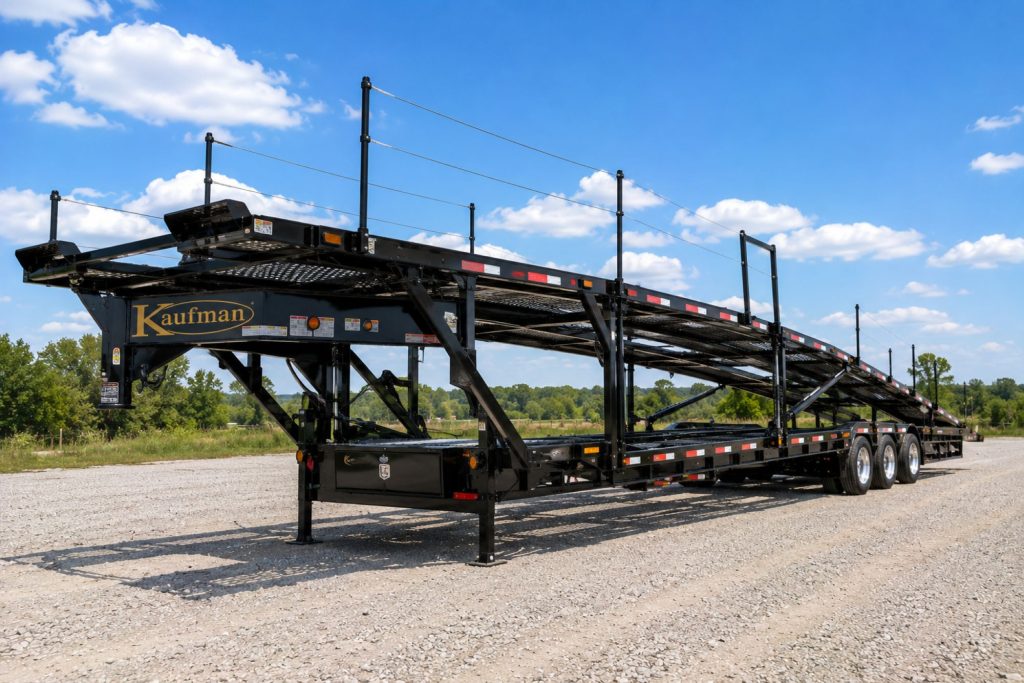
The Kaufman Car Hauler is an open vehicle-transport trailer designed for moving multiple cars, pickup trucks, vans, and SUVs. The Double Deck EZ 4 is one of Kaufman’s primary commercial vehicle-transport configurations and can carry as many as four vehicles when their combined size and weight fit the trailer’s limits.
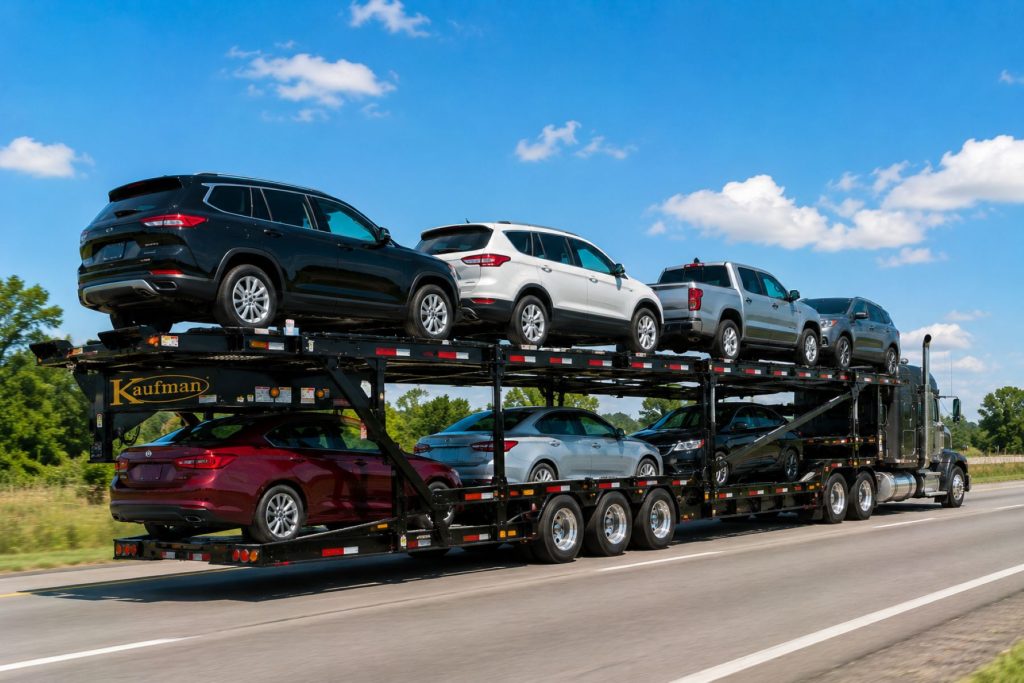
The trailer uses a double-deck arrangement to provide approximately 67 ft of total loading space within a trailer that has an approximately 47-foot main deck length. A hydraulically operated rear platform allows the operator to adjust the deck during loading and position vehicles on two levels.
The EZ 4 can be configured with a gooseneck ball coupler for heavy-duty pickup-truck operation or an SAE kingpin for connection to a commercial truck tractor. This makes the trailer useful for independent vehicle haulers, dealerships, auction transporters, and small commercial fleets.
Compared with a full-size high-mount automobile transporter, the Kaufman EZ 4 carries fewer vehicles but can be easier to operate, load, and maneuver.
Key Characteristics
The Kaufman EZ 4 combines a 31-foot upper deck with a lower deck measuring approximately 30 ft plus a 6-foot dovetail. This creates enough loading area for several combinations of passenger vehicles and light trucks.
A common load arrangement places a full-size SUV on the forward upper deck, a pickup or van on the rear lower deck, and two small or midsize cars through the center portion of the trailer.
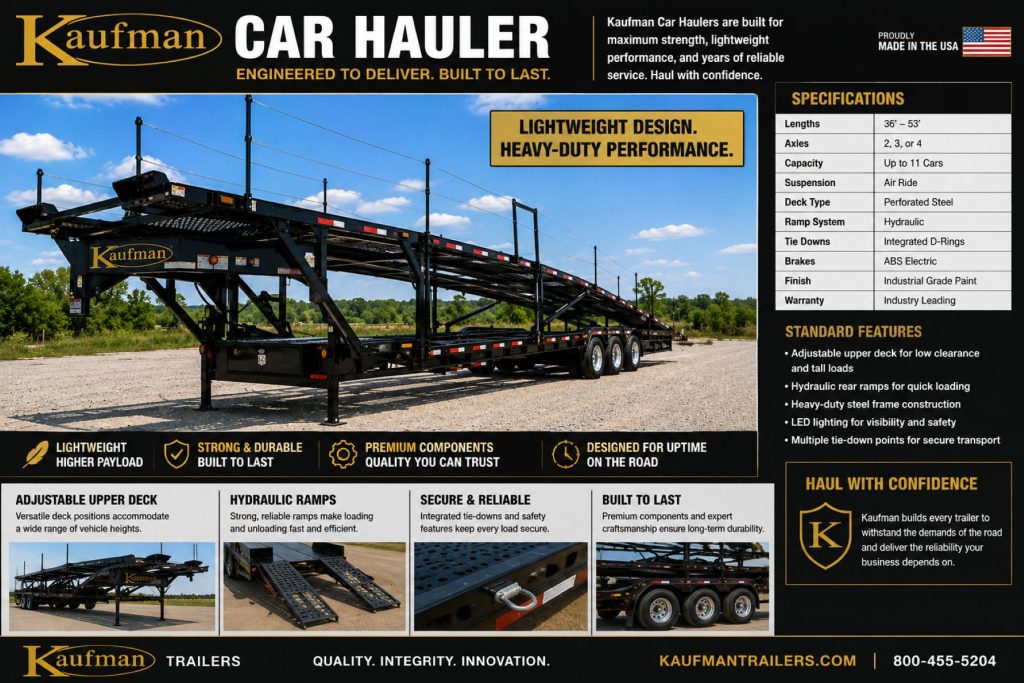
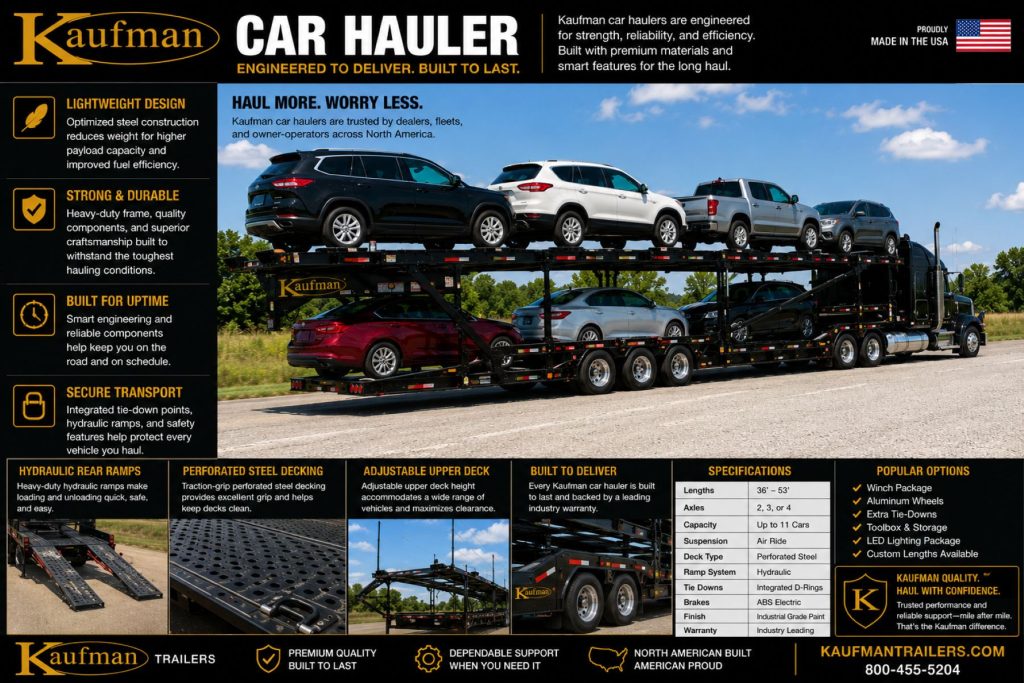
The self-contained hydraulic system raises and lowers the rear deck platform. A wireless remote allows the operator to control the platform while monitoring vehicle and deck clearance.
Ridged expanded-metal runners provide tire traction in rain and other challenging conditions. Aluminum loading ramps bridge the transition between the ground and trailer deck.
Vehicle combinations must be planned according to actual length, height, ground clearance, wheelbase, and weight. The ability to physically fit four vehicles does not automatically mean that the load remains within the trailer’s payload or axle limits.
Common Specifications
Vehicle Capacity
The EZ 4 is designed to carry up to four vehicles.
Actual capacity depends on:
- Vehicle length
- Vehicle width
- Vehicle height
- Vehicle wheelbase
- Vehicle ground clearance
- Individual vehicle weight
- Combined payload
- Required spacing between vehicles
Deck Length
The main trailer deck measures approximately 47 ft.
The upper and lower deck arrangement provides approximately 67 ft of total vehicle-positioning space.
Upper Deck
The upper deck is approximately 31 ft long and includes a hydraulically lifted rear platform.
The platform can be positioned during loading to create access and clearance for vehicles carried on the lower deck.
Lower Deck
The lower section commonly provides approximately:
- 30 ft of flat deck
- 6 ft of dovetail
The dovetail creates a more gradual approach angle for loading low-clearance vehicles.
Frame Construction
The trailer uses a tubular steel frame.
Representative construction includes:
8-by-3-inch tubular-steel main frame
6-by-2-inch heavy-wall tubing in selected chassis areas
10-by-4-inch tubular-steel tongue on gooseneck versions
GVWR
A GVWR of approximately 25,000 lbs is common.
The actual available payload equals the GVWR minus the trailer’s empty weight and any permanently installed equipment.
Some representative trailers have an empty weight around 9,000 lbs and an available payload near 16,000 lbs, but the certification plate should be used for the specific trailer.
Axles
Three 8,000-lb axles are commonly installed.
Actual axle capacity does not override the trailer’s certified GVWR or applicable legal weight restrictions.
Suspension
Slipper-spring suspension is commonly used.
The suspension provides a straightforward mechanical design suitable for commercial vehicle-hauling service.
Brakes
Electric brakes are commonly installed on all wheels.
A breakaway system applies the trailer brakes if the trailer separates from the tow vehicle.
Tires
A common tire specification is 215/75R17.5 with a 16-ply rating.
A mounted spare tire may be included.
Coupling Options
Available coupling configurations include:
- Adjustable 2 5/16-inch gooseneck ball coupler
- SAE 2-inch kingpin
- The selected coupling must match the tow vehicle and trailer rating.
Hydraulic System
The rear platform uses a self-contained hydraulic system operated by a wireless remote.
Hydraulic cylinders, hoses, fittings, controls, battery, and charging equipment require regular inspection.
Loading Ramps
Eight-foot aluminum ramps are commonly included.
The ramps must be positioned correctly and remain within their individual and combined capacity ratings.
Deck Surface
Ridged expanded-metal runners with an open center are commonly used.
A heavier mesh-floor option may be available to provide additional tie-down locations and support tire-based securement equipment.
Securement Equipment
Depending on the deck and ordered equipment, the trailer may use:
- Wheel straps
- Tire ratchets
- Transport chains
- Wheel loops
- Deck-mounted tie-down points
- Winch equipment
Landing Gear
Two heavy-duty drop-foot jacks support the trailer when it is disconnected.
Representative configurations use dual 12,000-lb jacks.
Lighting and Wiring
DOT-approved wiring, connectors, LED lighting, reflectors, and required identification lights are commonly installed.
Specifications should be confirmed through Kaufman Trailers before ordering because equipment and ratings can change.
Common Applications
- New vehicle delivery
- Used vehicle transportation
- Dealership transfers
- Auto auction transportation
- Online vehicle purchase delivery
- Fleet vehicle relocation
- Rental vehicle movement
- Salvage vehicle transportation
- Classic car transportation
- Light-truck transportation
- SUV transportation
- Independent auto hauling
- Small commercial vehicle fleets
- Dealer-to-dealer transportation
Advantages
- Carries as many as four vehicles
- Double-deck design increases usable loading space
- Shorter and more maneuverable than many full-size car carriers
- Hydraulic rear platform simplifies deck positioning
- Wireless hydraulic remote improves visibility during loading
- Aluminum ramps reduce handling weight
- Expanded-metal runners provide tire traction
- Available gooseneck ball or commercial kingpin connection
- Can carry combinations of cars, pickups, vans, and SUVs
- Suitable for independent operators and small fleets
- Electric brakes provide compatibility with properly equipped tow vehicles
- Simpler loading arrangement than many large high-mount carriers
- Direct factory sales may simplify ordering and customization
Limitations or Considerations
- Four-vehicle capacity depends on vehicle dimensions and weight
- Limited capacity compared with full-size seven- to ten-vehicle transporters
- Open vehicles are exposed to weather and road debris
- Hydraulic deck introduces additional maintenance requirements
- Electric brakes require a compatible brake controller
- Long trailer requires additional turning and backing space
- Low-clearance vehicles may require careful ramp positioning
- Heavy pickups and SUVs can reduce the number of vehicles carried
- Load placement significantly affects tongue or kingpin weight
- The trailer may require a commercial truck and CDL depending on its configuration and use
- Commercial auto transport requires specialized insurance and operating authority
- Each vehicle must be secured independently
Driver and Operator Considerations
The operator should develop a loading plan before moving the first vehicle onto the trailer. Vehicle length, weight, height, ground clearance, and final delivery order should all be considered.
Heavy vehicles should be positioned to maintain safe weight on the tow vehicle and trailer axles. Excessive forward weight can overload the tow vehicle, while insufficient forward weight can create unstable handling.
Upper-deck vehicles must have enough clearance from vehicles positioned beneath them. The driver should check body panels, roofs, mirrors, antennas, spoilers, and suspension movement.
Hydraulic platforms should never be moved while a person is standing beneath or between moving deck components.
After loading, each vehicle should be placed in park or gear, have its parking brake applied when appropriate, and be independently secured using approved equipment.
Maintenance and Ownership Notes
The steel frame should be inspected for cracks, corrosion, bent components, damaged welds, and evidence of overloading.
Expanded-metal runners and deck connections should be examined for broken welds, distortion, sharp edges, and excessive wear.
Hydraulic cylinders, hoses, fittings, valves, battery connections, and controls should be checked for leaks and damage.
Loading ramps should remain straight and should have undamaged connection points and traction surfaces.
Wheel straps, ratchets, chains, hooks, and tie-down anchors require regular inspection. Equipment with cuts, deformation, corrosion, or damaged hardware should be removed from service.
Axles, slipper springs, equalizers, hangers, wheel bearings, electric brakes, tires, lights, and the trailer’s electrical system require routine maintenance.
Buying Considerations
- Confirm the exact model and year
- Verify the GVWR
- Check the trailer’s empty weight
- Calculate the available payload
- Confirm the number and rating of the axles
- Inspect the tubular-steel frame
- Check all deck welds and expanded-metal runners
- Operate the hydraulic rear platform
- Test the wireless remote and manual controls
- Inspect hydraulic hoses, cylinders, fittings, and battery
- Verify the length and rating of the aluminum ramps
- Inspect the coupler or kingpin
- Check the landing jacks
- Test the electric brakes and breakaway system
- Inspect the tires and wheel bearings
- Review the included vehicle-securement equipment
- Determine whether the trailer can carry the intended vehicle mix
- Confirm compatibility with the intended tow vehicle
- Review maintenance and repair records
- Verify specifications using the VIN and certification plate
Common Brands or Manufacturers
- Kaufman Trailers
- Cottrell
- Sun Country Trailers
- Miller Industries
- Boydstun
- Delavan
- Wally-Mo
- Infinity Trailers
- Take 3 Trailers
- Big Tex Trailers
Variants and Related Configurations
- Double Deck EZ 4
- Four-car open carrier
- Three-car wedge trailer
- Two-car hauler
- Gooseneck car hauler
- Kingpin-equipped car hauler
- Hydraulic-deck car hauler
- Fixed-deck car hauler
- Open vehicle transporter
- Enclosed car hauler
- Single-vehicle enclosed trailer
- Heavy-duty mesh-floor configuration
- Pickup-truck-towed car carrier
- Commercial tractor-towed car carrier
Comparison to Similar Trailers
Compared with a full-size high-mount car carrier, the Kaufman EZ 4 carries fewer vehicles but is generally easier to maneuver and may require less specialized loading experience.
Compared with a three-car wedge trailer, the EZ 4 provides an additional vehicle position and a hydraulically adjustable deck. The hydraulic system also adds weight, cost, and maintenance requirements.
Compared with an enclosed car hauler, the Kaufman open carrier provides greater vehicle capacity and easier loading access. An enclosed trailer provides better protection for high-value, collectible, and exotic vehicles.
Compared with a flatbed trailer, the Kaufman model provides vehicle-specific decks, ramps, and securement equipment. A flatbed is more versatile for general freight but is less efficient for routine multi-vehicle transport.
Comparable commercial vehicle transporters include the Cottrell Car Hauler Trailer and Sun Country Car Hauler Trailer.
Best Fit For
- Independent auto transporters
- Small vehicle-hauling fleets
- Automobile dealerships
- Auto auction buyers and sellers
- Vehicle wholesalers
- Rental car companies
- Fleet-management companies
- Online vehicle-delivery services
- Salvage vehicle transporters
- Classic vehicle transporters
- Operators carrying two to four vehicles per trip
- Businesses requiring a pickup-compatible commercial hauler
Related Equipment
- Brake Systems
- Suspension Systems
- Axles and Differentials
- Tires and Wheels
- Electrical Systems
- Safety Systems
- Telematics and ELD Systems
- Hydraulic Deck Systems
- Vehicle Winches
- Wheel Straps and Ratchets
- Loading Ramps
Related Freight Types
- Vehicle Freight
- Automobile Transportation
- Dealer Transfer Freight
- Auto Auction Freight
- Fleet Vehicle Transportation
- Rental Vehicle Transportation
- Salvage Vehicle Transportation
- Classic Car Transportation
- Light-Truck Transportation
- Specialty and Niche Freight
Related Trailer Types
- Car Hauler Trailers
- Open Car Carrier Trailers
- Enclosed Car Haulers
- Wedge Car Trailers
- Double-Deck Car Haulers
- Hydraulic-Deck Car Haulers
- Tow-Away Trailers
- Flatbed Trailers
- Specialty Trailers
Related Trailer Models
- Cottrell Car Hauler Trailer
- Sun Country Car Hauler Trailer
- Take 3 Car Hauler
- Wally-Mo Car Hauler
- Infinity Car Hauler
- Boydstun Car Carrier
Related Guides
- Complete Guide to Trailer Types
- Choosing the Right Trailer for Your Freight
- Complete Guide to Freight Types
Regulatory and Compliance Notes
The Kaufman Car Hauler must comply with federal, state, and local requirements governing trailer dimensions, GVWR, brakes, lighting, tires, vehicle securement, and commercial operations.
A combination with a GVWR or gross combination weight rating above certain thresholds may require a commercial driver’s license. Requirements depend on the tow vehicle, trailer rating, operation, and jurisdiction.
For-hire interstate vehicle transportation may require operating authority, insurance filings, vehicle markings, registration, and compliance with Federal Motor Carrier Safety Administration regulations.
Each transported vehicle must be independently secured with equipment that has adequate working load limits. The securement method must prevent forward, rearward, lateral, and vertical movement.
Overall loaded height must be measured whenever vehicles are positioned on the upper deck. The driver must also verify total length, width, axle weights, and tow-vehicle ratings.
Real World Operating Notes
In practical operation, the Kaufman EZ 4 provides a middle ground between a basic two- or three-car trailer and a full-size commercial automobile transporter.
A load of four compact or midsize cars may fit efficiently. A combination containing large pickups, vans, or SUVs may reduce practical capacity to two or three vehicles.
Loading order matters. Vehicles scheduled for the first delivery should remain accessible whenever possible, but safe weight distribution takes priority over delivery convenience.
The hydraulic platform and wireless remote allow the operator to monitor clearances while adjusting the deck. Final clearances should be checked after the platform is locked into its transport position.
Frequently Asked Questions
How many vehicles can the Kaufman EZ 4 carry?
It can carry as many as four vehicles. Actual capacity depends on their dimensions, weights, and the required loading arrangement.
What is the trailer’s GVWR?
A GVWR of approximately 25,000 lbs is common for the Double Deck EZ 4.
How long is the trailer?
The main deck is approximately 47 ft long, with about 67 ft of total upper- and lower-deck loading space.
Does the trailer have a hydraulic deck?
Yes. The rear portion of the upper deck is hydraulically operated and can be controlled with a wireless remote.
Can a pickup truck tow it?
A properly equipped heavy-duty pickup may tow a gooseneck version when all tow ratings, payload limits, licensing requirements, and legal weight restrictions are met.
Can it connect to a semi-truck tractor?
Certain configurations are available with an SAE 2-inch kingpin for connection to an appropriate commercial tractor.
What types of vehicles can it carry?
It can transport combinations of passenger cars, crossovers, SUVs, pickups, and vans when their size and weight fit the trailer’s limits.
Does it use air brakes?
The common EZ 4 configuration uses electric brakes. Buyers should verify the equipment installed on the specific trailer.
Are loading ramps included?
Eight-foot aluminum loading ramps are commonly included.
What should buyers inspect on a used Kaufman Car Hauler?
Buyers should inspect the steel frame, hydraulic deck, ramps, expanded-metal runners, securement equipment, axles, suspension, brakes, tires, coupler, lights, and wiring.
Availability and Where to Find
New Kaufman Car Haulers are available directly through Kaufman Trailers. Factory ordering and nationwide delivery may be available depending on the buyer’s location and selected configuration.
Used models can be found through commercial trailer dealers, vehicle-transport companies, equipment auctions, online marketplaces, and fleet sales.
Availability varies according to model year, coupling type, axle rating, deck configuration, floor material, hydraulic equipment, and included securement systems.
Before purchasing, buyers should confirm the VIN, GVWR, empty weight, available payload, axle ratings, hydraulic operation, coupler type, brake system, and compatibility with the intended tow vehicle.
Support Trucking Families
Truck Equipment Atlas supports the mission of Grey Cross, a nonprofit dedicated to helping families of truck drivers who lose their lives while on the road. As the site grows, part of its mission is to bring awareness and support to these families.
Podcast or Video Section
Learn More Through Audio and Video
Truck Equipment Atlas will continue expanding with podcast episodes, interviews, and equipment breakdowns to help drivers and fleets better understand trucks and equipment.
Follow the Growth of Truck Equipment Atlas
Truck Equipment Atlas continues to expand with new truck profiles, trailer coverage, diesel engine pages, equipment system resources, manufacturer information, and educational guides.
Visit our Site Updates page to explore recent additions, project milestones, and upcoming resources as we continue building one of the industry’s growing commercial trucking equipment reference libraries.
View the Latest Site Updates: Truck Equipment Atlas Site Updates