
Tremcar Fuel Tank Trailer
Quick Facts
- Manufacturer: Tremcar
- Trailer Type: Petroleum / Fuel Tank Trailer
- Common Cargo Tank Specifications: DOT 406 in the United States and TC 406 in Canada
- Tank Construction: Aluminum Alloy
- Common Tank Shape: Elliptical
- Typical United States Capacity: Approximately 9,000 to 9,500 Gallons
- Available Canadian Capacity: Up to Approximately 57,000 Liters in Certain Four-Axle Configurations
- Compartment Options: Single-Compartment and Multi-Compartment Designs
- Common Axle Configurations: Tandem Axle, Tri-Axle, Four-Axle, and B-Train
- Common Loading Method: Bottom Loading
- Common Discharge Method: Gravity Discharge or Pump-Off System
- Primary Applications: Gasoline, Diesel Fuel, Aviation Fuel, Ethanol Blends, Petroleum Products, and Compatible Refined Fuels
- Production Status: Active Production
Overview
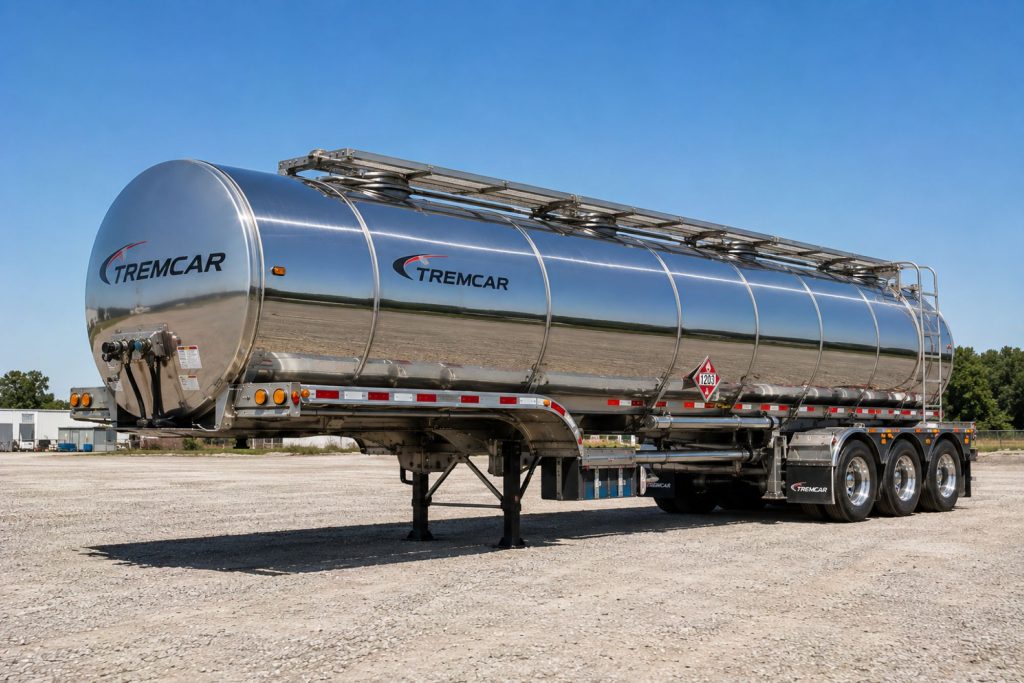
The Tremcar Fuel Tank Trailer is an aluminum petroleum tanker designed for transporting gasoline, diesel fuel, aviation fuel, ethanol blends, and other compatible refined petroleum products. Tremcar offers petroleum trailers for both United States and Canadian operations, including tandem-axle, tri-axle, four-axle, and B-train configurations.
United States models are commonly manufactured to the DOT 406 cargo tank specification, while Canadian versions may use the corresponding TC 406 specification. Both are designed specifically for low-pressure flammable-liquid transportation.
Multi-compartment construction allows distributors to transport several fuel grades within one trailer. A single load may include regular gasoline, premium gasoline, diesel fuel, or other compatible products assigned to separate compartments.
Bottom-loading equipment, vapor recovery, overfill protection, emergency valves, brake interlocks, and API discharge adapters support safe and efficient loading and delivery operations.
Key Characteristics
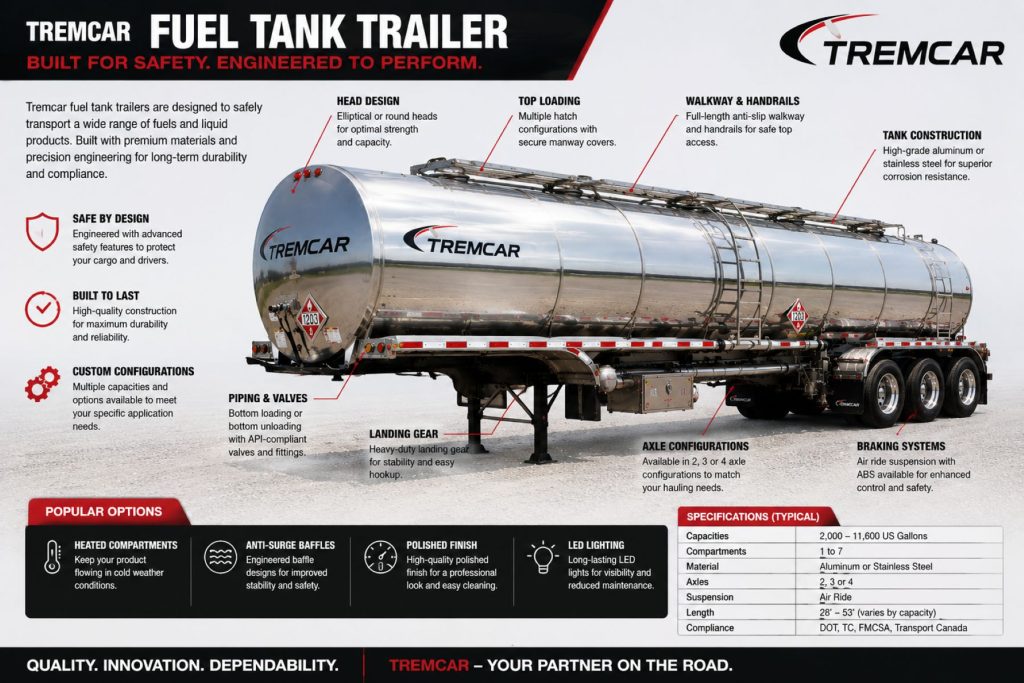
The Tremcar Fuel Tank Trailer commonly uses an elliptical aluminum tank designed to provide a low center of gravity and reduced empty weight. Aluminum construction helps increase available payload while providing corrosion resistance for compatible petroleum products.
Multiple sealed compartments allow different fuel grades to remain separated during transportation. Compartment sizes can be configured around a fleet’s typical delivery requirements.
Bottom-loading connections are commonly grouped inside a protected cabinet. This arrangement allows terminals to load fuel without requiring the operator to work from the top of the tanker.
Vapor-recovery equipment captures displaced fuel vapors during loading and unloading. Overfill sensors, pneumatic internal valves, and brake-interlock systems provide additional protection against spills and accidental movement.
Tremcar also offers larger multi-axle and B-train petroleum configurations for Canadian operations where regional weight and length regulations allow additional capacity.
Common Specifications
Cargo Tank Specification
Tremcar petroleum trailers are commonly manufactured to:
DOT 406 requirements for United States operation
TC 406 requirements for Canadian operation
The certification plate identifies the exact cargo tank specification, design limits, test requirements, and manufacturing information.
Construction Material
The tank shell is commonly manufactured from aluminum alloy.
Certain current TC 406 models use 5454-H32 aluminum alloy for the shell and 5454-HO aluminum alloy for the domed and flanged tank heads.
Tank Shape
An elliptical tank shape is common. The low-profile oval design helps lower the trailer’s center of gravity compared with a tall cylindrical tank.
Capacity
Common United States configurations include approximately:
- 8,500 gallons
- 9,000 gallons
- 9,500 gallons
Capacity depends on compartment arrangement, axle configuration, product density, trailer weight, and legal operating limits.
Larger Canadian configurations may provide approximately 42,000 to 57,000 liters.
B-train configurations can provide additional combined capacity where legally permitted.
Compartments
Fuel trailers may be configured with:
- Single compartment
- Three compartments
- Four compartments
- Five compartments
- Six compartments
- Custom compartment arrangements
- Multi-compartment trailers allow several fuel grades or products to be transported in one trip.
Bulkheads and Baffles
Compartments are separated by bulkheads. Double-bulkhead construction may be specified between selected compartments to provide additional product separation.
Baffles may be used to control liquid movement within certain tanks or compartments.
Bottom Loading
Bottom-loading adapters are commonly installed in a protected cabinet along the side of the trailer.
Bottom loading reduces the need for operators to climb onto the tanker and allows rapid connection at compatible loading terminals.
Discharge System
Available discharge equipment may include:
- Three-inch gravity discharge
- Four-inch API adapters
- Pump-off piping
- Driver-side discharge
- Curbside discharge
- Front or rear loading headers
- Air-operated internal valves
- Emergency shear sections
Vapor Recovery
Vapor-recovery connections allow displaced vapors to return to the terminal or storage system during loading and unloading.
The system can include vapor vents, rails, piping, adapters, and interlocks.
Overfill Protection
Electronic overfill sensors monitor the liquid level in each compartment during loading. Common systems use an optic socket that connects the trailer to the loading rack.
If the system detects an unsafe condition, the terminal can stop product flow.
Emergency Valves
Pneumatically operated internal emergency valves are commonly installed at compartment outlets. These valves are designed to stop product flow during an emergency or separation of external piping.
Brake Interlocks
Brake interlocks may be connected to the loading adapters, vapor-recovery connection, or cabinet equipment.
The interlock applies or maintains the trailer brakes while loading equipment is connected, helping prevent accidental drive-away incidents.
Suspension and Axles
Hendrickson Intraax air-ride suspension is available on many configurations.
Available axle arrangements include:
- Fixed tandem axle
- Tri-axle
- Four-axle
- B-train
- Regional multi-axle configurations
Brakes
Depending on the configuration, Tremcar petroleum trailers may use drum brakes or air disc brakes with an antilock braking system.
Wheels and Tires
Aluminum wheels are commonly used to reduce weight and resist corrosion.
Tire sizes depend on the axle arrangement, regional regulations, and trailer specification.
Safety Equipment
Available safety equipment includes:
- Overfill monitoring
- Emergency internal valves
- Brake interlocks
- Vapor recovery
- Rollover protection
- Fall-arrest equipment
- Spill containment
- Grounding connections
- Placard holders
- Emergency lighting
- High-visibility markings
Specifications differ between individual trailers. Buyers should confirm the ordered configuration through Tremcar or its authorized dealers.
Common Applications
- Gasoline transportation
- Diesel fuel transportation
- Aviation fuel transportation
- Ethanol-blend transportation
- Heating oil transportation
- Petroleum distribution
- Bulk fuel terminal operations
- Retail service-station delivery
- Commercial fleet fueling
- Agricultural fuel delivery
- Construction fuel supply
- Mining fuel supply
- Industrial petroleum transportation
- Refined fuel transportation
Advantages
- Lightweight aluminum tank construction
- Multiple compartment arrangements are available
- Suitable for transporting several fuel grades in one trip
- Bottom-loading system improves loading efficiency
- Vapor-recovery equipment supports emissions control
- Overfill protection helps prevent spills
- Emergency internal valves limit uncontrolled product release
- Brake interlocks help prevent drive-away incidents
- Elliptical tank design provides a lower center of gravity
- Tandem, tri-axle, four-axle, and B-train versions are available
- Aluminum construction provides corrosion resistance for compatible products
- Custom piping and discharge arrangements are available
- Strong dealer and service presence in Canada and expanding support in the United States
Limitations or Considerations
- Petroleum cargo is highly flammable
- Drivers may require tanker and hazardous materials endorsements
- Tankers have different handling characteristics than dry freight trailers
- Liquid surge increases stopping distance and affects stability
- Each compartment must remain within its filling limits
- Fuel contamination can result from incorrect loading procedures
- Bottom-loading and vapor-recovery equipment require compatible facilities
- Overfill systems must connect correctly with the loading terminal
- Valves, piping, and seals require specialized maintenance
- Cargo tank inspections and tests must remain current
- The trailer cannot carry every liquid without a compatibility review
- Actual payload depends on product density and axle-weight limits
- Tank cleaning and product changes require controlled procedures
Driver and Operator Considerations
Drivers must understand the handling effects created by liquid movement. Fuel can shift during acceleration, braking, lane changes, and cornering, increasing the possibility of rollover or loss of control.
Speed should be reduced before curves, ramps, intersections, and uneven road surfaces. Drivers should brake early and maintain additional following distance.
Before loading, the operator must verify the product, compartment assignment, available compartment capacity, terminal connection, vapor-recovery system, and overfill monitor.
Each compartment must contain the correct product quantity and required outage space. Filling a compartment beyond its approved level can create an unsafe condition as the product expands.
Before departure, the driver should confirm that loading adapters, vapor connections, internal valves, cabinet doors, hoses, and caps are properly disconnected and secured.
Maintenance and Ownership Notes
Routine maintenance should include the tank shell, heads, bulkheads, compartment piping, internal valves, discharge adapters, vapor-recovery equipment, manways, vents, and overfill-monitoring system.
The aluminum tank should be inspected for cracks, corrosion, abrasion, dents, weld damage, and signs of impact.
Cabinet components should be kept clean and properly labeled. Product adapters, seals, dust caps, and gaskets should be replaced when worn or damaged.
Emergency valves and remote shutdown equipment should be tested according to applicable procedures.
Suspension components, brakes, ABS equipment, tires, wheels, wheel ends, lighting, and the trailer’s electrical system require regular preventive maintenance.
Repairs affecting the cargo tank structure must be performed by a properly qualified and registered cargo tank facility.
Buying Considerations
- Confirm whether the trailer is DOT 406 or TC 406
- Verify the total gallon or liter capacity
- Review the number and size of compartments
- Determine whether double bulkheads are installed
- Confirm the tank’s aluminum alloy and construction
- Inspect the tank shell, heads, bulkheads, and welds
- Check the loading cabinet for product residue or damage
- Test the overfill-monitoring system
- Inspect the vapor-recovery equipment
- Operate the pneumatic internal valves
- Test the brake-interlock system
- Inspect all API adapters, discharge piping, seals, and caps
- Review the trailer’s previous cargo history
- Verify current cargo tank test and inspection dates
- Check the suspension, axles, brakes, ABS, tires, and wheels
- Review repair and alteration records
- Confirm that the trailer matches local loading-rack equipment
- Verify the VIN and cargo tank certification plates
- Have a qualified tank facility perform a pre-purchase inspection
Common Brands or Manufacturers
- Tremcar
- Heil Trailer International
- Polar Tank Trailer
- MAC Trailer
- Wabash
- Brenner Tank
- Beall
- LBT
- Fruehauf
- Dragon Products
Variants and Related Configurations
- DOT 406 petroleum trailer
- TC 406 petroleum trailer
- Tandem-axle fuel tanker
- Tri-axle fuel tanker
- Four-axle petroleum trailer
- B-train petroleum tanker
- Single-compartment fuel tanker
- Multi-compartment fuel tanker
- Three-compartment fuel tanker
- Four-compartment fuel tanker
- Five-compartment fuel tanker
- Six-compartment fuel tanker
- Aviation fuel trailer
- Petroleum pup trailer
- Crude oil tank trailer
- Fuel delivery truck-mounted tank
Comparison to Similar Trailers
Compared with a chemical tank trailer, the Tremcar Fuel Tank Trailer commonly uses lightweight aluminum construction and multiple compartments. Chemical tankers frequently use stainless steel and may have one large smooth-bore compartment.
Compared with a food-grade tanker, the Tremcar petroleum trailer uses fuel-specific valves, vapor-recovery systems, overfill monitoring, and hazardous-material safety equipment.
Compared with a crude oil tanker, a multi-compartment fuel trailer is designed primarily for refined petroleum distribution. Crude oil trailers frequently use a single large compartment and may include specialized pumping and gauging equipment.
Compared with the Brenner Chemical Tank Trailer, the Tremcar fuel tanker is designed specifically around gasoline, diesel, and other petroleum-distribution operations. The Brenner chemical model commonly uses stainless-steel construction for broader chemical compatibility.
Comparable models include the Heil Tank Trailer, Polar Tank Trailer, and MAC Tank Trailer.
Best Fit For
- Petroleum transportation companies
- Fuel distributors
- Retail service-station suppliers
- Aviation fuel operations
- Commercial fleet-fueling providers
- Agricultural fuel suppliers
- Construction fuel distributors
- Mining fuel suppliers
- Private petroleum fleets
- Bulk fuel terminal operators
- Carriers requiring multi-compartment tanks
- Canadian fleets requiring multi-axle petroleum configurations
- United States fleets operating DOT 406 equipment
Related Equipment
- Brake Systems
- Suspension Systems
- Axles and Differentials
- Tires and Wheels
- Electrical Systems
- Safety Systems
- Telematics and ELD Systems
- Fuel Transfer Pumps
- Vapor-Recovery Systems
- Overfill-Protection Systems
- Emergency Shutoff Systems
- Loading-Rack Equipment
Related Freight Types
- Petroleum Freight
- Gasoline Freight
- Diesel Fuel Freight
- Aviation Fuel Freight
- Hazardous Materials Freight
- Bulk Liquid Freight
- Energy Sector Freight
- Agricultural Fuel Freight
- Industrial Fuel Freight
- Specialty and Niche Freight
Related Trailer Types
- Tank Trailers
- Petroleum Tank Trailers
- Chemical Tank Trailers
- Crude Oil Tank Trailers
- Food-Grade Tank Trailers
- Multi-Compartment Tank Trailers
- B-Train Tank Trailers
- Specialty Trailers
Related Trailer Models
- Heil Tank Trailer
- Polar Tank Trailer
- MAC Tank Trailer
- Brenner Chemical Tank Trailer
- Dragon Crude Oil Tank Trailer
- Walker Tank Trailer
Related Guides
- Complete Guide to Trailer Types
- Complete Guide to Freight Types
- Choosing the Right Trailer for Your Freight
Regulatory and Compliance Notes
The Tremcar Fuel Tank Trailer is designed for repeated terminal-to-customer petroleum delivery cycles. Multi-compartment layouts allow a driver to deliver several fuel grades during one route.
Compartment planning is critical. The dispatcher and driver must match each product quantity to an appropriately sized compartment while maintaining legal axle weights and adequate outage.
An incorrect product connection can contaminate an entire storage tank or vehicle compartment. Drivers must verify product codes, compartment assignments, hose connections, and delivery locations before transferring fuel.
Even with compartment bulkheads, liquid movement affects braking and cornering. Partially loaded compartments can create more noticeable surge than full compartments.
Real World Operating Notes
Tremcar fuel tank trailers are subject to extensive regulations governing cargo tank construction, hazardous materials, vehicle operation, loading, unloading, testing, maintenance, and emergency response.
United States operations may fall under requirements administered by the Federal Motor Carrier Safety Administration and Pipeline and Hazardous Materials Safety Administration.
Canadian operations must comply with Transport Canada requirements and applicable provincial regulations.
Drivers commonly require a commercial driver’s license with tanker and hazardous materials endorsements or the applicable Canadian equivalents.
Petroleum loads require correct shipping papers, placards, emergency response information, product identification, and security procedures.
Cargo tank inspections and tests must remain current. Required examinations may include external visual inspections, internal visual inspections, leakage tests, pressure tests, thickness testing, and inspection of emergency equipment.
Vapor-recovery, overfill-protection, emergency-valve, and brake-interlock systems must remain operational and compatible with the facilities where the trailer is loaded and unloaded.
Frequently Asked Questions
What is a Tremcar Fuel Tank Trailer?
It is an aluminum cargo tank trailer designed to transport gasoline, diesel fuel, aviation fuel, ethanol blends, and other compatible petroleum products.
What cargo tank specification does it use?
United States petroleum trailers commonly use the DOT 406 specification. Canadian versions commonly use the TC 406 specification.
How much fuel can a Tremcar trailer carry?
Typical United States configurations carry approximately 9,000 to 9,500 gallons. Larger Canadian multi-axle models can carry approximately 42,000 to 57,000 liters.
Are multiple compartments available?
Yes. Tremcar offers multi-compartment arrangements that allow several fuel grades or petroleum products to be carried in one trailer.
Why is the tank made from aluminum?
Aluminum reduces empty trailer weight and provides corrosion resistance for compatible petroleum products.
Does the trailer use bottom loading?
Bottom loading is common. It allows fuel to be loaded through connections inside the side cabinet without requiring the operator to access the top of the tanker.
What does the vapor-recovery system do?
It collects displaced fuel vapors during loading or unloading and routes them back into an approved vapor-control system.
What is an overfill-protection system?
It uses sensors in the compartments to monitor liquid level. If an unsafe level or equipment problem is detected, the loading terminal can stop product flow.
Does operating the trailer require special endorsements?
Drivers commonly need both tanker and hazardous materials endorsements, depending on the jurisdiction and transported products.
What should buyers inspect on a used Tremcar fuel tanker?
Buyers should inspect the tank structure, compartments, bulkheads, valves, piping, vapor-recovery system, overfill monitor, brake interlocks, suspension, brakes, tires, and cargo tank testing records.
Availability and Where to Find
New Tremcar Fuel Tank Trailers are available through Tremcar and authorized dealers in the United States and Canada. Available configurations include tandem-axle, tri-axle, four-axle, and B-train petroleum tankers.
Used models can be found through tank trailer dealerships, petroleum transportation fleets, equipment-leasing companies, commercial auctions, and truck-and-trailer marketplaces.
Availability varies according to cargo tank specification, capacity, number of compartments, axle configuration, loading equipment, vapor-recovery system, and overfill-monitoring system.
Before purchasing, buyers should verify product compatibility, compartment sizes, inspection dates, test records, repair history, loading-rack compatibility, and current regulatory status.
Support Trucking Families
Truck Equipment Atlas supports the mission of Grey Cross, a nonprofit dedicated to helping families of truck drivers who lose their lives while on the road. As the site grows, part of its mission is to bring awareness and support to these families.
Podcast or Video Section
Learn More Through Audio and Video
Truck Equipment Atlas will continue expanding with podcast episodes, interviews, and equipment breakdowns to help drivers and fleets better understand trucks and equipment.
Follow the Growth of Truck Equipment Atlas
Truck Equipment Atlas continues to expand with new truck profiles, trailer coverage, diesel engine pages, equipment system resources, manufacturer information, and educational guides.
Visit our Site Updates page to explore recent additions, project milestones, and upcoming resources as we continue building one of the industry’s growing commercial trucking equipment reference libraries.
View the Latest Site Updates: Truck Equipment Atlas Site Updates