
RGN Trailer (Removable Gooseneck Trailer)
Quick Facts
- Trailer Category: Heavy-Haul Trailer
- Full Name: Removable Gooseneck Trailer
- Common Abbreviation: RGN
- Primary Purpose: Transporting oversized and overweight equipment
- Loading Method: Front-loading through detachable gooseneck
- Typical Industries: Construction, Mining, Energy, Infrastructure, Heavy Equipment Transport
- Common Freight: Excavators, Bulldozers, Cranes, Wheel Loaders, Mining Equipment, Transformers
- Common Deck Height: Approximately 18–24 inches
- Common Capacity Range: 35 Tons to 120+ Tons depending on configuration
- Related Trailer Types: Lowboy Trailers, Step Deck Trailers, Heavy-Haul Trailers
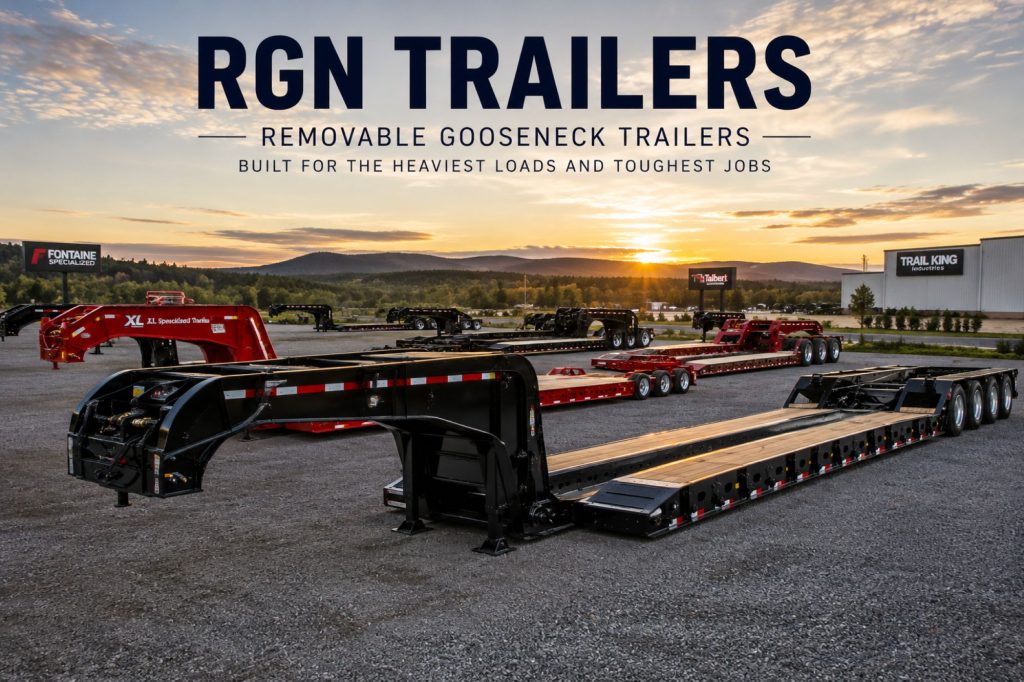
Overview
An RGN trailer, short for Removable Gooseneck Trailer, is a specialized heavy-haul trailer designed to transport oversized and overweight equipment that exceeds the capabilities of traditional flatbed and step deck trailers.
The defining feature of an RGN is its detachable front gooseneck. By removing the gooseneck, the front of the trailer lowers to ground level, allowing equipment to be driven directly onto the trailer deck.
This front-loading design makes RGNs one of the most popular trailer types for construction equipment, mining equipment, industrial machinery, and specialized project cargo.
While all RGNs are considered a type of lowboy trailer, not all lowboy trailers are RGNs. The removable gooseneck design is what separates an RGN from other lowboy configurations.

What Does RGN Mean?
- RGN stands for:
- Removable
- Goose
- Neck
The term describes the detachable front section of the trailer that allows equipment to be loaded directly from ground level.
This design provides significant advantages when transporting tracked or wheeled equipment that can be driven onto the trailer.
How Does an RGN Trailer Work?
The loading process typically follows these steps:
- Disconnect the gooseneck.
- Lower the trailer deck to the ground.
- Drive equipment onto the trailer.
- Position and secure the load.
- Reattach the gooseneck.
- Complete securement procedures.
- Begin transportation.
This loading method eliminates the need for external ramps in many situations and improves loading efficiency for large equipment.
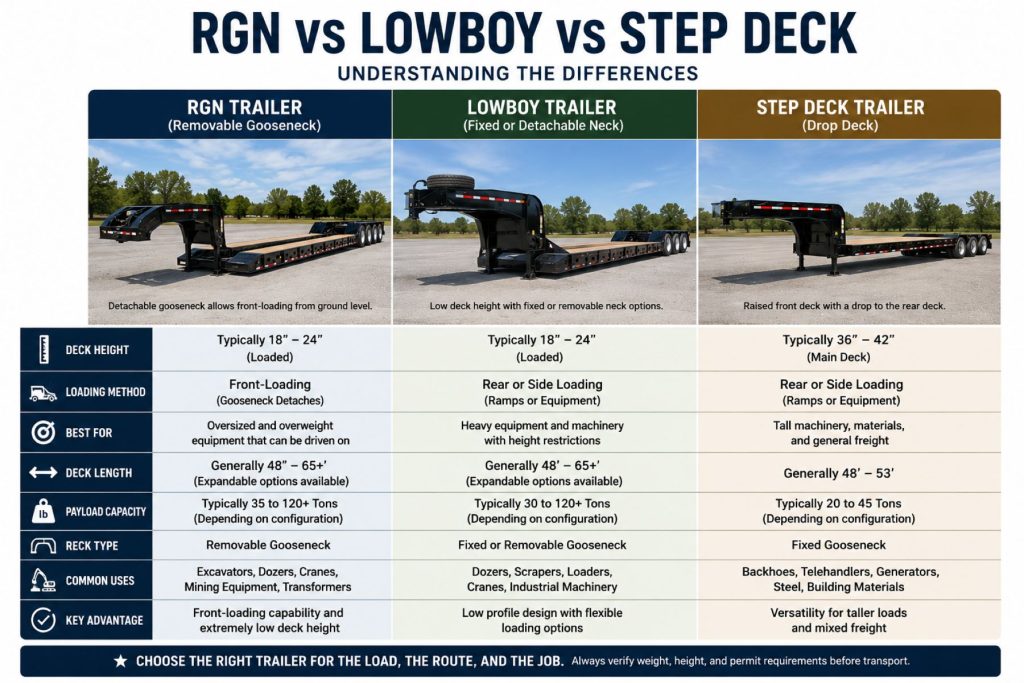
RGN vs Lowboy Trailer
This is one of the most common sources of confusion in trucking.
A lowboy trailer is a broad category of heavy-haul trailer.
An RGN is a specific type of lowboy trailer that features a removable gooseneck.
Lowboy Trailer
- General trailer category
- Extremely low deck height
- May use fixed or detachable neck designs
- Multiple configuration options
RGN Trailer
Type of lowboy trailer
- Removable gooseneck
- Front-loading capability
- Commonly used for construction and heavy equipment
In simple terms:
All RGNs are lowboys, but not all lowboys are RGNs.
RGN vs Step Deck Trailer
Step deck trailers and RGNs both transport equipment, but they serve different purposes.
Step Deck Trailer
- Deck height typically 36–42 inches
- Ideal for machinery and freight requiring additional height clearance
- Better for mixed freight operations
- Lower acquisition cost
RGN Trailer
- Deck height typically 18–24 inches
- Designed for oversized and overweight equipment
- Better for heavy-haul operations
- Higher acquisition and operating costs
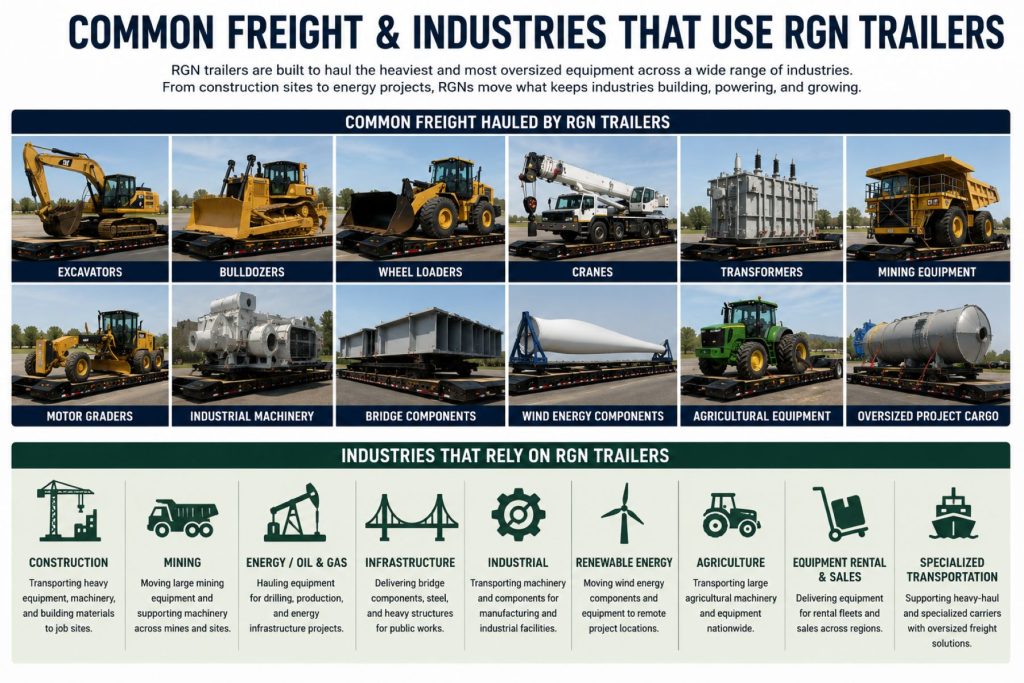
Common Freight Hauled by RGN Trailers
- Excavators
- Bulldozers
- Wheel Loaders
- Motor Graders
- Cranes
- Mining Equipment
- Transformers
- Bridge Components
- Industrial Machinery
- Wind Energy Components
- Agricultural Equipment
- Oversized Project Cargo
Industries That Use RGN Trailers
- Construction
- Mining
- Energy
- Oil & Gas
- Infrastructure Development
- Equipment Rental
- Industrial Manufacturing
- Heavy Equipment Sales
- Agriculture
- Specialized Transportation
Advantages of an RGN Trailer
- Extremely low deck height
- Front-loading capability
- Excellent heavy-haul capability
- Efficient loading process
- Wide range of capacities available
- Strong resale value
- Industry-standard heavy-haul solution
- Versatile configuration options
Limitations and Considerations
- Higher purchase cost
- Specialized maintenance requirements
- Permit requirements often apply
- Requires heavy-haul knowledge
- Higher operating costs than standard trailers
- Not ideal for general freight transportation
Mechanical vs Hydraulic RGN
Mechanical RGN
- Simpler design
- Lower acquisition cost
- Fewer hydraulic components
- Often preferred for lighter heavy-haul applications
Hydraulic RGN
- Faster loading operations
- Easier gooseneck removal
- More common in severe-duty applications
- Higher acquisition and maintenance costs
Buying Considerations
- Required payload capacity
- Deck length requirements
- Hydraulic vs mechanical gooseneck
- Axle configuration requirements
- Permit requirements
- Dealer support availability
- Resale value expectations
- Maintenance requirements
- Operating region regulations
- Expected freight types
Popular RGN Manufacturers
- Trail King Industries
- Talbert Manufacturing
- Fontaine Specialized
- Kalyn Siebert
- Rogers Brothers
- XL Specialized Trailers
- Etnyre
- Murray Trailers
Popular RGN Models
- Fontaine Magnitude RGN
- Trail King Hydraulic RGN
- Talbert RGN Series
- Kalyn Siebert RGN
- Rogers Brothers RGN
- XL Specialized RGN
Related Equipment
- Hydraulic Detachable Gooseneck Systems
- Mechanical Detachable Gooseneck Systems
- Jeep Axles
- Booster Axles
- Trailer Axles
- Trailer Suspension Systems
- Trailer Brake Systems
- Heavy-Duty Cargo Securement Systems
- Chain Tie Downs
- Load Binders
- Hydraulic Steering Axles
- Oversize Load Signage
- Escort Vehicle Equipment
Related Freight Types
- Heavy Equipment Freight
- Construction Freight
- Mining Freight
- Industrial Freight
- Energy Sector Freight
- Project Cargo
- Oversized Freight
- Overweight Freight
- Transformer Freight
Related Trailer Types
Frequently Asked Questions
What does RGN stand for?
RGN stands for Removable Gooseneck Trailer.
Is an RGN a lowboy?
Yes. An RGN is a specific type of lowboy trailer.
Why are RGNs used?
RGNs make it easier to transport oversized and overweight equipment by allowing front-loading and utilizing an extremely low deck height.
What equipment can an RGN haul?
Excavators, bulldozers, cranes, mining equipment, transformers, industrial machinery, and other oversized freight.
Are RGN trailers expensive?
Yes. They generally cost more than flatbed and step deck trailers because of their specialized design and heavy-haul capabilities.
Which manufacturers build RGNs?
Popular manufacturers include Trail King, Talbert, Fontaine Specialized, Kalyn Siebert, Rogers Brothers, and XL Specialized.
Availability and Where to Find
RGN trailers are available through specialized heavy-haul trailer dealerships, manufacturer dealer networks, equipment brokers, fleet resale programs, and transportation equipment auctions throughout North America. This page is intended as an educational overview of the trailer type. For specific specifications and capacities, refer to individual RGN model pages.
Support Trucking Families
Truck Equipment Atlas supports the mission of Grey Cross, a nonprofit organization dedicated to helping families of truck drivers who lose their lives while working on America’s highways.
Podcast or Video Section
Learn more about RGN trailers, heavy-haul transportation, permit planning, equipment loading procedures, and specialized hauling operations through future Truck Equipment Atlas videos and podcast content.
Follow the Growth of Truck Equipment Atlas
Truck Equipment Atlas continues to expand with new truck profiles, trailer coverage, diesel engine pages, equipment system resources, manufacturer information, freight-sector content, and educational guides.
Visit our Site Updates page to follow major milestones, newly published resources, and future projects as we continue building one of the industry’s growing commercial trucking equipment reference libraries.
From commercial trucks and specialized trailers to diesel engines, equipment systems, and future Truck Stop Atlas resources, new content is being added regularly to help drivers, owner-operators, fleets, technicians, students, and industry professionals better understand the equipment that keeps freight moving.