
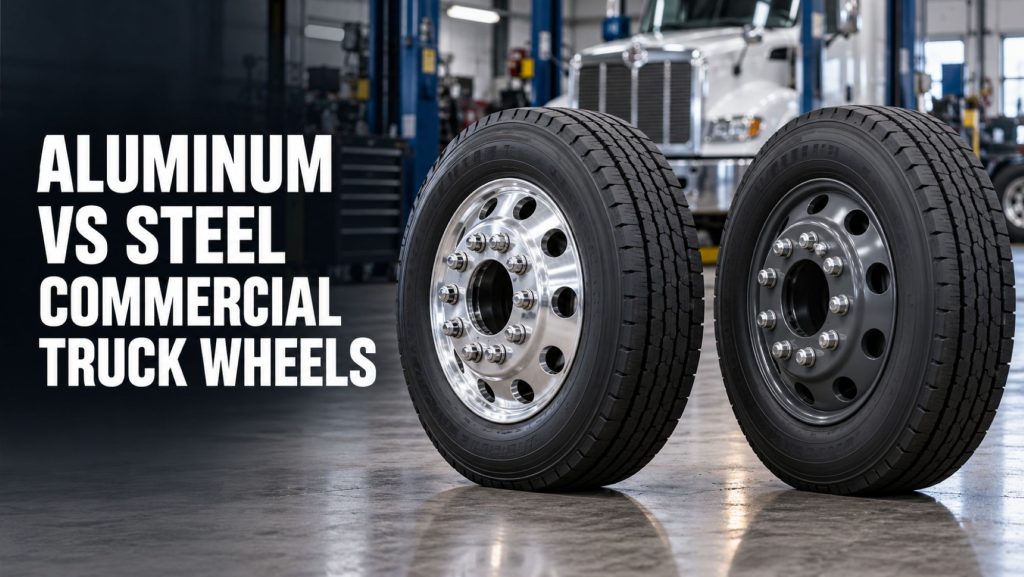
Commercial truck wheels are commonly manufactured from either steel or forged aluminum. Both materials can provide dependable service when the wheel is correctly specified, mounted, inspected, and maintained, but they offer different advantages in weight, purchase price, appearance, corrosion resistance, and operating application.
Aluminum wheels are often selected to reduce vehicle weight, improve appearance, and provide additional payload capacity. Steel wheels are widely used because of their lower initial cost, broad availability, and suitability for demanding fleet and vocational applications.
The best choice depends on the truck’s axle ratings, tire size, duty cycle, payload needs, maintenance program, operating environment, and total ownership goals. This guide compares aluminum and steel commercial truck wheels and explains what fleets should evaluate before choosing either material.
Aluminum vs Steel Truck Wheels at a Glance
| Comparison Area | Aluminum Wheels | Steel Wheels |
|---|---|---|
| Typical weight | Generally lighter | Generally heavier |
| Initial purchase price | Usually higher | Usually lower |
| Payload potential | Lower wheel weight can create additional payload capacity | Higher wheel weight may reduce available payload compared with a lighter equivalent |
| Appearance | Polished, machined, coated, or treated finishes are available | Usually painted or powder-coated |
| Corrosion behavior | Does not rust like steel but can corrode, pit, or experience surface damage | Can rust when protective coatings are damaged or deteriorated |
| Repairability | Damaged wheels should not be welded, straightened, or altered unless specifically permitted by the manufacturer | Damaged wheels also require manufacturer-approved evaluation and must not be casually repaired or reshaped |
| Common applications | Long haul, weight-sensitive fleets, tankers, bulk operations, premium tractors, and trailers | General freight, vocational trucks, trailers, severe environments, and cost-sensitive fleets |
These are general comparisons. Actual wheel weight, load rating, pressure rating, finish, and service requirements depend on the specific wheel model—not material alone.
How Aluminum Commercial Truck Wheels Are Made
Many heavy-duty aluminum truck wheels are manufactured through a forging process. A solid aluminum alloy billet is shaped under pressure and then machined into the final wheel design. Forging aligns and compresses the material structure, allowing manufacturers to produce wheels that combine relatively low weight with the strength required for commercial service.
Forged aluminum wheels should not be confused with every type of cast aluminum wheel used in lighter automotive applications. Commercial truck wheels must be selected according to their specific load, pressure, dimension, mounting, and application ratings.
Manufacturers may offer aluminum wheels with different surface treatments and finishes, including:
- Machined finishes
- Polished finishes
- Mirror-polished finishes
- Protective surface treatments
- Coated or colored finishes
Finish type affects appearance and cleaning requirements but does not replace routine wheel inspection.
How Steel Commercial Truck Wheels Are Made
Steel disc wheels are generally manufactured from formed steel components that are joined to create the rim and center disc. The finished wheel normally receives paint, powder coating, or another protective coating intended to reduce corrosion.
Steel wheels are available in a wide range of commercial truck, trailer, bus, and vocational configurations. Modern designs may use high-strength or low-alloy steel to reduce weight while maintaining the required load capacity.
The protective finish is an important part of steel-wheel service life. Scratches, stone impacts, road salt, moisture, mounting-tool damage, and chemical exposure can damage the finish and allow corrosion to develop.
Wheel Weight and Payload Capacity
Weight is usually the most recognizable difference between aluminum and steel wheels. A comparable forged aluminum wheel often weighs less than a steel wheel designed for the same general position and tire size.
Reducing wheel weight can provide several potential advantages:
- Additional legal payload capacity where gross weight is the limiting factor
- Lower empty vehicle weight
- Possible fuel-efficiency benefits depending on route, load, and operation
- Easier handling during tire and wheel service
- More flexibility when adding other equipment to the vehicle
The total weight savings must be calculated using the exact wheels being compared. Multiply the per-wheel difference by the number of wheels being changed, and include any changes in tires, mounting hardware, spacers, valve equipment, or wide-base configurations.
Weight savings are most valuable when the truck regularly reaches its legal or operational weight limit. A lightly loaded vehicle may receive less financial benefit from additional payload capacity.
Purchase Price and Total Cost of Ownership
Steel wheels generally have a lower initial purchase price. This can make them attractive for large fleets, trailers, replacement inventory, and operations where wheel appearance or weight savings provide limited financial value.
Forged aluminum wheels typically cost more initially, but purchase price is only one part of the ownership calculation. A complete comparison may include:
- Initial wheel cost
- Payload-related revenue
- Fuel consumption
- Cleaning and refinishing labor
- Corrosion-related maintenance
- Wheel replacement frequency
- Vehicle resale value and appearance
- Inventory and roadside replacement availability
The lowest-priced wheel is not always the least expensive wheel over the vehicle’s complete service life. At the same time, a higher-priced aluminum wheel will not produce the same return in every fleet.
Strength and Load Capacity
It is incorrect to assume that steel is always stronger or that aluminum is automatically less durable. Commercial wheels are engineered and rated for specific applications. The load rating, pressure rating, dimensions, mounting system, and manufacturer approval determine whether a wheel is suitable.
Both aluminum and steel wheels are available for heavy-duty applications. Some forged aluminum wheels are specifically designed for severe-service, high-load, transit, refuse, logging, mining, and other demanding operations.
Never choose a wheel by material alone. Verify:
- Maximum wheel load rating
- Maximum inflation-pressure rating
- Wheel size and approved tire sizes
- Rim width and contour
- Bolt circle and bolt-hole configuration
- Hub-piloted or stud-piloted mounting system
- Inset, outset, offset, and dual spacing
- Axle-position and vehicle-manufacturer requirements
Corrosion and Environmental Exposure
Aluminum does not develop red rust like carbon steel, but it is not immune to corrosion. Aluminum wheels can experience oxidation, pitting, galvanic corrosion, finish damage, and corrosion around mounting or valve areas.
Steel wheels depend heavily on the condition of their protective coating. When paint or powder coating is damaged, moisture and road chemicals can reach the steel and allow rust to develop.
Corrosion risk increases with exposure to:
- Road salt and deicing chemicals
- Coastal environments
- Fertilizer, livestock, waste, and chemical-hauling operations
- Frequent pressure washing with harsh chemicals
- Damaged coatings or surface treatments
- Dirt and moisture trapped between mounting surfaces
Both materials require routine cleaning and inspection. Severe pitting, material loss, cracks, or mounting-surface damage can make a wheel unsafe regardless of its material.
Appearance and Fleet Image
Aluminum wheels are commonly selected for their bright, polished appearance. They can contribute to a premium fleet image without wheel covers or decorative simulators.
Steel wheels are usually painted or powder-coated. They may be ordered in fleet colors and can provide a clean, uniform appearance when the finish is maintained. However, chipped coatings and visible rust can require repainting or replacement to preserve appearance.
Appearance may be especially important for:
- Premium long-haul tractors
- Owner-operator trucks
- Vehicle fleets with strong public branding
- Car carriers and specialized transporters
- Show trucks and customer-facing vehicles
Cleaning and Routine Maintenance
Cleaning requirements depend on the wheel material and finish. Always follow the wheel manufacturer’s approved cleaning instructions.
Maintaining Aluminum Wheels
Uncoated polished aluminum may require periodic cleaning and polishing to maintain its appearance. Wheels with a factory-applied surface treatment or coating may require only approved washing products, but aggressive abrasives can damage the finish.
- Use cleaning products approved for the wheel’s exact finish.
- Avoid harsh acids, strong alkaline cleaners, and unapproved abrasives.
- Do not use steel wool or tools that can scratch the wheel.
- Inspect around bolt holes, hand holes, valve openings, and rim flanges.
- Follow the manufacturer’s procedures for removing oxidation or staining.
Maintaining Steel Wheels
Steel-wheel maintenance focuses on preserving the protective coating and identifying corrosion before it causes significant material loss.
- Clean road salt, mud, fertilizer, and chemicals from the wheel.
- Inspect for chipped paint, coating damage, and developing rust.
- Use only manufacturer-approved refinishing procedures.
- Keep mounting surfaces clean and free of excessive paint buildup.
- Remove wheels with severe corrosion, cracking, deformation, or material loss from service.
Heat and Brake-System Considerations
Wheel material can influence how heat moves through the wheel assembly, but brake and wheel-end performance depends on the entire system. Brake design, drum or rotor condition, bearing adjustment, vehicle speed, grade, load, airflow, and driver operation all affect temperature.
Do not select wheels based on a general claim that one material will solve a brake-temperature problem. Excessive heat should be investigated as a brake, bearing, lubrication, adjustment, or operating issue.
Any wheel exposed to fire, severe brake heat, welding heat, or another extreme-temperature event should be removed from service and evaluated according to the manufacturer’s instructions. Heat exposure can change material properties even when the wheel still appears usable.
Ride Quality and Vehicle Performance
Reducing unsprung and rotating weight may influence vehicle response, but drivers should not expect a wheel-material change by itself to transform ride quality. Tires, inflation pressure, suspension design, axle position, vehicle loading, wheel balance, and road surface usually have a larger effect.
A wheel that is bent, improperly mounted, mismatched, or out of balance can create vibration regardless of whether it is made from aluminum or steel.
Mixing Aluminum and Steel Wheels
Some commercial vehicles use aluminum wheels in visible outside positions and steel wheels in inner dual positions. Mixed-material installations require careful attention to wheel dimensions, mounting hardware, stud length, wheel thickness, inset, outset, and dual spacing.
Do not assume an aluminum wheel can directly replace a steel wheel without additional checks. The mounting stack thickness may change, affecting available stud engagement and fastener installation.
Before combining materials, verify:
- The vehicle, axle, and wheel manufacturers permit the combination.
- Both wheels use the correct mounting system.
- The wheel offsets provide approved dual spacing.
- The studs and fasteners provide correct engagement.
- The wheel and tire load ratings meet the axle requirements.
- The mounting surfaces are clean, flat, and compatible.
Mounting and Fastener Torque
Correct mounting is essential for both steel and aluminum wheels. Dirt, corrosion, damaged fasteners, excessive paint, incorrect lubricants, or improper tightening can reduce clamping force and allow wheel movement.
Wheel nuts should be tightened in the specified sequence to the vehicle or wheel manufacturer’s required torque using calibrated equipment. An impact wrench may be used for removal or controlled rundown when permitted, but it should not be treated as the final torque-measuring tool.
Follow the applicable procedure for lubrication. Some wheel systems require a small amount of approved lubricant on specific fastener surfaces, while mounting faces must generally remain clean and dry. Applying lubricant to the wrong location can change clamping force or allow wheel movement.
After wheel installation, follow the manufacturer’s and fleet’s requirements for torque verification and inspection.
Wheel Inspection and Removal Criteria
Inspect wheels whenever tires are checked, mounted, removed, or serviced. Look at both sides of the wheel when possible.
- Cracks near bolt holes, hand holes, welds, or the rim area
- Bent or distorted flanges
- Elongated or damaged bolt holes
- Severe corrosion, pitting, or material loss
- Loose fasteners or rust trails around wheel nuts
- Damaged mounting surfaces
- Rim-flange wear
- Evidence of overloading or improper tire inflation
- Heat damage or discoloration
- Unauthorized welding, straightening, machining, drilling, or other alterations
A cracked, bent, severely corroded, heat-damaged, or improperly altered wheel should not be returned to service based only on a visual cosmetic repair. Follow the wheel manufacturer’s removal criteria and replacement instructions.
When Aluminum Wheels May Be the Better Choice
Forged aluminum wheels may be a strong choice when:
- The truck regularly operates near its legal weight limit.
- Additional payload capacity can produce additional revenue.
- Reducing empty vehicle weight is a major fleet objective.
- A polished or premium fleet appearance is important.
- The fleet wants to reduce steel-wheel rust and refinishing work.
- The selected aluminum wheel has the correct rating for the application.
- The expected ownership period supports the higher initial investment.
When Steel Wheels May Be the Better Choice
Steel wheels may be a strong choice when:
- Lower initial purchase cost is the primary consideration.
- The vehicle rarely reaches its maximum allowable weight.
- Appearance is less important than basic serviceability.
- The fleet requires broad replacement availability and standardized inventory.
- The application exposes wheels to frequent cosmetic damage.
- The fleet already has an effective steel-wheel inspection and refinishing program.
- A properly rated steel wheel best matches the vehicle and operating environment.
Choosing Wheels by Truck Application
| Application | Important Selection Factors |
|---|---|
| Long-haul tractor | Vehicle weight, fuel use, appearance, corrosion exposure, and long-term ownership cost |
| Bulk or tanker operation | Payload value, wheel weight, chemical exposure, and cleaning requirements |
| Dry van or refrigerated trailer | Fleet standardization, weight savings, corrosion, replacement availability, and trailer utilization |
| Dump, refuse, logging, or construction truck | Load rating, severe-service approval, impact exposure, finish damage, and inspection frequency |
| Local delivery truck | Stop-and-go operation, curb exposure, brake heat, cost, and medium-duty wheel availability |
| Premium owner-operator tractor | Appearance, weight, finish maintenance, resale value, and personal preference |
Wheel Selection Checklist
- Identify the correct wheel diameter, width, contour, and mounting system.
- Verify the wheel’s load and inflation-pressure ratings.
- Confirm compatibility with the selected tire size.
- Check offset, inset, outset, brake clearance, and dual spacing.
- Calculate the actual weight difference between the wheel options.
- Determine whether reduced weight will create usable payload or operating value.
- Compare initial cost with expected maintenance and service life.
- Evaluate road salt, chemicals, moisture, impacts, and other environmental exposure.
- Confirm replacement-wheel availability along the vehicle’s routes.
- Review manufacturer mounting, cleaning, inspection, and removal procedures.
Frequently Asked Questions
Are aluminum truck wheels stronger than steel wheels?
Strength cannot be determined from material alone. Both aluminum and steel commercial wheels are engineered for specific loads and applications. Compare the exact wheel ratings rather than assuming one material is always stronger.
How much lighter are aluminum truck wheels?
The difference depends on wheel size and model. Some aluminum wheels can save a significant amount of weight compared with a conventional steel equivalent, while lightweight steel designs may narrow the difference. Use published weights for the exact products being compared.
Do aluminum wheels improve fuel economy?
Reducing vehicle weight may improve efficiency in some operations, but the result depends on route, speed, load, vehicle configuration, and driving conditions. Fleets that replace saved weight with additional payload may receive the primary benefit through productivity instead of fuel savings.
Do aluminum truck wheels corrode?
Yes. Aluminum does not rust like steel, but it can oxidize, pit, and experience galvanic or chemical corrosion. Proper cleaning, mounting, and inspection are still required.
Can aluminum and steel wheels be used together?
Some approved configurations combine aluminum and steel wheels, particularly in dual assemblies. However, wheel thickness, offset, dual spacing, stud length, fasteners, and manufacturer approval must all be verified before mixing materials.
Can a bent aluminum or steel wheel be straightened?
Do not straighten, weld, heat, machine, or otherwise alter a commercial wheel unless the wheel manufacturer specifically permits the procedure. Improper repairs can hide damage or weaken the wheel.
Which wheel material is best for severe service?
Either material may be suitable when the specific wheel is rated and approved for severe service. The decision should consider load capacity, impacts, corrosion exposure, finish damage, replacement availability, maintenance practices, and total cost.
Explore Commercial Truck Tire and Wheel Guides
- Commercial Truck Wheels
- Commercial Truck Tire Types Explained
- Steer vs Drive vs Trailer Tires
- How to Read Commercial Truck Tire Sizes and Ratings
- How to Inspect and Maintain Commercial Truck Tires
- Tire Pressure Monitoring and Inflation Systems
Explore the Tires & Wheels Library
Visit the Tires & Wheels guide library for more information about commercial tires, truck wheels, tire-pressure systems, wheel selection, inspection, and maintenance.
Related Guide Libraries
Continue Exploring Truck Equipment Atlas
Truck Equipment Atlas publishes practical guides covering commercial truck components, specifications, selection, inspection, and maintenance. Visit Site Updates to find newly published and recently updated resources.