
Hendrickson COMPOSILITE EXS Lift Axle
Quick Facts
- Manufacturer: Hendrickson
- Product Family: COMPOSILITE EXS
- Equipment Type: Steerable auxiliary lift-axle suspension
- Axle Function: Adds load-carrying capacity and distributes vehicle weight across another axle
- Drive Type: Non-driven
- Steering Type: Passive self-steering
- Available Capacities: Approximately 8,000–20,000 lb, depending on model and configuration
- Common Positions: Pusher axle ahead of the drive axles or tag axle behind them
- Common Applications: Dump trucks, refuse trucks, roll-off trucks, concrete mixers, heavy vocational trucks, specialty trailers, and weight-sensitive fleet applications
- Notable Technology: Fabricated STEERTEK axle construction, inset lower beams, zero-torsion rubber bushings, and bolt-on axle seats
- Suggested Slug: hendrickson-composilite-exs-lift-axle
Overview
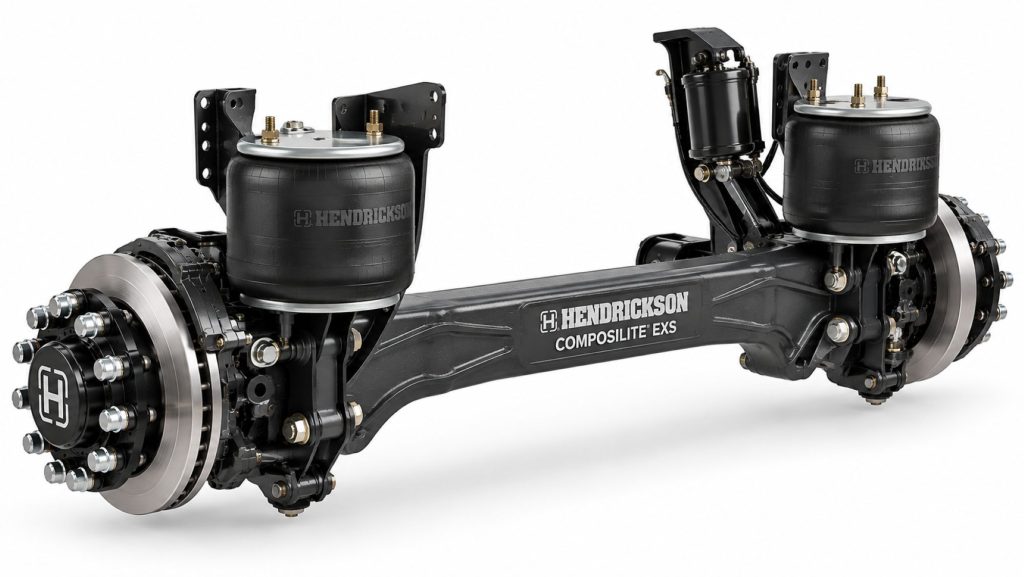
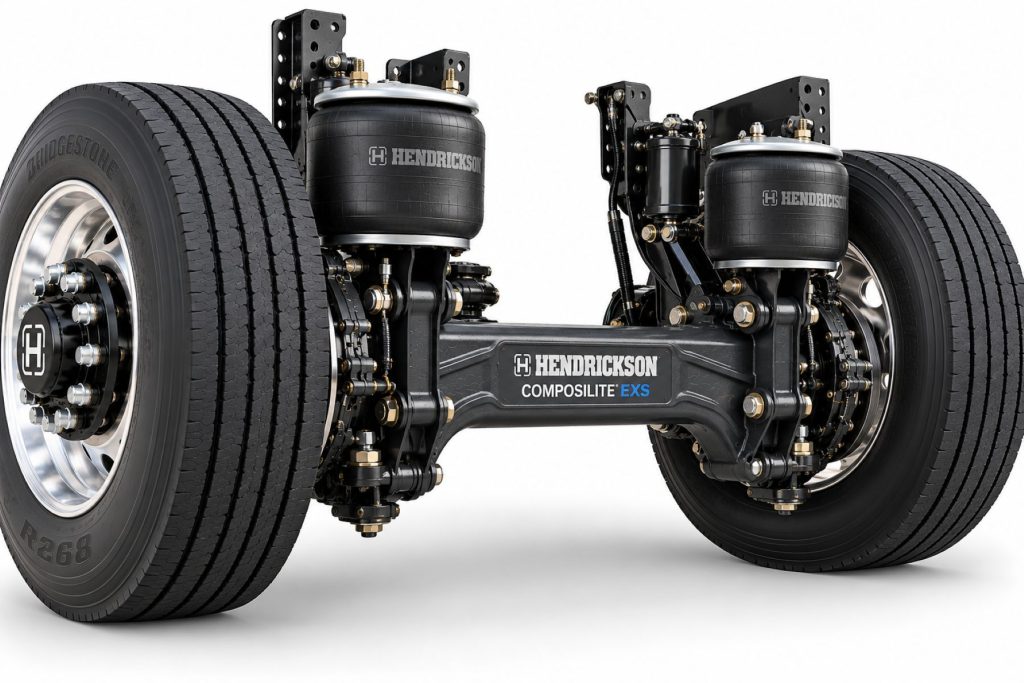
The Hendrickson COMPOSILITE EXS is a steerable auxiliary lift-axle suspension designed for vocational trucks, specialty vehicles, and certain trailer applications. It combines the axle, suspension beams, air springs, steering geometry, mounting structure, and brake provisions into an integrated system.
Unlike a conventional drive axle, the COMPOSILITE EXS does not transmit engine power or contain a differential. Its purpose is to support additional weight, distribute axle loading, and help a properly configured vehicle comply with applicable axle-weight and bridge-formula requirements.
The system can be lowered when additional load support is needed and raised when operating conditions or vehicle loading do not require the extra axle. When lowered during forward travel, the wheels follow the vehicle’s direction through passive self-steering action.
Key Characteristics
- Integrated steerable lift-axle suspension rather than a separate bare axle
- Available in multiple capacity classes for medium- and heavy-duty applications
- Fabricated two-piece STEERTEK axle construction
- Inset lower beams designed to improve lateral stiffness
- Zero-torsion rubber bushings intended to improve service life
- Bolt-on axle seats that simplify servicing and reconfiguration
- Weld-free front hanger design that helps reduce concentrated frame stresses
- Air-operated raising, lowering, and load-support functions
- Passive self-steering operation during forward travel
- Available for truck, roll-off, and selected trailer installations
How the Axle or Differential Works
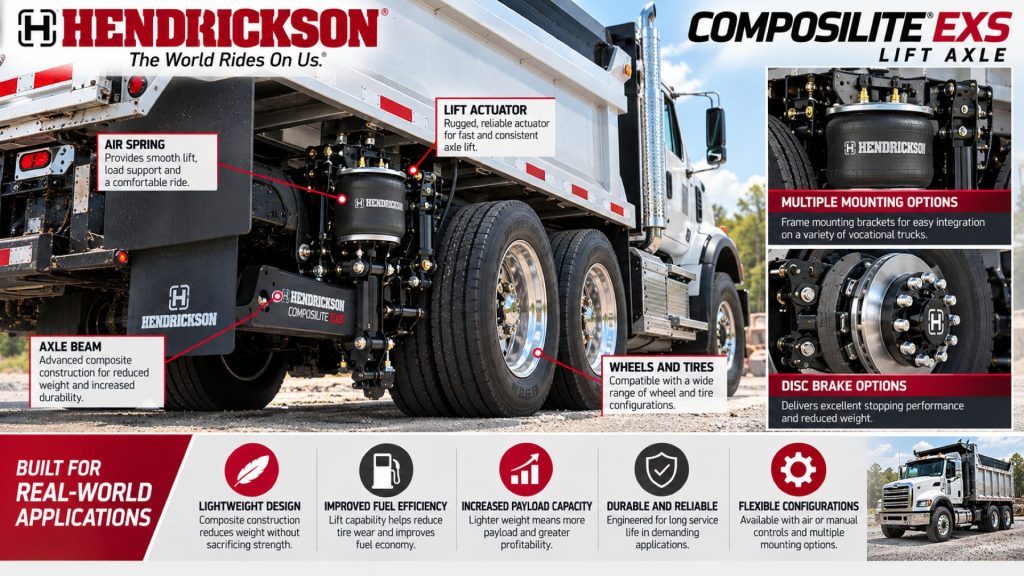
The COMPOSILITE EXS uses air springs and suspension beams to lower the axle and transfer part of the vehicle’s weight onto its tires. The amount of supported load depends on the axle model, air pressure, installation geometry, vehicle weight, and control-system calibration.
When the vehicle moves forward with the axle lowered, caster and steering geometry allow the wheel ends to align naturally with the direction of travel. This self-steering action can reduce tire scrubbing compared with a rigid non-steerable auxiliary axle.
The axle is not mechanically connected to the drivetrain. It has no ring-and-pinion gearset, drive shafts, axle shafts, or differential carrier. Raising the axle removes its tires from the road when the additional support is unnecessary or when required for certain maneuvers.
Reverse operation requires particular attention. Depending on the installation, the axle may need to be raised or equipped with an approved reverse-locking or centering system to prevent the wheels from turning unpredictably.
Axle Position and Function
The COMPOSILITE EXS can be installed as a pusher axle ahead of the vehicle’s driven tandem or as a tag axle behind the primary rear suspension. Exact placement depends on the chassis, body, wheelbase, load distribution, and applicable weight laws.
On vocational trucks, the system commonly helps distribute payload weight that would otherwise be concentrated on the steer axle or rear drive axles. Trailer versions provide similar load-distribution benefits without contributing propulsion.
Adding a lift axle does not automatically increase the manufacturer’s gross vehicle weight rating. The chassis, frame, brakes, tires, wheels, steering system, suspension, and legal operating limits must all support the intended configuration.
Common Specifications
- System Type: Integrated steerable auxiliary lift axle and air suspension
- Available Models: EXS08, EXS10, EXS13, and EXS20 configurations
- Nominal Capacity Range: Approximately 8,000–20,000 lb
- EXS08 Capacity: Approximately 8,000 lb
- EXS10 Capacity: Approximately 10,000 lb
- EXS13 Capacity: Up to approximately 13,500 lb, depending on configuration
- EXS20 Capacity: Approximately 20,000 lb
- EXS20 Suspension Weight: Approximately 1,470 lb in published truck configurations
- Steering Angle: Varies by model and application; approximately 22–31 degrees on selected configurations
- Suspension Type: Air-operated lift and load-support system
- Axle Construction: Fabricated two-piece STEERTEK design
- Available Spindle Configurations: Application-dependent options may include FF, N, and P spindle arrangements
- Brakes: Application-specific drum or air-disc brake configurations
Specifications vary by model year, truck or trailer application, mounting arrangement, track width, wheel equipment, brakes, and customer requirements. Confirm the exact specification using the axle identification information and Hendrickson documentation.
Axle Ratios and Gearing
The COMPOSILITE EXS does not have an axle ratio because it is a non-driven auxiliary axle. It contains no differential, ring gear, pinion gear, or propulsion gearing.
Vehicle gearing continues to be determined by the transmission, drive-axle ratio, tire size, and engine or electric-powertrain configuration. The lift axle affects load distribution and rolling resistance but does not change the truck’s mechanical final-drive ratio.
Differential and Traction Options
The COMPOSILITE EXS does not use a differential and is not available with differential-locking or limited-slip traction systems.
Because the axle is non-driven, lowering it may shift some weight away from the powered drive axles. The lift-axle air-pressure settings and vehicle loading must be properly adjusted so the drive axles retain enough weight for traction, braking stability, and controlled operation.
Brake and Wheel-End Options
Available brake and wheel-end equipment depends on the axle model, capacity, customer specification, and vehicle manufacturer.
- Air-disc brake configurations
- S-cam drum brake configurations
- Application-specific hubs and wheel bearings
- Single-tire wheel-end arrangements
- Different spindle and track-width options
- ABS wheel-speed sensor provisions
- Automatic slack adjusters on applicable drum-brake packages
Compatible tire and wheel packages must have adequate load ratings for the axle’s intended operating weight. Brake chambers, foundation brakes, ABS components, hubs, bearings, seals, tires, and wheels should be verified as a complete system.
Common Applications
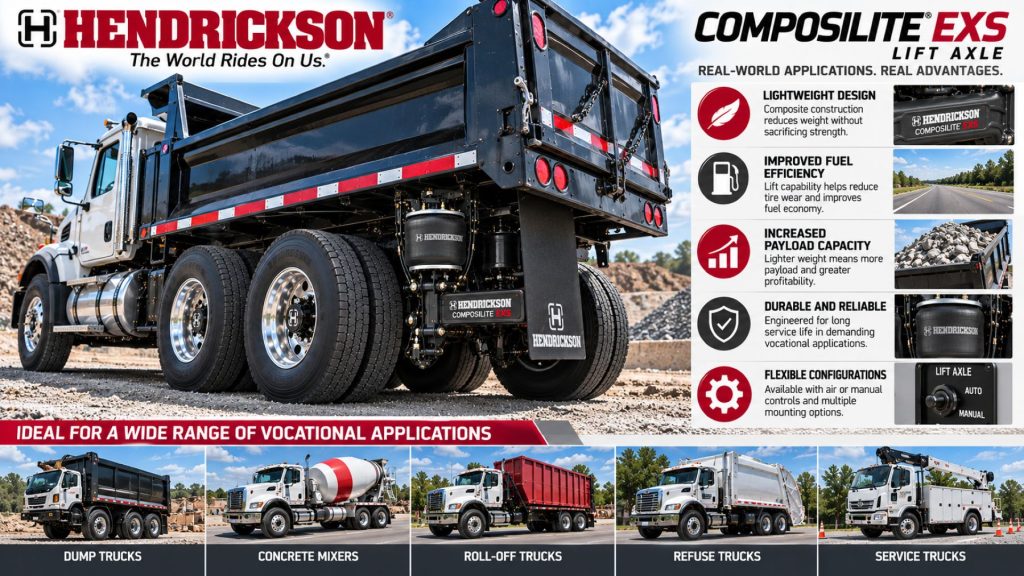
- Dump trucks
- Roll-off trucks
- Refuse and recycling vehicles
- Concrete mixers
- Construction trucks
- Heavy vocational trucks
- Bulk-hauling vehicles
- Specialty municipal vehicles
- Weight-sensitive truck configurations
- Selected semi-trailers and specialty trailers
Truck, Suspension, and Drivetrain Compatibility
The COMPOSILITE EXS can be integrated into many vocational truck and trailer configurations, but it is not a universal bolt-on system. Compatibility depends on available frame space, wheelbase, exhaust placement, fuel tanks, battery boxes, hydraulic equipment, body mounts, driveshaft clearance, and legal axle-spacing requirements.
Because the system is non-driven, it can be used with diesel, natural-gas, hybrid, and battery-electric drivetrains when the chassis and installation are properly engineered. Installation must not interfere with the drive shaft, steering components, brake plumbing, suspension movement, or vehicle body equipment.
The truck’s air system must have sufficient capacity and appropriate controls to raise, lower, and regulate the axle. Brake-system integration, ABS configuration, air-pressure control, and electronic logic must comply with the vehicle manufacturer’s requirements.
Advantages
- Adds another load-supporting axle when properly configured
- Helps distribute vehicle weight across a greater number of tire contact points
- Steerable design reduces tire scrub during turns
- Lift capability reduces unnecessary tire wear when the axle is not needed
- Multiple capacity choices support different vocational applications
- Integrated design combines the axle and suspension system
- Inset lower beams provide lateral stability without separate V-rods
- Zero-torsion bushings can reduce binding and maintenance demands
- Bolt-on axle seats improve serviceability
- Fabricated axle construction helps balance strength and weight
- Can improve vehicle maneuverability compared with a rigid auxiliary axle
Limitations or Considerations
- Does not automatically increase the truck’s certified GVWR or legal payload
- Adds weight, cost, air-system demand, and maintenance components
- Requires adequate chassis space and professional installation
- Improper air pressure can overload or underload the auxiliary axle
- Excessive lift-axle pressure can reduce drive-axle traction
- Steering performance depends on alignment, caster, loading, and component condition
- The axle may need to be lifted or controlled differently during reverse operation
- Tires can scrub if steering movement is restricted or improperly adjusted
- Axle use and control requirements vary by state, province, and jurisdiction
- Added axle spacing does not guarantee compliance with every bridge-formula requirement
Driver and Operator Experience
When properly adjusted, the COMPOSILITE EXS should follow the truck smoothly during forward turns. Drivers may notice a larger turning footprint and changes in steering feel when the axle is lowered and carrying weight.
The system can improve stability and load distribution, but lowering it can also change traction at the drive axles. Operators should understand when the axle must be deployed, how much pressure it should carry, and when it should be raised.
Drivers should confirm the axle’s position before reversing, entering a tight jobsite, crossing uneven terrain, or traveling over obstacles. Cab indicators and controls should clearly show whether the axle is raised or lowered.
Maintenance and Ownership Notes
Inspect the axle, beams, hangers, bushings, fasteners, air springs, shocks, steering components, brakes, hubs, and air lines at the intervals specified by Hendrickson and the vehicle manufacturer.
Alignment and caster settings are particularly important on a steerable lift axle. Irregular tire wear, wandering, shimmying, slow centering, or excessive tire scrub can indicate an alignment, loading, bushing, steering, or wheel-end problem.
Owners should also check air-pressure regulators and controls to confirm that the axle is carrying its intended share of the vehicle’s weight. Scale readings provide a more reliable basis for adjustment than visual estimates.
Replacement parts should match the axle model, brake package, spindle arrangement, track width, and serial-number information. Similar-looking COMPOSILITE components may not be interchangeable across every EXS capacity or configuration.
Common Axle or Differential Problems
- Irregular or rapid lift-axle tire wear
- Incorrect toe, caster, or axle alignment
- Wheels failing to center after a turn
- Steering shimmy or oscillation
- Restricted steering movement
- Worn steering joints or linkage components
- Damaged or deteriorated suspension bushings
- Air leaks from air springs, fittings, valves, or lines
- Axle failing to raise or lower completely
- Incorrect axle load caused by regulator or control-system adjustment
- Loose mounting hardware or axle-seat fasteners
- Cracked, bent, or damaged suspension components
- Wheel-bearing noise, looseness, or lubricant leakage
- Brake imbalance or excessive brake wear
- ABS sensor, wiring, or tone-ring faults
- Tire interference with the chassis, body, or suspension
Because the COMPOSILITE EXS is non-driven, differential gear noise, axle-ratio problems, and differential-lock malfunctions do not apply.
Identification Information
- Manufacturer: Hendrickson
- Product Family: COMPOSILITE
- Model Series: EXS
- Common Model Designations: EXS08, EXS10, EXS13, and EXS20
- Equipment Category: Steerable auxiliary lift-axle suspension
- Identification Sources: Suspension identification tag, axle tag, serial number, vehicle build records, and original equipment documentation
- Important Configuration Details: Capacity, axle position, track width, spindle type, brake package, wheel equipment, mounting arrangement, and truck or trailer application
Record the complete model and serial information before ordering parts. Brake and wheel-end components should also be identified separately because those specifications may vary within the same EXS model family.
Buying Considerations
- Required axle capacity
- Pusher or tag-axle position
- Truck, roll-off, or trailer configuration
- Available chassis and frame space
- Required axle spacing
- Expected legal and operating weights
- Brake type and size
- Hub, spindle, tire, and wheel compatibility
- Track width and steering clearance
- Air-system capacity
- Lift and load-control requirements
- ABS and electronic-system integration
- Reverse-operation strategy
- Replacement-parts availability
- Installer experience and engineering support
- Warranty coverage and documentation
Variants and Configurations
- COMPOSILITE EXS08 with approximately 8,000-lb capacity
- COMPOSILITE EXS10 with approximately 10,000-lb capacity
- COMPOSILITE EXS13 with capacity up to approximately 13,500 lb
- COMPOSILITE EXS20 with approximately 20,000-lb capacity
- Truck-mounted pusher-axle configurations
- Truck-mounted tag-axle configurations
- Roll-off vehicle configurations
- Weld-on trailer configurations
- Bolt-on trailer configurations
- Different brake and wheel-end packages
- Application-specific track widths and spindle arrangements
Comparison to Similar Equipment
Compared with a rigid non-steerable lift axle, the COMPOSILITE EXS allows its wheels to follow the vehicle through a turn. This can reduce tire scrub, pavement disturbance, and resistance during low-speed maneuvering.
Compared with a conventional steer axle connected to the steering gear, the EXS uses passive self-steering geometry rather than direct input from the steering wheel. This simplifies its role as an auxiliary axle but makes correct caster, alignment, loading, and reverse-operation controls especially important.
Compared with a driven pusher or tag axle, the COMPOSILITE EXS does not improve propulsion or deliver engine torque. Its primary benefits are weight distribution, additional braking capacity when properly equipped, and compliance support.
Best Fit For
- Vocational trucks that need additional legal axle capacity
- Fleets operating near regulated axle-weight limits
- Applications requiring better turning behavior than a rigid lift axle provides
- Dump, refuse, mixer, and roll-off trucks
- Vehicles that frequently alternate between loaded and unloaded operation
- Specialty trailers requiring a steerable auxiliary axle
- Operators with access to qualified installation and alignment support
- Applications where reduced tire scrub is an important ownership consideration
Related Truck Types
- Vocational Trucks
- Heavy Haul Trucks
- Dump Trucks
- Refuse Trucks
- Roll-Off Trucks
- Concrete Mixer Trucks
Related Truck Models
Related Axle and Differential Types
- Hendrickson STEERTEK NXT Steer Axle
- Meritor MFS Front Steer Axle
- Lift Axles and Auxiliary Axles
- Commercial Truck Axles and Differentials
- Non-Steerable Lift Axles
- Pusher Axles
- Tag Axles
Related Equipment Systems
- Suspension Systems
- Steering Systems
- Brake Systems
- Tires and Wheels
- Safety Systems
Related Guides
- Lift Axles Explained
- How Commercial Truck Axles and Differentials Work
- How to Identify a Truck Axle or Differential
Regulatory and Compliance Notes
Lift-axle regulations vary by jurisdiction. Requirements may cover axle spacing, maximum axle weight, bridge-formula calculations, tire width, brake equipment, automatic deployment, driver controls, reverse operation, and when the axle must remain lowered.
Some jurisdictions restrict manual lift-axle controls or require controls to be located outside the cab. Others may require a steerable axle for particular weights or axle positions.
The vehicle must comply with its certified ratings as well as road-use regulations. Operators should verify requirements with the appropriate transportation authority before placing a new or modified lift-axle vehicle into service.
Real World Operating Notes
Actual lift-axle performance depends heavily on correct installation and load adjustment. A capable axle can still produce poor tire life or unstable handling if the alignment, air pressure, or steering geometry is incorrect.
The axle load should be verified on a certified scale under realistic operating conditions. The truck should be checked with typical fuel, equipment, body, and payload weights rather than relying only on theoretical calculations.
Drivers should avoid lowering the axle directly onto curbs, deep ruts, large debris, or other obstacles. The system should also be inspected after off-road impacts or severe jobsite operation.
A steerable lift axle works best when its tires, wheel bearings, steering joints, air controls, and alignment are maintained as a complete system.
Frequently Asked Questions
Is the Hendrickson COMPOSILITE EXS a drive axle?
No. It is a non-driven auxiliary lift axle and does not transmit power from the engine or electric drivetrain.
Does the COMPOSILITE EXS contain a differential?
No. It has no ring-and-pinion gearset, differential carrier, or drive-axle shafts.
Is the COMPOSILITE EXS steerable?
Yes. It is a passive self-steering system that uses caster and suspension geometry to follow the vehicle during forward travel.
What capacities are available?
Common EXS models cover capacities from approximately 8,000 to 20,000 lb. The exact rating depends on the model and installation.
Can the axle be used as a pusher or tag axle?
Yes. Depending on the engineered installation, it may be positioned ahead of or behind the primary rear suspension.
Should the axle be raised while reversing?
Many steerable auxiliary axles must be raised, centered, or otherwise controlled during reverse operation. Follow the vehicle builder’s control strategy and Hendrickson instructions for the exact installation.
Does adding the axle increase the truck’s GVWR?
Not automatically. The vehicle’s certified ratings and the capacities of its frame, brakes, tires, wheels, suspension, and other components still apply.
Why are the lift-axle tires wearing unevenly?
Common causes include incorrect toe or caster, improper axle loading, worn steering components, restricted steering movement, unequal tire pressure, damaged bushings, or a bent component.
How should lift-axle air pressure be adjusted?
Adjustment should follow the vehicle builder’s instructions and be verified with actual axle weights on a suitable scale. Excessive pressure can unload the drive axles and reduce traction.
Can the COMPOSILITE EXS be installed on any truck?
No. Frame space, axle spacing, chassis ratings, brake integration, steering clearance, body equipment, and local regulations must all be evaluated before installation.
Availability and Where to Find
The Hendrickson COMPOSILITE EXS is available through authorized Hendrickson distributors, qualified truck-equipment installers, vocational body builders, trailer manufacturers, and commercial-truck parts suppliers.
New systems are commonly ordered as part of a new truck, body, or trailer build. Replacement assemblies and service parts should be matched using the complete model, capacity, serial number, brake package, spindle type, and installation information.
For current product information, technical literature, and distributor assistance, visit the Hendrickson Auxiliary Axle Systems page.
Support Trucking Families
Truck Equipment Atlas supports the mission of Grey Cross, a nonprofit dedicated to helping families of truck drivers who lose their lives while on the road. As the site grows, part of its mission is to bring awareness and support to these families.
Podcast or Video Section
Learn More Through Audio and Video
Truck Equipment Atlas will continue expanding with podcast episodes, interviews, and equipment breakdowns to help drivers and fleets better understand trucks and equipment.
Follow the Growth of Truck Equipment Atlas
Truck Equipment Atlas continues to expand with new truck profiles, trailer coverage, diesel engine pages, equipment system resources, manufacturer information, and educational guides.
Visit our Site Updates page to explore recent additions, project milestones, and upcoming resources as we continue building one of the industry’s growing commercial trucking equipment reference libraries.
View the Latest Site Updates: Truck Equipment Atlas Site Updates