
Detroit Front Steer Axle
Quick Facts
- Manufacturer: Detroit Diesel Corporation
- Parent Company: Daimler Truck North America
- Product Name: Detroit Front Steer Axle
- Axle Type: Non-driven front steer axle
- Available Model Families: Model 2, Model 3, and Model 5 configurations
- Published Weight Ratings: Approximately 6,000 to 23,000 pounds, depending on model and application
- Maximum Wheel Cut: Up to 55 degrees on selected configurations
- Primary Applications: Medium-duty, linehaul, vocational, severe-service, and heavy-haul trucks
- Common Truck Brands: Freightliner and Western Star
- Steering Joint Design: Needle-bearing technology on selected configurations
- Brake Compatibility: Application-dependent drum and air disc brake configurations
- Differential: Not applicable because this is a non-driven steer axle
- Product Page Slug: detroit-front-steer-axle
Overview
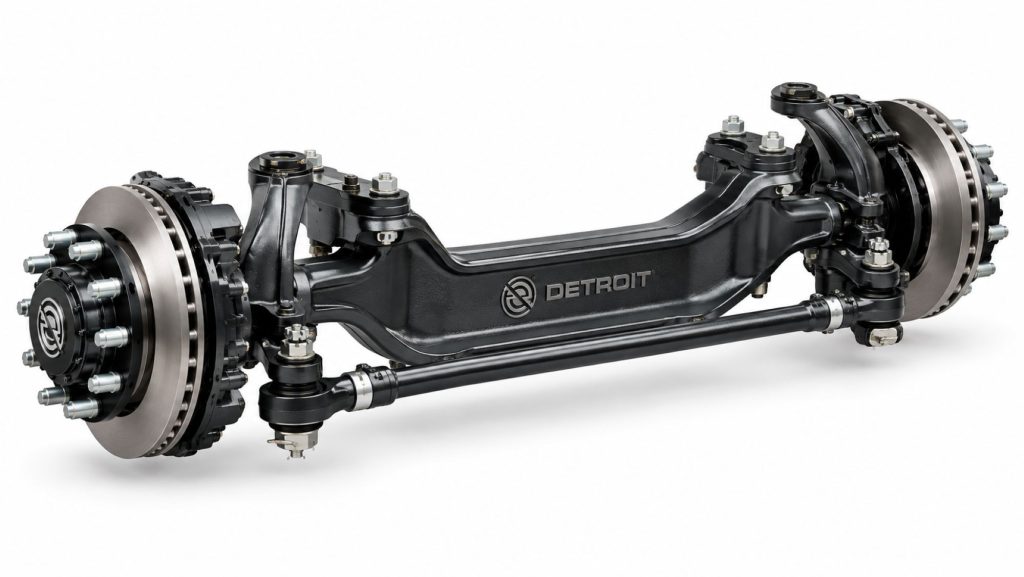
The Detroit Front Steer Axle is a family of non-driven front axles designed for Freightliner and Western Star commercial trucks. Available configurations cover medium-duty delivery vehicles, highway tractors, vocational trucks, and heavy front-axle applications.
Detroit steer axles are engineered to support the front of the vehicle while providing controlled steering movement, brake mounting, wheel-end support, and load transfer into the suspension and frame. Selected configurations provide wheel cuts of up to 55 degrees, helping trucks maneuver through loading areas, construction sites, city streets, and other confined locations.
Detroit currently promotes a vocational front axle rating of up to 23,000 pounds. Lighter configurations, including an available 12,500-pound rating, allow fleets to match the axle more closely to the truck’s payload, weight distribution, and intended operation.
Key Characteristics
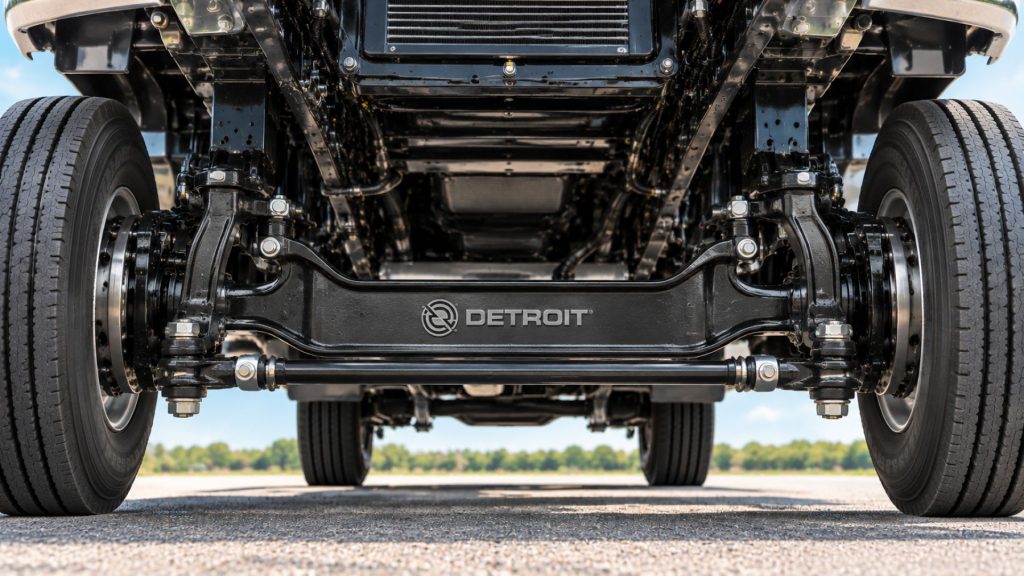
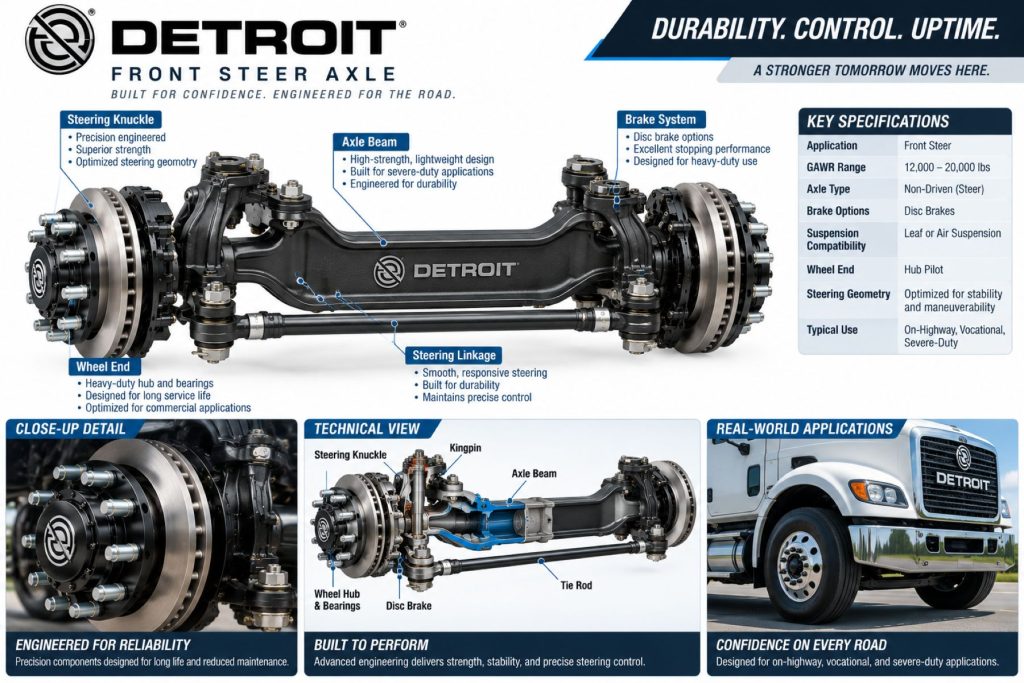
The Detroit Front Steer Axle uses an I-beam-style axle structure with steering knuckles, kingpins, steering arms, tie-rod components, hubs, and application-specific brake mounts.
Needle-bearing technology is used in selected steering-joint configurations to reduce friction and provide controlled movement as the wheels turn. This design can contribute to consistent steering response and long-term durability when properly lubricated and maintained.
Selected models provide wheel cuts of up to 55 degrees. Heavy vocational configurations may use a lower maximum wheel cut because larger tires, brakes, suspension components, and axle structures require additional clearance.
How the Axle or Differential Works
The axle beam spans the front of the truck and supports the steering knuckles at each end. Kingpins and bearings allow the knuckles to pivot while carrying the front vehicle load.
The steering gear transfers driver input through the pitman arm and drag link to one steering knuckle. A tie rod connects the left and right sides so both front wheels turn together while maintaining the required steering geometry.
The axle beam transfers vertical loads, road impacts, cornering forces, and braking forces into the front suspension and chassis. The hubs and wheel bearings allow the wheels to rotate while the brake assemblies slow or stop the truck.
Because the Detroit Front Steer Axle is not powered, it does not contain a drive differential, ring-and-pinion gearset, or axle shafts for transmitting engine torque.
Axle Position and Function
The Detroit Front Steer Axle is installed beneath the front of compatible Freightliner and Western Star trucks. It supports the engine, front chassis, cab, accessories, and part of the vehicle or cargo load.
Its primary functions are carrying the front axle load, allowing the wheels to steer, supporting the front wheel ends, mounting the front brakes, and transferring vehicle forces into the suspension.
The axle must be properly matched to the truck’s front gross axle weight rating, suspension, steering system, brakes, tires, wheels, and frame. The lowest-rated component determines the practical and legal front axle capacity.
Common Specifications
- Axle Configuration: Single non-driven front steer axle
- Model 2 Published Rating Range: Approximately 6,000 to 8,000 pounds
- Model 3 Published Rating Range: Approximately 8,000 to 14,700 pounds
- Model 5 Published Rating Range: Approximately 16,000 to 20,000 pounds in traditional configurations
- Available Vocational Rating: Up to 23,000 pounds on approved current configurations
- Available Linehaul Rating: 12,500 pounds on selected installations
- Maximum Wheel Cut: Up to 55 degrees on selected models
- Model 5 Wheel Cut: Up to approximately 45 degrees, depending on configuration
- Axle Structure: I-beam-style steer axle
- Steering Support: Kingpin and needle-bearing technology on selected configurations
- Brake Options: Application-dependent drum or air disc brakes
- Primary Vehicle Brands: Freightliner and Western Star
Exact ratings, beam widths, spring centers, kingpin dimensions, wheel cuts, brake packages, and wheel-end specifications vary by model and truck configuration.
Axle Ratios and Gearing
Axle ratios do not apply to the Detroit Front Steer Axle because it is a non-driven axle. It does not contain reduction gears and does not transmit engine torque to the front wheels.
The truck’s operating ratio is determined by its driven rear axle, transmission, engine speed, and tire size.
Differential and Traction Options
The Detroit Front Steer Axle does not contain a differential. Open, locking, limited-slip, and electronically controlled differential options therefore do not apply.
Front-end traction is influenced by steer-tire selection, tire pressure, road surface, suspension behavior, and the amount of weight carried by the axle.
A truck requiring powered front wheels needs a specialized front drive axle and transfer system. The standard Detroit Front Steer Axle cannot be converted into a powered axle by adding a differential lock or traction-control feature.
Brake and Wheel-End Options
Detroit steer axles can be configured with application-approved drum or air disc brakes. Brake availability depends on the axle model, gross axle weight rating, truck model, wheel size, and intended vocation.
Higher-capacity vocational axles require brake systems, hubs, wheels, and tires that are rated for the expected front axle load. Detroit identifies a 23,000-pound configuration as its highest front axle rating compatible with disc brakes.
Wheel-end arrangements may differ according to the truck specification. Technicians should identify the installed hubs, bearings, seals, brake assemblies, and spindle configuration before ordering parts or beginning service.
Common Applications
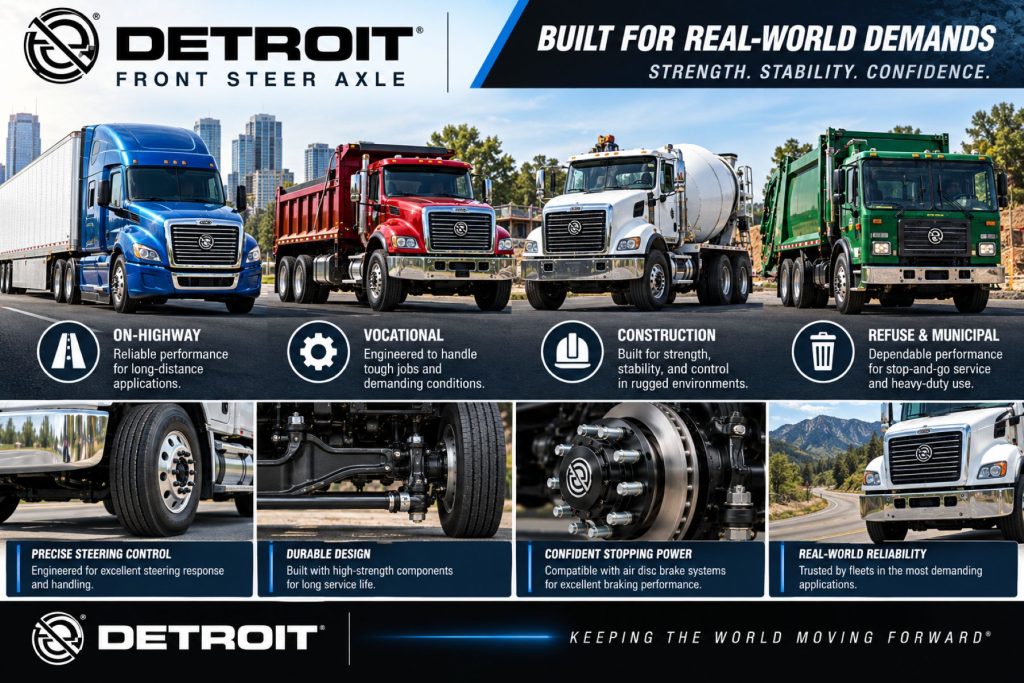
- Highway tractors
- Regional-haul tractors
- Medium-duty delivery trucks
- Box trucks
- Dump trucks
- Concrete mixer trucks
- Refuse trucks
- Municipal vehicles
- Utility trucks
- Snowplows
- Construction trucks
- Heavy-haul tractors
- Logging trucks
- Emergency and rescue vehicles
- Specialized vocational equipment
Truck, Suspension, and Drivetrain Compatibility
The Detroit Front Steer Axle is primarily engineered for compatible Freightliner and Western Star truck platforms. Availability depends on the truck model, production year, suspension selection, brake package, tire size, and intended vocation.
The axle may be combined with leaf-spring or application-approved front air-suspension systems. Spring centers, axle seats, steering geometry, ride height, wheel offset, and tire clearance must match the chassis specification.
Because the axle is non-driven, it does not directly determine engine, transmission, or rear axle compatibility. However, the complete powertrain and vehicle layout affect front-to-rear weight distribution.
Detroit front steer axles are commonly specified as part of an integrated Detroit powertrain that can include a Detroit engine, Detroit transmission, and Detroit rear drive axles.
Advantages
- Weight ratings for medium-duty through heavy vocational trucks
- Available 12,500-pound linehaul configuration
- Vocational ratings reaching 23,000 pounds
- Wheel cuts of up to 55 degrees on selected models
- Strong maneuverability in confined operating areas
- Needle-bearing steering technology on selected configurations
- Integration with compatible Freightliner and Western Star chassis
- Application-dependent drum and air disc brake options
- Multiple capacities for matching the axle to the truck’s actual requirements
- Detroit dealer and service support
- Potential powertrain integration with Detroit engines, transmissions, and rear axles
- Heavy-duty configurations for demanding front axle loads
Limitations or Considerations
- Not a powered front drive axle
- Specifications vary considerably among Model 2, Model 3, and Model 5 configurations
- Maximum wheel cut is not available with every capacity or tire package
- Heavy vocational configurations can add weight compared with linehaul axles
- Large tires and wide wheels may reduce steering clearance
- Axle capacity does not override lower tire, wheel, brake, suspension, or frame ratings
- Improper alignment can cause rapid and expensive steer-tire wear
- Kingpins, bearings, tie rods, and steering joints require regular inspection
- Front-mounted equipment can overload an otherwise correctly specified axle
- Replacement parts must match the complete axle identification information
- Detroit axle availability is concentrated within Freightliner and Western Star truck platforms
- Used axle assemblies may not interchange across different chassis or brake packages
Driver and Operator Experience
A properly aligned Detroit Front Steer Axle should provide predictable tracking, controlled steering effort, and stable handling. The available wheel cut of up to 55 degrees can reduce the space required to turn or position the truck.
Drivers working in urban delivery, construction, refuse, and distribution operations may benefit most from the tighter turning capability. Highway drivers may notice easier maneuvering in terminals, fuel islands, parking areas, and loading docks.
Steering wander, pulling, vibration, excessive free play, or uneven tire wear can indicate problems within the axle, tires, suspension, steering gear, wheel ends, or alignment. These symptoms should be inspected before they become safety or tire-cost concerns.
Maintenance and Ownership Notes
Routine maintenance should include lubrication of specified steering joints, inspection of kingpins and bearings, examination of tie-rod ends, wheel-bearing checks, brake inspection, and verification of critical fastener torque.
Steer-tire wear should be monitored across the complete tread. Feathering, shoulder wear, cupping, or wear concentrated on one tire can help identify incorrect toe, worn steering components, suspension movement, tire-pressure problems, or axle damage.
Wheel bearings and hubs must be serviced according to the installed wheel-end configuration. Technicians should not assume that every Detroit steer axle uses the same adjustment or lubrication procedure.
Axle alignment should be checked after collision damage, curb strikes, suspension repairs, steering-component replacement, tire-wear complaints, or the installation of heavy front-mounted equipment.
Common Axle or Differential Problems
- Kingpin or bearing wear
- Loose or worn tie-rod ends
- Steering-knuckle movement
- Wheel-bearing wear or incorrect adjustment
- Hub seal leakage
- Brake pull or uneven brake wear
- Incorrect toe alignment
- Excessive or uneven steer-tire wear
- Steering wander
- Excessive steering free play
- Bent axle beam following an impact or overload
- Loose steering-arm or suspension fasteners
- Cracked or damaged steering components
- Corrosion around the hubs, brakes, or steering joints
- Restricted wheel cut caused by interference or incorrect adjustment
Because this is a non-driven steer axle, differential gear noise and differential-lock problems do not apply.
Identification Information
- Manufacturer: Detroit Diesel Corporation
- Product Type: Front steer axle
- Model Families: Model 2, Model 3, and Model 5
- Primary Identification Source: Axle identification tag or stamped axle information
- Vehicle Identification Sources: VIN, Freightliner or Western Star build sheet, and dealer parts records
- Important Capacity Information: Gross axle weight rating and vehicle-certified front axle rating
- Important Configuration Information: Beam dimensions, spring centers, steering geometry, brake package, wheel ends, and tire size
- Replacement-Part Information: Axle model, serial number, assembly number, production date, and component numbers when available
The complete identification information should be recorded before ordering kingpins, bearings, knuckles, steering arms, tie rods, hubs, seals, brakes, or a replacement axle beam.
Buying Considerations
- Required front gross axle weight rating
- Exact Detroit axle model
- Truck make, model, year, and VIN
- Original vehicle build sheet
- Linehaul or vocational application
- Expected front axle load
- Weight of front-mounted equipment
- Required wheel cut
- Axle beam and spring-center dimensions
- Steering linkage compatibility
- Suspension type and ride height
- Drum or air disc brake package
- Hub, bearing, and wheel-end configuration
- Wheel and tire size
- Parts availability through local Detroit dealers
- Condition of the beam, kingpins, knuckles, tie rods, hubs, and brakes
- Evidence of overloading, collision damage, unauthorized welding, or straightening
- Compatibility with the truck’s certified weight ratings
Variants and Configurations
- Model 2 medium-duty configurations
- Model 3 medium- and heavy-duty configurations
- Model 5 heavy vocational configurations
- Approximately 6,000-pound configurations
- Approximately 8,000-pound configurations
- 12,000-pound configurations
- 12,500-pound configurations
- 13,000-pound and higher linehaul or vocational configurations
- Heavy-duty ratings through approximately 20,000 pounds
- Vocational configurations rated up to 23,000 pounds
- Drum-brake configurations
- Air disc brake configurations
- Different beam widths and spring-center dimensions
- Different steering-angle configurations
- Different hub and wheel-end packages
- Freightliner-specific installations
- Western Star-specific installations
Comparison to Similar Equipment
The Detroit Front Steer Axle competes with commercial steer axles from Dana Spicer, Meritor, and other axle manufacturers. The correct choice depends on truck manufacturer availability, weight rating, beam dimensions, brake package, wheel cut, service support, and intended vocation.
The Dana Spicer E-Series Steer Axle covers common medium- and heavy-duty ratings and offers standard and wide-beam configurations.
The Dana Spicer D-Series Steer Axle includes models for medium-duty, linehaul, vocational, and heavy-haul applications.
The Meritor MFS Front Steer Axle is another widely used non-driven front axle family with multiple capacities and commercial truck applications.
Detroit’s principal advantage is its integration with Freightliner and Western Star chassis and the wider Detroit powertrain and dealer-support network.
Best Fit For
- Freightliner and Western Star truck buyers
- Fleets wanting a Detroit-integrated powertrain specification
- Medium-duty delivery operations
- Regional and linehaul tractors
- Urban trucks requiring strong maneuverability
- Vocational trucks with elevated front axle loads
- Dump, mixer, refuse, and construction vehicles
- Snowplow and municipal applications
- Heavy-haul tractors requiring additional front axle capacity
- Fleets with access to Detroit dealer service
- Applications requiring air disc brakes at higher front axle ratings
- Operators wanting axle capacities tailored to the vehicle’s actual load
Related Truck Types
- Medium-Duty Trucks
- Day Cab Trucks
- Sleeper Trucks
- Vocational Trucks
- Severe-Service Trucks
- Heavy-Haul Trucks
Related Truck Models
- Freightliner Cascadia
- Freightliner M2 106
- Freightliner M2 112
- Freightliner 114SD
- Freightliner 122SD
- Western Star 47X
- Western Star 49X
- Western Star 57X
Related Axle and Differential Types
- Commercial Truck Steer Axles
- Dana Spicer E-Series Steer Axle
- Dana Spicer D-Series Steer Axle
- Meritor MFS Front Steer Axle
- Commercial Truck Axles and Differentials
Related Equipment Systems
Related Guides
- How Commercial Truck Axles and Differentials Work
- How to Identify a Truck Axle or Differential
- Common Truck Axle and Differential Problems
Regulatory and Compliance Notes
The axle, suspension, brakes, hubs, wheels, tires, steering components, and frame must meet the truck’s required front gross axle weight rating and applicable commercial vehicle regulations.
The lowest-rated component determines the usable front axle capacity. Installing a 20,000- or 23,000-pound axle does not increase the truck’s legal or certified capacity unless the suspension, brakes, steering system, frame, tires, wheels, and vehicle certification also support that rating.
Steering components are safety-critical. Repairs, alignment adjustments, and component replacement should follow Detroit and vehicle-manufacturer procedures.
State, provincial, and local axle-weight regulations may limit the load below the axle’s mechanical rating.
Real World Operating Notes
Front axle loading can increase considerably after installing a snowplow, crane, winch, reinforced bumper, hydraulic equipment, or specialized body. The completed vehicle should be weighed by axle under realistic operating conditions.
A higher-capacity front axle can improve load support, but it may also add weight and require larger tires, wheels, brakes, springs, and steering components. Fleets should select the capacity that provides an appropriate operating margin without unnecessarily reducing payload.
High wheel-cut capability is valuable in tight locations, but actual turning radius also depends on wheelbase, tire size, steering stops, frame clearance, suspension components, and body equipment.
Frequently Asked Questions
Is the Detroit Front Steer Axle a powered axle?
No. It is a non-driven axle that supports the front of the truck and allows the wheels to steer. Engine torque is normally delivered through the rear drive axle.
What weight ratings are available?
Published Detroit steer axle configurations range from approximately 6,000 pounds for lighter models to 23,000 pounds for approved vocational applications.
What is the available 12,500-pound axle designed to provide?
The 12,500-pound rating offers approximately 500 pounds of additional front capacity compared with a traditional 12,000-pound axle without requiring the fleet to move directly to a substantially heavier configuration.
How far can the wheels turn?
Selected Detroit steer axles provide wheel cuts of up to 55 degrees. Heavy Model 5 configurations may provide up to approximately 45 degrees, depending on the truck and axle specification.
Does the axle contain a differential?
No. A conventional non-driven steer axle does not require a differential, ring gear, pinion, or drive axle shafts.
Are air disc brakes available?
Yes. Air disc brakes are available on compatible configurations. Detroit also identifies a vocational front axle rating of up to 23,000 pounds that is compatible with disc brakes.
Which trucks commonly offer Detroit steer axles?
Detroit axles are primarily offered in compatible Freightliner and Western Star commercial trucks. Availability varies by model, production year, and vocation.
What commonly causes uneven steer-tire wear?
Incorrect toe, worn kingpins, loose tie-rod ends, wheel-bearing movement, suspension wear, improper tire pressure, wheel imbalance, or a bent axle beam can cause abnormal tire wear.
Can a higher-rated Detroit axle increase the truck’s legal capacity?
Not by itself. Every related component and the vehicle’s certification must support the higher rating.
How should a replacement axle be identified?
Use the axle tag or stamped information together with the truck’s VIN and original build sheet. Confirm the model, capacity, dimensions, steering geometry, brakes, and wheel ends before purchasing a replacement.
Availability and Where to Find
Detroit Front Steer Axles are available as original equipment on compatible Freightliner and Western Star trucks. Replacement assemblies and service components may be obtained through authorized Detroit, Freightliner, and Western Star dealers.
Used and remanufactured axles may also be available through commercial truck salvage yards, axle rebuilders, and heavy-truck parts suppliers. Buyers should verify the complete identification, capacity, dimensions, brake package, wheel ends, and physical condition before purchasing.
Current product information and dealer support are available through the Detroit Front Steer Axles product page.
Support Trucking Families
Truck Equipment Atlas supports the mission of Grey Cross, a nonprofit dedicated to helping families of truck drivers who lose their lives while on the road. As the site grows, part of its mission is to bring awareness and support to these families.
Podcast or Video Section
Learn More Through Audio and Video
Truck Equipment Atlas will continue expanding with podcast episodes, interviews, and equipment breakdowns to help drivers and fleets better understand trucks and equipment.
Follow the Growth of Truck Equipment Atlas
Truck Equipment Atlas continues to expand with new truck profiles, trailer coverage, diesel engine pages, equipment system resources, manufacturer information, and educational guides.
Visit our Site Updates page to explore recent additions, project milestones, and upcoming resources as we continue building one of the industry’s growing commercial trucking equipment reference libraries.
View the Latest Site Updates: Truck Equipment Atlas Site Updates