
Meritor MFS Front Steer Axle
Quick Facts
- Manufacturer: Meritor, now part of Cummins
- Equipment Type: Front Non-Drive Steer Axle
- Axle Family: MFS Series
- Weight Ratings: Approximately 6,000 to 23,000 pounds, depending on model
- Common Heavy-Truck Ratings: 12,000, 12,500, 13,200, 14,600, 16,000, 18,000, 20,000, 22,800, and 23,000 pounds
- Maximum Wheel Cut: Up to approximately 55 degrees on applicable configurations
- Axle Beam Drops: Multiple configurations from approximately 3.5 to 6.5 inches
- Brake Compatibility: Air Disc and Drum Brake Configurations
- Primary Applications: Highway Trucks, Vocational Trucks, Fire and Rescue Vehicles, Construction Trucks, Utility Vehicles, Buses, and Coaches
- Product Availability: North America and Other Global Commercial-Vehicle Markets
- Production Status: Current Commercial Axle Family
Overview
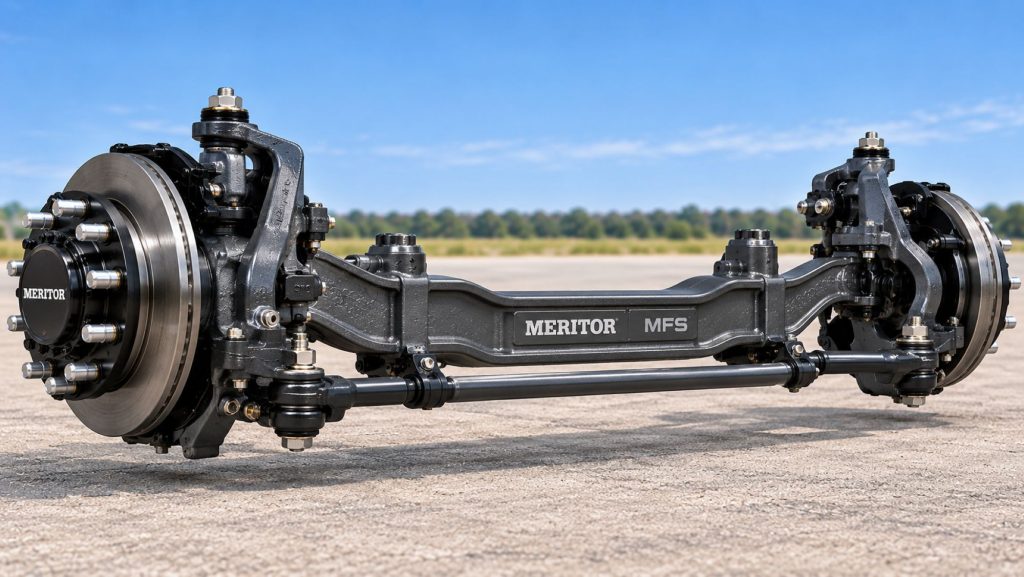
The Meritor MFS Front Steer Axle is a family of non-driven front axles used in medium-duty and heavy-duty commercial trucks, buses, fire apparatus, construction vehicles, utility trucks, and other specialized equipment.
Unlike a drive axle, the MFS does not receive power from the engine or contain a drive differential. Its primary responsibilities are supporting the front portion of the vehicle, carrying steering and braking components, maintaining wheel alignment, and allowing the driver to control the truck’s direction.
The MFS family includes multiple weight ratings, axle-beam drops, track widths, kingpin-intersection dimensions, steering arms, tie-rod arrangements, wheel ends, and brake configurations. This broad selection allows truck manufacturers to match the axle with different chassis layouts and vocational requirements.
The MFS is part of the larger Commercial Truck Steer Axles category within Truck Equipment Atlas.
Key Characteristics
- Front non-drive steer-axle design
- Multiple ratings from approximately 6,000 to 23,000 pounds
- High turning angles for improved maneuverability
- Universal-knuckle design
- Multiple steering-arm and tie-rod configurations
- Optimized I-beam construction
- Easy Steer bushings
- Dual draw-key kingpin retention
- Multiple axle-beam drops
- Multiple kingpin-intersection widths
- Standard and wide-track configurations
- Air disc and drum brake compatibility
- Highway and vocational applications
- Serviceable two-piece knuckle-and-arm design
- Lightweight configurations available
How the Axle or Differential Works
The Meritor MFS does not transmit engine power to the wheels. Instead, it supports the front of the truck and allows the front wheels to pivot when the driver turns the steering wheel.
Steering movement passes through several components:
- The steering wheel turns the steering gear.
- The steering gear moves the pitman arm.
- The pitman arm moves the drag link.
- The drag link rotates the steering arm and steering knuckle.
- The tie rod transfers movement to the opposite steering knuckle.
- Both front wheels turn together at coordinated angles.
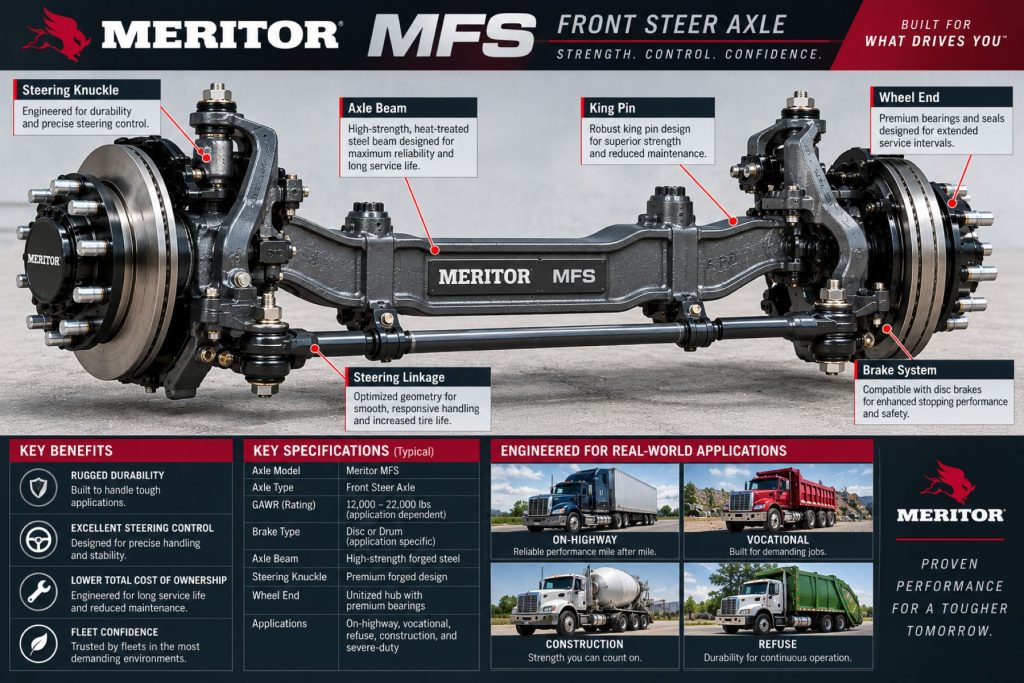
Each steering knuckle pivots around a kingpin installed through the end of the axle beam. Bushings and thrust bearings support this movement while carrying vertical and lateral loads.
The axle beam connects the left and right wheel positions and supports the truck’s front suspension, wheel ends, brakes, and steering hardware.
Because the MFS is a non-drive axle, it does not contain a ring gear, pinion gear, axle shafts, power divider, or differential.
Axle Position and Function
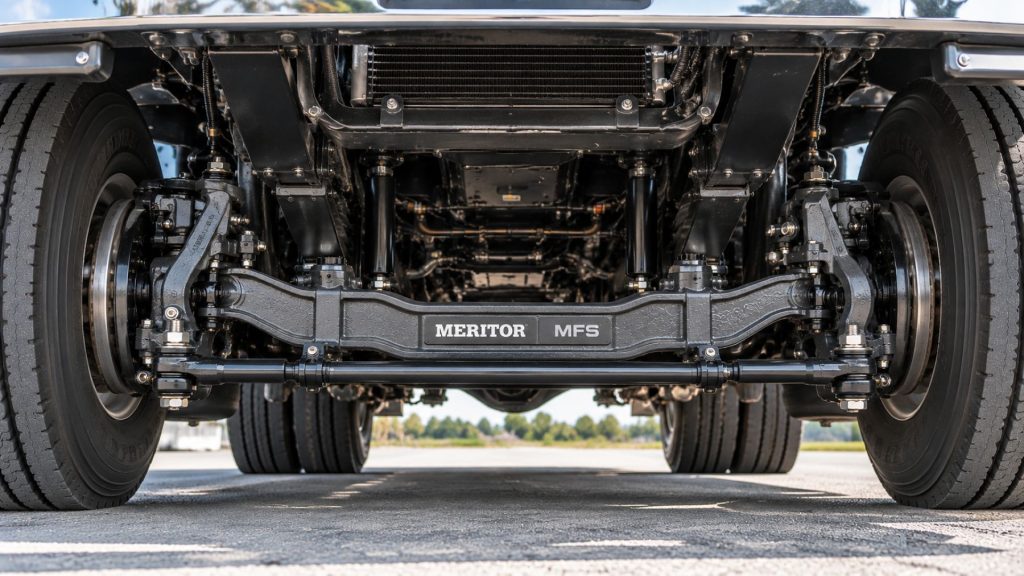
The Meritor MFS is installed at the front of the truck beneath the engine, cab, or forward chassis section.
Its primary functions include:
- Supporting the front portion of the vehicle
- Carrying the front suspension load
- Providing mounting points for the steering knuckles
- Allowing the front wheels to turn
- Maintaining proper wheel alignment
- Supporting the front brakes and wheel ends
- Absorbing road and steering forces
- Contributing to directional stability
- Helping determine turning radius
- Carrying part of the vehicle’s legal operating weight
The MFS axle works with the steering gear, drag link, steering arms, tie rod, springs or air suspension, shock absorbers, brakes, hubs, bearings, wheels, and tires.
Common Specifications
- Axle Type: Front non-drive steer axle
- Available Ratings: Approximately 6,000 to 23,000 pounds
- Common Class 8 Ratings: Approximately 12,000 to 14,600 pounds
- Heavy Vocational Ratings: Approximately 16,000 to 23,000 pounds
- Axle-Beam Drops: Approximately 3.5, 3.74, 4.76, 5.0, and 6.5 inches, depending on model
- Kingpin-Intersection Dimensions: Approximately 65.2 to 75.8 inches, depending on configuration
- Maximum Wheel Cut: Up to approximately 55 degrees on applicable models
- Knuckle Design: Universal or application-specific configurations
- Kingpin Retention: Dual draw-key design on applicable models
- Bushing System: Meritor Easy Steer
- Brake Compatibility: Air disc and drum brakes
- Wheel-End Compatibility: Multiple commercial wheel-end series
Exact specifications depend on the axle model, vehicle manufacturer, track width, suspension, brakes, tires, wheels, and intended application.
Axle Ratios and Gearing
The Meritor MFS does not have an axle ratio because it is a non-driven steer axle.
Axle ratios apply to drive axles containing ring-and-pinion gearing. The MFS does not receive torque from the engine and does not provide drivetrain gear reduction.
Specifications that serve a similar selection role on a steer axle include:
- Gross axle weight rating
- Axle-beam drop
- Kingpin-intersection width
- Track width
- Wheel cut
- Steering-arm configuration
- Tie-rod configuration
- Brake type
- Wheel-end series
- Wheel and tire capacity
These measurements determine whether the axle will fit the chassis, provide the required turning clearance, support the vehicle’s weight, and work with the selected steering and braking systems.
Differential and Traction Options
The Meritor MFS does not contain a differential because it is not a drive axle.
Each front wheel rotates independently on its own wheel end. During a turn, steering geometry allows the inside and outside wheels to follow different paths without needing a differential.
The MFS can work with vehicle systems that influence steering and stability, including:
- Anti-lock braking systems
- Electronic stability control
- Traction-control systems acting through the brakes
- Power steering
- Collision-mitigation systems
- Lane-keeping or steering-assistance technologies
- Tire-pressure monitoring systems
These systems may use sensors at or near the steer axle, but they do not convert the MFS into a powered axle.
Brake and Wheel-End Options
The MFS family supports multiple commercial brake and wheel-end configurations.
Depending on the axle model and truck specification, available equipment may include:
- Meritor air disc brakes
- Commercial drum brakes
- ABS wheel-speed sensors
- Conventional wheel ends
- Preset wheel-end systems
- Unitized wheel-end systems
- Different hub and bearing configurations
- Standard-width tires
- Wide-base tires
- Multiple wheel-offset configurations
The universal-knuckle design provides broad brake-packaging flexibility. Certain configurations use specialized knuckles, integrated torque plates, or brake orientations that simplify assembly and service.
The brake, hub, bearing, wheel, tire, and suspension ratings must equal or exceed the vehicle’s intended front-axle loading.
Common Applications
The MFS family covers a wide range of commercial-vehicle applications, including:
- Long-haul highway tractors
- Regional tractors
- Day cab trucks
- Medium-duty trucks
- Construction trucks
- Dump trucks
- Concrete mixers
- Utility trucks
- Fire and rescue vehicles
- Refuse trucks
- Municipal vehicles
- Buses and motorcoaches
- Material-handling vehicles
- Specialized commercial equipment
Truck, Suspension, and Drivetrain Compatibility
The Meritor MFS can be integrated into numerous commercial-truck platforms, but compatibility depends on the exact axle model and vehicle specification.
Potential truck applications include properly specified versions of:
- Freightliner Cascadia
- Freightliner 114SD
- International LT Series
- International HX Series
- Kenworth T680
- Kenworth T880
- Peterbilt 567
- Peterbilt 579
- Western Star 47X
- Volvo VHD
The MFS may be installed with:
- Taper-leaf front suspensions
- Multi-leaf spring suspensions
- Front air suspensions
- Heavy-duty vocational suspensions
- Power-steering systems
- Air disc brakes
- Drum brakes
- Conventional or unitized wheel ends
The steer axle is independent of the truck’s engine, transmission, and rear-drive-axle brand. However, the entire chassis must be engineered so the axle, suspension, steering, brakes, wheels, and tires operate together correctly.
Advantages
- Wide range of axle weight ratings
- Broad truck and vocational compatibility
- High wheel-cut capability
- Improved low-speed maneuverability
- Multiple axle-beam drops
- Multiple track-width options
- Universal-knuckle design
- Broad brake compatibility
- Easy Steer bushings
- Dual draw-key kingpin retention
- Optimized I-beam construction
- Strong lateral stability
- Serviceable steering components
- Lightweight configurations available
- Established aftermarket support
- Suitable for highway and vocational applications
Limitations or Considerations
- Exact specifications vary considerably across the MFS family
- The axle must be matched to the suspension and chassis
- Higher ratings may add weight
- Maximum wheel cut depends on the complete truck configuration
- Tire, wheel, brake, frame, and suspension clearance can limit steering angle
- Improper alignment can cause rapid tire wear
- Kingpins and bushings require periodic inspection and lubrication
- Worn tie-rod ends can create steering looseness
- Incorrect wheel bearing adjustment can cause heat or premature wear
- Brake and wheel-end compatibility depends on the individual axle specification
- A non-drive steer axle does not provide powered front-wheel traction
- Replacement parts must be ordered using the complete model and specification numbers
Driver and Operator Experience
The steer axle directly affects steering effort, directional stability, turning radius, tire wear, braking feel, and driver confidence.
A properly maintained MFS axle should provide smooth steering movement without excessive looseness, wandering, binding, vibration, or uneven tire wear.
Drivers should watch for:
- Steering wheel play
- Vehicle wandering
- Pulling to one side
- Uneven steering effort
- Shimmy or vibration
- Clunking during turns
- Uneven front-tire wear
- Excessive tire-edge wear
- Wheel-end heat
- Brake pull
- Failure of the steering wheel to return normally after a turn
Changes in steering behavior should be inspected promptly because they may indicate problems with the axle, kingpins, bushings, tie rods, drag link, wheel bearings, suspension, tires, or alignment.
Maintenance and Ownership Notes
Important MFS maintenance areas include:
- Kingpin inspection
- Kingpin-bushing lubrication
- Thrust-bearing inspection
- Draw-key inspection
- Tie-rod-end inspection
- Tie-rod lubrication where applicable
- Drag-link inspection
- Steering-arm inspection
- Wheel-bearing adjustment
- Hub and seal inspection
- Brake inspection
- ABS sensor inspection
- Axle-beam inspection
- U-bolt inspection
- Spring or air-suspension inspection
- Steering-stop inspection
- Front-end alignment
- Tire-pressure maintenance
- Front-tire rotation and replacement
Lubrication intervals and inspection procedures depend on the specific axle model, truck manufacturer, duty cycle, and maintenance program.
Common Axle or Differential Problems
The MFS does not contain a differential, but its steering, wheel-end, and axle components can develop wear or damage.
Common problems include:
- Worn kingpin bushings
- Damaged or worn kingpins
- Worn thrust bearings
- Loose or damaged draw keys
- Worn tie-rod ends
- Bent tie rods
- Loose steering arms
- Cracked or damaged axle beam
- Bent axle ends
- Wheel-bearing wear
- Improper wheel-bearing adjustment
- Hub-seal leaks
- Uneven tire wear
- Steering pull
- Excessive steering play
- Reduced wheel cut
- Incorrect toe setting
- Brake pull
- ABS sensor faults
Identification Information
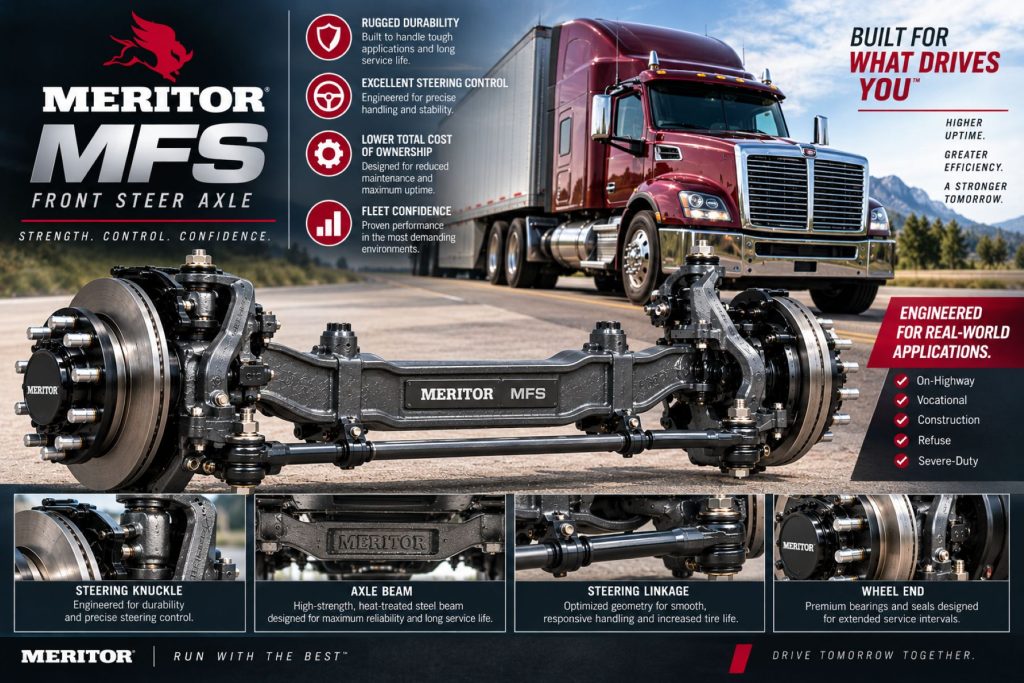
The MFS axle should be identified using the manufacturer tag attached to the axle beam.
Identification information may include:
- Meritor manufacturer name
- MFS Series designation
- Complete axle model number
- Axle specification number
- Gross axle weight rating
- Customer or OEM part number
- Serial number
- Manufacturing date
- Axle-beam drop
- Kingpin-intersection dimension
- Wheel-end series
- Brake attachment information
- Track-width designation
Common model designations may include MFS-12, MFS-13, MFS-14, MFS-16, MFS-18, MFS-20, MFS-22, and MFS-23, followed by additional characters identifying the precise configuration.
Do not order parts using only the axle’s weight rating. Use How to Identify a Truck Axle or Differential when documenting the axle or locating replacement components.
Buying Considerations
- Confirm the complete MFS model number
- Record the axle specification number
- Verify the gross axle weight rating
- Confirm the axle-beam drop
- Verify the kingpin-intersection dimension
- Check the track width
- Determine the available wheel cut
- Identify the steering-arm configuration
- Identify the tie-rod configuration
- Confirm brake compatibility
- Identify the wheel-end series
- Verify wheel and tire ratings
- Confirm suspension compatibility
- Inspect the axle beam for cracks, bends, or repairs
- Check kingpins and bushings for movement
- Inspect tie-rod ends
- Check wheel-bearing condition
- Inspect hubs and seals for leaks
- Review alignment and tire-wear patterns
- Confirm replacement-parts availability
- Verify that the axle is approved for the intended vehicle and application
Variants and Configurations
- MFS 6,000-pound configurations
- MFS 7,000-pound configurations
- MFS 8,000-pound configurations
- MFS 10,000-pound configurations
- MFS 12,000-pound configurations
- MFS 12,500-pound configurations
- MFS 13,000 and 13,200-pound configurations
- MFS 14,600-pound configurations
- MFS 16,000-pound configurations
- MFS 18,000-pound configurations
- MFS 20,000-pound configurations
- MFS 22,800-pound configurations
- MFS 23,000-pound configurations
- Standard-drop axle beams
- Deep-drop axle beams
- Standard-track configurations
- Wide-track configurations
- Air-disc-brake configurations
- Drum-brake configurations
- Multiple wheel-end series
- Different steering-arm and tie-rod packages
Comparison to Similar Equipment
The original MFS Series is closely related to the newer MFS+ front steer axle.
Compared with the original MFS, the MFS+ places greater emphasis on:
- Reduced axle weight
- Optimized beam construction
- Integrated torque-plate and tie-rod arms
- Simplified assembly
- Reduced service time
- Modern air-disc-brake packaging
The original MFS provides:
- A very broad range of weight ratings
- Extensive application flexibility
- Multiple beam drops and track widths
- Established fleet and aftermarket familiarity
- Broad highway and vocational coverage
Both families use non-drive steer-axle designs. The best selection depends on vehicle weight, steering geometry, brake choice, suspension, wheel ends, required wheel cut, and OEM availability.
Best Fit For
- Highway tractors
- Regional tractors
- Day cab trucks
- Vocational trucks
- Construction vehicles
- Dump trucks
- Concrete mixers
- Utility vehicles
- Fire and rescue apparatus
- Municipal vehicles
- Buses and coaches
- Fleets needing multiple front-axle ratings
- Applications requiring strong maneuverability
- Trucks requiring air disc or drum brake compatibility
Related Truck Types
Related Truck Models
- Freightliner Cascadia
- Freightliner 114SD
- International HX Series
- Kenworth T680
- Kenworth T880
- Peterbilt 567
- Peterbilt 579
- Volvo VHD
- Western Star 47X
Related Axle and Differential Types
- Commercial Truck Steer Axles
- Commercial Truck Drive Axles
- Lift Axles and Auxiliary Axles
- Axles and Differentials
Related Equipment Systems
Related Guides
- How Commercial Truck Axles and Differentials Work
- How to Identify a Truck Axle or Differential
- Air Brake Systems Explained
Regulatory and Compliance Notes
The axle’s published rating does not automatically determine the truck’s legal front-axle weight.
Legal and mechanical limits depend on:
- Federal and state axle-weight regulations
- Tire load ratings
- Wheel ratings
- Hub and bearing capacity
- Suspension rating
- Brake capacity
- Frame capacity
- Steering-system rating
- Gross vehicle weight rating
- Truck manufacturer certification
- Axle-spacing requirements
- Permit conditions
The truck must remain within both the legal weight limit and the rating of its lowest-capacity component.
Modifications to steering stops, wheels, tires, suspension height, brakes, or axle position can affect vehicle compliance and safe steering clearance.
Real World Operating Notes
The MFS is widely suited to commercial trucks because its many ratings and dimensions allow it to serve both highway and vocational applications.
Highway fleets generally prioritize low weight, stable steering, reduced tire wear, and broad service availability. Vocational fleets may prioritize higher weight ratings, deeper axle-beam drops, durable wheel ends, larger brakes, and clearance for specialized chassis equipment.
The maximum advertised wheel cut does not guarantee that every truck will achieve that steering angle. Wheel cut may be limited by tires, wheels, brake chambers, steering gears, suspension components, frame rails, engine packaging, or body equipment.
Front-tire wear provides valuable information about axle condition. Feathering, shoulder wear, cupping, or rapid uneven wear can indicate alignment problems, worn steering parts, loose wheel bearings, incorrect inflation, suspension wear, or axle damage.
Frequently Asked Questions
What is the Meritor MFS axle?
The Meritor MFS is a family of front non-drive steer axles used in commercial trucks, buses, fire apparatus, construction vehicles, and other specialized equipment.
Is the MFS a drive axle?
No. It supports and steers the front of the vehicle but does not receive power from the engine.
What weight ratings are available?
The complete MFS family includes ratings from approximately 6,000 to 23,000 pounds. Heavy-truck models commonly use ratings between 12,000 and 23,000 pounds.
What is the maximum steering angle?
Applicable MFS configurations can provide wheel cuts of up to approximately 55 degrees. Actual wheel cut depends on the complete truck configuration.
Does the MFS contain a differential?
No. A differential is not required because the MFS is a non-driven steer axle.
Can the MFS use air disc brakes?
Yes. MFS configurations are available with air disc brakes, while other versions support drum brakes.
What are Easy Steer bushings?
Easy Steer bushings are designed to reduce steering friction and provide smooth steering-knuckle movement.
What is the difference between MFS and MFS+?
MFS+ is a newer, weight-optimized version that uses integrated components and updated packaging. The original MFS provides a wider established range of configurations and ratings.
Where is the identification tag located?
The identification tag is normally attached to the axle beam and contains the model and specification numbers needed for parts identification.
What commonly causes uneven front-tire wear?
Potential causes include incorrect alignment, worn kingpins, loose tie-rod ends, wheel-bearing problems, incorrect tire pressure, suspension wear, or a bent axle.
Availability and Where to Find
The Meritor MFS Front Steer Axle is available through participating commercial truck manufacturers, authorized dealerships, Cummins-Meritor distributors, commercial truck parts suppliers, and axle service facilities.
New-vehicle availability depends on the truck manufacturer, model, weight rating, suspension, brakes, wheel ends, and customer specifications.
Replacement kingpins, bushings, tie-rod ends, cross tubes, steering arms, seals, bearings, hubs, brake components, and other service parts are available through authorized aftermarket channels.
Manufacturer Information: Meritor MFS Series Front Non-Drive Axle
Support Trucking Families
Truck Equipment Atlas supports the mission of Grey Cross, a nonprofit dedicated to helping families of truck drivers who lose their lives while on the road. As the site grows, part of its mission is to bring awareness and support to these families.
Podcast or Video Section
Learn More Through Audio and Video
Truck Equipment Atlas will continue expanding with podcast episodes, interviews, and equipment breakdowns to help drivers and fleets better understand trucks and equipment.
Follow the Growth of Truck Equipment Atlas
Truck Equipment Atlas continues to expand with new truck profiles, trailer coverage, diesel engine pages, equipment system resources, manufacturer information, and educational guides.
Visit our Site Updates page to explore recent additions, project milestones, and upcoming resources as we continue building one of the industry’s growing commercial trucking equipment reference libraries.
View the Latest Site Updates: Truck Equipment Atlas Site Updates