
Common Truck Axle and Differential Problems
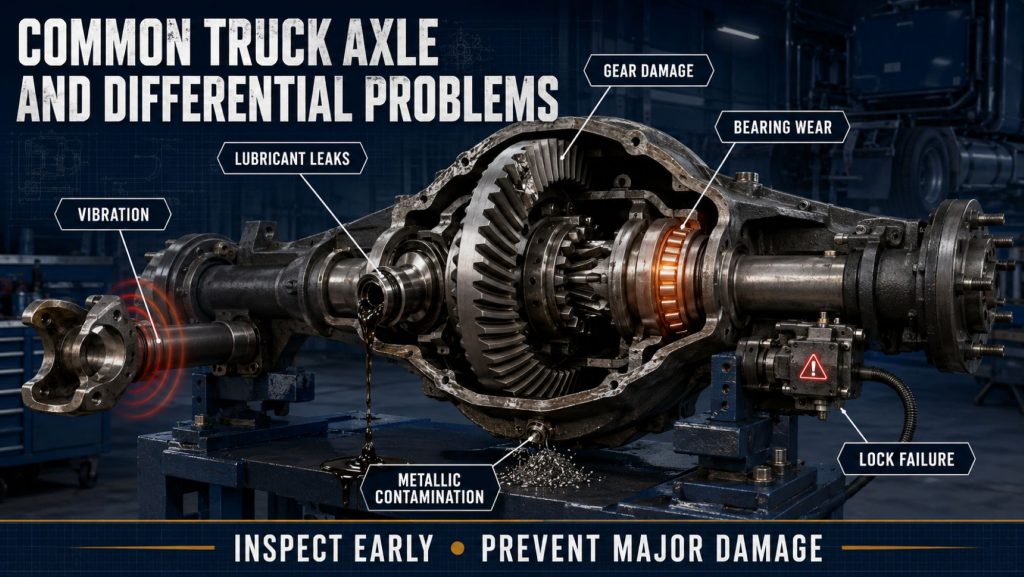
Commercial truck axles and differentials operate under heavy loads while supporting the vehicle, transferring engine torque, maintaining wheel alignment, and allowing the drive wheels to rotate at different speeds.
Problems can develop from insufficient lubrication, contamination, improper adjustment, overloading, impact damage, worn bearings, mismatched tires, incorrect axle ratios, damaged gears, or improper differential-lock operation.
Early symptoms may include noise, vibration, lubricant leaks, excessive heat, wheel-end movement, irregular tire wear, or changes in traction. Identifying the source before major damage occurs can reduce repair costs and help prevent roadside failures.
This guide explains the most common commercial truck axle and differential problems, their possible causes, and the inspections typically used to diagnose them.
Common Warning Signs
Possible signs of an axle or differential problem include:
- Humming
- Whining
- Gear howl
- Growling
- Grinding
- Clunking
- Vibration
- Excessive driveline backlash
- Lubricant leaks
- Overheating
- Burning odor
- Metal particles in the lubricant
- Wheel-end movement
- Differential lock failing to engage
- Differential lock failing to release
- Inter-axle differential problems
- Uneven tire wear
- Vehicle pulling to one side
- ABS or traction-control warning lights
These symptoms can also originate from the transmission, driveshaft, universal joints, suspension, brakes, wheel bearings, wheels, or tires. Proper diagnosis should examine the complete system.
Differential Whine or Gear Howl
A high-pitched whine or howl may indicate a problem with the ring-and-pinion gearset.
The sound may change according to whether the truck is:
- Accelerating
- Maintaining steady speed
- Decelerating
- Coasting
- Turning
- Operating under heavy load
Possible causes include:
- Incorrect ring-and-pinion backlash
- Incorrect pinion depth
- Improper bearing preload
- Worn gear teeth
- Damaged gear teeth
- Poor tooth-contact pattern
- Loose pinion bearings
- Worn carrier bearings
- Incorrect gear installation
- Insufficient lubricant
- Contaminated lubricant
- Previously damaged gearset
A ring-and-pinion gearset develops a matching wear pattern during operation. Incorrect adjustment or pairing a used ring gear with an unrelated pinion can produce noise and rapid wear.
Humming or Growling
A humming or growling sound that changes with road speed may originate from axle or wheel-end bearings.
Possible causes include:
- Worn pinion bearings
- Worn differential carrier bearings
- Worn wheel bearings
- Incorrect bearing preload
- Damaged bearing races
- Lubricant contamination
- Insufficient lubrication
- Misaligned components
- Excessive axle load
Noise from tires can resemble bearing or gear noise. Technicians should compare the sound with vehicle speed, engine speed, load, road surface, and steering input.
Grinding Noise
Grinding generally indicates significant mechanical contact or component damage.
Possible causes include:
- Broken gear teeth
- Failed bearings
- Damaged spider gears
- Damaged side gears
- Insufficient lubrication
- Severe internal contamination
- Loose internal components
- Wheel-bearing failure
- Differential-lock damage
A truck producing a new grinding noise should be inspected promptly. Continuing to operate it can spread metal through the axle lubricant and damage otherwise reusable components.
Clunking When Power Is Applied
A clunk may occur when the driver accelerates, releases the throttle, changes direction, or shifts between forward and reverse.
Possible causes include:
- Excessive ring-and-pinion backlash
- Worn differential gears
- Worn axle-shaft splines
- Loose yoke
- Worn universal joints
- Worn slip joint
- Loose suspension components
- Worn torque-rod bushings
- Loose wheel-end components
- Differential-lock damage
- Excessive driveline movement
Some driveline movement is normal, but a new or increasingly severe clunk should be investigated.
Backlash may exist in several components simultaneously. Checking only the differential can overlook wear in the driveshaft, transmission, wheel ends, or suspension.
Driveline Vibration
Vibration may be felt through the cab, floor, seat, steering wheel, or chassis.
Possible axle-related causes include:
- Bent axle housing
- Worn pinion bearings
- Loose input yoke
- Damaged differential gears
- Incorrect pinion angle
- Axle misalignment
- Loose suspension mounts
- Incorrect ride height
- Damaged wheel ends
- Bent wheels
- Irregular tire wear
- Mismatched tires across a tandem
Possible non-axle causes include:
- Driveshaft imbalance
- Incorrect universal-joint operating angles
- Worn universal joints
- Damaged slip joint
- Transmission-output problems
- Engine or transmission mounting issues
The speed, frequency, and operating conditions associated with the vibration can help identify its source.
Lubricant Leaks
Axle lubricant can leak from several locations.
Common leak points include:
- Pinion seal
- Differential carrier gasket
- Carrier-to-housing joint
- Rear cover
- Fill plug
- Drain plug
- Axle-shaft flange
- Wheel seal
- Axle housing weld
- Differential-lock actuator
- Breather
- Hubcap
Possible causes include:
- Worn seal
- Damaged sealing surface
- Loose fasteners
- Incorrect installation
- Excessive internal pressure
- Blocked axle breather
- Overfilled housing
- Incorrect lubricant
- Bent or worn yoke
- Bearing movement
- Damaged axle housing
A small external leak can eventually lower the lubricant level enough to damage gears and bearings.
Lubricant reaching brake components can also reduce braking performance and require replacement of contaminated friction materials.
Pinion-Seal Leaks
The pinion seal prevents lubricant from escaping around the rotating input yoke.
Possible causes of a pinion-seal leak include:
- Worn seal lip
- Grooved yoke sealing surface
- Loose yoke
- Worn pinion bearings
- Excessive housing pressure
- Blocked breather
- Incorrect seal installation
- Damaged seal
- Excessive driveline movement
Replacing the seal without checking the yoke, bearings, breather, and pinion preload may allow the leak to return.
Improperly tightening the pinion nut can alter bearing preload or damage the axle.
Wheel-Seal Leaks
Wheel seals keep lubricant inside the hub or axle system.
A leaking wheel seal may allow lubricant to reach:
- Brake shoes
- Brake drums
- Brake pads
- Brake rotors
- Wheels
- Tires
Possible causes include:
- Worn seal
- Incorrect seal installation
- Damaged spindle
- Incorrect wheel-bearing adjustment
- Excessive hub movement
- Contaminated lubricant
- Blocked axle breather
- Overfilled axle or hub
- Excessive wheel-end temperature
Contaminated brake friction material may need replacement even after the leak is repaired.
Axle or Differential Overheating
Axles generate heat through gear contact, bearing friction, lubricant movement, and transferred torque.
Possible causes of excessive temperature include:
- Low lubricant level
- Incorrect lubricant
- Contaminated lubricant
- Excessive load
- Incorrect bearing preload
- Failing bearings
- Incorrect ring-and-pinion adjustment
- Mismatched axle ratios
- Mismatched tire sizes
- Driveline windup
- Differential lock remaining engaged
- Blocked axle breather
- Brake drag
- Wheel-bearing problems
Temperature should be compared across similar axles and wheel ends under similar operating conditions.
A single hot hub may indicate a local wheel-bearing or brake problem. An overheated differential carrier may indicate a gear, bearing, lubricant, or ratio problem.
Metal in the Axle Lubricant
A small amount of fine metallic material may collect on a magnetic drain plug during normal wear.
Larger particles, flakes, chips, or excessive metallic paste can indicate internal damage.
Possible sources include:
- Ring-and-pinion gears
- Differential side gears
- Spider gears
- Bearings
- Bearing races
- Thrust washers
- Differential-lock components
- Inter-axle differential
- Power-divider gears
- Axle-shaft splines
The color, size, shape, and magnetic properties of the material can provide clues about its origin.
Metal contamination should not be ignored. Particles circulating through the lubricant can damage additional gears and bearings.
Broken or Damaged Gear Teeth
Gear teeth may crack, chip, pit, or break because of:
- Shock loading
- Severe wheelspin followed by sudden traction
- Incorrect gear adjustment
- Insufficient lubricant
- Bearing failure
- Excessive load
- Fatigue
- Improper installation
- Foreign material inside the housing
- Mismatched ring-and-pinion components
Broken gear material can circulate through the axle and cause widespread damage.
A damaged ring-and-pinion gearset is normally replaced as a matched set.
Worn Differential Bearings
Carrier and pinion bearings maintain the gearset’s position and alignment.
Worn bearings can allow movement that changes:
- Pinion depth
- Gear backlash
- Tooth-contact pattern
- Seal alignment
- Gear operating noise
Possible symptoms include:
- Humming
- Growling
- Gear howl
- Increased backlash
- Lubricant leaks
- Excessive heat
- Metal particles
- Loose input yoke
Replacing damaged bearings without identifying the cause may lead to another failure.
Excessive Backlash
Backlash is the clearance between mating gear teeth. The ring-and-pinion gearset requires a specific amount of backlash to allow lubrication and normal operation.
Excessive backlash can cause:
- Clunking
- Impact loading
- Gear noise
- Accelerated tooth wear
- Delayed response when power is applied
- Poor tooth-contact pattern
Possible causes include:
- Worn gear teeth
- Worn carrier bearings
- Loose bearing adjusters
- Incorrect installation
- Damaged differential case
- Pinion-bearing wear
- Improper previous adjustment
Too little backlash can also cause heat, noise, lubrication problems, and gear damage.
Backlash must be measured and adjusted according to the axle manufacturer’s specifications.
Improper Ring-and-Pinion Contact Pattern
The contact pattern shows where the pinion teeth engage the ring-gear teeth.
An incorrect pattern may result from:
- Incorrect pinion depth
- Incorrect backlash
- Improper bearing preload
- Housing distortion
- Worn bearings
- Incorrect gearset
- Installation errors
An incorrect pattern can cause noise, concentrated tooth loading, overheating, and premature gear failure.
Pattern interpretation should be performed using the manufacturer’s procedures and marking compound.
Differential Lock Will Not Engage
A driver-controlled differential lock may fail to engage because of:
- Low air pressure
- Damaged air line
- Faulty solenoid valve
- Electrical fault
- Defective dashboard switch
- Failed engagement sensor
- Damaged shift cylinder
- Bent shift fork
- Worn locking collar
- Misaligned gear teeth
- Internal contamination
- Damaged wiring or connector
Some locks may not engage immediately if the locking teeth are not aligned. The vehicle manufacturer may specify a low-speed operating procedure that allows engagement.
The driver should not force engagement by applying excessive throttle or creating severe wheelspin.
Differential Lock Will Not Release
A differential lock that remains engaged can cause tire scrubbing and driveline stress on high-traction surfaces.
Possible causes include:
- Air pressure trapped in the actuator
- Sticking solenoid valve
- Damaged return spring
- Binding shift fork
- Worn locking collar
- Driveline torque holding the mechanism engaged
- Electrical-control problem
- Contamination or corrosion
- Internal mechanical damage
The indicator light may remain illuminated because the lock is still engaged or because the sensor or wiring has failed.
The actual mechanical condition should be verified before normal highway operation continues.
Differential Lock Engages Unexpectedly
Unexpected engagement may be caused by:
- Faulty switch
- Shorted wiring
- Defective solenoid
- Incorrect air-line routing
- Contaminated valve
- Control-module fault
- Internal actuator damage
- Incorrect previous repair
Unexpected differential locking can change vehicle handling and damage the drivetrain.
The system should be inspected before the truck returns to service.
Inter-Axle Differential Problems
The inter-axle differential distributes torque between the forward-rear and rear-rear axles in a tandem-drive truck.
Possible problems include:
- Bearing wear
- Gear damage
- Power-divider noise
- Locking mechanism failure
- Lubricant starvation
- Excessive heat
- Mismatched axle ratios
- Mismatched tire sizes
- Incorrect inter-axle driveshaft angles
- Driveline windup
Symptoms may include:
- Noise near the forward-rear axle
- Vibration
- Poor traction
- Inter-axle lock warning
- Excessive heat
- Failure to transfer power properly
- Metal in the lubricant
Inter-axle differential problems can damage both drive axles if the underlying cause is not corrected.
Mismatched Tandem Axle Ratios
Both drive axles in a conventional tandem must use matching ratios.
A mismatch may occur after:
- Differential carrier replacement
- Complete axle replacement
- Incorrect parts ordering
- Improper gearset installation
- Previous undocumented repairs
Mismatched ratios force the inter-axle differential to compensate continuously for different axle speeds.
This can cause:
- Power-divider overheating
- Driveline windup
- Tire scrubbing
- Gear damage
- Bearing damage
- Inter-axle differential failure
- Driveshaft stress
- Complete axle failure
Both ratios should be positively verified using tags, stamped numbers, build information, or internal gear identification.
Mismatched Tires on Tandem Axles
Different tire diameters can make tandem drive axles rotate at different speeds even when their mechanical axle ratios match.
Differences may result from:
- Unequal tread depth
- Different tire models
- Different manufacturers
- Incorrect inflation
- Different tire sizes
- Unequal loads
- Mixing new and worn tires
- Tire damage
Continual speed differences can increase inter-axle differential activity and generate heat.
Tires across tandem drive positions should be matched according to the vehicle, tire, and axle manufacturers’ requirements.
Bent Axle Housing
An axle housing can bend because of:
- Overloading
- Severe road impact
- Collision
- Off-road operation
- Improper towing or lifting
- Incorrect suspension installation
- Concentrated loading
- Frame or suspension damage
Possible symptoms include:
- Uneven tire wear
- Axle misalignment
- Wheel-bearing wear
- Seal leaks
- Handling problems
- Increased rolling resistance
- Repeated wheel-end failures
Alignment correction cannot compensate for every damaged housing. The housing must be measured and evaluated using the appropriate procedures.
Cracked or Damaged Axle Housing
Axle housings may crack near:
- Suspension mounts
- Welded brackets
- Differential carrier flange
- Axle tubes
- Spindle areas
- Power-divider housing
- Impact-damaged sections
Possible warning signs include:
- Lubricant leak
- Visible crack
- Rust line around a crack
- Movement at a bracket
- Alignment changes
- Repeated fastener loosening
- Abnormal tire wear
Structural axle-housing damage requires professional evaluation. Welding or straightening procedures must follow the axle manufacturer’s requirements.
Axle-Shaft Problems
Axle shafts transfer torque from the differential to the drive wheels.
Possible axle-shaft problems include:
- Twisted shaft
- Cracked shaft
- Broken shaft
- Worn splines
- Damaged flange
- Loose flange fasteners
- Leaking flange gasket
- Improper shaft length
- Incorrect replacement shaft
Symptoms may include:
- Loss of propulsion
- Clunking
- Metal contamination
- Lubricant leakage
- Differential damage
- Visible movement at the flange
A broken axle shaft can leave fragments inside the housing and may damage the differential.
Wheel-Bearing Problems
Wheel bearings support the hubs and allow the wheels to rotate.
Possible symptoms include:
- Humming or growling
- Excessive wheel movement
- High wheel-end temperature
- Seal leakage
- Abnormal tire wear
- ABS sensor problems
- Metal particles
- Wheel vibration
Possible causes include:
- Incorrect adjustment
- Insufficient lubricant
- Contamination
- Improper installation
- Excessive load
- Damaged spindle
- Brake heat
- Incorrect bearing components
A severe wheel-bearing failure can result in hub damage or wheel separation.
Uneven Tire Wear
Axle or suspension problems can produce irregular tire wear.
Possible causes include:
- Axle misalignment
- Bent axle housing
- Worn suspension bushings
- Worn torque rods
- Incorrect ride height
- Loose wheel bearings
- Incorrect tire pressure
- Mismatched tires
- Improper axle loading
- Differential remaining locked
- Frequent tight turns
- Brake drag
The wear pattern should be compared across all tires on the axle group.
Replacing tires without correcting the mechanical cause will allow the wear to return.
Vehicle Pulling or Steering Problems
Steer-axle and suspension problems can cause the truck to pull, wander, or require constant steering correction.
Possible causes include:
- Incorrect alignment
- Bent steer axle
- Worn kingpins
- Worn tie-rod ends
- Loose wheel bearings
- Unequal tire pressure
- Uneven tire wear
- Brake drag
- Suspension damage
- Unequal vehicle loading
- Ride-height problems
Steering complaints should be evaluated as part of the complete steer-axle, suspension, brake, wheel, and tire system.
ABS and Traction-Control Warnings
Axle and wheel-end problems may trigger warning lights when they affect:
- Wheel-speed sensors
- Tone rings
- Sensor wiring
- Wheel-bearing movement
- Tire-size consistency
- Differential-lock sensors
- Traction-control communication
- Electronic axle controls
A diagnostic scan can identify stored fault codes, but physical inspection is still required to confirm the cause.
Causes of Premature Axle Failure
Common contributing factors include:
- Incorrect lubricant
- Low lubricant level
- Extended lubricant intervals
- Contamination
- Blocked axle breather
- Overloading
- Shock loading
- Incorrect axle ratio
- Mismatched tandem ratios
- Mismatched tires
- Incorrect bearing preload
- Improper backlash
- Poor tooth-contact pattern
- Incorrect driveline angles
- Damaged suspension
- Differential-lock misuse
- Improper towing
- Incorrect component installation
- Failure to correct an earlier problem
Major axle failures often develop from several smaller problems rather than one isolated cause.
Basic Axle and Differential Inspection
A routine inspection may include:
- Check the axle housing for cracks or damage.
- Look for lubricant leaks.
- Inspect the differential carrier and housing joints.
- Check the pinion-seal area.
- Inspect wheel seals and hubs.
- Check axle-shaft flanges.
- Inspect axle breathers.
- Examine driveshafts and universal joints.
- Check suspension mounting points.
- Inspect torque rods and bushings.
- Compare tire sizes and tread depths.
- Look for uneven tire wear.
- Confirm differential-lock operation.
- Inspect air lines and electrical wiring.
- Compare axle and wheel-end temperatures.
- Listen for unusual noises.
- Review the lubricant condition.
- Check magnetic drain plugs when serviced.
The truck should be supported safely before anyone works beneath it or removes drivetrain components.
Diagnosing Noise by Operating Condition
The conditions under which a noise occurs can help narrow the search.
Noise During Acceleration
Possible causes include:
- Ring-and-pinion drive-side wear
- Incorrect gear contact
- Worn pinion bearings
- Excessive backlash
- Loose yoke
- Driveshaft or universal-joint wear
Noise During Deceleration
Possible causes include:
- Ring-and-pinion coast-side wear
- Incorrect pinion depth
- Bearing movement
- Excessive backlash
- Loose driveline components
Noise During Turns
Possible causes include:
- Differential side-gear problems
- Spider-gear wear
- Limited-slip clutch chatter
- Wheel-bearing problems
- Tire scrubbing
- Locked differential
- Suspension or steering problems
Noise at All Road Speeds
Possible causes include:
- Severe gear damage
- Bearing failure
- Tire noise
- Wheel-end problems
- Driveshaft vibration
- Insufficient lubricant
Sound alone cannot provide a final diagnosis, but it can guide further inspection.
When the Truck Should Be Removed From Service
Immediate inspection may be necessary when the truck has:
- Grinding from an axle or wheel end
- Rapid lubricant loss
- Visible axle-housing crack
- Extreme wheel-end temperature
- Severe vibration
- Loose wheel or hub
- Broken axle shaft
- Metal chunks in the lubricant
- Differential lock that will not release
- Evidence of mismatched tandem ratios
- Sudden loss of propulsion
- Smoke or burning odor from a wheel end
- Brake contamination from lubricant
- Significant wheel-bearing movement
Continuing to operate the vehicle may increase damage or create a loss-of-control risk.
Repairing an Axle or Differential
Internal axle repairs may require:
- Manufacturer service information
- Appropriate lifting and support equipment
- Dial indicator
- Bearing pullers and installers
- Torque tools
- Pinion-depth tools
- Gear-marking compound
- Bearing-preload measurements
- Backlash measurements
- Correct lubricant
- Approved replacement components
Ring-and-pinion setup requires precise adjustment of:
- Pinion depth
- Pinion-bearing preload
- Differential-bearing preload
- Ring-gear backlash
- Tooth-contact pattern
Incorrect adjustment can cause noise, overheating, and premature failure.
Preventing Axle and Differential Problems
Preventive practices include:
- Use the correct lubricant.
- Maintain the proper lubricant level.
- Follow the recommended service interval.
- Inspect for leaks regularly.
- Keep axle breathers open.
- Check magnetic drain plugs.
- Monitor wheel-end and axle temperature.
- Match tires across drive axles.
- Verify tandem axle ratios after replacement.
- Maintain correct suspension ride height.
- Inspect torque rods and bushings.
- Avoid overloading.
- Prevent severe wheelspin.
- Follow differential-lock operating instructions.
- Correct driveline vibration promptly.
- Investigate new noises before they worsen.
- Use the correct installation and adjustment procedures.
Good maintenance cannot eliminate every failure, but it can prevent many common lubrication, adjustment, and contamination problems.
Related Axle and Differential Categories
- Commercial Truck Drive Axles
- Commercial Truck Steer Axles
- Lift Axles and Auxiliary Axles
- Truck Differentials
- Commercial Trailer Axles
- Electric Drive Axles
Related Equipment Resources
- Axles and Differentials
- Transmissions
- Suspension Systems
- Brake Systems
- Tires and Wheels
- Safety Systems
Explore More Axle and Differential Guides
Visit Axle and Differential Guides to explore additional resources covering commercial truck axles, axle ratios, differential types, and axle identification.