
How to Identify a Truck Axle or Differential
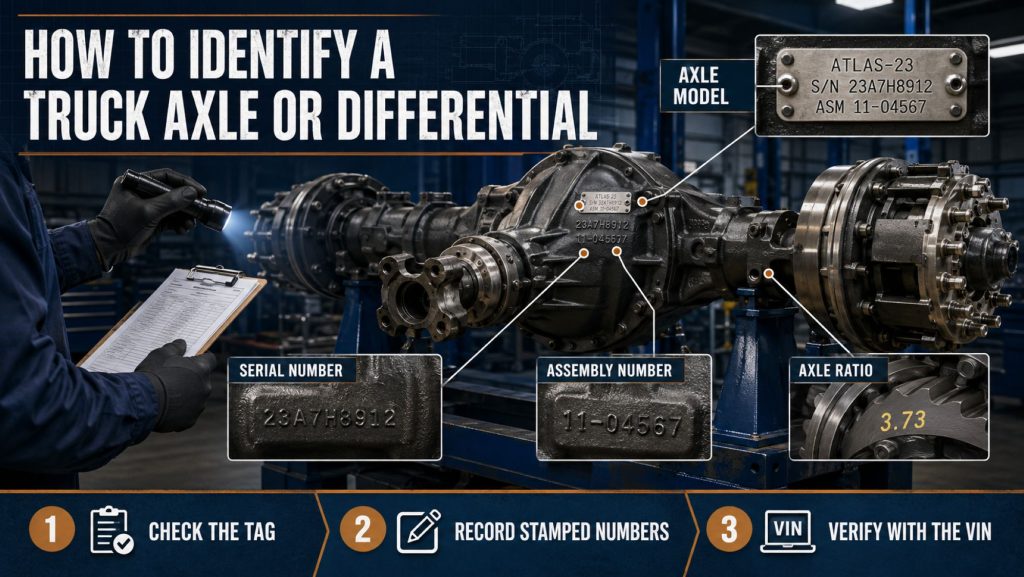
Correctly identifying a commercial truck axle or differential is essential before ordering replacement parts, selecting a differential carrier, changing an axle ratio, or beginning a repair.
Two axle assemblies that appear identical externally may use different capacities, gear ratios, differential designs, bearing arrangements, axle shafts, brake configurations, or internal components.
The most reliable identification normally comes from the manufacturer’s axle tag, carrier tag, vehicle build information, stamped numbers, and original equipment records. Physical appearance should be used as supporting evidence rather than the only identification method.
This guide explains where to look and which information should be recorded when identifying a commercial truck axle or differential.
Why Correct Axle Identification Matters
A commercial truck axle contains components that must match the exact axle model and configuration.
Correct identification helps ensure compatibility for:
- Differential carriers
- Ring-and-pinion gearsets
- Bearings
- Seals
- Axle shafts
- Wheel-end components
- Differential-lock components
- Inter-axle differential parts
- Input and output yokes
- Brake components
- Lubricants
- Suspension mounting hardware
Installing an incorrect component can cause poor fit, lubricant leaks, driveline vibration, overheating, incorrect gearing, or axle failure.
Both drive axles in a conventional tandem must use matching axle ratios. Installing a replacement carrier with the wrong ratio can cause severe driveline damage.
Information to Record
Before searching for parts or service information, record as much of the following as possible:
- Truck manufacturer
- Truck model
- Model year
- Vehicle identification number
- Front or rear axle position
- Single- or tandem-drive configuration
- Forward-rear or rear-rear tandem position
- Axle manufacturer
- Axle model
- Axle serial number
- Axle assembly number
- Customer or specification number
- Differential carrier model
- Carrier assembly number
- Axle ratio
- Gross axle weight rating
- Differential type
- Differential-lock configuration
- Brake type
- Suspension type
- Wheel-end configuration
- Tire size
- All casting, stamped, and tag numbers
Photograph every tag and marking before cleaning, removing, or disassembling components.
Start With the Vehicle Identification Number
The truck’s vehicle identification number can provide access to the original factory build information.
The VIN is commonly located:
- On the driver-side dashboard near the windshield
- On the driver-side door or door frame
- On a vehicle certification label
- On the title or registration
- In fleet maintenance records
- In the manufacturer’s electronic service system
A dealer or truck manufacturer may be able to use the VIN to locate:
- Original axle manufacturer
- Axle model
- Axle capacity
- Factory axle ratio
- Suspension configuration
- Brake equipment
- Original component part numbers
The original build information is valuable, but it does not guarantee that the axle currently under the truck is original. Axles, differential carriers, and gearsets may have been replaced during the vehicle’s service life.
The physical axle identification should therefore be compared with the factory records.
Locate the Axle Identification Tag
Many commercial axles have a metal identification tag attached to the axle housing or differential carrier.
Possible tag locations include:
- Differential carrier mounting bolt
- Carrier housing
- Front face of the axle housing
- Rear axle cover bolt
- Axle tube
- Brake-side area of the housing
- Near the input yoke
- Around the power-divider housing
- Near a suspension mounting bracket
The location varies by axle manufacturer and model.
An axle identification tag may contain:
- Manufacturer name
- Axle model
- Serial number
- Assembly number
- Specification number
- Customer number
- Axle ratio
- Manufacturing date
- Plant code
- Gross axle weight rating
Do not assume that every number on a tag is a part number. Record the complete tag exactly as it appears.
Locate Stamped Identification Numbers
If the tag is missing or unreadable, the axle may have identification numbers stamped directly into the housing.
Stamped markings may be found on:
- Axle tube
- Differential carrier flange
- Carrier housing
- Power-divider housing
- Rear cover
- Machined surface near the input yoke
- Area surrounding the carrier mounting flange
- Brake or suspension side of the housing
Stamped numbers can be difficult to locate beneath:
- Grease
- Road grime
- Paint
- Rust
- Undercoating
- Lubricant residue
Clean the area carefully using methods that will not remove or damage shallow stamped characters.
A flashlight held at an angle can make faint numbers easier to read. Taking several photographs from different angles may also help.
Identify the Axle Manufacturer
Commercial truck axles may be produced by manufacturers such as:
- Dana Spicer
- Meritor
- Detroit
- Mack
- Volvo
- PACCAR
- Hendrickson
- SAF-HOLLAND
- Dexter
- Other original-equipment or specialty manufacturers
Manufacturer identification may appear on:
- Axle tag
- Carrier tag
- Casting
- Hubcap
- Brake components
- Differential-lock hardware
- Vehicle build sheet
- Service records
A logo or casting name can help identify the manufacturer, but it may not establish the exact axle model.
Identify the Axle Position
The axle’s position on the vehicle is important because similar housings may serve different functions.
Possible positions include:
- Front steer axle
- Front drive axle
- Single rear drive axle
- Forward-rear tandem axle
- Rear-rear tandem axle
- Pusher axle
- Tag axle
- Trailer axle
- Self-steering axle
- Liftable axle
- Electric drive axle
Forward-Rear Tandem Axle
The forward-rear axle is the first drive axle in a conventional tandem.
It may include:
- Main input yoke
- Inter-axle differential
- Power divider
- Output yoke
- Inter-axle driveshaft connection
- Wheel differential
Rear-Rear Tandem Axle
The rear-rear axle is the second drive axle in a conventional tandem.
It normally receives power through the short inter-axle driveshaft from the forward-rear axle.
It generally has an input yoke but no rearward power-divider output.
Identify the Axle Model
The axle model may reveal important specifications such as:
- Axle series
- Design capacity
- Single- or tandem-axle application
- Forward-rear or rear-rear position
- Carrier design
- Reduction type
- Differential-lock availability
- Generation or production series
Model-number formats differ by manufacturer. Individual letters and numbers may represent capacity, gear design, axle position, brake configuration, or other features.
Use the manufacturer’s model-identification chart or parts catalog to decode the number. Do not assume that two similar model numbers use interchangeable parts.
Determine the Axle Ratio
The axle ratio may be listed on:
- Axle identification tag
- Differential carrier tag
- Vehicle build sheet
- Original specification sheet
- Ring-and-pinion markings
- Service records
- Electronic manufacturer records
A ratio may appear as:
3.363.553.734.104.56
It may also be represented by ring-and-pinion tooth counts.
For example:
- Ring gear: 41 teeth
- Pinion gear: 11 teeth
The ratio is:
The axle ratio is therefore approximately 3.73:1.
Read Ring-and-Pinion Markings
When the differential is disassembled, the ring gear and pinion may contain identifying markings.
These may include:
- Ring-gear tooth count
- Pinion tooth count
- Gearset part number
- Manufacturing date
- Match number
- Inspection marks
- Pinion-depth information
- Manufacturer code
Matched ring-and-pinion gears should remain together as a set. A used ring gear should not normally be paired with an unrelated pinion.
Follow the axle manufacturer’s service information when interpreting gear markings.
Check Both Axles in a Tandem
Both powered axles in a conventional tandem must use matching ratios.
Do not identify only one carrier and assume the other is the same.
Verify the ratio of:
- Forward-rear drive axle
- Rear-rear drive axle
A mismatch can cause:
- Driveline windup
- Inter-axle differential overheating
- Power-divider damage
- Tire scrubbing
- Gear and bearing wear
- Driveshaft stress
- Axle failure
If one differential carrier has been replaced previously, confirm that the installed ratio matches the second axle.
Identify the Differential Type
The truck may use an:
- Open differential
- Limited-slip differential
- Automatic locking differential
- Driver-controlled wheel differential lock
The differential type may be identified through:
- Axle model code
- Differential carrier tag
- Build sheet
- Parts catalog
- Dashboard controls
- Air lines
- Electrical wiring
- External shift cylinder
- Lock-position sensor
- Internal component inspection
External appearance can provide clues, but it may not confirm the internal differential design.
Identify a Driver-Controlled Differential Lock
A driver-controlled wheel differential lock may have visible external components such as:
- Air shift cylinder
- Electrical actuator
- Shift fork housing
- Air line
- Solenoid connection
- Electrical connector
- Engagement sensor
- Position switch
The cab may also have:
- Differential-lock switch
- Axle-lock symbol
- Warning light
- Engagement message in the instrument display
Do not rely only on the dashboard switch. The truck may have been rewired, the switch may control a different lock, or the axle may have been replaced.
Verify the equipment at the axle.
Identify an Inter-Axle Differential Lock
A tandem-drive truck may have an inter-axle differential lock in the forward-rear axle’s power-divider assembly.
This lock connects the forward-rear and rear-rear drive axles.
Possible identification clues include:
- Power-divider housing
- Inter-axle output yoke
- Short driveshaft to the rear-rear axle
- Air or electrical lock actuator
- Inter-axle lock switch
- Instrument-panel indicator
- Model information on the axle tag
An inter-axle differential lock is different from a wheel differential lock.
Engaging the inter-axle lock does not automatically lock the left and right wheels across either drive axle.
Identify a Limited-Slip Differential
A limited-slip differential may not have an external actuator or dashboard control.
Identification may require:
- Axle model decoding
- Carrier assembly number
- Vehicle build information
- Manufacturer parts catalog
- Lubricant specification
- Internal inspection
Some limited-slip differentials use clutch packs, while others use helical or torque-biasing gears.
Do not identify a limited-slip differential solely by rotating the wheels while the truck is lifted. Results can vary according to the design, lubricant, internal wear, brake drag, transmission position, and testing procedure.
Identify a Steer Axle
A steer axle can often be identified by its location and steering components.
Look for:
- Solid or fabricated axle beam
- Steering knuckles
- Kingpins
- Tie rod
- Steering arms
- Spindles
- Front hubs
- Brake components
- Suspension mounting points
Important steer-axle information includes:
- Manufacturer
- Model
- Capacity
- Kingpin size
- Track width
- Brake configuration
- Hub and bearing arrangement
- Steering-arm configuration
- Suspension compatibility
A driven steer axle will also have a differential housing and axle shafts or constant-velocity joints.
Identify a Lift or Auxiliary Axle
Lift and auxiliary axles may be positioned ahead of or behind the main rear axle group.
A pusher axle is located ahead of the primary rear axle or tandem. A tag axle is located behind it.
Identification information may appear on:
- Axle beam
- Suspension assembly
- Frame brackets
- Lift mechanism
- Steering system
- Manufacturer tag
- Air-control components
Record whether the axle is:
- Fixed or liftable
- Steerable or nonsteerable
- Self-steering or mechanically steered
- Single- or dual-tire
- Air- or mechanically suspended
- Braked or unbraked where permitted
The axle, lift mechanism, suspension, and steering components may come from different manufacturers.
Identify a Trailer Axle
A conventional trailer axle normally consists of a straight or dropped axle tube with a spindle and wheel end at each side.
Identification may be found on:
- Axle tube tag
- Stamped axle tube
- Suspension identification plate
- Integrated axle-system tag
- Brake identification
- Hub or wheel-end components
- Trailer build sheet
- Trailer vehicle identification number records
Important trailer-axle information includes:
- Axle manufacturer
- Axle model
- Capacity
- Track width
- Straight or drop design
- Spindle type
- Brake type
- Drum or rotor size
- Suspension type
- Fixed or sliding configuration
- Liftable or self-steering operation
- Tire-inflation system compatibility
An integrated axle-and-suspension system may require identification of the complete assembly rather than the axle tube alone.
Identify the Brake and Wheel-End Configuration
Axle identification should include the installed brakes and wheel ends.
Record whether the axle uses:
- Drum brakes
- Air disc brakes
- Hydraulic disc brakes
- Oil-lubricated hubs
- Grease-lubricated hubs
- Unitized wheel ends
- Conventional adjustable bearings
- Preset or preadjusted hubs
- Single or dual wheels
- Hub-piloted or stud-piloted wheels
- ABS wheel-speed sensors
- Tire-pressure or inflation equipment
Two axles with the same basic housing may use different brake, hub, spindle, or bearing arrangements.
Casting Numbers vs Assembly Numbers
Casting numbers identify the raw or machined housing component. They do not always identify the complete axle or differential assembly.
One casting may be used across several:
- Axle models
- Ratios
- Capacities
- Differential types
- Production years
- Customer specifications
An assembly number generally provides more useful information because it identifies the complete factory configuration.
Use casting numbers as supporting information when the primary tag or assembly number is unavailable.
Signs That the Axle Has Been Replaced
The axle currently installed may not match the truck’s original build information.
Possible signs of replacement include:
- Different paint color
- Nonfactory welds or brackets
- Modified suspension mounts
- Different brake components from the opposite axle
- Missing or altered identification tags
- Carrier tag that conflicts with the build sheet
- Mismatched casting dates
- Different hub or wheel-end designs
- Modified driveshaft length
- Ratio markings that conflict with vehicle records
- Service records showing previous axle replacement
A replacement axle is not necessarily a problem if it is correctly rated, installed, geared, and matched to the vehicle.
Identifying an Axle When the Tag Is Missing
If the tag is missing or unreadable:
- Record the truck’s VIN.
- Obtain the original build information.
- Determine the axle’s position.
- Clean the housing and search for stamped numbers.
- Record all casting numbers.
- Photograph the carrier, housing, yokes, brakes, hubs, and lock actuators.
- Check the differential carrier for a separate tag.
- Review maintenance and replacement records.
- Compare the housing with manufacturer identification references.
- Contact an axle specialist or manufacturer with the collected information.
- Verify internal components during disassembly if necessary.
Do not order expensive internal components using appearance alone.
Photographing an Axle for Identification
Useful identification photographs include:
- Full axle from the front
- Full axle from the rear
- Differential carrier
- Axle identification tag
- Stamped axle-tube numbers
- Input yoke
- Power-divider housing
- Inter-axle output yoke
- Differential-lock actuator
- Suspension mounts
- Brake assembly
- Wheel hub
- Axle-shaft flange
- Casting numbers
- Vehicle certification label
Use adequate lighting and include both close-up and wider photographs so the numbers can be connected to their location on the axle.
Measuring an Axle
When identification information is incomplete, measurements may help distinguish among possible configurations.
Useful measurements can include:
- Overall axle width
- Track width
- Housing-flange dimensions
- Carrier mounting pattern
- Axle-shaft length
- Axle-shaft spline count
- Input-yoke dimensions
- Brake size
- Hub dimensions
- Spindle dimensions
- Suspension mounting width
Measurements should be taken using the manufacturer’s defined reference points. Similar-looking measurements may refer to different locations on different axle models.
Before Ordering Replacement Parts
Before ordering parts, confirm:
- Manufacturer
- Axle model
- Assembly number
- Serial number
- Axle position
- Gear ratio
- Differential type
- Differential-lock configuration
- Carrier design
- Brake type
- Wheel-end type
- Axle-shaft spline count
- Yoke size
- Suspension configuration
- Vehicle VIN
Provide photographs and all available identification numbers to the parts supplier.
For a tandem-drive truck, verify the ratio in both axles before installing a replacement differential carrier.
Before Replacing a Differential Carrier
A replacement carrier must match more than the axle housing.
Verify:
- Axle model
- Forward-rear, rear-rear, or single-axle position
- Axle ratio
- Carrier series
- Differential type
- Inter-axle differential configuration
- Wheel differential-lock configuration
- Input and output yokes
- Mounting pattern
- Bearing and seal design
- Axle-shaft compatibility
- Lubrication requirements
Installing the wrong carrier can result in immediate incompatibility or delayed drivetrain failure.
Related Axle and Differential Categories
- Commercial Truck Drive Axles
- Commercial Truck Steer Axles
- Lift Axles and Auxiliary Axles
- Truck Differentials
- Commercial Trailer Axles
- Electric Drive Axles
Related Equipment Resources
Explore More Axle and Differential Guides
Visit Axle and Differential Guides to explore additional resources covering commercial truck axles, axle ratios, differential types, and common axle and differential problems.