
Open vs Locking vs Limited-Slip Differentials
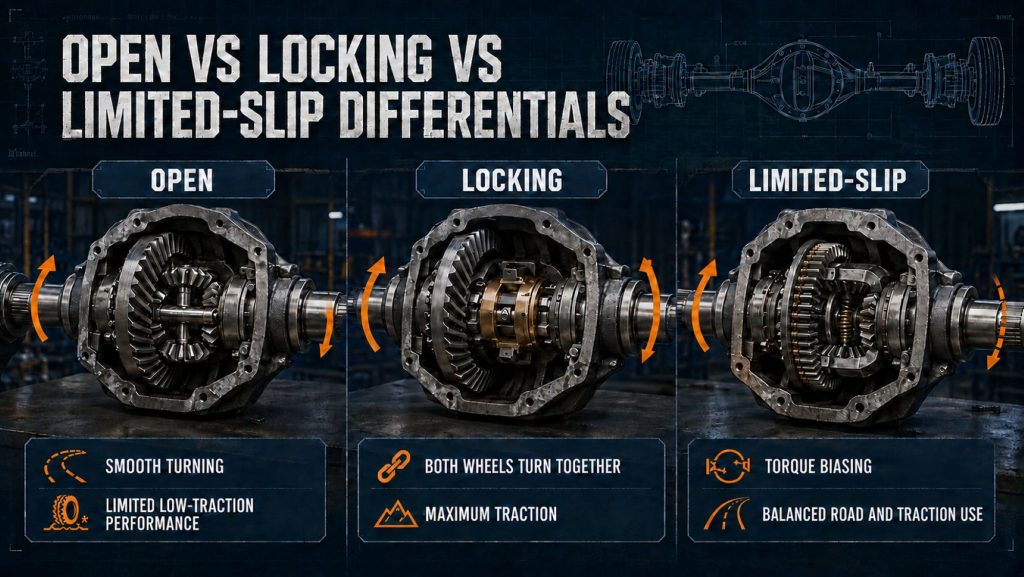
Open, locking, and limited-slip differentials distribute torque between the left and right drive wheels in different ways.
An open differential provides smooth operation and allows unrestricted differences in wheel speed, but its usable torque can be limited when one wheel loses traction. A locking differential mechanically connects both axle shafts when maximum traction is required. A limited-slip differential operates between these two designs by allowing normal differentiation while restricting excessive wheel-speed differences.
The correct differential depends on the truck’s weight, duty cycle, operating surface, traction requirements, maneuverability needs, and driver controls.
This guide compares the three principal differential types used in commercial trucks.
What Does a Truck Differential Do?
A differential is located inside a conventional drive axle. It receives power from the driveshaft and distributes that power to the left and right axle shafts.
Its two primary functions are:
- Transfer torque to the drive wheels
- Allow the left and right wheels to rotate at different speeds
When a truck travels through a turn, the outside wheel follows a longer path than the inside wheel. The outside wheel must therefore rotate faster.
The differential permits this speed difference without forcing one tire to slide across the road.
Without differential action, turning on a high-traction surface would cause:
- Tire scrubbing
- Driveline binding
- Increased steering resistance
- Axle-shaft stress
- Gear and bearing stress
- Accelerated tire wear
- Difficult vehicle handling
Main Differential Components
A conventional truck differential commonly includes:
- Differential carrier
- Input yoke
- Pinion shaft
- Pinion gear
- Ring gear
- Differential case
- Side gears
- Spider gears
- Cross shaft
- Carrier bearings
- Pinion bearings
- Axle shafts
- Differential-lock mechanism when equipped
The ring-and-pinion gearset transfers power into the differential case and establishes the truck’s axle ratio.
The internal differential gears distribute torque to the two axle shafts.
Open, Locking, and Limited-Slip Comparison
| Feature | Open Differential | Locking Differential | Limited-Slip Differential |
|---|---|---|---|
| Normal turning | Very smooth | Smooth when unlocked | Smooth with some internal resistance |
| Allows different wheel speeds | Yes | Yes when unlocked; restricted when locked | Yes, but excessive differences are limited |
| Low-traction performance | Limited | Highest when fully locked | Better than open |
| Driver control | Usually none | Available on driver-controlled systems | Usually automatic |
| Tire scrubbing | Minimal | Can be significant when locked | Usually limited |
| Mechanical complexity | Relatively simple | Additional locking components | Additional clutch or gear mechanisms |
| Common use | Highway and delivery trucks | Vocational and severe-service trucks | Medium-duty and mixed-surface applications |
Actual operation depends on the specific differential design.
How an Open Differential Works
An open differential allows the left and right axle shafts to rotate at different speeds without significant internal restriction.
During straight-line travel, the differential case, side gears, spider gears, and axle shafts rotate together at approximately the same speed.
During a turn, the spider gears rotate on their cross shaft. This allows one side gear and axle shaft to turn faster while the other turns more slowly.
The average speed of the two axle shafts remains related to the speed of the differential case.
This design provides smooth, predictable operation on paved roads.
Advantages of an Open Differential
Open differentials offer several practical benefits:
- Smooth operation during turns
- Minimal tire scrubbing
- Predictable highway handling
- Relatively simple construction
- Lower mechanical complexity
- Broad parts and service availability
- Efficient operation
- No special driver controls
- Lower cost than many traction-enhancing systems
These qualities make open differentials appropriate for trucks that spend most of their operating time on paved, high-traction surfaces.
Limitations of an Open Differential
An open differential’s primary limitation appears when one wheel has significantly less traction than the other.
The differential applies approximately equal torque to both axle shafts. The maximum usable torque is therefore restricted by the wheel with less available traction.
If one wheel is on ice, mud, loose gravel, or suspended off the ground, it may begin spinning. The opposite wheel may have good traction but receive insufficient torque to move the truck.
This limitation can be especially noticeable in:
- Mud
- Snow and ice
- Loose gravel
- Uneven construction sites
- Logging roads
- Oilfield roads
- Loading docks with uneven surfaces
- Ditches and deep ruts
- Situations where one wheel becomes unloaded
Electronic traction-control systems may reduce wheelspin by applying the brake at the spinning wheel or reducing engine torque, but their operation differs from mechanically locking the differential.
Common Open-Differential Applications
Open differentials are commonly used in:
- Long-haul highway tractors
- Regional-haul tractors
- Delivery trucks
- Medium-duty box trucks
- Buses
- Utility trucks
- Light vocational vehicles
- Trucks operating primarily on paved roads
A tandem-drive highway tractor may use open wheel differentials together with an inter-axle differential lock.
How a Locking Differential Works
A locking differential connects the left and right axle shafts so both drive wheels rotate together.
When fully locked, the differential no longer allows the normal difference in wheel speed between the two sides.
If one wheel loses traction, torque can still reach the wheel on the firmer surface. This can provide substantially more usable traction than an open differential.
Commercial-truck locking differentials may be:
- Driver controlled
- Air operated
- Electronically controlled
- Mechanically automatic
The precise engagement method depends on the axle and differential design.
Driver-Controlled Differential Locks
A driver-controlled differential lock allows the operator to engage or release the locking mechanism.
An air-operated system may use:
- Dashboard switch
- Solenoid valve
- Air line
- Shift cylinder
- Shift fork
- Sliding clutch or locking collar
- Engagement sensor
- Warning light
When the driver activates the switch, air pressure moves the locking mechanism and connects the differential case to an axle shaft or otherwise locks the two outputs together.
The dashboard indicator may confirm the command or actual engagement, depending on the vehicle design.
When to Use a Differential Lock
A differential lock may be useful on:
- Mud
- Snow
- Ice
- Loose gravel
- Sand
- Uneven jobsites
- Logging roads
- Oilfield roads
- Steep unpaved grades
- Loading areas with poor traction
- Situations where one wheel may become unloaded
The lock should normally be engaged before severe wheelspin begins.
Drivers should follow the vehicle and axle manufacturers’ instructions concerning:
- Maximum engagement speed
- Vehicle speed while locked
- Throttle position
- Steering position
- Acceptable road surfaces
- Indicator-light operation
- Procedures for disengagement
When Not to Use a Differential Lock
A differential lock should generally not remain engaged during normal operation on dry, high-traction pavement.
When the truck turns, the inside and outside wheels need to rotate at different speeds. A locked differential prevents that normal action.
Operating while locked on a high-traction surface can cause:
- Tire scrubbing
- Increased turning resistance
- Steering difficulty
- Axle-shaft stress
- Gear stress
- Driveline windup
- Suspension stress
- Accelerated tire wear
- Damage to locking components
The exact operating limitations depend on the manufacturer’s instructions.
Automatic Locking Differentials
An automatic locking differential engages and releases mechanically according to differences in torque or wheel movement.
It does not require the driver to operate a dashboard switch.
During straight-line driving, the unit can transfer torque to both wheels. During a turn, its internal design allows the outside wheel to rotate faster when operating conditions permit.
Automatic lockers can provide strong traction, but their engagement characteristics may be more noticeable than those of an open or limited-slip differential.
Possible operating characteristics include:
- Clicking or ratcheting during turns
- Changes in throttle response
- Increased tire movement on loose surfaces
- More noticeable engagement and release
- Different handling during power application
Drivers and technicians must understand what is normal for the specific design before diagnosing a problem.
Advantages of a Locking Differential
A locking differential can provide:
- Maximum mechanical connection between the drive wheels
- Improved low-speed traction
- Continued propulsion when one wheel loses traction
- Better mobility on uneven surfaces
- Improved performance in mud, snow, gravel, or loose soil
- Greater capability in vocational and severe-service work
- More predictable torque delivery when fully engaged
These benefits make locking differentials valuable in demanding operating environments.
Limitations of a Locking Differential
Potential limitations include:
- Additional mechanical complexity
- Added purchase cost
- Additional maintenance components
- Tire scrubbing when used incorrectly
- Driveline stress on high-traction surfaces
- Need for driver training
- Possible engagement-speed restrictions
- Changes in handling when locked
- Potential damage from engagement during severe wheelspin
A differential lock improves traction, but it does not increase the tires’ total grip or guarantee that the truck can cross every surface.
Common Locking-Differential Applications
Locking differentials are frequently used in:
- Dump trucks
- Concrete mixers
- Refuse trucks
- Logging trucks
- Oilfield trucks
- Mining vehicles
- Snowplows
- Heavy wreckers
- Heavy-haul tractors
- Severe-service trucks
- All-wheel-drive vocational trucks
- Construction vehicles
Highway tractors operating in snow, gravel yards, unpaved loading areas, or steep terminals may also be equipped with wheel differential locks.
How a Limited-Slip Differential Works
A limited-slip differential allows normal differences in left- and right-wheel speed while restricting excessive differences.
When one wheel begins spinning faster than the other, the differential’s internal mechanism creates resistance or transfers additional torque toward the wheel with better traction.
Depending on the design, a limited-slip differential may use:
- Clutch packs
- Cones
- Springs
- Helical gears
- Worm gears
- Torque-sensing gears
- Hydraulic or viscous mechanisms
- Electronically controlled clutches
Commercial-vehicle limited-slip systems are generally automatic and do not require the driver to engage a lock.
Clutch-Type Limited-Slip Differentials
A clutch-type limited-slip differential uses friction discs or clutch packs to resist differences in axle-shaft speed.
The clutch packs are connected to the differential case and side gears. When one wheel begins rotating faster, friction within the clutch assembly helps transfer more torque to the opposite side.
Clutch-type systems may require:
- A specific lubricant
- Approved friction modifier
- Periodic inspection
- Clutch-pack service
- Manufacturer-approved adjustment procedures
Incorrect lubricant can cause chatter, improper operation, excessive wear, or reduced traction performance.
Gear-Type Limited-Slip Differentials
A gear-type limited-slip differential uses helical, worm, or torque-biasing gears rather than friction clutch packs.
Internal gear forces create resistance when one wheel begins rotating faster than the other.
Potential benefits include:
- Smooth automatic operation
- No external engagement control
- No friction clutch packs in certain designs
- Progressive torque transfer
- Reduced maintenance compared with some clutch systems
A gear-type limited-slip unit still requires some resistance at both wheels. If one wheel is completely unloaded, its torque-transfer ability may be limited unless braking or another control strategy provides resistance.
Advantages of a Limited-Slip Differential
Limited-slip differentials may offer:
- Better traction than an open differential
- Automatic operation
- Normal wheel-speed differences during turns
- Less tire scrubbing than a fully locked differential
- Smooth operation in mixed driving conditions
- Improved mobility on snow, gravel, and wet surfaces
- No need for routine driver engagement
- A useful balance between highway operation and traction
These systems can work well in vehicles that need more traction but do not require a fully locked axle.
Limitations of a Limited-Slip Differential
Potential limitations include:
- Less traction than a fully locked differential
- Additional internal complexity
- Special lubricant requirements
- Friction-material wear in clutch-type systems
- Reduced effectiveness when one wheel has almost no resistance
- Heat generation during extended operation
- Different operating behavior among designs
- Greater cost than an open differential
A limited-slip differential does not create the same rigid axle-shaft connection as a fully locking differential.
Common Limited-Slip Applications
Limited-slip differentials may be used in:
- Medium-duty trucks
- Delivery vehicles
- Utility trucks
- Municipal trucks
- School buses
- Shuttle buses
- Snowbelt vehicles
- Service trucks
- Light construction vehicles
- Trucks traveling on gravel roads
- Mixed highway and vocational operations
Availability varies by axle manufacturer, truck manufacturer, axle capacity, and application.
Differential Locks in Tandem-Axle Trucks
A tandem-drive truck commonly contains three separate differentials:
- One inter-axle differential
- One wheel differential in the forward-rear axle
- One wheel differential in the rear-rear axle
The inter-axle differential distributes torque between the two drive axles.
The wheel differentials distribute torque between the left and right wheels of their respective axles.
A truck may have:
- Inter-axle differential lock only
- Wheel differential lock on one axle
- Wheel differential locks on both axles
- Limited-slip wheel differentials
- Automatic locking wheel differentials
- A combination of multiple traction systems
The dashboard controls and axle identification information should be checked to determine the truck’s actual configuration.
Inter-Axle Lock vs Wheel Differential Lock
An inter-axle differential lock connects the forward-rear and rear-rear axles in a tandem-drive system.
A wheel differential lock connects the left and right axle shafts within one drive axle.
These controls are not interchangeable.
| Lock Type | Components Connected | Primary Purpose |
|---|---|---|
| Inter-axle differential lock | Forward-rear and rear-rear drive axles | Prevents one entire drive axle from spinning faster than the other |
| Wheel differential lock | Left and right wheels on one axle | Prevents one wheel from spinning faster than the opposite wheel |
Engaging only the inter-axle lock does not necessarily prevent individual wheelspin across each axle.
Electronic Traction Control
Electronic traction control can improve mobility without mechanically locking the differential.
The system may use wheel-speed information from the antilock braking system to identify wheelspin.
Depending on the vehicle, it may respond by:
- Applying the brake to a spinning wheel
- Reducing engine torque
- Adjusting throttle response
- Coordinating with stability control
- Working with differential-lock controls
Braking a spinning wheel can create resistance across an open differential and allow more usable torque to reach the opposite wheel.
Electronic traction control and mechanical differential locks may be used together, but their operating procedures vary by vehicle.
Effects on Steering and Handling
Differential type affects how the truck responds during turns and on changing road surfaces.
Open Differential
An open differential provides the smoothest turning behavior because the wheels can rotate at different speeds freely.
Limited-Slip Differential
A limited-slip differential permits different wheel speeds but creates some resistance. Its effect on normal handling is usually less noticeable than a fully locked differential.
Locking Differential
A locked differential forces both drive wheels to rotate together. This can increase the truck’s tendency to continue straight and may increase steering effort or turning radius.
Drivers should reduce speed and use additional caution whenever traction systems change the vehicle’s handling.
Effects on Tire Wear
An open differential normally produces the least tire scrubbing during turns.
A limited-slip differential may create some additional tire wear depending on its internal resistance and operating conditions.
A locked differential can cause substantial tire scrubbing on high-traction surfaces because the inside and outside wheels cannot rotate at their required speeds.
Tire wear can also be increased by:
- Axle misalignment
- Incorrect tire pressure
- Mismatched tire diameter
- Suspension wear
- Improper axle loading
- Locked differentials
- Incorrect ride height
- Tight turning
- Worn torque rods or bushings
The differential should not be blamed for tire wear until the entire axle, suspension, and tire system has been inspected.
Differential Lubrication
All differential types require the correct lubricant.
Some limited-slip and locking designs require a specific lubricant or additive to operate properly.
Maintenance may include:
- Checking lubricant level
- Using the correct viscosity
- Confirming the required performance specification
- Adding approved friction modifier when required
- Changing lubricant at the proper interval
- Inspecting magnetic plugs for metal
- Checking axle breathers
- Repairing leaks
- Monitoring axle temperature
- Inspecting locking-system air lines or wiring
Never assume that a lubricant approved for an open differential is suitable for every limited-slip or locking differential.
Common Differential Problems
Possible problems include:
- Gear howl
- Bearing noise
- Clunking during power application
- Excessive backlash
- Lubricant leaks
- Overheating
- Metal particles in the lubricant
- Chatter during turns
- Differential lock failing to engage
- Differential lock failing to release
- Broken locking components
- Worn clutch packs
- Damaged side or spider gears
- Ring-and-pinion damage
- Uneven tire wear
- Persistent wheelspin
Differential noise can change during acceleration, steady throttle, deceleration, or turning. Those changes can help a qualified technician isolate the source.
Choosing the Right Differential
The correct differential depends on the complete vehicle and its operating conditions.
Important considerations include:
- Truck class
- Single- or tandem-drive configuration
- Gross vehicle weight
- Gross combination weight
- Engine torque
- Axle capacity
- Axle ratio
- Highway or vocational operation
- Paved or unpaved surfaces
- Snow and ice exposure
- Mud or loose-ground operation
- Terrain and grades
- Required driver control
- Turning frequency
- Tire wear priorities
- Maintenance capabilities
- Lubricant requirements
- Manufacturer support
- Replacement-component availability
An open differential may be sufficient for a highway truck operating almost entirely on pavement.
A limited-slip differential may suit a vehicle that needs improved automatic traction across mixed road surfaces.
A locking differential may be the best choice for severe-service work where maximum low-speed traction is essential.
Related Axle and Differential Categories
- Truck Differentials
- Commercial Truck Drive Axles
- Lift Axles and Auxiliary Axles
- Electric Drive Axles
Related Equipment Resources
Explore More Axle and Differential Guides
Visit Axle and Differential Guides to explore additional resources covering commercial truck axles, axle ratios, equipment identification, and common axle and differential problems.