
Commercial Trailer Axles
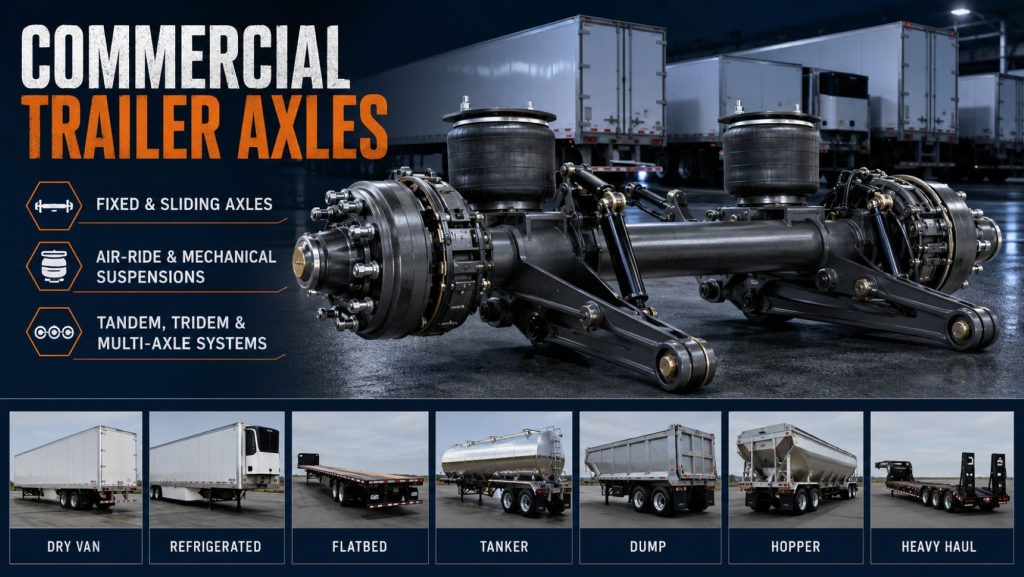
Commercial trailer axles support the trailer and its cargo while connecting the suspension, wheel ends, brakes, tires, and trailer frame. Unlike truck drive axles, conventional trailer axles do not receive engine torque or contain a powered differential.
Trailer axles are available in numerous capacities, track widths, tube designs, spindle configurations, brake arrangements, and suspension integrations. The correct axle depends on the trailer type, gross axle weight rating, suspension, brake system, tire configuration, deck height, operating environment, and intended cargo.
Commercial trailer configurations include fixed axles, sliding tandems, spread axles, tridems, liftable axles, self-steering axles, and specialized multi-axle systems.
This section of Truck Equipment Atlas organizes commercial trailer axle systems, integrated axle-and-suspension platforms, manufacturers, applications, and related equipment resources.
Commercial Trailer Axles on Truck Equipment Atlas
Hendrickson Trailer Axles
- Hendrickson INTRAAX AAT Trailer Axle System
- Hendrickson INTRAAX AAL Liftable Trailer Axle System
- Hendrickson VANTRAAX Trailer Axle System
- Hendrickson TRLAXLE Heavy-Duty Trailer Axle
SAF-HOLLAND Trailer Axles
- SAF-HOLLAND CBX40 Trailer Suspension and Axle System
- SAF-HOLLAND CBX23 Single-Axle Slider
- SAF-HOLLAND CBX-SSA Self-Steering Axle
- SAF-HOLLAND INTRADISC Trailer Axle System
Dexter Heavy-Duty Trailer Axles
Additional trailer axle, suspension, wheel-end, lift-axle, and steering-axle profiles will be added as the commercial trailer equipment library expands.
Understanding Commercial Trailer Axles
A conventional commercial trailer axle consists of a steel axle tube with a spindle attached at each end. The hubs, bearings, brakes, wheels, and tires are installed around those spindles.
The axle is connected to the trailer through a mechanical spring or air-ride suspension. Together, these components carry the trailer’s weight and allow the wheels to rotate while maintaining alignment with the trailer frame.
A typical commercial trailer axle assembly may include:
- Axle tube
- Spindles
- Hubs
- Inner and outer wheel bearings
- Wheel seals
- Brake drums or rotors
- Brake shoes or disc-brake calipers
- Brake chambers
- Slack adjusters on drum-brake systems
- ABS wheel-speed sensors
- Suspension mounting components
- Wheels and tires
Trailer axle ratings are determined by the complete system. The axle tube, spindles, bearings, hubs, brakes, suspension, wheels, and tires must all support the intended load.
Straight Trailer Axles
A straight axle uses an axle tube that extends across the trailer without a lowered center section.
Straight axles are widely used because they provide a simple, durable structure suitable for many commercial trailer types.
Common applications include:
- Dry van trailers
- Refrigerated trailers
- Flatbed trailers
- Tank trailers
- Hopper trailers
- Dump trailers
- Container chassis
- Livestock trailers
- Logging trailers
Drop Axles
A drop axle positions part of the axle beam or spindle arrangement lower than a comparable straight-axle design. This can help reduce deck or floor height in applications where vertical clearance is important.
Drop-axle designs may be used on:
- Lowboy trailers
- Drop-deck trailers
- Moving-floor trailers
- Specialized equipment trailers
- Certain car haulers
- Low-floor specialty trailers
The trailer manufacturer must coordinate the axle’s drop, suspension geometry, tire clearance, brake package, and loaded ride height.
Fixed Trailer Axles
Fixed trailer axles remain in one position beneath the trailer. Their mounting location establishes the relationship between the trailer’s kingpin, axle group, cargo deck, and rear overhang.
Fixed axles are common on flatbeds, tankers, dumps, lowboys, hoppers, logging trailers, chassis, and specialized trailers.
Because the axle group cannot slide, cargo placement is important for maintaining legal weight on the tractor drives and trailer axles.
Sliding Trailer Axles
A sliding tandem allows the trailer’s axle group to move forward or rearward beneath the frame. Locking pins secure the slider box in the selected position.
Moving the tandems changes how the trailer’s weight is distributed between the tractor drive axles and the trailer axles.
Sliding tandems are commonly used on:
- Dry van trailers
- Refrigerated trailers
- Specialty van trailers
- Certain container chassis
- Some platform trailers
The driver must confirm that every locking pin is fully engaged before moving the vehicle.
Tandem-Axle Configurations
A tandem trailer has two axles positioned as one axle group. This is the most common arrangement used on North American semitrailers.
Tandem axles provide a practical balance of:
- Load capacity
- Weight distribution
- Maneuverability
- Tire count
- Brake capacity
- Maintenance requirements
Tandem spacing varies by trailer design. Common arrangements include closed tandems, sliding tandems, and spread axles.
Closed-Tandem Axles
A closed tandem positions two trailer axles relatively close together. The group is treated differently from a widely spaced tandem under certain weight laws.
Closed tandems generally provide better maneuverability than spread axles because the tires experience less lateral scrubbing during tight turns.
They are commonly used on:
- Dry vans
- Refrigerated trailers
- Tank trailers
- Container chassis
- Dump trailers
- Vocational trailers
Spread-Axle Configurations
A spread axle increases the distance between the two trailer axles. A common North American platform-trailer configuration uses approximately 10 feet and 1 inch between axle centers, although spacing varies.
Spread axles can improve allowable weight distribution in certain jurisdictions. They also provide a stable platform for open-deck and specialized freight.
Common applications include:
- Flatbed trailers
- Step deck trailers
- Conestoga trailers
- Tank trailers
- Specialized platform trailers
The wider spacing can increase tire scrubbing and suspension stress during tight turns. Drivers must account for the trailer’s greater effective wheelbase when maneuvering.
Tridem-Axle Configurations
A tridem uses three axles in one trailer axle group. It distributes weight across more tires and brakes than a conventional tandem.
Tridems are commonly found on:
- Heavy-haul trailers
- Dump trailers
- Tank trailers
- Logging trailers
- Hopper trailers
- Canadian-specification trailers
- Specialized vocational trailers
- Certain container chassis
The legal capacity of a tridem depends on axle spacing, tire ratings, trailer ratings, bridge laws, and the jurisdiction where it operates.
Multi-Axle Trailer Configurations
Specialized heavy-haul trailers may use four or more axles or combine multiple axle groups with jeeps, boosters, dollies, and removable axle modules.
These configurations distribute exceptionally heavy loads over a larger number of ground-contact points.
Multi-axle systems are used for:
- Construction machinery
- Transformers
- Industrial equipment
- Crane components
- Mining equipment
- Energy-sector freight
- Other oversized or overweight loads
Axle count alone does not determine legal capacity. Axle spacing, group configuration, permits, route restrictions, tires, suspension, frame capacity, and bridge limits must also be considered.
Liftable Trailer Axles
A liftable trailer axle can be raised when it is not required to support the load. This reduces the number of tires contacting the road when the trailer is empty or lightly loaded.
Liftable axles may help:
- Reduce tire wear
- Reduce rolling resistance
- Improve maneuverability
- Adapt the trailer to changing loads
- Support multi-jurisdiction weight requirements
- Reduce tire scrubbing during tight turns
Lift-axle operation is regulated differently across jurisdictions. Certain states and provinces specify when an axle must be lowered, how it must carry weight, and how its controls may operate.
Self-Steering Trailer Axles
A self-steering trailer axle allows its wheels to follow the trailer through a turn. This can reduce tire scrubbing and lateral stress compared with a fixed axle.
Self-steering axles may be used on:
- Multi-axle trailers
- Tankers
- Moving-floor trailers
- Dump trailers
- Logging trailers
- Livestock trailers
- Specialized heavy-duty trailers
The axle may require a centering or locking system when reversing. Its operation must be coordinated with the suspension, brakes, alignment, and trailer control system.
Integrated Axle and Suspension Systems
An integrated trailer axle system combines the axle, suspension, and brake mounting structure into one engineered assembly.
Systems such as Hendrickson INTRAAX and VANTRAAX are designed to coordinate:
- Axle structure
- Air suspension
- Trailing arms
- Frame brackets
- Shock absorbers
- Air springs
- Brake geometry
- Alignment provisions
- Wheel-end equipment
Integrated systems can simplify trailer manufacturing and help ensure that the axle, suspension, and brakes are engineered to work together.
Mechanical-Suspension Trailer Axles
Mechanical suspensions use steel springs and related hardware to connect the axle to the trailer frame.
Common components include:
- Leaf springs
- Equalizers
- Torque arms
- Spring seats
- Hangers
- Bushings
- U-bolts
Mechanical suspensions are widely used on vocational, construction, logging, dump, chassis, agricultural, and heavy-duty trailers.
Their design is generally durable and straightforward, although ride quality may be firmer than a comparable air-ride system.
Air-Ride Trailer Axles
Air-ride suspension uses pressurized air springs to support the trailer and control ride height.
Air ride is common on dry vans, refrigerated trailers, flatbeds, tankers, specialty trailers, and other applications where ride quality and cargo protection are important.
An air-ride trailer axle installation may include:
- Air springs
- Trailing arms
- Shock absorbers
- Height-control valves
- Air reservoirs
- Air lines and fittings
- Dump valves
- Lift mechanisms when equipped
Drum-Brake Trailer Axles
Drum brakes remain widely used on North American commercial trailers.
A typical air-drum-brake axle includes brake chambers, pushrods, slack adjusters, S-cams, brake shoes, return springs, and brake drums.
Drum brakes offer broad service support and established parts availability across the trucking industry.
Disc-Brake Trailer Axles
Air disc brakes use a caliper to clamp brake pads against a rotor. Trailer axles equipped with disc brakes can provide consistent braking performance and simplified friction-material inspection.
Disc-brake axle systems are increasingly available on commercial trailers, although adoption depends on fleet preference, trailer type, purchase cost, service support, and maintenance strategy.
The axle, brake package, wheel ends, wheels, ABS, and suspension must be specified as a compatible system.
Common Trailer Applications
Dry Van and Refrigerated Trailers
Dry vans and refrigerated trailers commonly use sliding tandem axle systems with air-ride suspension. Fixed tandems and single-axle configurations are also available for specialized applications.
Flatbed and Step Deck Trailers
Platform trailers may use closed tandems, spread axles, sliding tandems, tridems, or liftable configurations depending on length, payload, and operating territory.
Lowboy and Heavy-Haul Trailers
Lowboys and detachable gooseneck trailers use low-ride-height axles, drop axles, tridems, quad-axle groups, flip axles, boosters, and other specialized systems.
Tank Trailers
Tankers use axle systems selected for high centers of gravity, concentrated loads, brake requirements, weight distribution, and the characteristics of the transported liquid or dry bulk material.
Dump and Hopper Trailers
Dump and hopper trailers frequently operate with dense loads and may use heavy-duty tandem, spread-axle, tridem, liftable, or self-steering configurations.
Container Chassis
Container chassis commonly use fixed or sliding tandem axles. Tridem and extendable configurations are available for specialized container lengths and weight-distribution requirements.
Logging and Specialty Trailers
Logging, livestock, refuse, moving-floor, and specialty trailers require axle systems matched to severe operating environments, frequent turning, unpaved surfaces, and specialized loading conditions.
Choosing a Commercial Trailer Axle
Trailer axles must be selected as part of the complete trailer specification.
Important considerations include:
- Trailer type
- Gross vehicle weight rating
- Gross axle weight ratings
- Intended payload
- Concentrated-load requirements
- Number of axles
- Axle spacing
- Fixed or sliding configuration
- Straight or drop axle
- Axle-tube capacity
- Track width
- Spindle type
- Single- or dual-tire wheel ends
- Mechanical or air-ride suspension
- Drum or disc brakes
- ABS compatibility
- Standard or low ride height
- Liftable or fixed operation
- Self-steering requirements
- Tire-inflation system compatibility
- Operating territory
- Replacement-parts availability
The axle’s published capacity cannot be used by itself to determine the trailer’s legal payload. Frame ratings, suspension capacity, brakes, hubs, wheels, tires, axle spacing, bridge laws, and certification ratings must all be considered.
Related Axle and Differential Categories
- Commercial Truck Drive Axles
- Commercial Truck Steer Axles
- Lift Axles and Auxiliary Axles
- Truck Differentials
- Electric Drive Axles
- Axle and Differential Guides
Related Equipment Resources
- Axles and Differentials
- Trailers
- Suspension Systems
- Brake Systems
- Tires and Wheels
- Electrical Systems
- Safety Systems
Explore the Complete Axle and Differential Library
Visit the Axles and Differentials hub to explore commercial truck drive axles, steer axles, lift axles, auxiliary axles, differentials, electric drive axles, trailer axles, manufacturer profiles, and educational resources.