
Truck Differentials
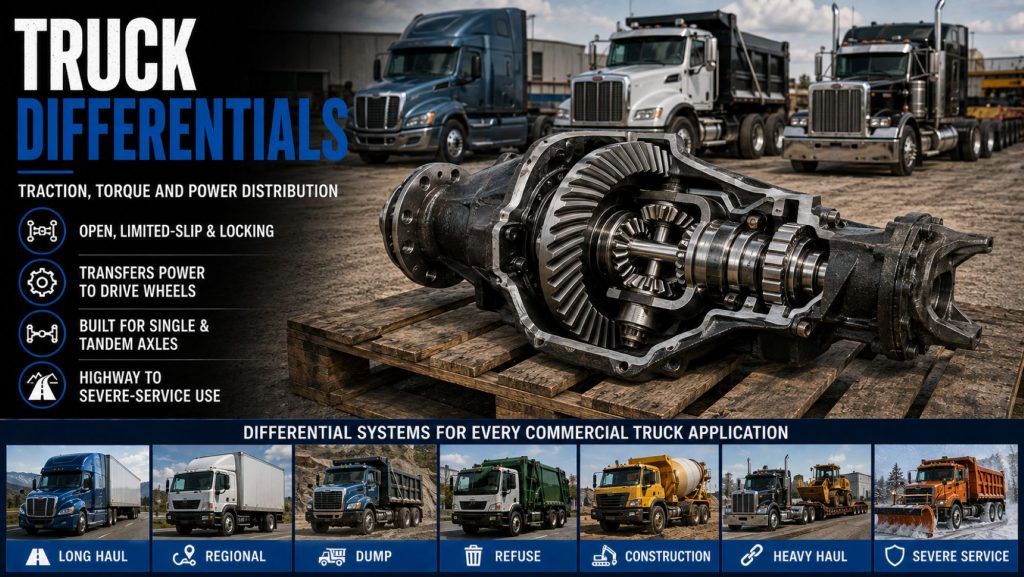
Truck differentials transfer power from a commercial truck’s driveshaft to its drive wheels while allowing the wheels to rotate at different speeds during turns.
The differential is housed within the drive axle and works with the ring gear, pinion gear, axle shafts, bearings, and traction-control components. Its design and axle ratio influence pulling power, highway efficiency, traction, engine speed, and overall driveline performance.
Commercial trucks may use open differentials, limited-slip differentials, automatic locking differentials, or driver-controlled differential locks. Tandem-drive trucks also use an inter-axle differential to distribute power between the two drive axles.
This section of Truck Equipment Atlas organizes differential systems, traction technologies, manufacturer products, and educational resources used throughout the commercial trucking industry.
Truck Differentials on Truck Equipment Atlas
Open Differentials
Open differentials allow the left and right drive wheels to rotate at different speeds. They are commonly used in highway trucks operating primarily on paved surfaces.
Individual open-differential profiles and manufacturer systems will be added as the equipment library expands.
Limited-Slip Differentials
Limited-slip differentials allow normal wheel-speed differences while transferring more usable torque toward the wheel with better traction.
Driver-Controlled Differential Locks
Driver-controlled differential locks allow the operator to connect the left and right axle shafts when additional traction is required.
Automatic Locking Differentials
Automatic locking differentials engage mechanically when operating conditions require additional traction.
Inter-Axle Differentials
Inter-axle differentials distribute power between the forward-rear and rear-rear drive axles in a tandem-drive truck.
Individual inter-axle differential and power-divider pages will be added as Truck Equipment Atlas expands.
Understanding Truck Differentials
Power from the transmission travels through the driveshaft and enters the drive axle through the input yoke and pinion shaft.
The pinion gear turns the larger ring gear attached to the differential case. Gears inside the differential then distribute torque to the left and right axle shafts.
During straight-line travel, the drive wheels normally rotate at similar speeds. During a turn, the outside wheel travels farther and must rotate faster than the inside wheel. The differential allows this speed difference while continuing to transfer power.
The differential assembly commonly includes:
- Input yoke
- Pinion shaft
- Pinion gear
- Ring gear
- Differential carrier
- Differential case
- Side gears
- Spider gears
- Cross shaft
- Carrier bearings
- Pinion bearings
- Axle shafts
- Differential-lock components when equipped
Open Differentials
An open differential provides smooth and predictable operation by allowing the drive wheels to rotate independently during turns.
This design is common in highway trucks that spend most of their operating time on paved roads. Open differentials are generally straightforward, efficient, and widely supported.
Their primary limitation appears when one drive wheel loses traction. A spinning wheel can reduce the usable torque reaching the wheel that remains on a firm surface.
Open differentials are commonly found in:
- Long-haul tractors
- Regional-haul tractors
- Delivery trucks
- Medium-duty trucks
- Highway buses
- Light vocational trucks
Limited-Slip Differentials
A limited-slip differential permits normal differentiation while restricting excessive speed differences between the two drive wheels.
Clutches, gears, torque-sensing mechanisms, or other internal components help transfer more torque toward the wheel with better traction.
Limited-slip systems can provide improved mobility without requiring the complete axle-shaft connection created by a fully locking differential.
Common applications include:
- Medium-duty trucks
- Utility vehicles
- Municipal trucks
- School buses
- Delivery trucks
- Snowbelt operations
- Trucks traveling on gravel roads
- Light vocational applications
Locking Differentials
A locking differential connects the left and right axle shafts so the wheels rotate together. This allows torque to reach a wheel with traction when the opposite wheel is slipping.
Commercial-truck locking systems may be automatic or controlled by the driver.
Driver-controlled locks are commonly activated through an air-operated or electronically controlled mechanism. Automatic lockers engage and release according to their internal mechanical design.
Locking differentials are frequently used in:
- Dump trucks
- Concrete mixers
- Refuse trucks
- Logging trucks
- Oilfield trucks
- Mining vehicles
- Snowplows
- Heavy wreckers
- Heavy-haul tractors
- Severe-service trucks
- All-wheel-drive vocational trucks
Inter-Axle Differentials
A tandem-drive truck has two powered rear axles. The inter-axle differential distributes torque between the forward-rear axle and the rear-rear axle while allowing small differences in axle speed.
An inter-axle differential is different from the wheel differential inside each drive axle.
A conventional tandem-drive system may contain:
- One inter-axle differential between the drive axles
- One wheel differential in the forward-rear axle
- One wheel differential in the rear-rear axle
An inter-axle differential lock connects the two drive axles so they receive power together. This improves traction when one complete axle begins slipping.
Locking the inter-axle differential does not necessarily lock the left and right wheels. Separate wheel differential locks are required to create that connection.
Differential and Axle Ratios
The ring-and-pinion gearset establishes the truck’s axle ratio. This ratio affects engine speed, wheel torque, startability, grade performance, highway efficiency, and maximum geared road speed.
Numerically lower ratios are commonly selected for fuel-efficient highway operation when paired with the correct engine, transmission, and tire size.
Numerically higher ratios provide greater torque multiplication and are often used in vocational, heavy-haul, off-highway, and severe-service applications.
Axle-ratio selection should consider:
- Engine torque curve
- Transmission ratios
- Direct-drive or overdrive transmission design
- Tire size
- Gross combination weight
- Highway speed
- Operating terrain
- Startability
- Gradeability
- Fuel-efficiency goals
- Vocational requirements
Both drive axles in a conventional tandem must use matching ratios. Mismatched axle ratios can cause driveline windup, overheating, tire wear, and severe component damage.
Common Truck Applications
Long-Haul and Regional Trucks
Highway tractors commonly use open differentials with an inter-axle differential lock. Optional wheel differential locks may be selected for fleets operating in snow, unpaved yards, steep loading areas, or other low-traction conditions.
Medium-Duty Trucks
Delivery trucks, utility trucks, school buses, municipal vehicles, and other medium-duty platforms may use open, limited-slip, or locking differentials depending on their routes and operating conditions.
Construction Trucks
Dump trucks, concrete mixers, roll-off trucks, and construction vehicles frequently use driver-controlled locks to improve mobility on dirt, gravel, mud, and uneven jobsites.
Refuse and Municipal Trucks
Refuse trucks, snowplows, street-maintenance vehicles, and municipal trucks may require additional traction for stop-and-go routes, poor weather, unpaved surfaces, and changing load conditions.
Logging and Oilfield Trucks
Logging, oilfield, and severe-service trucks commonly use locking differentials, inter-axle locks, deeper axle ratios, and heavy-duty drive-axle configurations.
Heavy-Haul Trucks
Heavy-haul tractors use differential systems and axle ratios selected for high gross combination weights, low-speed control, startability, and demanding grades.
Choosing the Right Truck Differential
The correct differential depends on the complete truck specification and operating environment.
Important considerations include:
- Truck class
- Single- or tandem-drive configuration
- Engine torque
- Transmission gearing
- Axle ratio
- Tire size
- Gross vehicle weight
- Gross combination weight
- Highway or vocational operation
- Terrain and road conditions
- Low-traction exposure
- Inter-axle lock requirements
- Wheel differential lock requirements
- Limited-slip or automatic-locking operation
- Driver training
- Manufacturer support
- Replacement-component availability
A long-haul tractor operating primarily on interstate highways may not require the same traction equipment as a dump truck, logging truck, snowplow, heavy wrecker, or oilfield vehicle.
Differential selection should be coordinated with the engine, transmission, driveshaft, drive axles, tires, and intended duty cycle.
Related Axle and Differential Categories
- Commercial Truck Drive Axles
- Commercial Truck Steer Axles
- Lift Axles and Auxiliary Axles
- Electric Drive Axles
- Commercial Trailer Axles
- Axle and Differential Guides
Related Equipment Resources
- Axles and Differentials
- Transmissions
- Engines
- Suspension Systems
- Brake Systems
- Tires and Wheels
- Safety Systems
Explore the Complete Axle and Differential Library
Visit the Axles and Differentials hub to explore commercial truck drive axles, steer axles, lift axles, auxiliary axles, differentials, electric drive axles, trailer axles, manufacturer profiles, and educational resources.