
Commercial Truck Steer Axles
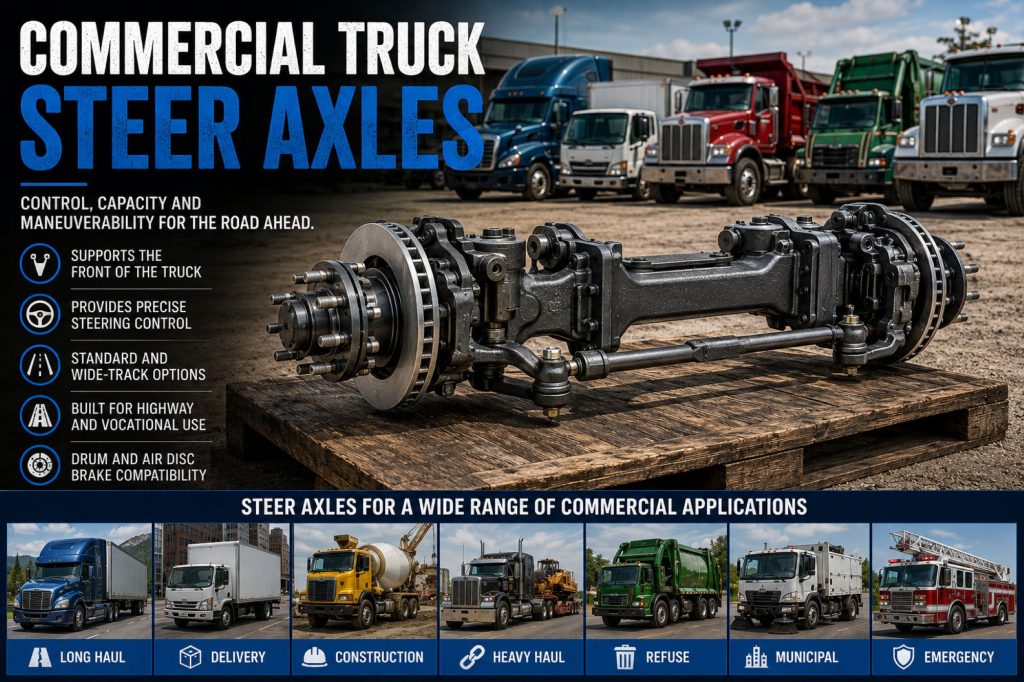
Commercial truck steer axles support the front of the vehicle and provide the pivot points that allow the front wheels to respond to steering input. They play a major role in vehicle handling, maneuverability, braking, stability, tire wear, front-axle loading, and driver control.
Steer axles are used throughout medium-duty, heavy-duty, vocational, long-haul, construction, refuse, municipal, heavy-haul, severe-service, bus, and specialized commercial vehicle applications.
Truck Equipment Atlas covers steer-axle models, capacity ratings, standard- and wide-track configurations, axle beams, steering knuckles, kingpins, tie rods, wheel ends, brake compatibility, suspension integration, maintenance requirements, and individual steer-axle families from major commercial-vehicle manufacturers.
Commercial Truck Steer Axles on Truck Equipment Atlas
Explore the commercial truck steer axles being added to Truck Equipment Atlas:
Cummins-Meritor
Dana Spicer
Detroit
PACCAR
Hendrickson
Additional medium-duty, heavy-duty, bus, vocational, severe-service, and specialized steer-axle systems will be added as the Truck Equipment Atlas Axle and Differential Library continues to expand.
How Commercial Truck Steer Axles Work
A conventional steer axle is mounted beneath the front of the truck and connected to the vehicle’s front suspension. The axle beam supports the front portion of the vehicle while the steering knuckles provide pivot points for the front wheels.
When the driver turns the steering wheel, movement travels through the steering gear and steering linkage. The drag link moves one steering knuckle, while the tie rod coordinates movement between the left and right wheels.
The kingpins or equivalent pivot assemblies allow the steering knuckles to turn relative to the axle beam. Wheel hubs, bearings, brakes, and wheels are mounted at the outer ends of the axle.
Most conventional North American commercial trucks use a non-driven front steer axle. Specialized all-wheel-drive and severe-service trucks may use powered front steer axles, but these are different from the non-drive steer axles used on most highway trucks.
Common Steer-Axle Components
A commercial truck steer-axle system can include:
- Axle beam
- Steering knuckles
- Kingpins
- Kingpin bushings
- Tie rod
- Tie-rod ends
- Steering arms
- Drag link connection
- Wheel hubs
- Wheel bearings
- Spindles
- Brake spiders or torque plates
- Air disc or drum brakes
- Suspension mounting points
- Steering stops
- Seals
- Lubrication fittings
- Wheel-speed sensors
The exact arrangement varies by axle manufacturer, truck model, suspension, brake system, wheel-end configuration, and capacity rating.
Forged and Fabricated Steer Axles
Commercial steer-axle beams can use forged or fabricated construction.
Forged I-Beam Steer Axles
Forged I-beam axles have a long history in commercial trucking. They are known for strength, durability, service familiarity, and broad application coverage.
These axles are widely used in:
- Highway tractors
- Medium-duty trucks
- Dump trucks
- Construction trucks
- Heavy-haul tractors
- Refuse vehicles
- Buses
- Severe-service vehicles
Fabricated Steer Axles
Fabricated steer axles use engineered steel components joined into a structure designed to provide the required strength while reducing unnecessary weight.
Potential benefits can include:
- Reduced axle weight
- Increased payload potential
- Application-specific construction
- Integration with modern suspensions
- Compatibility with air disc brakes
- Reduced number of separate components in certain designs
The Hendrickson STEERTEK NXT is a well-known example of a fabricated commercial front steer axle.
Standard-Track and Wide-Track Axles
Steer axles may be available in standard- or wide-track configurations.
Track width describes the lateral distance between the wheel positions. A wider track can affect turning clearance, tire position, fender clearance, stability, wheel cut, and compatibility with wide vocational tires.
Standard-track axles are common on highway and medium-duty trucks. Wide-track configurations may be used on vocational, refuse, construction, heavy-haul, fire, and severe-service vehicles.
The correct track width depends on:
- Truck model
- Frame configuration
- Suspension
- Wheel and tire size
- Fender clearance
- Steering geometry
- Brake configuration
- Intended application
A wide-track axle should not be assumed to fit a vehicle originally designed around a standard-track configuration.
Steer-Axle Capacity Ratings
Commercial steer axles are available across a broad range of gross axle weight ratings.
Common capacity ranges can include:
- Less than 10,000 pounds for lighter commercial vehicles
- 10,000- to 12,000-pound medium-duty applications
- Approximately 12,000- to 14,600-pound highway and heavy-duty applications
- 16,000- to 20,000-pound vocational applications
- 20,000- to 23,000-pound heavy vocational and heavy-haul applications
- Higher specialized ratings for severe-service vehicles
Dana’s E-Series, for example, includes standard- and wide-beam configurations across approximately 10,000 to 14,600 pounds. Higher-capacity systems such as the PACCAR FX-20 and FX-22 are designed around 20,000- to 22,000-pound ratings.
Axle capacity alone does not establish the truck’s legal or mechanical front-axle capacity. The lowest-rated related component determines the practical limit.
Related ratings include:
- Tires
- Wheels
- Hubs and bearings
- Suspension
- Springs or air springs
- Brakes
- Steering system
- Frame
- Vehicle certification
- Applicable federal and state weight limits
Steering Geometry and Wheel Cut
Steering geometry determines how the front wheels move relative to each other and the truck’s frame during a turn.
Important measurements and settings include:
- Toe
- Camber
- Caster
- Kingpin inclination
- Steering-arm geometry
- Wheel cut
- Steering stops
- Axle setback or set-forward position
Greater wheel cut can improve maneuverability by reducing the truck’s turning radius. However, available wheel cut depends on axle design, tire size, wheel offset, steering linkage, suspension, frame clearance, and other chassis components.
Incorrect alignment or steering geometry can cause:
- Uneven tire wear
- Steering pull
- Poor return-to-center behavior
- Wandering
- Increased driver effort
- Reduced stability
- Steering-component wear
- Higher fuel consumption
Highway Steer-Axle Applications
Long-haul and regional trucks require steer axles that balance durability, weight, steering response, braking, ride quality, and maintenance requirements.
Important highway considerations can include:
- Reduced axle weight
- Payload capacity
- Straight-line stability
- Predictable steering response
- Tire life
- Air disc or drum brake compatibility
- Suspension integration
- Wheel-end maintenance
- Service availability
- Driver comfort
Highway trucks can accumulate substantial annual mileage, making alignment, kingpin wear, wheel-bearing condition, lubrication, and tire maintenance especially important.
Medium-Duty Steer-Axle Applications
Medium-duty trucks frequently operate in urban and suburban environments with repeated turns, stops, curb approaches, loading cycles, and low-speed maneuvering.
Applications can include:
- Box trucks
- Delivery trucks
- Utility trucks
- Beverage trucks
- Tow trucks
- Municipal vehicles
- School buses
- Shuttle buses
- Fire and rescue vehicles
- Service trucks
- Landscape trucks
- Small dump trucks
Medium-duty steer axles must provide adequate capacity while supporting maneuverability, driver comfort, brake performance, and reasonable maintenance costs.
Vocational Steer-Axle Applications
Vocational trucks can place particularly demanding requirements on front steer axles.
Common applications include:
- Dump trucks
- Refuse trucks
- Concrete mixers
- Construction trucks
- Logging trucks
- Utility trucks
- Municipal vehicles
- Snowplows
- Fire and emergency vehicles
- Oilfield trucks
- Crane trucks
- Severe-service vehicles
These vehicles may operate on rough surfaces, make frequent tight turns, encounter curbs and job-site obstacles, or carry substantial front-mounted equipment.
Vocational axle selection may depend on capacity, track width, ground clearance, wheel cut, tire size, brake configuration, suspension articulation, steering effort, and compatibility with front-mounted equipment.
Heavy-Haul Steer-Axle Applications
Heavy-haul tractors can require substantially higher front-axle capacity than standard highway trucks.
Higher front-axle loads may result from:
- Large engines
- Heavy transmissions
- Set-forward axle configurations
- Reinforced frames
- Large sleepers
- Auxiliary equipment
- Ballast
- Heavy trailers
- High fifth-wheel loading
- Multi-axle vehicle configurations
Heavy-haul steer axles may use wide-track designs, larger tires, higher-capacity wheels, stronger suspensions, larger brakes, reinforced steering components, and ratings of 20,000 pounds or more.
The PACCAR FX-20 and FX-22 are examples of high-capacity front axle systems intended for demanding vocational applications.
Set-Forward and Set-Back Front Axles
The position of the steer axle relative to the engine and cab affects weight distribution, maneuverability, wheelbase, and application suitability.
Set-Back Front Axle
A set-back front axle is positioned farther rearward beneath the truck.
Potential benefits can include:
- Shorter turning radius
- Improved maneuverability
- Reduced overall wheelbase
- Aerodynamic hood designs
- Suitability for highway and urban operation
Set-Forward Front Axle
A set-forward front axle is positioned closer to the front of the truck.
Potential benefits can include:
- Increased front-axle loading capability
- Improved weight distribution in certain vocational applications
- Compatibility with specific body and equipment installations
- Suitability for heavy-haul and severe-service configurations
Neither arrangement is automatically better. The correct axle position depends on the truck, body, equipment, trailer, axle-weight requirements, turning environment, and intended application.
Steer Axles and Suspension Systems
The steer axle works directly with the truck’s front suspension.
Common front suspension configurations include:
- Multi-leaf spring suspension
- Taper-leaf spring suspension
- Parabolic spring suspension
- Air suspension
- Integrated axle and suspension systems
- Severe-service spring configurations
The suspension carries the vehicle load between the frame and axle while controlling ride, axle movement, and vehicle stability.
Axle capacity must be matched with the suspension, springs, steering, brakes, wheels, tires, and frame. Installing a higher-rated axle alone does not automatically increase the certified capacity of the truck.
Explore Suspension Systems for additional information.
Steer Axles and Brake Systems
Commercial steer axles may be equipped with drum brakes or air disc brakes depending on the truck and application.
Brake compatibility can depend on:
- Steering-knuckle design
- Brake spider or torque plate
- Rotor or drum size
- Caliper clearance
- Wheel size
- Hub configuration
- Wheel-end design
- Axle rating
- Vehicle application
Modern steer axles may use universal or integrated knuckle designs that support multiple brake configurations.
Explore Brake Systems for additional information.
Advantages of Modern Commercial Steer Axles
Modern steer-axle technology can provide several operational advantages:
- High front-axle capacity
- Improved maneuverability
- Reduced component weight
- Greater payload potential
- Improved steering response
- Increased wheel cut
- Standard- and wide-track configurations
- Drum and air disc brake compatibility
- Integration with modern suspensions
- Improved kingpin and bushing designs
- Reduced maintenance in certain configurations
- Highway and vocational options
The actual benefits depend on the axle design, truck specification, alignment, tires, suspension, operating environment, and maintenance program.
Steer-Axle Limitations and Considerations
No single steer axle is appropriate for every commercial truck.
Important considerations include:
- Gross axle weight rating
- Axle weight
- Track width
- Set-forward or set-back position
- Wheel cut
- Tire size
- Wheel offset
- Suspension compatibility
- Brake compatibility
- Wheel-end configuration
- Steering-system compatibility
- Kingpin design
- Maintenance requirements
- Replacement-parts availability
- Vehicle application
- Legal weight limits
A lightweight highway axle may not be appropriate for a severe-service dump truck. A 20,000-pound vocational axle may add unnecessary weight and cost to a standard highway tractor.
Driver and Operator Considerations
Steer-axle condition directly affects how a truck handles.
Drivers should monitor for:
- Steering pull
- Wandering
- Excessive steering effort
- Loose steering response
- Steering-wheel vibration
- Uneven front-tire wear
- Abnormal tire cupping
- Wheel-end heat
- Brake pull
- Clunking during turns
- Steering that does not return to center
- Visible lubricant or grease leakage
- Changes in turning radius
These symptoms can be related to alignment, tires, wheel bearings, kingpins, bushings, tie-rod ends, steering linkage, brakes, suspension, or other chassis components.
Maintenance and Ownership
Commercial steer axles require regular inspection and maintenance.
Important service areas can include:
- Kingpins
- Kingpin bushings
- Steering knuckles
- Tie rods
- Tie-rod ends
- Steering arms
- Drag links
- Wheel bearings
- Hubs and seals
- Brake components
- Wheel-speed sensors
- Steering stops
- Axle beam condition
- Suspension mounting points
- Lubrication fittings
- Wheel alignment
- Tire condition
- Tire inflation
- Wheel balance
Lubrication procedures and service intervals vary by axle design. Some components require scheduled greasing, while certain modern designs use low-maintenance or extended-service components.
Owners and technicians should follow the service instructions for the exact axle, suspension, brake, wheel-end, and vehicle configuration.
Choosing a Commercial Truck Steer Axle
Selecting a steer axle requires evaluating the complete vehicle specification.
Important factors include:
- Truck class
- Front gross axle weight rating
- Actual loaded front-axle weight
- Highway or vocational operation
- Heavy-haul requirements
- Set-forward or set-back position
- Standard or wide track
- Tire size and capacity
- Wheel capacity
- Suspension
- Brake type
- Hub and wheel-end configuration
- Steering system
- Required wheel cut
- Ground clearance
- Front-mounted equipment
- Body configuration
- Maintenance requirements
- Parts and service support
There is no single best steer axle for every commercial truck. The proper axle is one matched to the vehicle’s certified ratings, suspension, steering, brakes, tires, operating environment, and intended work.
Related Axle and Differential Categories
Explore additional axle and differential categories:
- Commercial Truck Drive Axles
- Lift Axles and Auxiliary Axles
- Truck Differentials
- Electric Drive Axles
- Commercial Trailer Axles
- Axle and Differential Guides
Related Truck Equipment Resources
- Commercial Trucks
- Suspension Systems
- Brake Systems
- Tires and Wheels
- Safety Systems
- Equipment Systems
Understanding how the steer axle, steering system, suspension, brakes, wheel ends, tires, frame, vehicle weight, and operating application work together is essential when evaluating a commercial truck’s front axle.
Explore the Complete Axle and Differential Library
Commercial truck steer axles represent one part of the larger commercial axle and drivetrain landscape.
Visit the Truck Equipment Atlas Axle and Differential Library to explore steer axles, drive axles, lift axles, differentials, trailer axles, electric axles, individual equipment profiles, and educational guides.
Additional steer-axle models, manufacturers, historical axle families, specialized front-drive systems, and educational resources will be added as Truck Equipment Atlas continues to expand.