
Fontaine Velocity Conestoga
Quick Facts
- Manufacturer: Fontaine Trailer
- Trailer Type: Conestoga-Equipped Flatbed or Drop Deck Trailer
- Base Trailer Platform: Fontaine Velocity Steel Platform Trailer
- Common Lengths: 48 ft and 53 ft depending on configuration
- Common Width: 102 inches
- Common Deck Configurations: Flat Deck and Drop Deck
- Frame Construction: High-Strength Steel
- Common Axle Configurations: Closed Tandem, Spread Axle, Sliding Tandem, and Tridem depending on model
- Frame Rating: Up to 80,000 lbs distributed on common Velocity configurations; axle and tire ratings determine legal payload
- Common Flooring: Apitong Hardwood Decking
- Cover System: Retractable Rolling Tarp Enclosure
- Loading Access: Rear, Side, or Overhead with the enclosure retracted
- Common Suspension Types: Mechanical Spring or Air-Ride Suspension
- Primary Applications: Steel Products, Lumber, Machinery, Building Materials, Industrial Components, Weather-Sensitive Flatbed Freight
- Production Status: Fontaine Velocity trailers remain available; Conestoga-system availability depends on dealer, installer, and trailer configuration
Overview
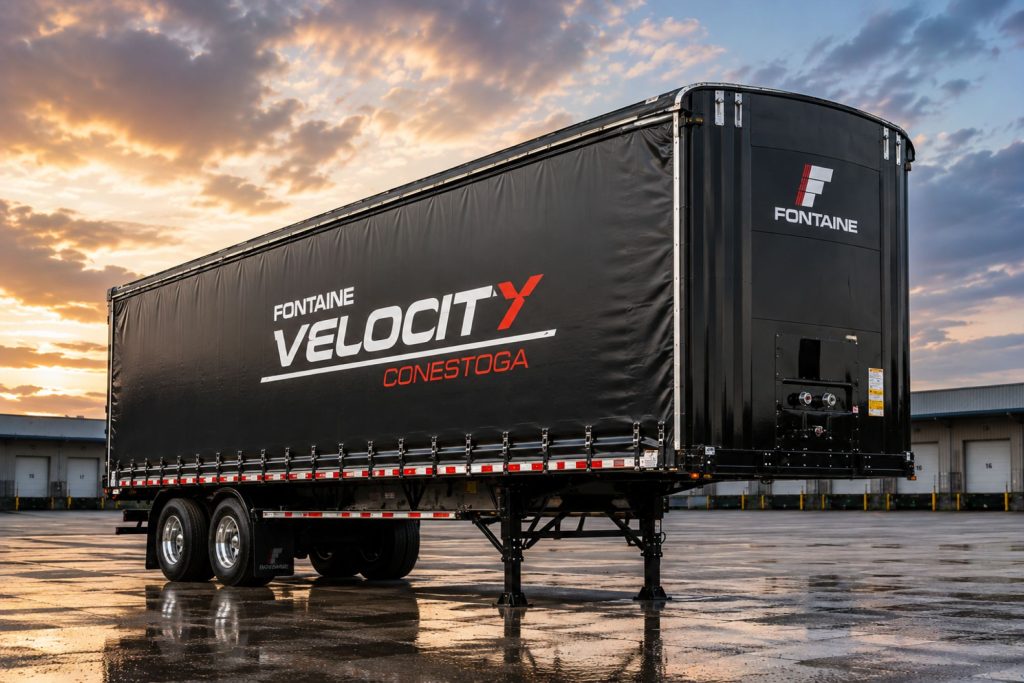
The Fontaine Velocity Conestoga combines a Fontaine Velocity steel platform trailer with a retractable rolling-tarp enclosure. This configuration provides much of the loading flexibility of a conventional flatbed while protecting freight from rain, snow, road debris, and other environmental exposure.
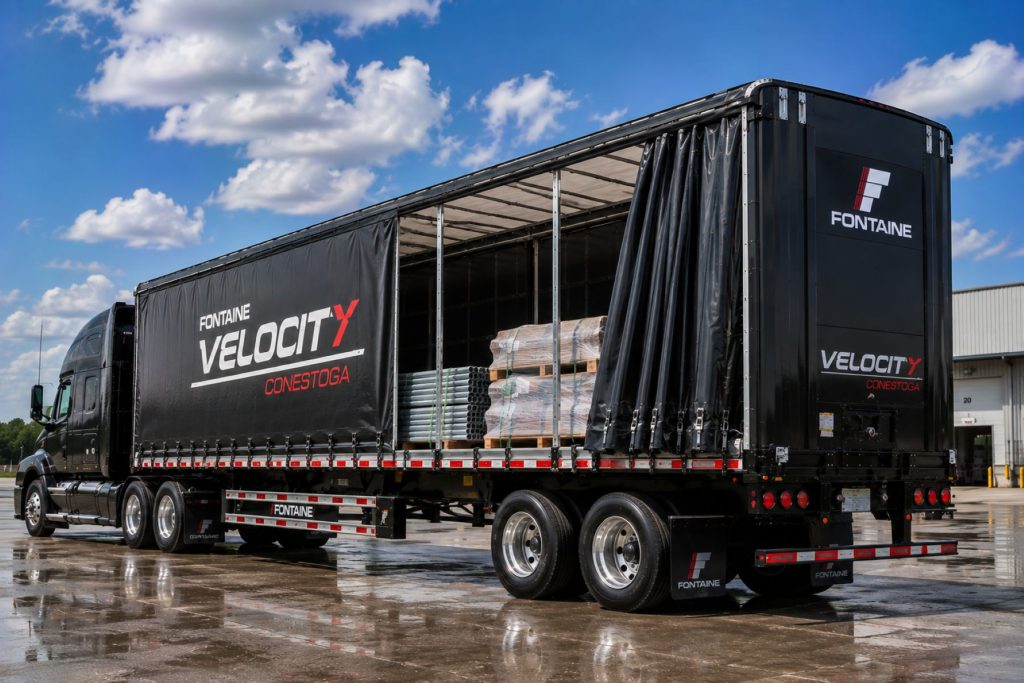
The Conestoga system is not a conventional fixed-wall trailer body. Its roof, side curtains, and supporting framework retract along rails, opening the deck for loading from the side, rear, or overhead. Once the cargo has been positioned and secured, the enclosure is pulled closed around the load.
Fontaine’s Velocity platform is available in flat-deck and drop-deck configurations. A Conestoga enclosure may be installed as part of a completed dealer or fleet specification, so exact dimensions, weight, capacity, and system design can differ between individual trailers.
The combination is especially useful for carriers that transport steel, aluminum, machinery, building products, fabricated components, lumber, and other cargo requiring flatbed loading access and weather protection.
Key Characteristics
The Fontaine Velocity Conestoga is built around the rugged steel construction of the Velocity platform. The underlying trailer carries and secures the freight, while the retractable enclosure provides environmental protection.
Unlike traditional flatbed tarps, the rolling enclosure can be opened and closed without manually lifting large, heavy tarps over the cargo. This can reduce physical strain and shorten the time required to cover and uncover a load.
With the enclosure retracted, forklifts can approach the deck from the side, and cranes can lower freight from above. This makes the trailer more flexible than most enclosed trailers during loading and unloading.
The system does not replace cargo securement. Freight must still be properly restrained with straps, chains, binders, blocking, bracing, or other equipment appropriate for the commodity.
Operators must also account for the enclosure’s internal height, width, and structural framework. Cargo that would fit on an unrestricted flatbed may be too tall or wide to fit inside the closed Conestoga system.
Common Specifications
Length Options
Fontaine Velocity platform trailers are commonly available in 48-foot and 53-foot configurations. The exact usable enclosure length depends on the rolling-tarp system and bulkhead design.
Trailer Width
A common trailer width is 102 inches. The enclosure’s framework and curtains reduce the usable internal width slightly, so operators should confirm interior clearance before accepting a load.
Flat-Deck Configurations
The flat-deck configuration provides a level cargo surface from the front to the rear of the trailer. It is commonly used for steel, lumber, building products, machinery, and general industrial freight.
Drop-Deck Configurations
A Velocity drop deck provides a lower main deck behind the upper deck. This configuration offers additional vertical clearance for taller freight but requires a Conestoga system designed specifically for the trailer’s stepped profile.
Frame Construction
Velocity trailers use steel main structural components engineered for demanding platform-trailer service. Fontaine lists an 80,000-pound distributed frame rating for many Velocity configurations, although gross axle weight ratings, tires, wheels, laws, and tractor specifications determine the usable legal payload.
Flooring
Apitong hardwood decking is common on Velocity steel trailers. Flooring thickness and exposed deck width vary by model and configuration.
Axle Arrangements
Available configurations may include closed tandem, spread axle, sliding tandem, and tridem arrangements. Axle selection affects weight distribution, maneuverability, tire wear, and compliance with regional axle-spacing laws.
Suspension
Mechanical spring and air-ride suspension configurations are available across the Velocity platform. Air ride can provide improved ride quality for sensitive freight, while spring suspension offers a durable and straightforward design.
Brake and ABS System
Commercial air brakes and trailer ABS are standard requirements. Certain Velocity configurations use a 4S/2M ABS arrangement, although equipment varies by model and order specification.
Cargo Securement
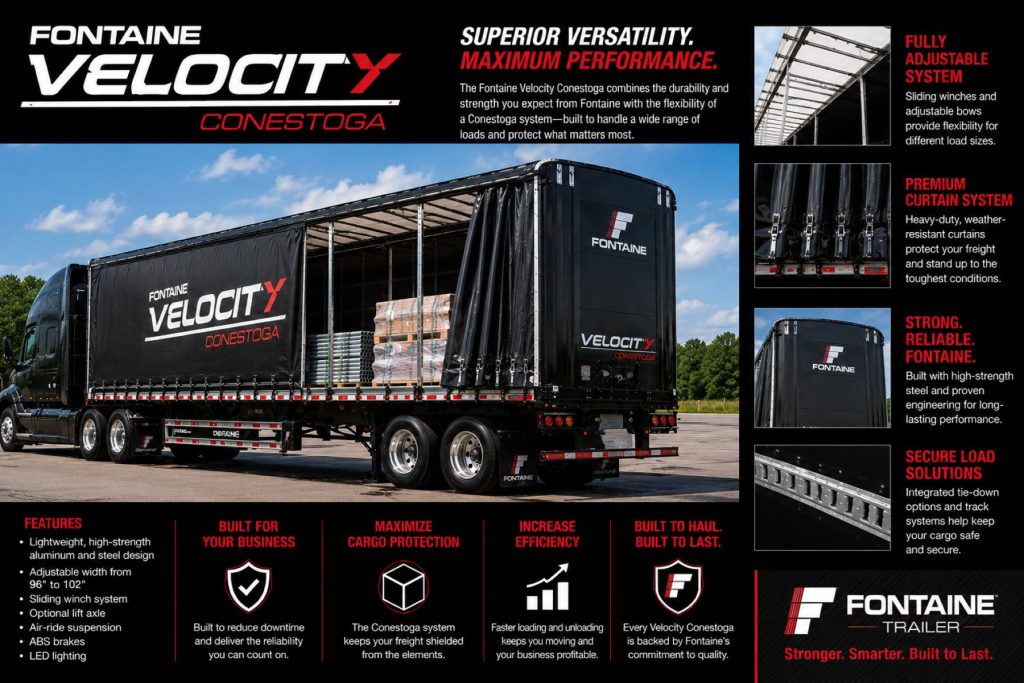
Available securement equipment may include winch tracks, sliding winches, straps, chain tie-downs, J-hooks, stake pockets, rub rails, and additional anchor points.
Conestoga Enclosure
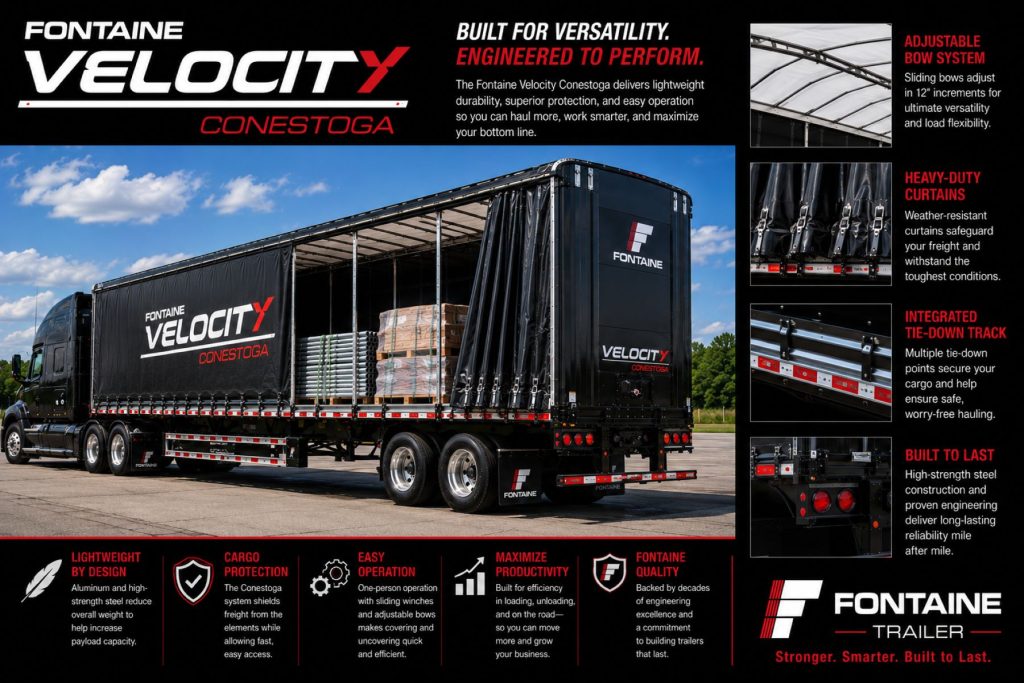
The retractable system normally includes a front bulkhead, rolling roof supports, side curtains, rear closure, tracks, rollers, tensioning components, and locking mechanisms. Specifications depend on the enclosure manufacturer and installer.
Common Applications
- Steel coils and fabricated steel products
- Aluminum products
- Lumber and building materials
- Industrial machinery
- Manufactured components
- Pipe and tubing
- Roofing and construction materials
- Weather-sensitive flatbed freight
- Palletized industrial products
- Automotive components
- Agricultural equipment and supplies
- Regional and long-haul specialized freight
Advantages
- Provides flatbed-style side and overhead loading access
- Protects freight from rain, snow, road spray, and debris
- Reduces the need to handle heavy conventional flatbed tarps
- Can shorten covering and uncovering time
- Suitable for weather-sensitive steel and machinery
- Available on flat-deck and drop-deck trailer configurations
- Offers more loading flexibility than most enclosed trailers
- Steel Velocity platform provides durable construction
- Multiple axle and suspension configurations are available
- Can improve driver working conditions during poor weather
- Creates a professional enclosed appearance when closed
- Supports regional, dedicated, and long-haul operations
Limitations or Considerations
- The enclosure adds weight and reduces available payload
- Internal height and width limit the size of covered freight
- Rolling-system components require additional maintenance
- Curtain or roof damage can allow water to reach the cargo
- The enclosure does not replace legally required load securement
- Repairs can be more specialized than conventional flatbed repairs
- Wind can complicate opening and closing the system
- Tracks must remain clean and properly aligned
- Ice and snow can interfere with roof movement
- The system generally costs more than a standard open flatbed
- Certain oversized loads cannot fit inside the enclosure
- Forklift operators must avoid striking the curtains, rails, and framework
Driver and Operator Considerations
Drivers should inspect the entire rolling enclosure before beginning a trip. The inspection should cover the curtains, roof material, bows, rollers, tracks, front bulkhead, rear closure, locks, tensioners, and weather seals.
The enclosure should be completely opened and secured before loading begins. Forklift and crane operators should understand the trailer’s clearance limitations and avoid contacting the roof supports or curtain tracks.
Cargo must be secured directly to the trailer using approved securement equipment. The curtain is designed primarily to protect the load from weather and is not normally intended to restrain shifting freight.
Before closing the system, the driver should confirm that the load fits within the enclosure and that straps, chains, binders, corners, or sharp cargo surfaces will not damage the curtain.
The enclosure must be completely closed, tensioned, and locked before the trailer enters the roadway. Drivers should recheck the system and cargo securement during required en-route inspections.
Maintenance and Ownership Notes
The Fontaine Velocity chassis requires the same preventive maintenance expected of a commercial platform trailer. Brakes, suspension, axles, wheel ends, tires, lighting, flooring, frame components, and securement equipment should be inspected regularly.
The Conestoga system adds tracks, rollers, bows, curtains, tensioners, seals, and locking hardware to the maintenance program. Dirt and debris should be removed from the tracks to prevent binding or uneven movement.
Rollers should move freely without excessive looseness. Bent tracks, damaged bows, worn bearings, or misaligned framework can make the enclosure difficult to operate and may cause additional damage.
Curtains and roof material should be inspected for punctures, tears, worn areas, loose seams, and failed seals. Small damage should be repaired before it expands or allows water into the enclosure.
The front bulkhead and rear closure should be checked for structural damage and water intrusion. Operators in winter climates should remove accumulated snow and ice before attempting to move the enclosure.
Buying Considerations
- Determine whether a flat-deck or drop-deck configuration best fits the intended freight.
- Confirm the trailer’s exact length, width, frame rating, and axle ratings.
- Measure the usable internal length, width, and height of the enclosure.
- Operate the rolling system through its complete travel range.
- Inspect the tracks for bends, corrosion, cracks, and previous repairs.
- Check every roller, bow, tensioner, latch, and locking component.
- Inspect the curtains and roof for tears, patches, leaks, and UV damage.
- Examine the bulkhead and rear closure for impact damage.
- Inspect the trailer frame for cracks, corrosion, distortion, or poor repairs.
- Check the Apitong flooring for decay, cracking, loose fasteners, and damaged boards.
- Review the condition of the brakes, suspension, axles, tires, wheels, and electrical system.
- Confirm replacement-part availability for both the Fontaine trailer and the enclosure system.
- Compare the trailer’s empty weight against the payload required by the operation.
- Review maintenance records and the installation history when purchasing used equipment.
Common Brands or Manufacturers
- Fontaine Trailer
- Aero Industries
- Reitnouer Trailers
- Benson Trailers
- Wilson Trailer
- Utility Trailer Manufacturing
- MAC Trailer
- East Manufacturing
- Great Dane
- Manac
- Transcraft Trailer
Variants and Related Configurations
- 48-Foot Velocity Flat-Deck Conestoga
- 53-Foot Velocity Flat-Deck Conestoga
- 48-Foot Velocity Drop-Deck Conestoga
- 53-Foot Velocity Drop-Deck Conestoga
- Closed-Tandem Configuration
- Spread-Axle Configuration
- Sliding-Tandem Configuration
- Tridem Configuration
- Spring-Suspension Configuration
- Air-Ride Configuration
- Full-Height Conestoga Enclosure
- Reduced-Height Conestoga Enclosure
- Fixed-Bulkhead Configuration
- Rear-Retracting Rolling-Tarp System
Comparison to Similar Trailers
Compared with a conventional Flatbed Trailer, the Fontaine Velocity Conestoga provides built-in weather protection and eliminates most manual tarping. The tradeoff is greater empty weight, higher purchase cost, reduced cargo clearance, and additional maintenance.
Compared with a dry van, the Conestoga provides much better access for side and overhead loading. A dry van may offer stronger environmental sealing and greater interior volume, but its fixed walls and roof restrict how freight can be loaded.
Compared with a curtain-side trailer, the Conestoga’s supporting framework and roof retract to expose more of the deck. A conventional curtain-side trailer generally retains a fixed roof structure when its side curtains are opened.
Compared with an aluminum Conestoga trailer, the steel Fontaine Velocity platform may weigh more but offers the durability and operating characteristics associated with Fontaine’s steel trailer line.
The Velocity Conestoga is also comparable to Conestoga-equipped platforms from Reitnouer, Benson, Wilson, MAC, Utility, and other platform-trailer manufacturers. The best choice depends on payload goals, dealer support, base-trailer construction, enclosure design, and freight requirements.
Best Fit For
- Flatbed carriers hauling weather-sensitive freight
- Steel and aluminum product carriers
- Building-material distributors
- Industrial freight operations
- Machinery transportation companies
- Dedicated manufacturing routes
- Drivers seeking an alternative to manual tarping
- Regional flatbed fleets
- Long-haul specialized carriers
- Operations requiring side or overhead loading
- Freight that needs protection but cannot be loaded easily into a dry van
- Fleets that value durable steel platform construction
Related Equipment
- Cargo Securement Systems
- Rolling-Tarp Systems
- Winches and Straps
- Chains and Load Binders
- Edge Protectors
- Trailer Bulkheads
- Brake Systems
- Suspension Systems
- Axles and Differentials
- Tires and Wheels
- Electrical Systems
- Safety Systems
- Telematics and ELD Systems
Related Freight Types
- Flatbed Freight
- Specialized and Niche Freight
- Steel Freight
- Lumber Freight
- Building Materials Freight
- Machinery Freight
- Industrial Freight
- Manufacturing Freight
- Construction Freight
- Pipe and Tubing Freight
- Automotive Components Freight
- Weather-Sensitive Open-Deck Freight
Related Trailer Types
- Flatbed Trailers
- Conestoga Trailers
- Step Deck Trailers
- Drop Deck Trailers
- Curtain-Side Trailers
- Rolling-Tarp Trailers
- Specialty Trailers
Related Trailer Models
- Fontaine Revolution Flatbed
- Fontaine Velocity Flat Deck
- Fontaine Velocity Drop Deck
- Reitnouer MaxMiser Conestoga Trailer
- Benson Conestoga Trailer
- Wilson Conestoga Trailer
- MAC Conestoga Trailer
- Utility Conestoga Trailer
- Transcraft Eagle II Conestoga
- Transcraft Eagle II Flatbed Trailer
Related Guides
- Complete Guide to Trailer Types
- Choosing the Right Trailer for Your Freight
- Flatbed vs Step Deck vs Double Drop
Regulatory and Compliance Notes
The Fontaine Velocity Conestoga must comply with federal and state commercial trailer regulations governing brakes, tires, lighting, conspicuity markings, underride protection, dimensions, axle weights, and gross vehicle weight.
Cargo inside the enclosure remains subject to applicable FMCSA cargo-securement requirements. Closing the curtain around the freight does not eliminate the need for properly rated straps, chains, binders, blocking, bracing, or other required securement devices.
Drivers must account for the enclosure’s exterior height and width when planning routes. Cargo cannot legally extend through or interfere with the closed curtain system.
Weight added by the enclosure reduces the trailer’s available cargo payload compared with an otherwise identical open flatbed. Operators should use certified scale weights and the trailer’s certification label when determining legal loading capacity.
Oversized or overweight cargo may require permits, approved routes, signs, lighting, flags, or escort vehicles. The enclosure should not be used to conceal cargo that exceeds legal dimensions.
Real World Operating Notes
In everyday operation, the Fontaine Velocity Conestoga can significantly reduce the time and physical effort involved in protecting flatbed freight. Drivers can retract the enclosure, allow the shipper to load the deck, secure the freight, and close the system without climbing over the load with conventional tarps.
The greatest operating benefits are often seen on dedicated routes carrying steel, aluminum, machinery, or building products that require frequent side loading and weather protection.
Drivers still need flatbed securement knowledge. Every load must be restrained according to its weight, shape, length, and commodity-specific requirements.
Keeping the tracks clean is essential. Gravel, ice, wood fragments, strap hooks, and other debris can stop the system from moving or damage its rollers.
Operators should avoid forcing a stuck enclosure. Resistance can indicate debris, a damaged track, misaligned bows, excessive wind pressure, or a mechanical problem that should be corrected before operation continues.
Frequently Asked Questions
What is a Fontaine Velocity Conestoga?
It is a Fontaine Velocity steel flatbed or drop-deck trailer equipped with a retractable rolling-tarp enclosure that protects cargo while preserving side, rear, and overhead loading access.
Is the Conestoga enclosure part of the trailer’s cargo securement?
No. The enclosure primarily provides weather protection. Cargo must still be secured with properly rated straps, chains, binders, blocking, bracing, or other required equipment.
What freight can a Fontaine Velocity Conestoga carry?
Common loads include steel, aluminum, lumber, machinery, building products, fabricated components, pipe, industrial materials, and other weather-sensitive flatbed freight.
Does the Fontaine Velocity Conestoga eliminate manual tarping?
It eliminates most traditional flatbed tarping because the enclosure rolls open and closed around the load. Drivers must still operate, inspect, and maintain the enclosure.
Is the Velocity Conestoga available as a step deck?
A Conestoga system can be fitted to compatible Velocity drop-deck configurations. The system must be engineered for the trailer’s stepped deck profile.
What lengths are commonly available?
The Fontaine Velocity platform is commonly offered in 48-foot and 53-foot lengths. Completed Conestoga specifications depend on the base trailer and enclosure installation.
Does the enclosure reduce payload capacity?
Yes. The bulkhead, curtains, roof supports, tracks, and operating hardware add weight compared with an open flatbed, reducing the remaining payload available within legal limits.
Can oversized freight be carried inside the enclosure?
Only when the freight fits within the enclosure and the completed vehicle remains within legal dimensions. Loads exceeding the enclosure’s clearance may require an open trailer or a different specialized configuration.
Is a Conestoga easier for drivers to operate than a conventional flatbed?
It can reduce tarping time and physical strain, but drivers still need proper cargo-securement skills and must maintain the rolling enclosure.
Availability and Where to Find
Fontaine Velocity trailers are available through Fontaine’s commercial platform dealer network. A completed Conestoga configuration may be purchased through a dealer, rolling-tarp installer, fleet-equipment supplier, or used commercial trailer marketplace.
Buyers should verify whether a listed trailer was factory ordered with the enclosure, completed by an authorized installer, or converted later in its service life. Installation quality, enclosure condition, trailer specifications, and parts support should all be reviewed before purchase.
Current Velocity configurations and dealer availability can be confirmed through Fontaine Trailer.
Support Trucking Families
Truck Equipment Atlas supports the mission of Grey Cross, a nonprofit dedicated to helping families of truck drivers who lose their lives while on the road. As the site grows, part of its mission is to bring awareness and support to these families.
Podcast or Video Section
Learn More Through Audio and Video
Truck Equipment Atlas will continue expanding with podcast episodes, interviews, and equipment breakdowns to help drivers and fleets better understand trucks and equipment.
Follow the Growth of Truck Equipment Atlas
Truck Equipment Atlas continues to expand with new truck profiles, trailer coverage, diesel engine pages, equipment system resources, manufacturer information, and educational guides.
Visit our Site Updates page to explore recent additions, project milestones, and upcoming resources as we continue building one of the industry’s growing commercial trucking equipment reference libraries.
View the Latest Site Updates: Truck Equipment Atlas Site Updates