
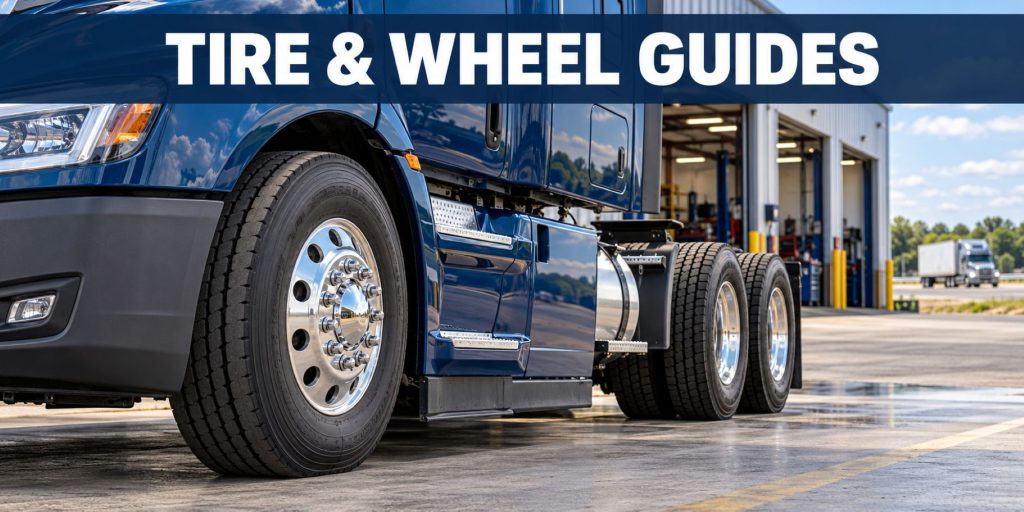
Commercial truck and trailer tires create the vehicle’s contact with the road, while wheels connect those tires to the hubs, axles, brakes, and suspension systems. Their condition and configuration directly affect traction, steering, braking, stability, fuel consumption, payload, ride quality, and roadside reliability.
The Truck Equipment Atlas Tire & Wheel Guides explain commercial tire positions, compare steer, drive, and trailer tires, identify important tire and wheel markings, outline inspection and maintenance practices, and examine the differences between aluminum and steel commercial wheels.
These guides are designed for commercial drivers, owner-operators, fleet managers, technicians, equipment buyers, CDL students, trailer operators, and anyone who wants to better understand the tires and wheels used on commercial trucks and trailers.
Explore Tire & Wheel Guides
Commercial Truck Tire Types Explained
Learn about the major tire types used on commercial trucks, tractors, trailers, buses, vocational vehicles, and specialized equipment.
This guide explains steer, drive, trailer, all-position, wide-base, regional, long-haul, mixed-service, severe-service, winter, and specialty commercial tires. It also examines tread patterns, casing construction, retreadability, rolling resistance, traction, and application matching.
Steer vs Drive vs Trailer Tires
Compare the three primary tire-position categories used on commercial tractors and semitrailers.
This guide explains how steer, drive, and trailer tires differ in tread design, traction, directional control, rolling resistance, shoulder construction, casing requirements, irregular-wear risks, and operating applications.
How to Read Commercial Truck Tire Sizes and Ratings
Learn how to identify and interpret the information molded into a commercial tire’s sidewall.
This guide covers tire width, aspect ratio, radial construction, wheel diameter, load range, single and dual load capacity, maximum cold inflation pressure, speed ratings, service descriptions, Department of Transportation identification, and manufacturing date codes.
How to Inspect and Maintain Commercial Truck Tires
Review the principal inspection and maintenance areas associated with commercial truck and trailer tires.
This guide covers inflation pressure, tread depth, irregular wear, sidewall damage, punctures, valve equipment, dual-tire spacing, embedded objects, alignment, rotation, tire repairs, casing condition, retread considerations, and warning signs requiring professional evaluation.
Aluminum vs Steel Commercial Truck Wheels
Compare aluminum and steel wheels used on commercial trucks, tractors, trailers, buses, and vocational vehicles.
This guide examines weight, payload impact, strength, corrosion resistance, appearance, purchase cost, maintenance, repair considerations, heat transfer, wheel ratings, mounting systems, and common highway and vocational applications.
What These Guides Cover
The Tire & Wheel Guides provide educational information about the components, configurations, markings, operating principles, inspection areas, maintenance requirements, and selection considerations associated with commercial truck and trailer tires and wheels.
Topics include:
- Commercial truck tire construction
- Steer tires
- Drive tires
- Trailer tires
- All-position tires
- Long-haul and regional tires
- Vocational and severe-service tires
- Wide-base single tires
- Dual-tire assemblies
- Tire sizes and sidewall markings
- Load ranges and load capacity
- Speed ratings and service descriptions
- Cold inflation pressure
- Tread depth and wear patterns
- Tire inspection and preventive maintenance
- Retreadable tire casings
- Aluminum commercial wheels
- Steel commercial wheels
- Wheel dimensions, offsets, and ratings
- Hub-piloted and stud-piloted mounting systems
- Tire-pressure monitoring systems
- Automatic tire-inflation systems
- Tire and wheel application matching
How Commercial Tires Support Vehicle Operation
Commercial tires contain reinforced casings designed to support substantial loads while flexing as the tire rotates. Compressed air inside the tire carries most of the vehicle’s load, while the casing, belts, tread, sidewalls, beads, and wheel maintain the tire’s operating shape and connection to the vehicle.
The tire’s contact patch transfers acceleration, braking, steering, and cornering forces between the vehicle and the road. Tread design, tread compound, inflation pressure, load, speed, alignment, temperature, road surface, and weather conditions all affect this interaction.
A tire must be selected for its intended wheel position and service application. A design developed for fuel-efficient highway service may not provide the cut resistance, stone rejection, traction, or casing protection required for construction, logging, refuse, mining, or mixed-service work.
Begin with Commercial Truck Tire Types Explained for a complete overview of the major tire categories.
Steer, Drive, and Trailer Tire Information
The wheel position where a tire operates influences its tread design, construction, wear patterns, and performance requirements.
Steer Tires
Steer tires are installed on the steering axle and are responsible for directional control, steering response, vehicle stability, and a significant portion of braking performance.
Steer-tire designs commonly emphasize:
- Directional stability
- Predictable steering response
- Water evacuation
- Resistance to irregular shoulder wear
- Even tread wear
- Low rolling resistance in highway applications
- Casing durability and retreadability
Drive Tires
Drive tires are installed on powered axles and transfer engine torque to the road. Drive-tire designs may use open or closed shoulders depending on the required balance between traction, fuel economy, tread life, stability, and operating environment.
Drive-tire designs commonly emphasize:
- Forward traction
- Braking traction
- Resistance to torque-related wear
- Snow, mud, or loose-surface performance
- Fuel efficiency in highway service
- Stability under load
- Casing durability
Trailer Tires
Trailer tires support the trailer and cargo without transmitting engine power or steering the vehicle. They can experience tandem-axle scrubbing, tight turns, curb contact, high lateral forces, heat, impact damage, and long storage periods.
Trailer-tire designs commonly emphasize:
- Low rolling resistance
- Resistance to lateral scrub
- Even wear across the tread
- Casing durability
- Heat management
- Resistance to impacts and curb damage
- Retreadability
Read Steer vs Drive vs Trailer Tires for the complete position comparison.
Commercial Tire Size and Rating Information
Commercial tire sidewalls contain identification and operating information that must be interpreted correctly when selecting, replacing, inflating, or inspecting a tire.
The tire guides explain:
- Nominal tire width
- Aspect ratio
- Radial construction designation
- Wheel diameter
- Load range
- Single-tire load capacity
- Dual-tire load capacity
- Maximum cold inflation pressure
- Service description
- Speed rating
- Department of Transportation identification
- Tire manufacturing date code
- Approved wheel-width information
A tire’s dimensions do not independently establish compatibility. Tire selection must also account for wheel dimensions, load capacity, inflation requirements, axle rating, vehicle clearance, operating speed, duty cycle, and manufacturer application information.
Visit How to Read Commercial Truck Tire Sizes and Ratings for the complete guide.
Commercial Tire Inspection and Maintenance Information
Regular inspection and pressure maintenance help identify conditions that can affect tire performance, vehicle control, fuel consumption, casing life, and roadside reliability.
Important inspection areas include:
- Cold inflation pressure
- Tread depth
- Uneven or irregular tread wear
- Cuts, cracks, bulges, and exposed material
- Embedded stones, nails, and other objects
- Tread separation or casing distortion
- Valve stems, valve extensions, and valve caps
- Dual-tire matching and spacing
- Objects trapped between dual tires
- Signs of excessive heat
- Evidence of underinflation or overloading
- Alignment-related wear
- Repair condition and casing integrity
- Tire-pressure monitoring or inflation-system warnings
Inflation pressure should be evaluated when the tire is cold and according to verified load, tire, vehicle, and manufacturer requirements. A tire that is hot, damaged, overloaded, rapidly losing pressure, or showing signs of structural failure requires appropriate professional evaluation.
Visit How to Inspect and Maintain Commercial Truck Tires for the complete inspection and maintenance guide.
Aluminum and Steel Wheel Information
Commercial truck and trailer wheels are commonly manufactured from aluminum or steel. Each material offers different characteristics involving weight, cost, appearance, corrosion resistance, repair practices, and operating application.
Aluminum Wheels
Aluminum wheels are generally lighter than comparable steel wheels. Reducing wheel weight may lower unsprung weight or increase available payload, depending on the vehicle and complete configuration.
Potential aluminum-wheel considerations include:
- Lower wheel weight
- Potential payload benefit
- Corrosion resistance
- Polished or treated appearance
- Higher initial purchase cost
- Application-specific refinishing and repair limitations
- Special cleaning and appearance maintenance
Steel Wheels
Steel wheels are widely used because of their strength, availability, service familiarity, and generally lower initial purchase cost.
Potential steel-wheel considerations include:
- Broad commercial availability
- Established repair and replacement support
- Lower initial purchase cost
- Higher weight than many comparable aluminum wheels
- Protective-coating maintenance
- Potential corrosion in demanding environments
Wheel material alone does not establish suitability. Size, offset, bolt pattern, mounting system, load rating, tire compatibility, brake clearance, hub compatibility, and fastener requirements must also be verified.
Read Aluminum vs Steel Commercial Truck Wheels for the full comparison.
Tire Pressure Monitoring and Inflation Systems
Tire-pressure monitoring systems can alert drivers or fleet personnel when tire pressure or temperature moves outside programmed limits. Depending on the system, information may be displayed in the cab, transmitted to a fleet platform, or recorded for maintenance review.
Automatic tire-inflation systems can deliver air to supported wheel positions to help maintain pressure within an intended operating range. These systems are especially common on commercial trailers but may also be available for tractors and specialized equipment.
Monitoring and inflation systems do not replace physical inspection. A tire may still require immediate service because of punctures, casing damage, tread separation, wheel damage, valve problems, bearing problems, dragging brakes, or excessive heat.
Explore the Tire Pressure Monitoring & Inflation Systems section for related equipment and product profiles.
Who These Guides Are For
The Tire & Wheel Guides are designed for:
- Commercial truck drivers
- Owner-operators
- Fleet managers
- Tire and wheel technicians
- Truck and trailer inspectors
- Maintenance managers
- Equipment buyers
- Truck and trailer dealers
- Safety managers and driver trainers
- Highway and regional carriers
- Vocational and severe-service operators
- Heavy-haul operators
- CDL students
- Anyone learning about commercial tires and wheels
How to Use the Tire & Wheel Guides
- Begin with Commercial Truck Tire Types Explained to understand the major tire categories and applications.
- Use Steer vs Drive vs Trailer Tires when comparing the three principal wheel-position categories.
- Read How to Read Commercial Truck Tire Sizes and Ratings when identifying tire dimensions, capacity, inflation information, and service markings.
- Consult How to Inspect and Maintain Commercial Truck Tires for inspection areas, preventive maintenance, wear patterns, and warning signs.
- Use Aluminum vs Steel Commercial Truck Wheels when comparing wheel materials, weight, cost, maintenance, and application fit.
Related Guide Libraries
- Truck Guides
- Trailer Guides
- Brake System Guides
- Suspension System Guides
- Axle and Differential Guides
- Fifth Wheel & Coupling Equipment Guides
- Equipment System Guides
Related Equipment Systems
- Tires & Wheels
- Suspension Systems
- Brake Systems
- Axles & Differentials
- Electrical Systems
- Telematics & ELD Systems
- Safety Systems
Tire & Wheel Guide Library Expansion
Truck Equipment Atlas will continue expanding its tire and wheel guide library as additional technologies, manufacturers, maintenance subjects, operating practices, and vehicle applications are added.
Future guides may cover:
- Commercial tire inflation and load management
- Wide-base single tires vs dual tires
- Long-haul vs regional commercial tires
- Open-shoulder vs closed-shoulder drive tires
- Commercial tire retreading
- Common commercial tire wear patterns
- Commercial truck wheel mounting systems
- Hub-piloted vs stud-piloted wheels
- Tire-pressure monitoring systems
- Automatic tire-inflation systems
- Vocational and severe-service tire selection
- Winter commercial truck tires
- Commercial tire repair and casing evaluation
- Wheel inspection and fastener maintenance
Follow the Growth of Truck Equipment Atlas
Truck Equipment Atlas continues to expand with new truck profiles, trailer coverage, diesel engine pages, equipment-system resources, manufacturer information, and educational guides.
Visit the Truck Equipment Atlas Site Updates page to explore recent additions, project milestones, and upcoming resources.