
Meritor 17X Drive Axle
Quick Facts
- Manufacturer: Meritor, now part of Cummins
- Equipment Type: Heavy-Duty Single Rear-Drive Axle
- Current Version: Meritor 17X HE
- Axle Configuration: Single Drive Axle
- Common Vehicle Configurations: 4×2 and 6×2
- Gross Axle Weight Rating: 23,000 pounds in 4×2 applications and 20,000 pounds in 6×2 applications
- Gross Combination Weight Rating: Up to 140,000 pounds
- Ring-Gear Diameter: 18 inches
- Available Axle Ratios: 2.06 to 3.36
- Differential Lock: Optional
- Primary Applications: Line-Haul and Regional Highway Trucks
- Production Status: Current Commercial Axle Platform
Overview
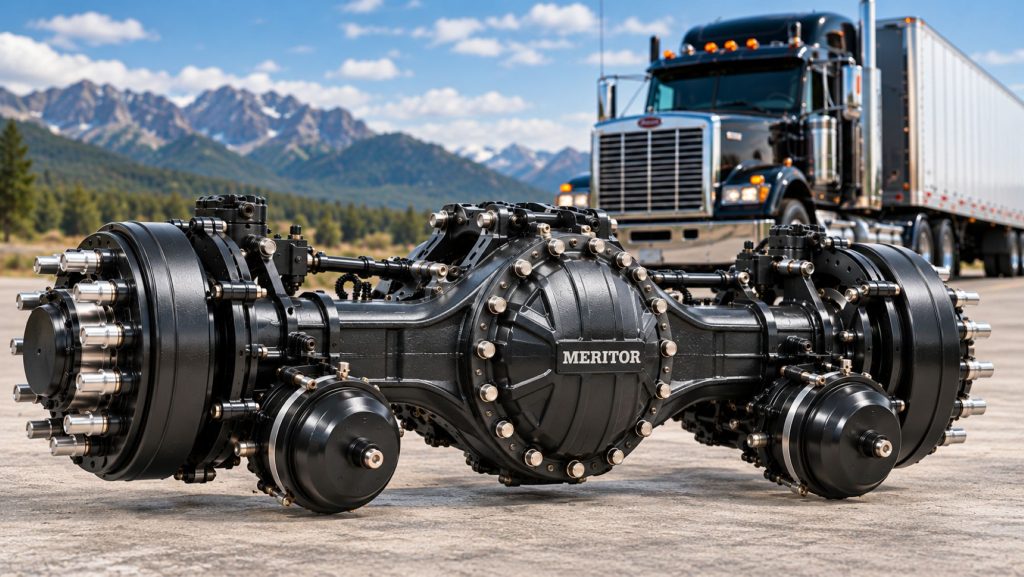
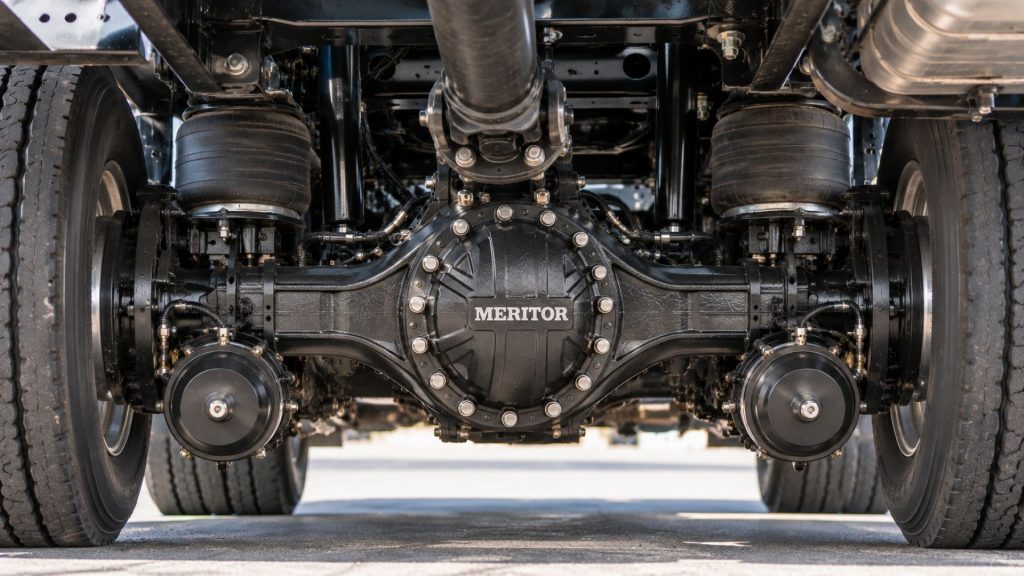
The Meritor 17X Drive Axle is a heavy-duty single rear-drive axle developed for highway tractors using 4×2 or 6×2 configurations. The current version is known as the Meritor 17X HE, with HE standing for High Efficiency.
Unlike a conventional tandem-drive system that sends power to two rear axles, the 17X sends power through one drive axle. In a 6×2 truck, the second rear axle normally functions as a non-driven tag axle that helps support and distribute vehicle weight.
The 17X HE combines an 18-inch ring gear with fast axle ratios, high-efficiency bearings, reduced lubricant volume, and the Meritor Lube Management System. These features are designed to reduce internal power loss and improve fuel efficiency in high-mileage highway operations.
The axle belongs to the larger family of commercial truck drive axles used to transfer engine power from the driveshaft to the drive wheels.
Key Characteristics
- Single rear-drive axle design
- Approved for 4×2 solo-axle applications
- Approved for 6×2 drive-and-tag-axle applications
- 18-inch ring gear
- Gross axle weight rating of up to 23,000 pounds
- Gross combination weight rating of up to 140,000 pounds
- Fast axle ratios beginning at 2.06
- High-efficiency bearings
- Meritor Lube Management System
- Reduced lubricant volume
- Laser-welded ring gear and differential case
- Optional driver-controlled differential lock
- Automatic differential-lock capability
- Standard and DualTrac housing configurations
- Designed primarily for line-haul highway operation
How the Axle or Differential Works
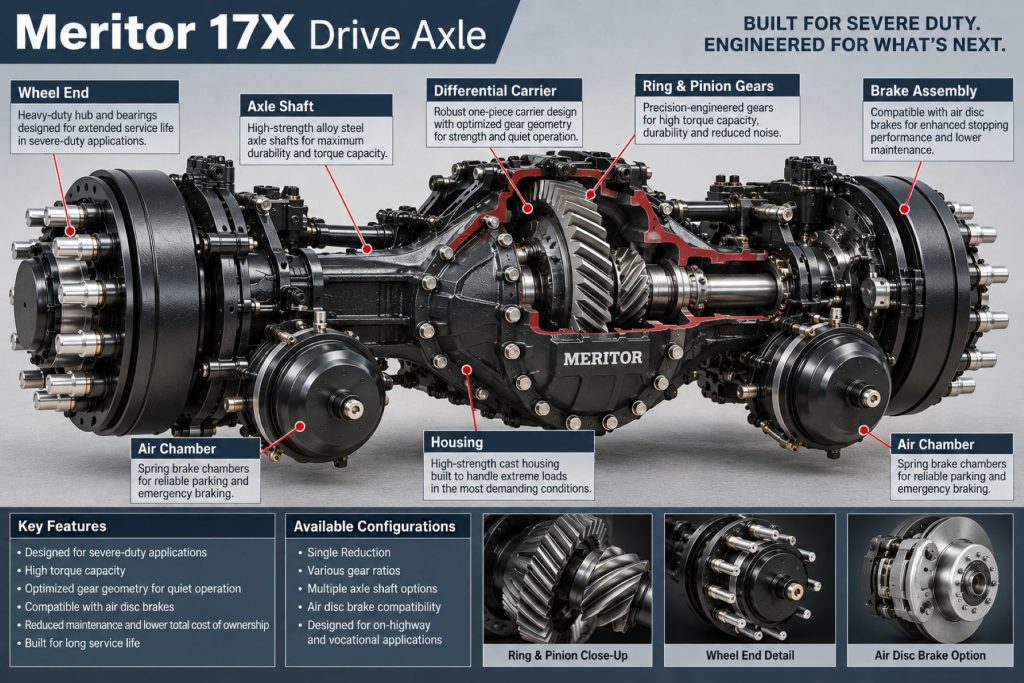
Power produced by the engine passes through the transmission and main driveshaft before entering the 17X carrier through its driveline flange.
Inside the carrier, the drive pinion turns the larger ring gear. This changes the direction of power flow and provides the final mechanical gear reduction before torque reaches the axle shafts.
The wheel differential distributes power between the left and right drive wheels while allowing them to rotate at different speeds during turns. This differential action prevents excessive tire scrub and driveline binding during normal operation.
The operating sequence is:
- Engine produces torque
- Transmission selects the required gear
- Driveshaft carries power to the axle
- Pinion gear turns the ring gear
- Differential distributes torque between the drive wheels
- Axle shafts transfer power to the wheel ends
- Drive tires transfer power to the road
In a 6×2 configuration, the 17X powers one rear axle while a non-driven tag axle supports additional weight. Unlike a 6×4 tandem-drive system, a 6×2 configuration does not require an inter-axle differential to divide power between two drive axles.
Learn more in How Commercial Truck Axles and Differentials Work.
Axle Position and Function
The Meritor 17X can serve as the truck’s only rear axle in a 4×2 configuration or as the driven member of a two-axle rear suspension in a 6×2 configuration.
In a 4×2 truck, the vehicle normally has:
- One front steer axle
- One rear drive axle
- Four primary wheel positions
In a 6×2 truck, the vehicle normally has:
- One front steer axle
- One rear drive axle
- One non-driven tag axle
- Six primary wheel positions
Depending on the specific 6×2 system, the drive axle may be positioned ahead of or behind the non-driven axle. Suspension and load-management systems may transfer weight toward the drive axle when additional traction is needed.
Common Specifications
- GAWR for 4×2 Applications: 23,000 pounds
- GAWR for 6×2 Applications: 20,000 pounds
- Highway GCWR: Up to 140,000 pounds
- Ring-Gear Pitch Diameter: 18 inches
- Available Ratios: 2.06, 2.17, 2.31, 2.47, 2.64, 2.85, 3.08, and 3.36
- Differential Lock: Optional
- Pinion Spline: 2.75 inches with 21 teeth
- Pinion Vertical Offset: 20 millimeters
- Driveline Connection: 180 KV flange
- Housing Box Size: Approximately 5.25 by 4.62 inches
- Housing Thickness: Approximately 0.5 inch
- Housing Options: Standard and DualTrac
Exact specifications depend on the axle version, truck manufacturer, model year, suspension, brakes, tires, wheel ends, and intended application.
Axle Ratios and Gearing
The current Meritor 17X HE is available with axle ratios ranging from 2.06 to 3.36.
Available ratios include:
- 2.06
- 2.17
- 2.31
- 2.47
- 2.64
- 2.85
- 3.08
- 3.36
The 2.06 and 2.17 ratios are exceptionally fast ratios intended to support downsped highway powertrains. Downspeeding allows the engine to operate at a lower RPM while maintaining normal highway speed.
Potential advantages of faster ratios include reduced engine speed, lower noise, reduced fuel consumption, and improved highway efficiency. However, faster gearing also provides less mechanical torque multiplication.
The correct ratio depends on the engine, transmission, tire diameter, gross combination weight, operating speed, terrain, startability requirements, and expected grade conditions.
Learn more in Commercial Truck Axle Ratios Explained.
Differential and Traction Options
The 17X uses a wheel differential to distribute torque between the left and right drive wheels. An optional differential lock can provide additional traction when one side of the axle encounters a slippery surface.
Depending on the configuration, traction equipment may include:
- Standard wheel differential
- Optional driver-controlled differential lock
- Automatic differential-lock capability
- Electronic traction-control integration
- Load-transfer assistance in 6×2 applications
An automatic or driver-controlled differential lock can improve traction, but it does not turn a 6×2 truck into a 6×4 tandem-drive truck. Only one rear axle continues to receive engine power.
Differential locks must be operated according to manufacturer instructions. Improper use on dry, high-traction pavement can cause tire scrub, driveline binding, difficult steering, and component damage.
Brake and Wheel-End Options
The current 17X HE may be configured with Meritor EX+ air disc brakes and reduced-copper brake pads. Exact brake and wheel-end options depend on the truck manufacturer and vehicle specification.
Available equipment may include:
- Meritor EX+ air disc brakes
- ABS wheel-speed sensors
- Electronic stability-control integration
- Conventional wheel ends
- Preset or unitized wheel ends
- Dual-wheel configurations
- Wide-base single-tire configurations
- Standard housing
- DualTrac housing
Brake capacity, tire ratings, wheel-end capacity, and suspension ratings must be matched with the axle and complete vehicle specification.
Common Applications
- Long-haul dry van freight
- Long-haul refrigerated freight
- Regional highway freight
- Dedicated freight operations
- High-mileage fleet tractors
- Intermodal highway transportation
- Highway tanker operations
- Highway flatbed operations
- Fuel-efficiency-focused fleets
- Weight-sensitive freight operations
- 6×2 fleet tractors
- 4×2 single-drive tractors
Truck, Suspension, and Drivetrain Compatibility
The Meritor 17X is designed for heavy-duty highway trucks using 4×2 or 6×2 configurations.
Potential truck compatibility includes properly specified versions of:
- Freightliner Cascadia
- International LT Series
- Kenworth T680
- Peterbilt 579
- Volvo VNL
- Western Star 57X
The axle may be paired with:
- Manual transmissions
- Automated manual transmissions
- Direct-drive transmissions
- Overdrive transmissions
- Highway air suspensions
- 6×2 load-transfer systems
- Non-driven tag axles
- Dual drive tires
- Wide-base single tires
Compatibility must be confirmed using the truck manufacturer’s specifications for the exact model, model year, suspension, engine, transmission, and duty cycle.
Advantages
- Lower drivetrain weight than many 6×4 tandem-drive configurations
- Reduced mechanical drag because only one rear axle is driven
- Fast ratios that support downsped powertrains
- Potential fuel-efficiency improvements in highway service
- Up to approximately one percent efficiency improvement over the earlier 17X EVO
- Reduced lubricant volume
- Lower lubricant-churning losses
- High-efficiency bearings
- Meritor Lube Management System
- Large 18-inch ring gear
- Up to 140,000-pound gross combination weight rating
- Optional differential lock
- Standard and DualTrac housing options
- Suitable for 4×2 and 6×2 highway trucks
Limitations or Considerations
- Only one rear axle receives engine power
- A 6×2 configuration generally provides less low-traction capability than a 6×4 tandem drive
- Fast ratios require careful powertrain matching
- Not intended to replace severe-service or heavy vocational axles
- Traction can depend heavily on proper suspension load transfer
- Incorrect weight distribution can reduce drive-tire traction
- Extreme off-road or loose-surface operation may favor a 6×4 configuration
- Mismatched drive tires can affect differential operation
- The lowest numerical ratio is not automatically the most efficient choice
- Approved lubricant and maintenance requirements must be followed
- Vehicle availability depends on the truck manufacturer and model year
Driver and Operator Experience
Drivers may notice lower engine RPM and quieter highway operation when the 17X is paired with a properly matched downsped powertrain.
A 6×2 truck may feel similar to a conventional 6×4 tractor during normal dry-pavement operation. Differences become more noticeable during snow, ice, mud, loose gravel, steep loading ramps, or other low-traction conditions.
Drivers should understand:
- Which rear axle is driven
- How the differential lock operates
- Whether an automatic differential lock is installed
- How the suspension load-transfer system operates
- When the tag axle can be unloaded or lifted
- How axle-weight distribution affects traction
- When traction controls should be engaged
- The truck’s axle and combination weight limits
Maintenance and Ownership Notes
Routine maintenance should include:
- Checking axle lubricant level
- Using the approved lubricant
- Following the specified lubricant-change interval
- Inspecting the axle housing and carrier for leaks
- Checking the pinion seal
- Inspecting wheel seals
- Monitoring wheel-bearing condition
- Keeping the axle breather clear
- Inspecting the driveshaft and universal joints
- Testing differential-lock operation
- Monitoring axle temperature
- Inspecting suspension components
- Checking axle alignment
- Maintaining correct tire inflation
- Keeping tires properly matched
- Inspecting 6×2 load-transfer components
The reduced lubricant volume makes correct lubricant level and specification especially important. Maintenance requirements can vary according to axle version, lubricant, duty cycle, truck manufacturer, and warranty coverage.
Common Axle or Differential Problems
- Pinion-seal leaks
- Wheel-seal leaks
- Low or contaminated lubricant
- Blocked axle breather
- Ring-and-pinion wear
- Carrier-bearing wear
- Pinion-bearing wear
- Differential-lock actuator failure
- Damaged axle shafts
- Excessive gear backlash
- Wheel-end overheating
- Driveshaft or universal-joint vibration
- Axle misalignment
- Uneven drive-tire wear
- Reduced traction caused by improper load transfer
- Damage caused by incorrect tire matching
Identification Information
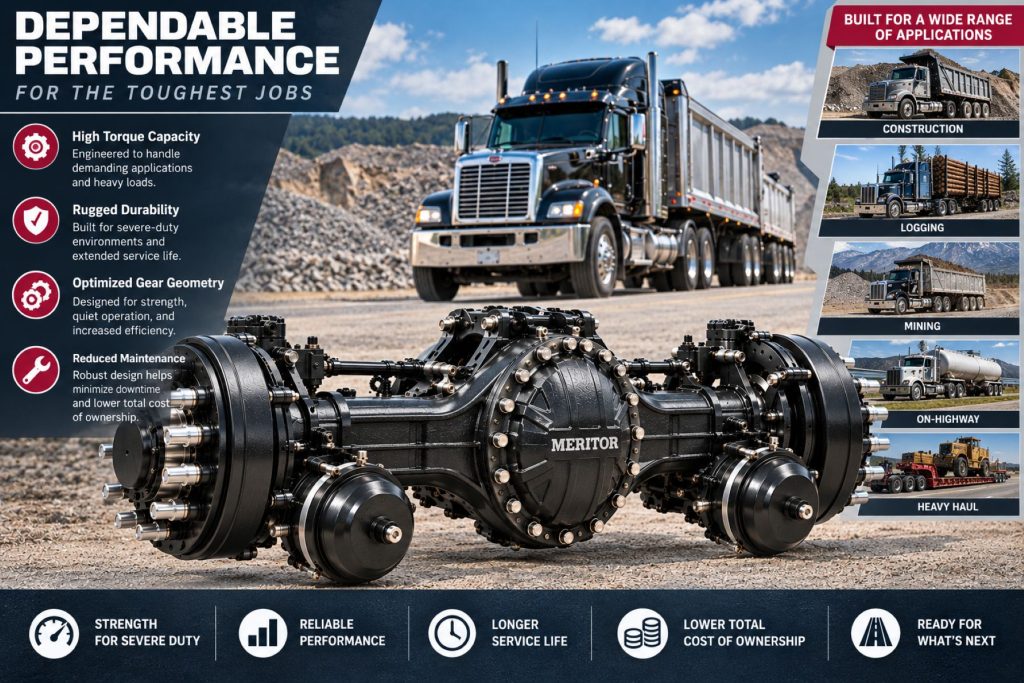
The axle should be identified using the manufacturer tag or specification label attached to the axle housing or carrier.
Identification information may include:
- Meritor manufacturer name
- 17X, 17X EVO, or 17X HE model designation
- Axle model number
- Axle specification number
- Customer or OEM part number
- Axle ratio
- Serial number
- Manufacturing date
- Carrier assembly number
- Housing configuration
- Brake information
- Wheel-end information
- Differential-lock designation
Do not identify the axle using appearance alone. Similar Meritor axle housings may contain different carriers, ratios, ratings, and internal components.
Use How to Identify a Truck Axle or Differential when documenting an existing truck or ordering replacement parts.
Buying Considerations
- Confirm whether the axle is a 17X, 17X EVO, or 17X HE
- Verify the complete model and specification numbers
- Confirm whether the truck uses a 4×2 or 6×2 configuration
- Verify the axle’s gross axle weight rating
- Confirm the gross combination weight rating
- Identify the installed axle ratio
- Check engine-torque compatibility
- Verify transmission gearing
- Confirm tire size and revolutions per mile
- Determine whether the truck uses direct-drive or overdrive gearing
- Verify the suspension and load-transfer system
- Confirm whether a differential lock is installed
- Identify the brake and wheel-end configuration
- Review lubricant and maintenance records
- Inspect the carrier and housing for leaks
- Listen for whining, humming, or clunking
- Check the lubricant for contamination or metal debris
- Inspect drive tires for uneven wear
- Confirm parts and service availability
- Evaluate whether a 6×2 or 4×2 configuration provides sufficient traction for the operation
Variants and Configurations
- Meritor 17X legacy configurations
- Meritor 17X EVO
- Meritor 17X HE
- 4×2 solo rear-drive configuration
- 6×2 drive-and-tag configuration
- FUELite+ 6×2 configuration
- Axle ratios from 2.06 to 3.36 on the current 17X HE
- Standard wheel differential
- Optional driver-controlled differential lock
- Automatic differential-lock-capable configuration
- Standard housing
- DualTrac housing
- Dual-wheel configuration
- Wide-base single-tire configuration
- Different OEM suspension and wheel-end packages
- Specifications and availability vary between the original 17X, 17X EVO, and current 17X HE platforms.
Comparison to Similar Equipment
The Meritor 17X is larger and more heavily rated than many conventional single-drive axles. Its 18-inch ring gear and high gross combination weight rating support demanding highway applications while retaining the efficiency benefits of a single driven rear axle.
Compared with the Meritor 14X Tandem Drive Axle, the 17X normally powers only one rear axle instead of two.
The 17X may provide:
- Lower drivetrain weight
- Reduced internal friction
- Reduced lubricant requirements
- Improved highway efficiency
- Simpler power flow
- The tandem-drive 14X may provide:
- Better low-traction performance
- Power to both rear axles
- Greater suitability for mixed highway and vocational operation
- More flexibility for severe terrain
- A broader selection of deeper axle ratios
The better choice depends on freight weight, road conditions, terrain, traction requirements, fuel-efficiency priorities, and fleet operating practices.
Best Fit For
- Long-haul highway tractors
- Regional highway tractors
- High-mileage fleets
- Fuel-efficiency-focused operations
- 6×2 truck configurations
- 4×2 single-drive configurations
- Downsped powertrains
- Weight-sensitive freight operations
- Dry van freight
- Refrigerated freight
- Dedicated transportation
- Primarily paved-road operations
Related Truck Types
Related Truck Models
- Freightliner Cascadia
- International LT Series
- Kenworth T680
- Peterbilt 579
- Volvo VNL
- Western Star 57X
Related Axle and Differential Types
- Commercial Truck Drive Axles
- Truck Differentials
- Axles and Differentials
- Meritor 14X Tandem Drive Axle
Related Equipment Systems
Related Guides
- How Commercial Truck Axles and Differentials Work
- Commercial Truck Axle Ratios Explained
- Single Axle vs Tandem Axle Trucks
Regulatory and Compliance Notes
The axle’s mechanical rating does not automatically determine how much weight the truck can legally carry.
Legal operating limits depend on:
- Federal bridge-formula requirements
- State axle-weight regulations
- Axle spacing
- Tire load ratings
- Wheel and wheel-end ratings
- Suspension capacity
- Brake capacity
- Truck manufacturer ratings
- Gross vehicle weight rating
- Gross combination weight rating
- Permit requirements
A 6×2 truck must also maintain sufficient legal weight on its drive axle for traction while keeping every axle and component within its approved rating.
Real World Operating Notes
The Meritor 17X is most beneficial in high-mileage highway operations where reduced drivetrain weight and friction can produce measurable savings across a large fleet.
Its fast axle ratios work best when the entire powertrain has been engineered around lower cruising RPM. Selecting an extremely fast ratio without considering startability, tire size, transmission gearing, terrain, and gross combination weight can lead to poor performance.
In 6×2 applications, correct weight distribution is essential. A lightly loaded drive axle may lose traction even when the truck remains within its overall legal weight limits.
Fleets operating primarily on maintained highways may benefit from the 17X’s efficiency. Fleets regularly entering construction sites, logging roads, muddy yards, steep loading areas, or snow-covered routes should carefully compare a 6×2 configuration with a conventional 6×4 tandem-drive truck.
Frequently Asked Questions
What is the Meritor 17X Drive Axle?
The Meritor 17X is a heavy-duty single rear-drive axle designed for 4×2 and 6×2 highway trucks. The current high-efficiency version is called the 17X HE.
How much weight can the Meritor 17X HE support?
It is rated at 23,000 pounds in 4×2 applications and 20,000 pounds when used as the drive axle in a 6×2 application.
What is the gross combination weight rating?
The current 17X HE has a highway gross combination weight rating of up to 140,000 pounds.
What axle ratios are available?
The current axle offers ratios of 2.06, 2.17, 2.31, 2.47, 2.64, 2.85, 3.08, and 3.36.
Is the Meritor 17X a tandem-drive axle?
No. The 17X is a single drive axle. In a 6×2 truck, it operates alongside a non-driven tag axle.
Is a differential lock available?
Yes. A differential lock is optional, and automatic differential-lock capability may be available in certain configurations.
Is the Meritor 17X suitable for downspeeding?
Yes. Its fast axle ratios are specifically suited to properly matched downsped highway powertrains.
Is a 6×2 truck as good in snow as a 6×4 truck?
A 6×2 truck generally has less available drive-wheel traction because only one rear axle receives power. Differential locks, traction control, and suspension load transfer can help, but they do not create a second drive axle.
What is the difference between the 17X EVO and 17X HE?
The 17X HE adds newer efficiency-focused features, including reduced lubricant volume, the Meritor Lube Management System, high-efficiency bearings, and faster available axle ratios.
Is the Meritor 17X appropriate for vocational work?
It is primarily designed for highway applications. Operations involving severe shock loading, regular off-road travel, or extreme vocational service may require a different axle platform.
Availability and Where to Find
The Meritor 17X HE is available through participating commercial truck manufacturers and their dealership networks for approved 4×2 and 6×2 highway applications.
Replacement carriers, differential components, seals, bearings, brakes, wheel-end parts, and service information may be available through Cummins-Meritor distributors and authorized commercial truck parts providers.
Availability depends on the truck manufacturer, model, model year, suspension, powertrain, axle configuration, and customer specifications.
Manufacturer Information: Meritor 17X HE Single Rear-Drive Axle
Support Trucking Families
Truck Equipment Atlas supports the mission of Grey Cross, a nonprofit dedicated to helping families of truck drivers who lose their lives while on the road. As the site grows, part of its mission is to bring awareness and support to these families.
Podcast or Video Section
Learn More Through Audio and Video
Truck Equipment Atlas will continue expanding with podcast episodes, interviews, and equipment breakdowns to help drivers and fleets better understand trucks and equipment.
Follow the Growth of Truck Equipment Atlas
Truck Equipment Atlas continues to expand with new truck profiles, trailer coverage, diesel engine pages, equipment system resources, manufacturer information, and educational guides.
Visit our Site Updates page to explore recent additions, project milestones, and upcoming resources as we continue building one of the industry’s growing commercial trucking equipment reference libraries.
View the Latest Site Updates: Truck Equipment Atlas Site Updates