
Single Axle vs Tandem Axle Trucks
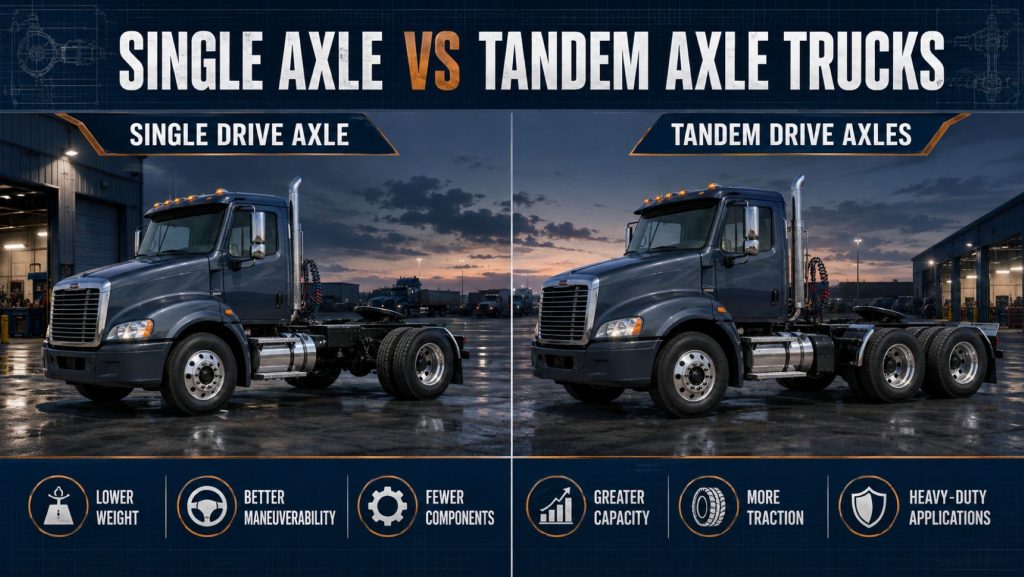
The difference between a single-axle truck and a tandem-axle truck centers on the number and arrangement of rear axles beneath the vehicle.
A single-axle truck normally has one rear axle, while a tandem-axle truck has two rear axles positioned close together. On powered trucks and tractors, these are commonly described as single-drive and tandem-drive configurations.
The number of rear axles affects load capacity, traction, vehicle weight, maneuverability, tire count, maintenance costs, purchase price, and the types of work the truck can perform.
This guide compares single- and tandem-axle commercial trucks and explains where each configuration works best.
What Is a Single-Axle Truck?
A single-axle truck has one rear axle or one primary rear axle position.
Most single-axle tractors and powered straight trucks use:
- One front steer axle
- One rear drive axle
This is commonly called a 4×2 configuration. The first number represents the vehicle’s primary wheel positions, while the second represents the powered wheel positions.
A single rear drive axle supports the rear of the truck and transfers power from the engine and transmission to the drive wheels.
Single-axle configurations are commonly found on:
- Local delivery trucks
- Box trucks
- Beverage trucks
- Utility trucks
- Service trucks
- Municipal trucks
- Medium-duty dump trucks
- School buses
- Shuttle buses
- Yard tractors
- Day cab tractors
- Short-haul tractors
- Light vocational trucks
Some trucks may have one drive axle plus a nonpowered auxiliary axle. Although the vehicle has more than one rear axle, it may still have only one powered drive axle.
What Is a Tandem-Axle Truck?
A tandem-axle truck has two rear axles positioned as one axle group.
Most heavy-duty tandem tractors use:
- One front steer axle
- One forward-rear drive axle
- One rear-rear drive axle
This is commonly described as a 6×4 configuration because the truck has three primary axle positions and two powered rear axles.
Tandem-drive configurations are widely used on:
- Long-haul tractors
- Regional-haul tractors
- Heavy-duty day cabs
- Dump trucks
- Concrete mixers
- Refuse trucks
- Logging trucks
- Heavy wreckers
- Oilfield trucks
- Heavy-haul tractors
- Severe-service vehicles
A tandem group may also contain one powered axle and one nonpowered axle. The truck’s appearance alone does not confirm that both rear axles are driven.
Single-Drive Axle vs Tandem-Drive Axles
The most important distinction is not simply the number of axles—it is how many of those axles receive power.
Single-Drive Configuration
In a conventional single-drive truck, power follows this path:
- The engine produces torque.
- The transmission selects the operating ratio.
- The driveshaft transfers torque to the rear axle.
- The drive pinion turns the ring gear.
- The differential distributes torque between the axle shafts.
- The axle shafts turn the drive wheels.
All propulsion torque delivered to the rear of the truck passes through one drive axle.
Tandem-Drive Configuration
In a conventional tandem-drive truck, power enters the forward-rear axle first.
An inter-axle differential or power-divider assembly distributes torque between:
- The forward-rear drive axle
- The rear-rear drive axle
A short inter-axle driveshaft carries power from the forward-rear axle to the rear-rear axle.
Each drive axle also contains its own wheel differential for distributing torque between the left and right wheels.
Single-Axle and Tandem-Axle Comparison
| Consideration | Single-Axle Truck | Tandem-Axle Truck |
|---|---|---|
| Rear axle arrangement | One primary rear axle | Two rear axles grouped together |
| Powered axles | Usually one | Usually two on a tandem-drive truck |
| Vehicle weight | Lower | Higher |
| Load-carrying capability | Lower | Higher |
| Traction | Less available drive-tire contact | More available drive-tire contact |
| Maneuverability | Generally better | Requires more turning space |
| Tire count | Fewer | More |
| Brake and wheel-end count | Fewer | More |
| Maintenance costs | Generally lower | Generally higher |
| Purchase price | Generally lower | Generally higher |
| Fuel consumption | Can be lower in lighter applications | Can be higher because of weight and driveline losses |
| Common use | Local and medium-duty work | Heavy-duty, highway, and vocational work |
Actual performance and capacity depend on the complete truck specification.
Load-Carrying Capacity
A tandem-axle truck can generally support more weight than a comparable single-axle truck because the load is distributed across two rear axles instead of one.
However, axle count alone does not determine legal or mechanical capacity.
The truck’s allowable weight may be limited by:
- Gross axle weight ratings
- Gross vehicle weight rating
- Gross combination weight rating
- Axle spacing
- Suspension ratings
- Brake capacity
- Wheel ratings
- Tire load ratings
- Frame capacity
- Federal, state, or provincial regulations
- Bridge-weight formulas
- Permit requirements
A mechanically capable axle may not be allowed to carry its maximum rated weight on every public road.
Vehicle Weight and Payload
A single-axle truck is normally lighter than a comparable tandem-axle model.
A tandem configuration adds:
- A second axle housing
- Additional differential components
- Another driveshaft
- Additional suspension components
- More wheel hubs and bearings
- More brakes
- Additional wheels and tires
- More lubricant
- Additional frame and mounting structure
This additional equipment reduces the amount of the vehicle’s gross weight rating available for cargo.
For operations that do not require tandem capacity, a single axle may provide better payload efficiency because the truck carries less equipment weight.
For heavier operations, the tandem’s increased axle capacity can outweigh the penalty of its additional weight.
Traction
Tandem-drive trucks generally provide greater traction because engine torque can reach more drive tires.
This is especially important in:
- Mud
- Snow
- Loose gravel
- Construction sites
- Logging roads
- Mines and quarries
- Oilfield operations
- Steep grades
- Uneven terrain
- Heavy-haul applications
A tandem-drive truck may also have an inter-axle differential lock that connects the two drive axles. Some configurations include wheel differential locks on one or both axles.
A single-drive truck can still provide adequate traction for paved-road and moderate-duty applications, particularly when equipped with:
- Suitable tires
- Proper weight distribution
- Limited-slip differential
- Automatic locking differential
- Driver-controlled wheel differential lock
- Electronic traction control
Two drive axles do not guarantee unlimited traction. Tire condition, axle loading, differential configuration, road surface, and driver operation remain important.
Maneuverability
Single-axle trucks generally have a shorter wheelbase and a tighter turning radius than comparable tandem-axle trucks.
This makes them useful in:
- Urban delivery routes
- Residential areas
- Small loading docks
- Congested distribution centers
- Parking lots
- Narrow streets
- Tight construction sites
A tandem group increases the vehicle’s effective wheelbase. During a tight turn, its tires travel along slightly different paths and can scrub against the pavement.
Tandem trucks may therefore require:
- More room to turn
- Greater awareness of off-tracking
- Additional tire inspection
- Careful route planning
- More space when backing
Wheelbase, steering angle, axle spacing, tire size, and chassis design all affect maneuverability.
Ride Quality and Stability
A tandem-axle truck distributes rear weight across a longer portion of the chassis. This can improve stability and provide a more controlled ride when the vehicle is heavily loaded.
Tandem suspension systems may also help equalize weight between the two rear axles.
A single-axle truck can provide excellent ride quality when properly matched to its load and application. Its shorter wheelbase may make it feel more responsive, although ride characteristics can change considerably between loaded and unloaded operation.
Ride quality depends on:
- Mechanical or air suspension
- Wheelbase
- Axle spacing
- Tire size and pressure
- Vehicle weight
- Load placement
- Cab suspension
- Seat suspension
- Road conditions
Tire Wear
A single-axle truck has fewer tires and generally experiences less tire scrubbing during tight turns.
A typical single-drive axle with dual tires uses four rear tires. A conventional tandem drive with dual tires uses eight rear tires.
Tandem trucks can experience additional tire wear from:
- Tight turning
- Axle misalignment
- Unequal axle loading
- Incorrect suspension ride height
- Worn torque rods or bushings
- Improper tire inflation
- Mismatched tire sizes
- Locked differentials
- Driveline binding
Matching tire diameter across tandem drive positions is important. Significant tire-size differences can cause continuous differential action, heat, wear, and driveline stress.
Fuel and Energy Efficiency
A single-axle truck can be more efficient when its lower capacity is sufficient for the job.
Potential efficiency advantages include:
- Lower empty weight
- Fewer tires
- Reduced rolling resistance
- Fewer rotating components
- Lower driveline friction
- Less lubricant churning
- Reduced maintenance-related downtime
A tandem-drive truck carries additional weight and contains more rotating components. However, it may still be the proper and most efficient choice for operations requiring higher loads or greater traction.
Using an undersized single axle for work that requires a tandem can cause overloading, poor traction, accelerated component wear, and operational restrictions.
Braking Capacity
A tandem-axle truck normally has brakes at both rear axle positions. This provides more brake assemblies and greater total braking capacity than a comparable single-rear-axle truck.
Brake performance still depends on the complete system, including:
- Brake type
- Drum or rotor size
- Air-system condition
- Brake adjustment
- Friction-material condition
- ABS operation
- Tire traction
- Vehicle weight
- Load distribution
- Road conditions
Additional brakes do not permit the truck to exceed its certified weight ratings or legal operating limits.
Maintenance Requirements
A single-drive truck normally costs less to maintain because it has fewer axle and wheel-end components.
Single-axle maintenance may involve:
- One drive-axle lubricant supply
- One differential carrier
- Two rear wheel ends
- Two rear brake positions
- Four rear tires with conventional duals
- One rear driveshaft connection
A tandem-drive truck adds:
- A second drive axle
- A second wheel differential
- An inter-axle differential or power divider
- An inter-axle driveshaft
- Two additional wheel ends
- Additional brakes
- Additional suspension components
- Four additional tires with conventional duals
- More seals, bearings, joints, and lubricant
The tandem configuration creates more inspection points and more components that can eventually require service.
Purchase and Operating Costs
Single-axle trucks generally cost less to purchase because they use fewer components.
They may also reduce:
- Tire replacement costs
- Brake-service costs
- Axle lubricant costs
- Wheel-end maintenance
- Suspension maintenance
- Registration costs in certain jurisdictions
- Fuel consumption in suitable applications
Tandem-axle trucks cost more but provide additional capacity, traction, durability, and application flexibility.
The correct financial comparison should consider:
- Purchase price
- Expected payload
- Number of annual miles
- Fuel consumption
- Tire replacement
- Brake service
- Axle and suspension maintenance
- Registration
- Insurance
- Resale value
- Revenue-producing capacity
- Vehicle utilization
A lower-priced single-axle truck is not economical if it cannot legally or reliably perform the required work.
Common Single-Axle Applications
Local Delivery
Single-axle box trucks and tractors are well suited to local routes where maneuverability, lower empty weight, and frequent stops are important.
Utility and Service Work
Utility-body, service, and maintenance trucks can use single rear axles when their equipment and payload remain within the vehicle’s ratings.
Medium-Duty Dump Trucks
Single-axle dump trucks can serve landscaping, municipal, agricultural, and light construction operations where loads are smaller and access is limited.
Beverage and Food Distribution
Single-axle trucks work well on routes with frequent deliveries, urban traffic, and confined unloading areas.
Yard and Terminal Operations
Single-axle yard tractors can provide the maneuverability required to move trailers around terminals and distribution centers.
Short-Haul Tractor Work
Single-axle day cabs can pull lighter trailers on regional and local routes when the tractor’s drive-axle rating and legal limits are sufficient.
Common Tandem-Axle Applications
Long-Haul and Regional Tractors
Tandem-drive tractors are the standard choice for many heavy combination vehicles because they provide the capacity and traction required for loaded semitrailers.
Heavy Construction Trucks
Dump trucks, mixers, roll-off trucks, and other construction vehicles use tandem drives to support heavy loads and operate on unpaved surfaces.
Logging and Oilfield Trucks
These trucks benefit from the tandem configuration’s traction, load distribution, and heavy-duty construction.
Refuse Trucks
Refuse vehicles carry concentrated loads and operate in frequent stop-and-go conditions. Tandem rear axles help support the weight and provide additional braking capacity.
Heavy Wreckers
Heavy towing and recovery trucks require high rear-axle capacity to support towing equipment and transferred vehicle weight.
Heavy-Haul Tractors
Heavy-haul trucks may use tandem, tridem, or more complex drive-axle arrangements to distribute extreme combination weights.
Single Drive Axle With an Auxiliary Axle
Some trucks combine one powered drive axle with a nonpowered pusher or tag axle.
This configuration may provide:
- Greater load-carrying capacity than a basic single axle
- Lower driveline complexity than a tandem drive
- Reduced weight compared with two powered axles
- The ability to lift the auxiliary axle when unloaded
- Improved maneuverability in certain configurations
However, the auxiliary axle does not provide propulsion torque. Its contribution is primarily weight support and distribution.
This design may be suitable for trucks that need additional capacity but do not require the traction of a true tandem drive.
6×2 vs 6×4 Configurations
Two trucks may each have three axle positions but use different drive arrangements.
6×2 Configuration
A 6×2 truck typically has:
- One steer axle
- One powered rear axle
- One nonpowered rear axle
The nonpowered axle may be fixed, load-shifting, or liftable.
Potential benefits include lower weight and reduced driveline losses compared with a 6×4 tandem drive.
6×4 Configuration
A 6×4 truck typically has:
- One steer axle
- Two powered rear axles
The two drive axles are connected through an inter-axle differential and inter-axle driveshaft.
The 6×4 configuration generally provides better traction and is widely used in demanding highway and vocational applications.
Choosing Between Single and Tandem Axles
The correct configuration depends on the truck’s expected work.
Important considerations include:
- Truck or tractor configuration
- Gross vehicle weight
- Gross combination weight
- Expected payload
- Trailer kingpin weight
- Front-to-rear weight distribution
- Required drive-axle capacity
- Highway or vocational operation
- Paved or unpaved surfaces
- Snow, mud, or loose-ground exposure
- Terrain and grades
- Turning and maneuvering space
- Annual mileage
- Fuel-efficiency priorities
- Maintenance budget
- Tire costs
- Required traction equipment
- State and provincial weight laws
- Future operating requirements
Choose a single axle when lower weight, maneuverability, efficiency, and reduced maintenance are more important than maximum capacity or traction.
Choose a tandem drive when the truck must carry heavier loads, operate at higher combination weights, work on difficult surfaces, or provide greater traction and durability.
The final specification should be confirmed using the truck manufacturer’s ratings and the applicable operating regulations.
Related Axle and Differential Categories
- Commercial Truck Drive Axles
- Commercial Truck Steer Axles
- Lift Axles and Auxiliary Axles
- Truck Differentials
- Commercial Trailer Axles
Related Equipment Resources
Explore More Axle and Differential Guides
Visit Axle and Differential Guides to explore additional resources covering commercial truck axles, axle ratios, differential types, equipment identification, and common axle and differential problems.